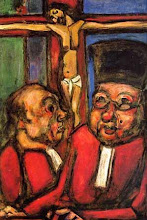
Angilbert (fl. ca. 840/50), On the Battle Which was Fought at Fontenoy

The Law of Christians is broken,
Blood by the hands of hell profusely shed like rain,
And the throat of Cerberus bellows songs of joy.

Angelbertus, Versus de Bella que fuit acta Fontaneto

Fracta est lex christianorum
Sanguinis proluvio, unde manus inferorum,
gaudet gula Cerberi.
Showing posts with label Principle of Double Effect. Show all posts

Tuesday, March 29, 2011

Natural Law's Modern Cousin Germain: Respect for Basic Values

THE SEVENTH REQUIREMENT OF PRACTICAL reasonableness, according to the Finnisian presentation of the natural law in Natural Law and Natural Rights, relates to practical reasonableness's relationship to the basic goods (including itself since practical reasonableness is itself one of the basic human goods). The principle may be cast in negatively or positively:
  • One should not choose to do any act "which of itself does nothing but damage or impede a realization or participation of any one or more of the basic forms of human good."
  • One should always choose to do any act "as a means of promoting or protecting, directly or indirectly, one or more of the basic goods, in one or more of their aspects."
Framed in both negative and positive language, this principle leads us into the realm of moral absolutes and distinguishes any ontological ethic from a teleological ethic,* an ethic based upon being and good versus one based upon consequences and utility. This seventh requirement of practical reasonableness is of great importance: it is, in fact, the basis for moral absolutes and the basis for fundamental human rights. This is "the principle on which alone rests . . . the strict inviolability of human rights." NLNR, 121. This is the principle that stands guard, as it were, over the entire moral enterprise, forbidding that self-interest, feelings, emotions, and impulse, or some sort of ends-justifies-the-means irrationality govern a moral choice in lieu of reason. Dismantle or ignore this requirement and you have brought down the entire moral enterprise into a bundle of unworkable relativism and the eventual tyranny that will flow from it. "There is no human right that will not be overridden if feelings (whether generous and unselfish, or mean and self-centered) [or consequences, real, imagined, or speculative] are allowed to govern choice, or if cost-benefit considerations are taken outside their appropriate technical sphere and allowed to govern one's direct engagement . . . with basic goods."** NLNR, 121-22.

It also brings us to the need to discuss the principle of unintended consequences or the principle of double effect.***


La Brea Tar Pits

The requirements of practical reasonableness demand that no chosen act directly damage or impede a basic human good. Any justification for damaging or impeding a basic human good (other than just irrational whim or urge, which cannot be a reason) can only arguendo be justified by an act's consequences, specifically that the good consequences outweigh the act against the basic human good. This, of course, throws us into the morass of consequentialism, which is as difficult to get out of as the La Brea tar pits were for those unfortunate mastodons that found themselves trapped in its black sticky morass. Consequentialist "reasoning" allows such moral enormities to be excused such as the killing of an innocent human (which attacks the basic value of life) so long as the supposed consequences yield a greater good. There is virtually nothing than cannot be justified using consequences, whether it be concentration camps, the death of fetuses and infants and the aged, and the bombing of civilian populations with the atom bomb and with napalm. Consequentialism naturally results in viewing man as an instrument, a tool, a means instead of an end. "[A] man who thinks that his rational responsibility is to be always doing and pursuing good is satisfied by a commitment to act always for the best consequences is a man who treats every aspect of human personality (and, indeed, therefore, treats himself) as a utensil." NLNR, 121. Moreover, it also places upon humans the unreasonable responsibility for consequences they do not even intend, thereby ushering them into a moral neurosis. As an exclusive determinant of right and wrong, the focus on consequences is wrong. The doctrine that the end justifies the means is unreasonable. Evil may not be done so that good may come. The "naïvely arbitrary limitation of focus to the purported calculus" of consequentialism must be rejected as unreasonable, and indeed ultimately inhumane, and dangerously so. NLNR, 119.

Accordingly, acts may only be chosen that--directly or indirectly--(affirmatively) advance, promote, or participate in, or (negatively) protect the basic human values (life, knowledge, play, aesthetic experience, friendship, religion, practical reasonableness). The problem of choice, however, brings us to the principle of double effect, a principle which is manifestly different from consequentialism:

The basic values, and the practical principles expressing them, are the only guides we have. Each is objectively basis, primary, incommensurable with the others in point of objective importance. If one is to act intelligently at all one must choose to realize and participate in some basic value or values rather than others, and this inevitable concentration of effort will indirectly impoverish, inhibit, or interfere with the realization of those other values. . . . These unsought but unavoidable side-effects accompany every human choice, and their consequences are incalculable. But is is always reasonable to leave some of them, and often reasonable to leave all of them, out of account.

NLNR, 119-20. Examples prove the necessary point. If I elect to become a doctor (so as to save lives), I exclude the opportunity, at least for a time, to become a professor of music history (and so advance aesthetic appreciation). Selecting one human value necessarily impedes the promotion of the other. If I, as a doctor confronting some catastrophe, have to select between patient X and patient Y, and triage suggests that patient X would be better served, operating on patient X necessarily means patient Y will be unattended and likely die while attending patient X.


Triage during WW I

However, this indirect and unintended damage to a basic value is something drastically different from the consequentialist ethic of the ends justifies the means:
[T]o indirectly damage any basic good (by choosing an act that directly and immediately promotes either that basic good in some other aspect or participation, or some other basic good or goods) is obviously quite different, rationally and thus morally, from directly and immediately damaging a basic good in some aspect or participation by choosing an acct which in and of itself simply (or, we should now add, primarily) damages that good in some aspect or participation but which indirectly via the mediation of expected consequences, is to promote either that good in some other aspect or participation, or some other basic good(s).
NLNR, 120. The problem with doing something that directly acts against a basic human good or directly impedes it is that it measures what is unmeasurable. It seeks to weigh the harm caused a basic human good with the promotion of another basic human good. But the basic human goods cannot be adequately weighed one against the other. They are incommensurable.

To chose and act which in itself simply (or primarily) damages a basic good is thereby to engage oneself willy-nilly (but directly) in an act of opposition to an incommensurable value (and aspect of human personality) which one treats as if it were an object of measurable worth that could be outweighed by commensurable objects of greater (or cumulatively greater) worth.

NLNR, 120. True, such end-justifies-the-means decisions against a human value are frequently urged by feelings, perhaps even feelings of generosity, sympathy, or even altruism (though they may be equally supported by less benign sentiments). But morality cannot be predicated on feelings. "We must choose rationally . . . . [and] [r]eason requires that every basic value be at least respected in each and every action." NLNR, 120. (As Finnis observes, often the application of reason helps shift the wrongful clues provided by misguided albeit generally benevolent feelings; reason "can often promote a shift in our perspective and consequently a realignment of initial feelings." So someone who "feels" that euthanasia is merciful will, if he applies reason, realize that this feeling is misguided, and so will understand that his feelings of sympathy at the suffering of one of his fellows should elicit from him the desire to reduce the sufferings through morally legitimate means. The one-time misguided feelings of a Dr. Bernard Nathanson† for example may be guided into appropriate channels and in fact then feel the opposite of what they originally felt.)

____________________________
*The natural law (in its classical, not necessarily in its Finnisian construct) has, as part of its metaphysical foundations, a concept of nature that is teleological. Nature, in particular the nature of man, has an end toward which it tends. The ontology behind natural law, therefore, is teleological in this manner of speaking. However, the teleological ontology of the natural law should be distinguished from the teleological ethic which measures good and bad not from the teleological ontology (the teleology of human nature), but from the teleology of the human act. A teleological ethic based exclusively upon the consequences of the human act is, as we have seen, unreasonable and, in fact, a cover for evil under the guise of reasonable good. A short summary of the Finnisian critique of consequentialism may be found in the prior post Natural Law's Modern Cousin Germain: Consequences Matter. A more in depth criticism of consequentialism based upon the word of Professor David Oderberg may be accessed under the titles Contra Consequentialismum.
**For the "technical" use of consequences, utility, or efficiency withing the greater requirements of practical reasoning, see Natural Law's Modern Cousin Germain: Consequences Matter.
***The principle of double effect has been extensively treated in the prior posts. See, e.g., The Principle of Double Effect: Introduction, The Principle of Double Effect: The Conditions of Bringing About Evil, and Contra Consequentialismum: Answering Critics of PDE.
†Dr. Bernard Nathanson was an advocate of abortion who later changed his perception. His feelings with respect to abortion were markedly affected by realization that an abortion was an assault upon the fundamental human value of life.

Friday, November 12, 2010

Fat Men in Caves and Runaway Trams: Intention and Foresight

OBJECTORS TO THE PRINCIPLE OF DOUBLE EFFECT raise another argument against it in addition to those that we have addressed in prior postings. The opponents argue that there is not really a distinction between intention (or motive or end) and foreseen effects. Obviously, the principle of double effect distinguishes between those goods that are intended, and those evil consequences that are not intended, but are only foreseen. If this distinction, which is a fundamental part of the theory, is farcical, then the theory itself must be infirm. The argument essentially revolves around the claim that the line between intention and foresight is an arbitrary line, and, being arbitrary it is by definition unreasonable.


The Fat Man in a Cave

The sophists come up with a variety of "fiendishly difficult" situations intended to drive a wedge of difficult between distinguishing between intent and foresight. Such examples include the "fat man in the cave," or the "runaway tram."
A party of spelunkers are exploring in a cave, and the cave fills up with poison gas. They need to leave the cave or they will die, but the entrance is blocked by a fat man. One of the spelunkers sets off a bomb next to the fat man to gain access to the outside, and naturally the fat man dies. Was the fat man's death intended, or was it only a foreseeable effect of trying to widen the entrance?
A runaway tram is careening out of control on a track which splits into two. One one track stands one man, smoking a cigarette, unaware of the tram. On the other track there is a group of five men working on the track equally oblivious. The tram driver chooses to go down the track with the one man, killing him. Did he intend to kill the smoking man, or is the smoker's death merely foreseen?


The cases above, and the many varietals of them, present difficult questions; and they have drawn a number of solutions by the proponents of the principle of double effect, not all of them particularly adequate. Sometimes the problem of identifying the distinction between the two is made worse by vague concepts that are suggested as the proper vehicles of analysis such as "closeness" (a consequence is intended when "too close" to the act: is the bomb too close to the fat man?), or "invariable connection" between the act and the effect (is the bomb "invariably connected" to the death of the fat man? does invariable 100%, 90%, more than 50%?). Sometimes less vague terms are sought to overcome the problems associated with the vague terms. But these bring their own problems. For example, the notion of "logical entailment" (if the effect is "logically entailed" with the act it is intended: is the killing of the fat man logically entailed by the bombing of the cave entrance?) or "control" (the agent intends all acts that he "controls": can the spelunker control the death of the fat man?). Oderberg does not view these exercises as particularly fruitful:

One can play around with various concepts, seeing whether they capture our intuitive distinction between the intended and the foreseen, but the exercise appears fruitless.

Oderberg, 112-13.

Instead of narrowing, Orderberg suggests that the opposite approach may yield more satisfactory results: "It would be more useful," he suggests, "to begin with a broader brush in delineating the general way in which the distinction might be defended." Oderberg, 113. Oderberg begins by looking at the skeptics and the problems with their objections or their alternative proposals to the intention/foresight distinction of the proponents of the principle of double effect.

First of all, what may be said of "intention" can also be said of related concepts such as belief, knowledge, desire, of any sort of subjective component of man's psyche. Invariably, these are difficult to measure, but the difficulty in measuring them does not mean these realities do not exist.

Oderberg likewise rejects those who would maintain the intention/foresight distinction but use it sort of like lawyers and judges use the notion of "duty" in tort law. We make something intentional (as distinguished from just foreseeable) when "we want to hold the agent responsible for causing some serious harm." Oderberg 113-14. But this is to put the cart before the horse, "it reverses the proper order of explanation, because it seeks to explain intention in terms of action for which we want to hold responsible, rather than saying that our judgments of responsibility should be assessed in terms of what a person intends." Oderberg, 114. It also seems to put the judgment into the realm of intuition, which is a frustratingly amorphous concept, and, when used as the ultimate grounds for morality, conducive to skepticism because of the subjectivity inherent in it.

Oderberg insists that the distinction between intention and foresight is real, and the proponent of traditional morality ought not to act otherwise. He should back off from the difficult situations--the fat man in the cave, the runaway tram, etc.--to straightforward, paradigmatic cases of intention/foresight. Just like hard cases make bad law, so do hard situations make bad moral principles. Sometimes when we get too close to something we cannot recognize the greater reality.


A hemlock leaf seen too close up stops looking like a hemlock leaf

For every difficult situation where intention and foresight seem to blend, there are myriad situations where intention and foresight are clearly distinct. If I drink a glass of claret, for example, I intend to lift the glass to my lips, smell its bouquet, admire its clarity, and taste and swallow the fructus benedictus. There is more here than merely foreseeing. I aim, I focus, I plan, to wit, I intend. I am in control here. Another example. I am stuck in traffic. I foresee that I will be late for work, that I will miss an appointment, that it will wreak havoc with my schedule. While I foresee all of this, I do not intend any of it. So backing off from the difficult situations, it seems unquestionable that the distinction between intention and foresight is legitimate, is real.

Why does it get difficult to distinguish between intention and foresight in those less-than-paradigmatic-situations? Oderberg suggests that the problem comes from our failure to see intention as a mental state or concept, but one that is not necessarily verbalizable or at least not equivalent to its verbal formulation. "[I]ntention cannot be a matter of mere linguistic formulation." It is more primal a mental state. "Concepts . . . go deeper than language," though there may be "some deep connection between language mastery and the possession of concepts." Oderberg, 115, 116. One's description of that mental state is not that mental state. One's description of it is simply "one piece of defeasible evidence for intention." Oderberg, 115. The envelope in which we put a letter is not the letter, but it is evidence that that there is a letter. And if it is difficult for an individual to fathom his intention at times, it is doubly difficult for us to fathom the intention of others. And yet we do so all the time, from day-to-day transactions ("What one earth is that driver intending to do?") to more formal situations (a jury is charged by the court to try to determine what was the intent of the defendant when he entered someone's habitation).

Intention can be inferred by evidence, all of the evidence, because of the nature of things, defeasible. We rely upon what people say their intent is, but people can lie about their intent. We rely upon how they act to interpret their intent as most people act in a manner consistent with what they intend, but this is not infallible. We look at how they behave after the act, since they often express satisfaction or remorse depending upon what their intent was, but these can be feigned. We look at circumstances around the act to try to surmise the intent of the actor. The problem of intent is thus penetrable, but even the simplest act can be exceedingly intricate. And the problem with the difficult cases--the fat man in the cave, the runaway tram--is that they are "underdescribed." Oderberg, 117. They present situations that are so stark, that suffer from such a lack of intricacy, they are like what abstract bulls are to real bulls. Perhaps the difficult situations are rendered difficult because they are no longer concrete enough, but abstracted to unreality.


Picasso's Bulls: When is there too much abstraction from reality?

The final conclusion is therefore that there is a real distinction between intention and foresight, though many times in practice the practical ability to distinguish between the two is frightfully difficult and fraught with complexity and probability. In many cases, we may never quite know what a person's intent was, and the external evidence we use to infer whether an actor intended something or merely foresaw it but did not intend it as a consequence of his act is incomplete or misconstrued. "A comprehensive solution to the problem of distinguishing intention from foresight would require an exploration of technical issues in the philosophy of mind and the philosophy of action." Oderberg, 126. Yet a distinction exists, and ought not be despaired of. The literature is full of general principles and guidelines that are sufficient "to show that such a distinction can be made, and hence that PDE [principle of double effect" can be defended on that score." Oderberg, 126.

Wednesday, November 10, 2010

Contra Consequentialismum: Answering Critics of PDE

CONSEQUENTIALISTS ARE CRITICAL OF TRADITIONAL ETHICS, especially its notion that there are absolute, exceptionless norms. Consequentialists also criticize traditional eudaemonistic (happiness) ethical theories and their reliance on the principle of double effect. Peter Singer, for example, accuses every traditionalist of being a consequentialist under another name precisely because of his or her reliance on this principle, in particular that aspect of the principle of double effect that requires a proportionate reason in accepting evil as a result of some good. "[A] consequentialist judgement lurks behind the doctrine of double effect." Oderberg, MT, 97 (quoting Singer, Practical Ethics (Cambridge: Cambridge University Press, 1993) (2nd ed.), 210). The way Singer describes it, the principle of double effect elicits something like an image of Satan tempting Christ.


Is There a Consquentialist Lurking Behind the Principle of Double Effect?

Is the accusation legitimate? Is the "proportionate reason" prong of the principle of double effect consequentialism through the back door?

Not at all. The accusation is false, and it is based upon the seemingly similar cost/benefit analysis that the "proportionate reason" prong requires of the moral decisionmaker. But the proportionate reason prong of the principle of double effect, though it attempts to weigh the proportion of unintended evil relative to the intended good in assessing the moral liceity of any moral act, it is always "a fractional part of moral theory," and not the entirety of the moral theory such as consquentialists take their cost/benefit calculative theories to be. The other prongs of the principle of double effect must be regarded as part of the mix of the moral decision, and so, contrary to the consequentialist theory, "[o]ne can never use balancing to justify an otherwise evil act." Oderberg, 99. Balancing cannot be used to overcome the prohibition on using evil as a means to obtain some good, nor can balancing be used in balancing intended evil effects with good effects. The similarities between consequentialism's calculation and the principle of double effects weighing are superficial.


Never Give an Atom Bomb to a Consequentialist!

There is thus a great divide between the consquentialist's ideas of right and wrong and traditional morality and its principle of double effect. A consequentialist can justify as right the dropping of the atom bomb on the civilian populations at Hiroshima and Nagasaki (and all such efforts at justifying this act resort to speculative consequentialist calculations of Japanese lives lost versus American lives saved). A traditionalist would never even get to the question of proportionate reason and weigh the relative balance between evil and good because he would immediately see that dropping the atom bomb on innocent civilians, that is, non-combatants, would be intending evil, and one cannot do evil so that good may come, however great that good be. Even if arguendo Nagasaki or Hiroshima were military targets (which they were not), and the intention was to target the military installations and combatants and the civilian deaths considered an unintended evil effect (i.e., collateral damage), it would seem that there would not be a proportionately good reason to warrant the death and maiming of some many non-combatants, especially since there were other means to attack the supposed military targets that would not have resulted in such massive non-combatant casualties.*

There is thus a great divide between consequentialists, and their calculative ethos, and the traditional view, and the prudent weighing that is associated with the "proportionate reason" prong of the principle of double effect:

The weight of consequences, then, is doubly fractional in moral theory. First, it does not play a conceptual role in the vast majority of cases [for traditional moral theory], where far more complex and subtle issues than mere quantity are at issue. Second, even in those cases where it does play a role, it does so only after all other moral requirements have been satisfied: weighting goods might occasionally tip the balance in favour of this or that action, but it can never turn a bad action into a good one, and it can never be used as the sole criterion of right and wrong.

Oderberg, 101.

Another criticism frequently hurled at the principle of double effect is its distinction of intended from unintended consequences. "If [an] act is wrong with one intention, how can it be right with another?" they ask. Oderberg, 101-02 (quoting J. Rachels). Can we play games with our intention, "purifying the intention," or "directing our intention,"** as it were, making black white and white black? Is there really a difference between a doctor who prescribes a narcotic to his terminally-ill patient to relieve pain knowing that a consequence of it is to accelerate his patient's death and a doctor who prescribes a narcotic with the intention of terminating the life of his terminally-ill patient? Are moralists really required to be doctores subtilis, doctors of such subtleties? This seems a recipe for hypocrisy or casuistry, and perhaps in the hands of the dishonest, the dissembler, the hypocrite it is open to abuse. But that is true with most any theory. Intellectual dishonesty is intellectual dishonesty wherever it may be found. Intellectual dishonesty, or abuse of a theory, does not make the theory false.

The suggestion, however, by the critics of the principle of double effect that intention does not make a difference in assessing moral acts is an even greater enormity than the risk of an occasional scoundrel or casuist who plays jesuitical games with his conscience, as if the moral life were a game, a "matter of private mental gymnastics." Oderberg, 105. Isn't there a huge difference between the man who pulls the trigger of his gun to kill an unjust aggressor who comes at him with a knife, versus one who pulls the trigger of his gun to gain the victim's loot? "[E]ven a dog," Justice Holmes wryly observed, "distinguishes between being stumbled over and being kicked."*** Our intent is obviously moral materia prima, moral prime matter. The fact is, whether we like it or not, "[t]he only way of carving up responsibility, then, is by attention to what the agent has in mind by his actions--what the object of his will can properly be said to be." Oderberg, 103.

There is, without doubt, difficulty in the matter of intention. But the difficulty is not one of theory, it is one of evidence. It is difficult for us to know our own intentions, much less those of others. However that may be, the difficulty of knowing intention does not change the reality of it.
For the opponent of PDE [principle of double effect], then, to treat intention as fleeting mental events easily changeable irrespective of circumstance, and hence too elusive for moral theory, is to raise wholly general questions of skepticism about a person's mental life, questions that are relevant to every moral theory but persuasive against none.
Oderberg, 104-05. In other words, the opponent of the principle of double effect who focuses on the matter of intention in his criticism is implicitly criticizing the entire moral enterprise, including his own.

____________________________________
*This is not to suggest that all use of atomic weaponry is morally prohibited, and the use of atomic weaponry is per se evil (which is another topic). But its indiscriminate use against civilian population (as would also be the case with conventional weaponry), is absolutely proscribed. This has been a constant in Church teaching since Pius XII mentioned it in a Speech to the Eighth General Assembly of the World Medical Association in 1954. (The text is available in Spanish translation from the Italian original on the Vatican website see: Discurso de su Santidad Pío XII a los Participantes en la VIII Asamblea de la Asociación Médica Mundial):
Is modern "total war," in particular ABC [atomic, biological, or chemical] warfare, permissible in principle? One can entertain no doubt--especially because of the horrors and the immense suffering that results from modern warfare--that to initiate such warfare without just cause (that is to say, without it being imposed by an evident and extremely grave injustice which cannot be avoided by other means) is a "crime" worthy of most severe national and international sanctions. In principle, one cannot even propose the question of the liceity of atomic, chemical and bacteriological war, except in the case when it is indispensable for one's defense, and within the aforementioned conditions. Even then, however, one must strive by all means to avoid it through international agreements or by creating limits for its use that are so clear and precise that its effects remain circumscribed to the strict exigencies of defense. When, however, the use of such means of warfare would result in an extension of harm that completely escapes the control of mankind, its use should be rejected as immoral. Here one is no longer dealing with "defense" against injustice and the necessary "protection" of legitimate possessions, but with the annihilation pure and simple of all human life within the radius of its action. This is never permitted for any reason.
Pope Pius XII, “Sintesi di verità e di morale espressa alla VII Assemblea Medica Mondiale,” Sept. 30, 1954, in Discorsi e Radiomessaggi, Vol. XVI, 2 Marzo 1954 – 1 Marzo 1955, p. 169. On the matter of morality, between the lights of Truman and the lights of Pius XII, I'll side with the Pastor Angelicus over Give 'em Hell Harry every time.

**The phrase is Pascal's. It comes from his criticism of the Jesuits in his Provincial Letters (Letter VII, , where he criticizes the effort of "directing the intention" (diriger l'intention) or "purifying the intention" (purifiant l'intention) as a facile way to change the character of an act from evil to good. Pascal properly identifies an activity that could quickly become morality by trick, by legerdemain, casuistry in its worst form.
***Oliver Wendell Holmes, Jr., The Common Law (Boston: Little & Brown, 1881), 3.

Tuesday, November 9, 2010

The Principle of Double Effect: The Conditions of Bringing About Evil

THE PRINCIPLE OF DOUBLE EFFECT is the principle that ought to be applied in fulfilling the moral injunction of doing good as far as one can, and avoiding evil as far as one can. Specifically, the principle of double effect relates to the latter half of the basic moral equation: avoiding evil as far as one can. It is applicable in those cases, actually quite frequent, where good or at least not evil acts have consequences beyond those acts, unintended but foreseeable, that may be evil or that may have good mixed with evil. When are such good or at least not evil acts, which have these foreseen undesirable effects, permissible, and when not?

If we were to apply the rule that no good that has any foreseeable, yet unintended evil consequence can be done, we would be crippled. We could not get into our car and drive to the grocery store to pick up milk for our family's breakfast because it is a foreseeable, though unintended consequence, that we might run over some pedestrian along the way. We could not enjoy beurre blanc on our vegetables or scallops because it is a foreseeable though unintended consequence that such a wine and butter sauce would increase our weight and affect our cholesterol and, albeit remotely, lead to heart disease and possible death.


Are scallops with beurre blanc sauce to be shunned because
it is foreseeable that consuming them contributes
to heart disease and eventual death?


The principle of double effect helps us draw the line when confronting these decisions, and we use it almost instinctively. It helps, however, to be cognizant of the principle because it is a very helpful tool in addressing some of the more difficult moral questions in controversial areas such as those we confront at the edge of technology in bioethics, in self-defense, and in war.**

The principle of double effect requires that there be four conditions, all of which must be met, before an act may be performed that has both good and evil effects:
  • First, the intended act must be good or at least permissible (i.e., not evil).
  • Second, the good effect of the intended act must follow from that intended act as immediately as the evil effect. The analysis here is causal not temporal, meaning that the evil effect either has to be caused by the good effect or the evil effect and good effect have to arise simultaneously as a result of the intended act. In other words, the good effect must not be caused by the evil effect.*
  • The evil effect must not be intended, or willed; rather it should not be desired, and, at best, it is simply permitted or tolerated, and perhaps even regretted or not desired, as an unavoidable consequence that follows from or comes with the good;
  • There must be a proportionate and sufficient reason, associated with the intended good and its good effect, for permitting or tolerating the evil effect.
The last requirement, that of proportionate reason, is the most subtle, and the most difficult in practice to weigh. It is in this area in particular where prudence is most essential. It is this area also where the inexactness of the moral answer is most felt. As we have discussed before, inexactness is not the same as lack of knowledge. There are, however, some general principles that guide us in assessing whether under any given circumstance a proportionate reason exists for doing a good or at least permissible act, intending a good effect, yet foreseeing that an evil effect either arises in conjunction with the good effect or is caused by the good effect.
  • The greater the evil effect, the greater the reason for permitting it needs to be. There has to be a serious reason for allowing a foreseeable evil to happen as a result of one of our acts, even if unintended.
  • If the unintended evil effect would probably happen whether or not we performed our act, then a lesser reason for acting is required.
  • A greater reason is required to permit an unintended evil effect from occurring if foregoing the the act would definitely and effectively prevent the evil effect from happening.
  • The probability of the evil effect occurring must be taken into consideration. If the unintended evil effect may only possibly occur, then a lesser reason is required than if the unintended evil effect is certain to occur.
  • If the actor is under a prior duty to prevent the unintended evil effect, then a greater reason is required to permit the unintended evil effect.
  • If the actor has two ways of obtaining the intended good effect, one of which results in the unintended evil effect, and the other which does not result in the unintended evil effect, he must opt for the way without the unintended evil effect, as there no reason then to justify taking the course of action that results in unintended evil.
Our next blog posting will address common criticisms against the principle of double effect, and responses to those criticisms from the perspective of traditional ethics.

__________________________________________
*If the good effect followed from the evil effect, then one would be intending the evil effect as a means of bringing about the good effect. But it is axiomatic that the end does not justify the means. This is basic: St. Paul condemns those who would argue that one ought to do evil so that good may come. (cf. Rom. 3:8) (faciamus mala ut veniant bona quorum damnatio iusta est) (ποιήσωμεν τὰ κακὰ, ἵνα ἔλθῃ τὰ ἀγαθά; ὧν τὸ κρίμα ἔνδικόν ἐστιν). Because it is mentioned by St. Paul, this principle is sometimes referred to as the Pauline principle. Cf. William Penn, Some Fruits of Solitude (London: S. T. Freemantle, 1900), 122. ("To do evil, that good may come of it, is for bunglers in politics as well as morals.")
**I rely heavily on Oderberg, MT, 88-96, for this discussion on PDE (Principle of Double Effect).

Monday, November 8, 2010

The Principle of Double Effect: Introduction

ONE OF MAN'S UNIQUE FACULTIES IS FREEDOM. Relative to the brute animals, he seems to have degrees of freedom unheard of in the world of beings below him. Considering that the good of things relates to its activities, it seems that the good of man must comprehend or include the activities of his freedom, that is, the good must include his free choice and the use of his will.

Traditional ethics emphasizes, then, the act of will, without however excluding the nature of the exterior acts, in its analysis of whether an act is morally good. The will aims at some object, and it is this object toward which the will is directed, the will's intention, that "determines the quality of any other act that the will commands for the purpose of realizing that object." Oderberg, 86. Therefore, a traditional moralist is both concerned with what is done, and the intention behind it. It is the intention which makes something moral, morally good or morally evil. Without intention moral good and moral evil do not enter into the picture; without intention we only have pre-moral or physical goods and evils: acts of man instead of human acts.

It ought not to be thought that this emphasis on intention or the internal act of the will by traditional moralists makes morality an entirely subjective affair. Indeed, understanding what is good and evil in the objective moral order and what is good and evil in the non-moral (physical or material) order are absolute prerequisites to assessing the will, that is the actor's intention, and thus the moral act itself:

[W]hat a person does, externally, the effects he has on the world through his agency, are not matters of indifference because they will be characterized as good or evil, in the primary, non-moral sense, which is the object of all human action. . . . [I]t is impossible even to comprehend what makes and intention morally good or bad if the reality of objective non-moral good or evil is not apprehended in the first place. It is the inherent goodness of certain ends that makes them proper objects of human striving, so that the person who strives after them does good, or acts morally; and conversely for ends that are bad.

Oderberg, 87.


For example, avalanches are, from a physical perspective and like any natural catastrophe, a great physical evil. Avalanches, however, cannot in any sense be said to be moral evils. If a person however intends to cause an avalanche, say by making a loud noise when the snow is clearly unstable and he has been warned of such instability, that intention toward a physical, objective though non-moral evil colors the intent and makes it clearly an immoral, evil act. Intending this physical evil turns colors the physical evil into a moral one.

Both the act of the will, which adds the qualitative element to the entire assessment of any particular act, and the external act itself, which adds a quantitative assessment, are significant. Though distinguishable, the external act and the internal intention feed on each other. Thus, though someone may be guilty of a moral wrong by willing or intending another's death, though he be frustrated by some factor from going through with it, to actually go through with it makes the intention even worse.* "[T]he execution of intention often adds something quantitative to the intention itself, since it usually required greater and more prolonged effort to externalize the will, and hence more concentrated dwelling on the good or evil one has in one's sights." Oderberg, 88.

When intent and external act are equivalent, that is, when one intends an evil act, and with that intent, follows through with it, the moral analysis is relatively easy. Oderberg calls such a case the "paradigm of moral responsibility." When good intent and the good act accord, the act is morally good. A man gives alms to the poor to relieve their plight; such an act is morally good. When evil intent and evil act accord, the act is morally bad. A man intends to murder another for his money, and goes through with it; such an act is morally evil. Simple enough.


But there is a whole world where the intent of the human actor and the external act of the human actor do not quite fit together as nicely. We are responsible for more than what we intend. We may have no intention of bringing about a particular result, we may in fact desire its opposite, and yet we may be the agency by which the unintended effect comes about. Frequently, but not necessarily, this may be the result of negligent or reckless behavior. For example, suppose we are texting while driving, and so are reckless, and we run over a pedestrian. Though we had no intent of running over the pedestrian, we are held morally accountable for it. Suppose a physician prescribes some medicine effective for the treatment of a serious medical condition, but one of whose side effect he knows could be death. If I take the medicine and it results in my death, is the physician guilty of murder? A construction company is hired to build a canal in a tropical zone where it is likely that some of its employees will be exposed to Yellow Fever and die, and the President of the company knows this. During the course of the construction of the canal, some of its employees in fact die of Yellow Fever. Is the construction company morally guilty of their death? Should he have turned down the contract knowing that some of his employees would die of Yellow Fever despite all precaution?

Assessing moral guilt in instances that do not fit with the paradigm of moral responsibility, where intent and act do not perfectly overlap, requires some tools and the grasp of some basic concepts.

One of the notable things about the analysis in areas where intent and result do not perfectly match is what Oderberg calls "an asymmetry between good and evil results." "Unintended good results can never morally affect the intention which one otherwise acts. . . . Good side effects do not turn a bad act into a good one. But neither do they make a good act a better one." Oderberg, 89. This is not true with respect to unintended evil results. Unintended evil results can turn a good act into a bad one, and they can make a bad act even a worse one. This is reflected in our day-to-day language. We talk about someone being negligent, careless, reckless, and so hold them accountable for the evil that may be unintentionally done by them. There is no similar word that is used to describe a mental state less than intentional that results in unintended good. One negligently causes harm. One does not negligently cause good. The asymmetry in the moral analysis is reflected in the asymmetry in our language.

But given this asymmetry, how are we do determine the assessment of moral responsibility for those evil consequences one does not intend?

Traditional morality has devised a way to determine when someone is held accountable for unintended consequences of his act. This principle is called the principle of double effect, or the doctrine of unintended consequences. This principle is often misunderstood and misapplied, sometimes just abused. It is "a principle that is almost universally derided in modern applied ethics, dominated as the discipline is by consequentialist ways of thinking." Oderberg, 90.

Because of its importance in traditional ethics, we will devote the next several blog postings to this principle.

_______________________________
*Our criminal law is largely based on traditional concepts of morality. Intent or mens rea or scienter is an important assessment of the crime and its degree. Additionally, intent alone can be punishable or can intensify the crime. Thus simple assault and assault with the intent to commit murder are regarded as distinct offenses, the latter considered more egregious. Attempted murder, though murder itself has not occurred, is a punishable criminal offense.