Angilbert (fl. ca. 840/50), On the Battle Which was Fought at Fontenoy

The Law of Christians is broken,
Blood by the hands of hell profusely shed like rain,
And the throat of Cerberus bellows songs of joy.

Angelbertus, Versus de Bella que fuit acta Fontaneto

Fracta est lex christianorum
Sanguinis proluvio, unde manus inferorum,
gaudet gula Cerberi.

Friday, June 8, 2012

God's Glory Appears: From First Triad to Trinity to the Moral Life

THE MOST FRUITFUL WAY to understand the Revelation of God to man in Von Balthasar's eyes is to understand it as a sort of dramatic event, a particular, one-of-a-kind dramatic event, a "theodrama." Understood through the lens of this "dramatic form" allows us to gain the full Trinitarian aspect of God's revelation in Christ.

Von Balthasar identifies two "triads" that are intrinsic to the dramatic form and so may be found to exist in the theodrama.  The first triad is author, director, and actor.  The second triad is presentation, horizon, and audience.

Just like plays have an author, a director, and actors, so does the theodrama have this triad.  For von Balthasar, this is a "perfect metaphor for the economic Trinity in the theodrama."  (Steck, 55, quoting TDI 3.352)  In other words, what we have here is a pattern or analogy for understanding the Triune God, not in His transcendency (ad intra), but in his expression to the created world (ad extra). 

God the Father is the "author who shapes the drama and makes sure than it has its intended effect on the audience."  Steck, 55.  While he does this, he also must rely upon and grants a certain freedom and spontaneity to the director and actors in performing the work.  While the actor in one perspective "stands above" the director and the actor, he also must "cherish their autonomy."  Steck, 55 (quoting TD 1.280)

The Son of God is "the actor who makes real the author's dramatic idea."  Steck, 55.  While he is bound in a manner to the author's script, he is also designedly free to apply it in a non-mechanistic or non-manneristic way, as the author, God the Father, has necessarily left room for freedom of expression within his work.

The Holy Spirit is for von Balthasar the director, who takes the author's text, interprets, and allows it to speak "in a living and spiritual manner," by "prompting, inspiring, and organizing the actors as they bring their talents and energies to their respective roles."  Steck, 55.

 Trinity by Lucas Cranach the Elder

So, to put it all together, "God the author brings the dram 'into being as a unity'; God the actor conceives and executes his role 'on the basis of a single, unified vision.'; and God the director comes up 'with a unified vision embracing both the drama (with the author's entire creative contribution) and the art of the actors (with their very different creative abilities).'"  Steck, 56 (quoting TD 1.268, 284, 298)

To view Jesus as the divine "actor" in this theodrama allows us to view him further as an actor in a form of tragedy.  He is, as it were, a personification of the Greek tragic figure "who now does what Greek tragedy could never do: tie the contingent to the absolute in a universal way that stamps every existent with its pattern."  Steck, 56.  Jesus overcomes the limitations of philosophy (its universal, non-concrete quality) and the limitations of Greek tragedy or myth (its contingency, its lack of basis in reality).  Jesus is the "concrete universal."  Steck, 56.  (Jesus as the "concrete universal" is another way of stating the historical, ontological, and religious "scandal of particularity" we find in Jesus.)

The reason Jesus is the "concrete universal" is that he "opens for the finite, historical creature a stage in which his finitude is granted eternal (absolute) meaning."  The infinite absolute and universal become man in a contingent, particular, concrete existence in the Incarnation.  This bound together into one divine person both the universal and concrete, both God and man, the Uncreated Absolute and the created particularity.  It thus allows man to overcome his contingent existence and through this "concrete universal" himself become part of the absolute.

As we stated in our last posting, von Balthasar's view of the Christ-event as a sort of theodrama, and this triadic division of the theodrama into author-actor-director is wed to his Christian ethics.  "Whatever form of divine command ethics appears in von Balthasar, it must be interpreted in light of a God who 'authors' our play and give us our (christological) roles but who also makes room for our contribution as we are prompted by the Spirit."  Steck, 56.  Succinctly, the moral life is participation in the theodrama.


Thursday, June 7, 2012

God's Glory Appears: The Theodrama

IN PRIOR POSTS WE HAVE SEEN how beauty in nature, particularly in persons, requires not only an openness on the part of the recipient, but a receptiveness to the form of the beautiful object, and a giving of self to the other, all within the envelope of freedom, therefore resulting in a sort of dialogue, a loving exchange, that leads to communion between one person and the other. It is more akin to a mutual self-giving. "[T]he beauty of this form reflects the aesthetic rightness of the mutual exchange of gift given and gratefully received. The epiphany of goodness, we can suggest, is a theophany in earthly form of the triune life." Steck, 50.

So there is for von Balthasar implicit in every authentic human response to beauty a trinitarian aspect.  But though this may be a sort of theophany, it is not, strictly speaking, Revelation.  Our reaction to beauty, however, provides us an analogy for our reaction to the divine beauty, i.e., God's glory.  It provides us therefore a fitting model of how humans ought to response to Revelation.

Revelation--which is a manifestation of the divine beauty or glory of the Lord--is encountered when we have a manifestation of the divine love, specifically "the triune nature of God's love."  Revelation also must contain and effect "God's covenantal intent to include the individual human existence in God's triune love."  Steck, 51.  There is always the possibility of human static in "seeing" God's glory revealed, in choosing another good, or as a result of a disordered soul which hides in its shell of egoism.

To overcome the static, the disordered egoism in our soul which makes us incapable of proper response to God's glory revealed, God must enter history in a "dramatic form," specifically, the form of tragedy.  It is tragedy that is the dramatic form by which God reveals his glory, and so it is tragedy that is "the great, valid cypher of the Christ event." Steck, 51 (GL4.101)

This dramatic form is something more than philosophy, and certainly something entirely other than myth.  Philosophy deals in universals, not particularities.  While myth has the advantage of being open to revelation from above and a sort of particularity, in its Greek form it reached a dead end.  There was "darkness" and "absence" in and ultimate impersonal.  The Greek gods are "above" us and never "with us."  That is why philosophy replaced myth in Greece.  However, philosophical truths do not result in a one-on-one encounter, and do not lead to a communion of giver, gift, and receiver of the gift.  So something other than philosophy and something more real than myth is required for the true God to reveal his glory.  The dramatic form allows for an interpersonal encounter, which is real, and so exceeds the general, impersonal encounter with philosophical truths and the unreal encounter with myth.

 The Oberamagau Passion Play

The dramatic form, however, does borrow the "encounter from above" that is found in myth, but in Revelation the unreal aspect of the myths of men is exchanged for the real aspect of God's glory being revealed.  Ultimately, this is done through tragedy. 

In drama, human action is interpreted in light of some overarching meaning that bestows a final and authoritative judgment on the agent's free historical choices of limited values and goods. The capacity of the dramatic form to interpret concrete existence makes it a particularly appropriate tool of a theological aesthetics. The dramatic story of Christ--what von Balthasar calls the "theodrama"--is the horizon in which the Christian interprets his concrete story. Like the beautiful form, the theodrama awakens a particular response on the part of the person by inviting him to interpret his life in terms of the absolute horizon of covenantal love.

Steck, 53. When Christ reveals himself in the theodrama of the Christ-event, we do not abandon the "'aesthetic lens, but rather move from an 'iconic' aesthetics to a 'dramatic' one."  Steck, 43.  From stasis to dynamis.  The theodrama of the Christ-event is dynamic in the fullest sense of the word since it is dynamic in terms of He who reveals his glory and he who receives the glory of the One revealing.  "God has brought into drama of triune life the drama of fallen human existence, so that 'our play 'plays' in his play."  Steck, 54.   So it is that God enters into our world.

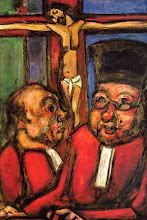
That is why the Christ-event must not be seen only as a Christological event (Christ-in-man), but also as a Trinitarian event (God-in-Three-Persons).  The Trinitarian eternal "play" plays in our temporal "play."  It is a remarkable event wherein God as judge suffers the humiliation of allowing Himself to be judged.  God judges the God-man, and so "something akin to drama is played out between the sovereignty of [God's] judgment and the humiliation whereby he allows himself to be judged," and the voices of the judge and the judged, "are both united and kept distinct by a third, ineffable voice."  Thus Father, Son, and Holy Spirit.
In Christ . . . [w]e see in this life a God who allows the distance between Father and Son to become the distance of sinful alienation in order that it be overcome through the ever greater unity of divine love.

Steck, 55.

In a sense, there are two "dramas" in the Christ event: the "economic drama," which is the salvific activity of God to man, but there is also the "triune drama" where God reveals his internal life.  There are therefore two separate "triads" associated with a play and likewise with the theodrama.  The first such triad is author, director, and actor.  The second triad is presentation, horizon, and audience.  To grasp these two triads as occurring in the Christ-event is important, because von Balthasar uses the triads as metaphors to help us understand the "economic Trinity," as well as "the manner in which God accomplishes his reconciliation with humanity, without compromising divine transcendence or human freedom."  Steck, 55.  They are also important points of reference in understanding our response to the Christ-event and therefore in understanding the moral life. 

We shall explore these triads a little further in our next posting.


Wednesday, June 6, 2012

God's Glory Appears: Holy Spirit as "Liquefaction" of Christ

VON BALTHASAR'S MORAL THEOLOGY is Trinitarian in focus. It follows that he puts equal emphasis on the three persons of the Trinity is understanding the Christian's moral life. The Holy Spirit is "the cohesive force of the drama of salvation and the 'agent' who brings it to its fulfillment." Steck, 48.

Von Balthasar does not see the Spirit as something that propels us into the Trinitarian life like the wind billows up the sails of a sail boat. Rather, he sees the spirit as something that propels us from within, perhaps more like the wind through a flute that elicits beautiful sounds.  This Spirit works inwardly, as it were, opening "our eyes to see the beauty, the glory, of the Christ-form and thus engenders in us a willingness, 'called faith,' where we 'allow love to have its way.'"  Steck, 48 (quoting GL7.401) 

Living in the Spirit is therefore not a self-abasement or self-neglect.  Rather "to be 'in the Spirit' . . . means to make this active and dramatic law of love the law of one's active existence."  To be sure, it requires a self-surrender, the surrender of faith.  But this surrender allows the "rhythm of the Spirit to become our rhythm," and it allows us to "enter into the kind of participation in divine life that God has made possible for us."  Steck, 48-49.

To live in the Spirit is to participate in the triune life of God.  Life "in Christ" is not possible except by life "in the Spirit."  This dynamism is viewed by von Balthasar thus:

We might say that the Incarnation introduces human nature into the Godhead, and, in turn, God brings the Christian into the triune life "in Christ." The incorporation into Christ is accomplished through the Spirit. In the Spirit we too face the eternal Father in praise and adoration.
'[T]he dialogue [of prayer] is not between our spirit and the Pneuma, but between our spirit, borne by the Pneuma, and the Father, a dialogue in which the Pneuma cannot be other than the Pneuma of the Son, in whom we have come to sare in sonship . . . [and are] drawn into the event of the eternal generation of the Son.'
Steck, 49 (quoting GL.7.405)
Cumean Sybil by Giovanni Francesco Barbieri (Guercino) 

Ultima Cumaei venit iam carminis aetas;
magnus ab integro saeclorum nascitur ordo:   
5
iam redit et Virgo, redeunt Saturnia regna;
iam nova progenies caelo demittitur alto.
Tu modo nascenti puero, quo ferrea primum
desinet ac toto surget gens aurea mundo,
casta fave Lucina: tuus iam regnat Apollo.    

 The last age of the Cumaean Sybil's song has come.
The mighty sequence of ages is born and begins anew.   
 Now the Maiden returns. The reign of Saturn returns.
Now a new generation descends from heaven on high.
At the birth of the child in whose time the iron race
shall cease and a golden race inherit the whole earth,
smile, O chaste Lucina: now your Apollo reigns.

--Virgil, Eclogue IV.3-10

There is a tendency to view the Holy Spirit as a sort of "force" or "faceless God."  To be viewed correctly, however, it must not be forgotten that the Holy Spirit is a divine person, a "personal Other."  Nor, however, must the doctrine of "appropriation" be forgotten.*  The role of the Spirit is essentially one to set us free.  "It is for freedom that Christ has set us free."  (Gal. 5:1)  The Holy Spirit is at the center of this God-granted freedom:
The Spirit bestows the freedom, spontaneity, and creativity of divine love by gracing Christians--and even non-Christians--with the gifts and apostolic tasks that will, in turn, 'personalize' them and allow their unique share in the one mission of Christ.
Steck, 49.**

It is the Spirit that allows the Christian disciple to effect the imitatio Christi, to live "in Christ."  Indeed, in a vivid image, von Balthasar sees the Holy Spirit as the person of God who "liquefies" Christ, so that the "historical Christ" is brought out from his one-time and one-place into a "universal reach," thus "granting the believer access" to Christ "through a simultaneity of mission."  (Steck, 49-50) (citing TD3.38-39) 

The Holy Spirit acts ad intra (within the Trinity) and ad extra among men.  This role is symphonic:

The Sprit is the bond of the free and personal exchange of love first and foremost between the Father and Son [ad intra]. But the Spirit also effects this creative and free bond between God and human person [ad extra]. In the presence of the Spirit, the human response is given divine breadth. . . . The Spirit bridges and resolves the disparities between the divine and human.

Steck, 50.

The Holy Spirit is not impeded by our limits or our sinfulness,*** but indeed overcomes them.  Thus the Spirit "is the guarantor that the good and loving elements in the Christian's actions, always touched by human perversity, will be made a cohesive part of God's work of salvation."  Steck, 50.

 _____________________________________
*For the doctrine of appropriation see here.  Essentially, however, appropriation is the doctrine that God's actions ad extra are shared among all persons of the Trinity; however, particular actions, though engaged in by all three persons of the Trinity, may be associated with one particular person of the Trinity. 
** In a footnote, Steck states the following: "The freedom of the Spirit 'to blow where he wills' extends beyond the bounds of the visible church. The Spirit can thus 'spread God's graces and secret revelations even outside the visible Church.  The Church of the earliest period certainly knew all this, and it is humiliating for us to have to learn it anew after so many centuries of at least partial forgetting.'"  Steck, 175 (quoting von Balthasar, "Council of the Holy Spirit," in Creator Spirit, 262-630. This is a truth which can be overemphasized to the point of destroying the importance of the Church and the Christian dispensation, making it boundary-less, but which can also be under-emphasized so as to view the Church as a sort of bottle where the Spirit does not work outside of the Church.  One should remember that in the Middle Ages, both the Cumaean Sibyl and Virgil--pagans both--were considered prophets of the birth of Christ.  The fourth of Virgil's Eclogues was viewed as having a Messianic prophecy. In the fourth of Virgil's Eclogues, the Cumean Sybil foretells the coming of a savior.  Christians viewed this as a prophetic intimation of the coming of Christ.  For this reason, Dante selected Virgil as his guide through the underworld (but not in Paradise!).  In the Sistine Chapel, Michelangelo painted the Cumean Sybil with the Old Testament prophets.  To suggest from the fact that the Holy Spirit works outside the borders of the visible Church that the Holy Spirit works with all fullness outside the confines of that visible Church, however, would be error.  It would be to pit Christ's Body (into which we are incorporated) against the Holy Spirit (who works against incorporation).  Similarly, one must not forget that some Churches (such as the Orthodox Church) have valid apostolic succession and priesthood, and so valid Sacraments, even though they are outside the unity of the Catholic Church.  Surely the Holy Spirit is present to confect the Sacrament of the Eucharist in such Churches?  Finally, it has always been held that anyone--even an unbaptized person can baptize another; thus being a conduit for the Holy Spirit. But this same Spirit who works outside the walls of the Church, must also be seen as constantly endeavoring to bring those outside the confines of the Church into the Church's fullness, and never as endeavoring to take souls outside of the Church.
***An example of this might be the fact that even a priest in mortal sin can confect the Sacrament of the Eucharist since the sacrament is confected ex opere operato. The sin of the priest does not present an obstacle the Holy Spirit cannot overcome.

Sunday, June 3, 2012

God's Glory Appears: Living "in Christ"

VON BALTHASAR'S ETHICS ARE PAULINE. They heavily rely on the prevalent notion of St. Paul of living a life "in Christ," ἐν Χριστῷ. This phrase (or synonymous phrases such as "in the Lord" (ἐν κυρίῳ) or "in him") are peppered throughout St. Paul's letters, and they clearly envision an incorporation in Christ as do the related formula "with Christ" (σὺν Χριστῷ), "through Christ" (διὰ Χριστῷ), "of Christ" (Χριστοῦ), "for the Lord" (τῷ κυρίῳ) and the like which are also found in St. Paul's epistles. These might be called the "incorporationist formulae" of St. Paul and it is central feature of his moral theology.

The term is both indicative and imperative.  That is, it is used to both express an existing truth and a truth to which we must strive as an ideal.  Perhaps this notion is best encapsulated by the notion of "be what you are."   We are incorporated into Christ, so we ought to act as Christ. 

There are three aspects which may be gained from St. Paul's teaching and which prevail in von Balthasar's ethical theories.

First, the formula "in Christ" clearly envisions an intimate union between the individual Christian (and the Church) and  Christ. It is Christocentric.  This is a vital, symbiotic union, one which is of dynamic influence.  Indeed, St. Paul expresses this symbiosis, this dynamism in language that is reciprocal, where we ebb into Christ and he ebbs into us, to the point that there is a union of persons that can hardly be separated.  "Yet I live, no longer I, but Christ lives in me," St. Paul says in Galatians 2:20.  Von Balthasar shares in this Pauline idea, and sees, moreover, like Paul, the Eucharist as being its highest expression.  (1 Cor. 10-11; TD3.24) (Steck, 47)

The second aspect is what effect incorporation into Christ causes the individual Christian.  It is Christomorphic.  Here we come into the notion that incorporation into Christ results in Christ's image being put in man.  The Christian becomes an image, an icon (εἰκών) of the risen Christ. We are "to be conformed to the image of the Son" (τῆς εἰκόνος τοῦ υἱοῦ αὐτοῦ).  (Rom. 8:29)  We are therefore to imitate Christ, his poverty, his obedience, his humility, his willingness to suffer for others.  Within this notion is comprehended the imitatio Christi, the imitation of Christ.

 Ite, missa est.  
Go forth on your mission to bring the world to Christ!


Yet for von Balthasar, there is something more than incorporation and imitation in the Christian's ethical life.  A third aspect is complementary of the above two aspect.  Our incorporation into Christ, our efforts to become an image of Christ, both lead to the fact that were are to participate in the mission of Christ.  In von Balthasar's words: "For Paul [his being seized by God] means that he must respond to Christ's personal love by surrendering to him in faith and by devoting himself to his apostolic mission.  Thus en [i.e., 'in Christ'] becomes syn ['with Christ'], a participation in Christ's dying and rising and in his work (synergoi)."  Steck, 48 (quoting TD3.247)


Part of Christian living is "making Christ visible," and this task, this mission is part of all those who share in the one body of Christ, by incorporation, through the Eucharist, through conforming themselves to the Lord.


Ite missa est.  Go!  You are sent forth!


Saturday, June 2, 2012

God's Glory Appears: Admirabile Commercium

IN PRIOR POSTINGS, we have addressed the relations among the persons of the Trinity, the relationship between the Father and the Son, and the mission of Christ. These three components are all important in von Balthasar's ethical theory because the Christian is incorporated into Christ and through this incorporation shares in a manner of speaking in these three components. This "new life in Christ" is at the heart of the Balthasarian ethical enterprise.

Von Balthasar's ethics are deeply Christocentric:

Christ stands at the center of the drama of salvation, and he does so in such a way that he gathers and realigns all the other themes, images, and events of revelation. Christ is the one "who upholds the creation and is its justification." He is "the ultimate meaning of the whole creation and as the revelation of the Father inherent in it from the beginning."

Steck, 43.  Christ must be understood within the context of salvation history, starting from the proto-evangelium forwards.  All of these point to and culminate in the Paschal Mystery.  It is Paschal Mystery that becomes the "heuristic key for all salvation history."  The Paschal Mystery extends beyond the Cross, and embraces the entire Triduum: Good Friday, Holy Saturday, and Easter Sunday.


What Christ did is at the heart of everything.  One must begin with the Incarnation itself.  The Incarnation is that marvelous event where the Son of God took on "the human condition radically, deciding out of divine freedom to give himself over in kenotic self-abandonment and to make the burden of finite freedom his own."  Steck, 44.  God therefore "bridges the chasm of human alienation not through an eternal decision lying solely within the Godhead . . . [but] steps dramatically onto the stage of human existence and brings the drama of triune life to it, in order to lead the human drama, from within, to God's ordained conclusion."  Steck, 44.

But this kenosis of God through the person of the Son, who deemed equality with God nothing to be grasped at, is marvelous in its plenitude.  Christ takes onto himself the entire experience of man: physical pain, unjust suffering, unjust death.  The bloody death of Christ is no "bloodless myth," but a full participation in the wrath of God and the demands of the covenant.*  Christ takes unto himself the descent into Hell where he "endures the full consequences of this condition, living in solidarity with sinful humanity and thus sharing their dreadful alienation from God." Steck, 44.

Christ's mission is to beckon, woo, draw "broken existence into the fullness of trinitarian life."  It is more than some forensic declaration of righteousness.  It is the "incredible gift of incorporating the human life into divine life."  Steck, 45.  To quote von Balthasar's view:
If the impossible happens; if the absolute not only irradiates finitude but actually becomes finite, something unimaginable happens to existence: what is finite, as such, is drawn into what is ultimate and eternal; what is finite in its temporal extension, in each one of its moments and their interconnection, and not merely, for instance, in its final result.

Steck, 45 (quoting TD4.132)  The result of God becoming creation is to incorporate creation into the Godhead.  There is a two-fold movement: a downward kenotic movement and a parallel if reciprocal movement of the "ascent of human nature into God."  Steck, 46.  This is at the heart of incorporation.  The notion of incorporation into the Godhead through Christ's incarnation is central to Balthasarian ethics:

The radicality of von Balthasar's anthropology emerges here. For he will root the subjectivity and agency of the Christian as deep within the trinitarian relations as the former's creaturely limits will allow. We are re-created, not just healed of our sinful brokenness, but raised to new, exalted status before God, or, better, in God. The insertion of the human creature into divine life is made possible only because in God there is already "other," triune other. God's relatedness to the finite creature compromises the integrity of neither party. In making the human person, one "so unfit for speech" (TD2.272), into a partner of God, God continues to be absolutely self-giving and personal love. At the same time, the human creature does not leave behind its humanity for a pseudo-divinity. Rather, the human person is lifted up--with his finitude and sinfulness--into the triune divine life as human at the point of interchange where the divine became human, that is, int he Second Person of the Trinity, Jesus Christ.

Steck, 45.

This is the result of the "wonderful commerce," the admirabile commercium, between God and man in Christ.  In ethics, it is the "human side" of the admirabile commercium that is the focus.  "The Christian is incorporated into the life of Christ and thus is formed into his praxis."  Steck, 46.

Steck identifies two arguments for this participation in Christ's life as central to ethics.  The first is the Pauline notion of living "in Christ" (ἐν Χριστῷ). The second is living within the life of the Holy Spirit, which he sees as a sort of "liquefying" of Christ. Our next post shall be about this notion of living in Christ, ἐν Χριστῷ. The posting following shall be about the Holy Spirit.
________________________________
*Von Balthasar rejects theories of imputation or solidarity as explanations of how the suffering death of Jesus is efficacious for man.  "The only help is to be had from the New Testament's idea of the divine love that out of love takes upon itself the sin of the world."  Steck, 44 (quoting GL7.207)