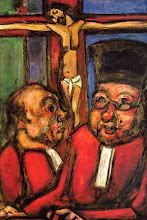
Angilbert (fl. ca. 840/50), On the Battle Which was Fought at Fontenoy

The Law of Christians is broken,
Blood by the hands of hell profusely shed like rain,
And the throat of Cerberus bellows songs of joy.

Angelbertus, Versus de Bella que fuit acta Fontaneto

Fracta est lex christianorum
Sanguinis proluvio, unde manus inferorum,
gaudet gula Cerberi.
Showing posts with label Augustine on Death Penalty. Show all posts

Wednesday, March 7, 2012

Capital Punishment and St. Thomas Aquinas

THE STATEMENT OF POPE INNOCENT III on capital punishment we addressed in our last post is probably the most significant Papal pronouncement on the matter in the Middle Ages. It is difficult to imagine how one can take the position that the Papal magisterium did not hold, as Innocent III clearly held, that the secular power can kill a malefactor without mortal sin as long as it was done within the constraints of law and justice and due process.

Probably the most influential theological treatment on capital punishment is found in the writings of St. Thomas Aquinas. From a canonical perspective, we might point to Gratian and his Decretum. It is impossible to gather together these witnesses of the medieval Church (and the many others that could be added) and not come away with the conclusion that the death penalty is, in the order of justice, something within the the secular power that is exercisable, in the proper circumstance, without moral fault.

We shall here treat of St. Thomas Aquinas's view of capital punishment. While St. Thomas handles the issue of punishment generally and capital punishment specifically in numerous of his writings,* we shall focus on his treatment of it in the Summa Theologiae. St. Thomas handles the issue of homicide in question No. 64 of the IIaIIae in the context of vices, which itself is within the greater context of virtues, which itself is nestled within the context of justice.


St. Thomas Aquinas, the Common Doctor

In Question No. 64, St. Thomas addresses eight questions regarding homicide. Our greatest interests lies in questions 2 and 3. Question 2 asks whether sinners (malefactors) may be put to death. After answering the question affirmatively, Question 3 asks who has the power to put sinners death. St. Thomas's conclusion is that the secular public power, entrusted with the care of the common good of a community, can lawfully--that is without sinning against justice--put a malefactor to death.

Rather than discuss St. Thomas Aquinas, I think the best thing to do is to present his treatment here entire:
Article 2. Whether it is lawful to kill sinners?

Objection 1. It would seem unlawful to kill men who have sinned. For our Lord in the parable (Matthew 13) forbade the uprooting of the cockle which denotes wicked men according to a gloss. Now whatever is forbidden by God is a sin. Therefore it is a sin to kill a sinner.

Objection 2. Further, human justice is conformed to Divine justice. Now according to Divine justice sinners are kept back for repentance, according to Ezekiel 33:11, "I desire not the death of the wicked, but that the wicked turn from his way and live." Therefore it seems altogether unjust to kill sinners.

Objection 3. Further, it is not lawful, for any good end whatever, to do that which is evil in itself, according to Augustine (Contra Mendac. vii) and the Philosopher (Ethic. ii, 6). Now to kill a man is evil in itself, since we are bound to have charity towards all men, and "we wish our friends to live and to exist," according to Ethic. ix, 4. Therefore it is nowise lawful to kill a man who has sinned.

On the contrary, It is written (Exodus 22:18): "Wizards thou shalt not suffer to live"; and (Psalm 100:8): "In the morning I put to death all the wicked of the land."

I answer that, As stated above (Article 1), it is lawful to kill dumb animals, in so far as they are naturally directed to man's use, as the imperfect is directed to the perfect. Now every part is directed to the whole, as imperfect to perfect, wherefore every part is naturally for the sake of the whole. For this reason we observe that if the health of the whole body demands the excision of a member, through its being decayed or infectious to the other members, it will be both praiseworthy and advantageous to have it cut away. Now every individual person is compared to the whole community, as part to whole. Therefore if a man be dangerous and infectious to the community, on account of some sin, it is praiseworthy and advantageous that he be killed in order to safeguard the common good, since "a little leaven corrupteth the whole lump" (1 Corinthians 5:6).

Reply to Objection 1. Our Lord commanded them to forbear from uprooting the cockle in order to spare the wheat, i.e. the good. This occurs when the wicked cannot be slain without the good being killed with them, either because the wicked lie hidden among the good, or because they have many followers, so that they cannot be killed without danger to the good, as Augustine says (Contra Parmen. iii, 2). Wherefore our Lord teaches that we should rather allow the wicked to live, and that vengeance is to be delayed until the last judgment, rather than that the good be put to death together with the wicked. When, however, the good incur no danger, but rather are protected and saved by the slaying of the wicked, then the latter may be lawfully put to death.

Reply to Objection 2. According to the order of His wisdom, God sometimes slays sinners forthwith in order to deliver the good, whereas sometimes He allows them time to repent, according as He knows what is expedient for His elect. This also does human justice imitate according to its powers; for it puts to death those who are dangerous to others, while it allows time for repentance to those who sin without grievously harming others.

Reply to Objection 3. By sinning man departs from the order of reason, and consequently falls away from the dignity of his manhood, in so far as he is naturally free, and exists for himself, and he falls into the slavish state of the beasts, by being disposed of according as he is useful to others. This is expressed in Psalm 48:21: "Man, when he was in honor, did not understand; he hath been compared to senseless beasts, and made like to them," and Proverbs 11:29: "The fool shall serve the wise." Hence, although it be evil in itself to kill a man so long as he preserve his dignity, yet it may be good to kill a man who has sinned, even as it is to kill a beast. For a bad man is worse than a beast, and is more harmful, as the Philosopher states (Polit. i, 1 and Ethic. vii, 6).


Article 3. Whether it is lawful for a private individual to kill a man who has sinned?

Objection 1. It would seem lawful for a private individual to kill a man who has sinned. For nothing unlawful is commanded in the Divine law. Yet, on account of the sin of the molten calf, Moses commanded (Exodus 32:27): "Let every man kill his brother, and friend, and neighbor." Therefore it is lawful for private individuals to kill a sinner.

Objection 2. Further, as stated above (2, ad 3), man, on account of sin, is compared to the beasts. Now it is lawful for any private individual to kill a wild beast, especially if it be harmful. Therefore for the same reason, it is lawful for any private individual to kill a man who has sinned.

Objection 3. Further, a man, though a private individual, deserves praise for doing what is useful for the common good. Now the slaying of evildoers is useful for the common good, as stated above (Article 2). Therefore it is deserving of praise if even private individuals kill evil-doers.

On the contrary, Augustine says (De Civ. Dei i) [Can. Quicumque percutit, caus. xxiii, qu. 8: "A man who, without exercising public authority, kills an evil-doer, shall be judged guilty of murder, and all the more, since he has dared to usurp a power which God has not given him."

I answer that, As stated above (Article 2), it is lawful to kill an evildoer in so far as it is directed to the welfare of the whole community, so that it belongs to him alone who has charge of the community's welfare. Thus it belongs to a physician to cut off a decayed limb, when he has been entrusted with the care of the health of the whole body. Now the care of the common good is entrusted to persons of rank having public authority: wherefore they alone, and not private individuals, can lawfully put evildoers to death.

Reply to Objection 1. The person by whose authority a thing is done really does the thing as Dionysius declares (Coel. Hier. iii). Hence according to Augustine (De Civ. Dei i, 21), "He slays not who owes his service to one who commands him, even as a sword is merely the instrument to him that wields it." Wherefore those who, at the Lord's command, slew their neighbors and friends, would seem not to have done this themselves, but rather He by whose authority they acted thus: just as a soldier slays the foe by the authority of his sovereign, and the executioner slays the robber by the authority of the judge.

Reply to Objection 2. A beast is by nature distinct from man, wherefore in the case of a wild beast there is no need for an authority to kill it; whereas, in the case of domestic animals, such authority is required, not for their sake, but on account of the owner's loss. On the other hand a man who has sinned is not by nature distinct from good men; hence a public authority is requisite in order to condemn him to death for the common good.

Reply to Objection 3. It is lawful for any private individual to do anything for the common good, provided it harm nobody: but if it be harmful to some other, it cannot be done, except by virtue of the judgment of the person to whom it pertains to decide what is to be taken from the parts for the welfare of the whole.
S.T. IIaIIae, q. 64, arts. 2, 3.

Modern Catholics seeking to abolish the death penalty have in their zeal, when confronted by St. Thomas's clear teaching, either ridiculed St. Thomas's teaching or chastised it as puerile or simplistic, being based on a "medicinal" (Bugger) or "gangrene" analogy (Megivern), being an argument that proves too much (Crowe), or being an argument of an Aristotelian, and not a Christian (Blázquez), etc.

To criticize St. Thomas's reasoning is really beside the point. The point is Saint Thomas taught that the public authority had the power justly to put a malefactor to death and that in the proper situation, in other words justly applied, it complied with the order of justice and constituted no mortal sin. In holding this doctrine he was within the Tradition of the Church. More than that, we might say that St. Thomas is an epitome of the Church's Tradition in that he is regarded the Common Doctor of the Church. It might behoove us to recall the words of Pope John XXIII to the Fifth International Thomistic Congress, September 16, 1960: "His [St. Thomas Aquinas's] teaching was, more than any other, fully in keeping with the truths that God has revealed, with the writings of the Holy Fathers, and with the principles of right reason and therefore Holy Church has adopted it as her own, and has given the name of common or universal teacher to its author." And what is true generally is true specifically with respect to St. Thomas Aquinas's teaching on the moral legitimacy of capital punishment.

______________________________________
*See, e.g., Summa Contra Gentiles, III.146.

Monday, March 5, 2012

Church Fathers and Capital Punishment: St. Augustine--Mercy and the Death Penalty

SAINT AUGUSTINE UPHELD the common teaching of the Church that the death penalty could be, from the perspective of justice, a proper exercise of State authority. He understood it to be a component of a properly-ordered state. The use of that penalty by legitimate authority was, in his view, absolutely established as morally lawful, by both natural and divine law.

But this is only half the story. For St. Augustine, the death penalty had to be viewed from another angle. Since the coming of Christ, mercy and truth had met each other: justice and peace had kissed. (Cf. Psalm 85:10) Therefore, it was not enough to rest satisfied on the view that the death penalty complied with strict justice. It was necessary--as a matter of mercy, of love, and his priestly or episcopate ministry--to encourage, indeed insist, on clemency.*

St. Augustine's letters are full of his efforts at getting local magistrates to stay the hand of the State, and exercise clemency to malefactors, in particular when it came to punishment by death. We see that St. Augustine's concerns are driven by his Christian anthropology which is based upon the dignity of every man, even the sinner. It is also driven by the value he gives to the possibility of redemption and reformation, and his insistence of the principle salus anima suprema lex, the salvation of souls is the greatest law, superseding even the demands of just punishment.


St. Nicholas Stopping the Execution of Three Men

In his letter to the magistrate Macedonius, St. Augustine describes his general attitude:

In no way, then, do we approve of the sins that we want to be corrected, nor do we want the wrongdoing to go unpunished because we find it pleasing. Rather, having compassion for the person and detesting the sin or crime, the more we are displeased by the sin the less we want the sinful person to perish without having been corrected. For it is easy and natural to hate evil persons because they are evil, but it is rare and holy to love those same persons because they are human beings. Thus, in one person you at the same time both blame the sin and approve of the nature, and for this reason you must justly hate the sin because it defiles the nature that you love. He, therefore, who punishes the crime in order to set free the human being is bound to another person as a companion not in injustice but in humanity. There is no other place for correcting our conduct save in this life. For after this life each person will have what he earned for himself in this life. And so, out of love for the human race we are compelled to intercede on behalf of the guilty lest they end this life through punishment so that, when it is ended, they cannot have an end to their punishment.

Nullo modo ergo culpas quas corrigi volumus, approbamus, nec quod perperam committitur, ideo volumus impunitum esse, quia placet; sed hominem miserantes, facinus autem seu flagitium detestantes, quanto magis nobis displicet vitium, tanto minus volumus inemendatum interire vitiosum. Facile enim est atque proclive malos odisse, quia mali sunt: rarum autem et pium eosdem ipsos diligere, quia homines sunt; ut in uno simul et culpam improbes, et naturam approbes, ac propterea culpam iustius oderis, quod ea foedatur natura quam diligis. Non est igitur iniquitatis, sed potius humanitatis societate devinctus, qui propterea est criminis persecutor, ut sit hominis liberator. Morum porro corrigendorum nullus alius quam in hac vita locus est; nam post hanc, quisque id habebit quod in hac sibimet conquisierit. Ideo compellimur humani generis caritate intervenire pro reis, ne istam vitam sic finiant per supplicium, ut ea finita non possint finire supplicium.

Letter 153 to Macedonius, 1.3.

This same heartfelt urge is expressed in one of his sermons, no doubt preached in the presence of magistrates and judges:
So do not condemn people to death, or while you are attacking the sin you will destroy the man. Do not condemn to death, and there will be someone there who can repent. Do not have a person put to death and you will have someone who can be reformed. As a man having this kind of love for men in your heart, be a judge of the earth. Love terrifying them if you like, but still go on loving. I don't deny that penalties must be applied. I don't forbid it. But let it be done in a spirit of love a spirit of caring, a spirit of reforming.

Noli ergo usque ad mortem, ne cum persequeris peccatum, perdas hominem. Noli usque ad mortem, ut sit quem paeniteat, homo non necetur ut sit quem paeniteat; homo non necetur ut sit qui emendetur. Hanc in corde retinens homo in homines dilectionem, esto iudex terrae. Et ama terrere, sed dilige. Si superbis, superbi in peccata, non in hominem. In illud saevi quod tibi displicet et in te, non in eum qui factus est sicut tu. De una officina existis, unum artificem habuistis, unus limus est vestra materies. Quid perdis non amando quem iudicas? Quoniam iustitiam perdis, non amando quem iudicas. Sed adhibeantur poenae. Non recuso, non interdico, sed animo amantis, animo diligentis, animo corrigentis.

Sermon 13.8.

It was these sort of sentiments, this intensely Christian spirit of mercy, which drove St. Augustine habitually to intercede for clemency on the part of those accused of serious capital offenses. For example, in his letter to Marcellinus,** an imperial commissioner with authority over the case of some Donatist clerics and Circumcellions*** guilty of the murder of Restitutus, a Catholic priest, and the beating and torture of another, he pled for the exercise of clemency. Though guilty of heinous offenses that entitled them to the most severe punishments, they ought not be put to death or suffer mutilation; rather, their freedom ought to be restrained so that repentance may be hoped for:
I appeal through the mercy of Christ the Lord to the faith that you have in Christ that you not do this or allow it to happen at all. For, although we can deny any responsibility for the death of those who are seen to have been handed over for judgment, not due to the accusations of ours, but because of the indictment of those who have charge of the defense of the public peace, we still do not want the sufferings of the servants of God to be avenged by punishments equal to those sufferings, as by the law requiring an eye for an eye. It is not that we would prevent criminals from losing the freedom to commit crimes, but we want it rather to be sufficient either that, alive and with no part of the body mutilated, they be taken from their restlessness and steered to the peace of good health by the restraints of law or that they be assigned to some useful work away from their evil works. This is, of course, called condemnation, but who does not understand that it should be called a benefit rather than a punishment when their bold fierceness is restrained and the remedy of repentance is not withdrawn?

Ideoque his litteris obtestor fidem tuam quam habes in Christo, per ipsius Domini Christi misericordiam, ut hoc nec facias, nec fieri omnino permittas. Quamvis enim ab eorum interitu dissimulare possemus, qui non accusantibus nostris, sed illorum Notoria ad quos tuendae publicae pacis vigilantia pertinebat, praesentati videantur examini; nolumus tamen passiones servorum Dei, quasi vice talionis, paribus suppliciis vindicari. Non quo scelestis hominibus licentiam facinorum prohibeamus auferri; sed hoc magis sufficere volumus ut vivi et nulla corporis parte truncati, vel ab inquietudine insana ad sanitatis otium legum coercitione dirigantur, vel a malignis operibus alicui utili operi deputentur. Vocatur quidem et ista damnatio; sed quis non intellegat magis beneficium quam supplicium nuncupandum, ubi nec saeviendi relaxetur audacia, nec poenitendi subtrahatur medicina?
Letter 133 to Marcellinus, 1.1.

In another letter to the same Marcellinus, St. Augustine pleads again that the "punishment of those people, though they have confessed to such great crimes, may not involve the death penalty both on account of our conscience and for the sake of emphasizing Catholic gentleness." Letter 139 to Marcelinus, 1 (Poena sane illorum, quamvis de tantis sceleribus confessorum, rogo te ut praeter supplicium mortis sit, et propter conscientiam nostram, et propter catholicam mansuetudinem commendandam.)

We have similar attitude expressed in St. Augustine's letter to Donatus, the proconsul of Africa. As procounsul, Donatus had authority over those condemned to death, including the Donatist heretics, the adversaries against which St. Augustine so mightily strove in his capacity as bishop of Hippo. He fears that the procounsul may judge "in accord with the immensity of their crimes and not rather in accord with a consideration of Christian gentleness (lenitatis Christianae)." He insists that Christ's injunction that we ought to love our enemies should apply in this case.

We love our enemies and pray for them. Hence, we desire that, by making use of judges and laws that cause fear, they be corrected, not killed, so that they do not fall into the punishments of eternal condemnation. We do not want discipline to be neglected in their regard or the punishment they deserve to be applied. Repress their sins, therefore, in such a way that those who repent having sinned may still exist. . . . It is not, my honorable and most beloved son, something unworthy or contemptible when we ask you that they, whom we ask the Lord to correct, not be put to death.

[D]iligimus inimicos nostros et oramus pro eis. Unde ex occasione terribilium iudicum ac legum, ne in aeterni iudicii poenas incidant, corrigi eos cupimus, non necari; nec disciplinam circa eos neglegi volumus, nec suppliciis quibus digni sunt exerceri. Sic igitur eorum peccata compesce, ut sint quos poeniteat peccasse. . . . Non tibi vile sit, neque contemptibile, fili honorabiliter dilectissime, quod vos rogamus ne occidantur, pro quibus Dominum rogamus ut corrigantur.

Letter 100 to Donatus, 1-2.

St. Augustine realized that there are times where such clemency simply cannot be applied. We find him addressing such a situation in a letter to the proconsul Apringius, brother of Marcellinus. He urges Apringius not to apply the death penalty to the Donatist clerics who killed and maimed Catholic priests: "I as a Christian beg the judge and as a bishop warn a Christian." Letter 134 to Apringius, 2. (hoc ne fiat et christianus iudicem rogo, et christianum episcopus moneo.)

If, then, there were no other means established to curb the malice of the wicked, extreme necessity might perhaps urge that such men be put to death, though, in our iew, if no milder punishment could be imposed on them, we would prefer that they be released rather than the sufferings of our brothers be avenged by the shedding of their blood.

Si ergo nihil aliud constitueretur frenandae malitiae perditorum, extrema fortasse necessitas ut tales occiderentur urgeret; quamquam quod ad nos attinet, si nihil mitius eis fieri posset, mallemus eos liberos relaxari, quam passiones fratrum nostrorum fuso eorum sanguine vindicari.

Letter 134 to Apringius, 4. But this is if all else fails. Ordinarily, St. Augustine's view was "lengthen the span of years," and not to shorten it through the penalty of death, "for the living enemies of the Church that they may repent." Letter 134. And what is true for the enemies of the Church may equally have been extended to the enemies of the common good, such as the slave traders mentioned by St. Augustine in his letter to Alipius. See Letter 10* to Alipius.

Fully to understand St. Augustine's teachings on capital punishment, therefore, requires more than simple focus on whether the death penalty is lawfully applied by properly constituted authority. It also requires us to superimpose upon the justice associated with the death penalty, the mercy derived from the Lord's mercy to us, the humanity of the malefactor, the possibility of his repentance, and fear that putting a man to death may inadvertently rob him of his ultimate good: eternal life.

Clemency was therefore St. Augustine's primary policy, and, though he accepted the moral lawfulness of the death penalty justly applied, he worked assiduously at minimizing its application through the application of clemency. At the same time, St. Augustine did realize that in the case of extreme necessity, such clemency might have to give way, and the malefactor would have to be put to death. This sounds vaguely reminiscent of the notion that execution of a malefactor ought not to occur "except in cases of absolute necessity: in other words, when it would not be possible otherwise to defend society." Evangelium vitae, 56. For both St. Augustine and Pope John Paul II, this, it would appear, would be the limits of clemency, the limits of mercy.

________________________________
*There is no inconsistency in St. Augustine if the distinction between justice and mercy are kept in mind. Therefore, James Megivern is wrong in his tendentious book The Death Penalty: An Historical and Theological Survey (New York: Paulist, 2003), 35, when he accuses St. Augustine of leaving an "ambivalent legacy." What Megivern forgets is the two different orders. The malefactor justly condemned to death cannot plead injustice. What he can plead for is mercy. The magistrate who justly condemns a man to death cannot be accused of injustice; but he can be admonished to exercise mercy. The failure to exercise mercy may not necessarily be a mortal sin, as would be the failure to exercise justice, but it is certainly unseemly for a Christian not to show mercy when they are enjoined to be merciful as their heavenly Father is merciful. Luke 6:36.
**Interestingly, the first books of St. Augustine's City of God were dedicated to this same Marcellinus of Carthage. Ultimately, Marcellinus and his brother Apringius were martyred in 413. The feast day for St. Marcellinus is April 6.
***For a quick summary of this quirky group, see http://en.wikipedia.org/wiki/Circumcellions.


Sunday, March 4, 2012

Church Fathers and Capital Punishment: St. Augustine--Justice and the Death Penalty

ALTHOUGH HE NEVER EXPRESSLY wrote a treatise on the subject, St. Augustine of Hippo (354-430) has in his writings a well-developed understanding of capital punishment. In a nutshell, St. Augustine recognizes that civil authorities have the God-given power to put a man justly to death for grave crimes, and that a Christian as a judge or magistrate, may exercise without penalty of sin that power in proper circumstances. However, that is not where he leaves the matter. Capital punishment is, for St. Augustine, not only a matter that must be looked at in the light of justice. It must also be looked at in the light of mercy. The light of mercy tempers the steel of justice to the point where capital punishment ought rarely be applied. St. Augustine's letters are full of requests for magistrates or judges to exercise clemency in applying the death penalty.

The writings where St. Augustine recognizes the law of the sword to include the ultimate punishment are many. We see it in his early Christian works, e.g., On Order and On Freedom of the Will. We see it in his mature works, for example, his On the City of God.

For what is fouler than the executioner? What is his cruel and barbarous purpose? But he has a necessary place within the well-ordered laws themselves of an orderly city. And though in his own person he does evil, the punishment of evildoers is not ascribed to him.

Quid enim carnifice tetrius? quid illo animo truculentius atque dirius? At inter ipsas leges locum necessarium tenet et in bene moderatae civitatis ordinem inseritur estque suo animo nocens, ordine autem alieno poena nocentium.

De Ordine, II.4.12.

In his dialogue On Free Choice of the Will, St. Augustine introduces the subject of capital punishment through his interlocutory Evodius which elicits absolute agreement:
Ev. If murder means taking the life of a man, this can sometimes happen without any sin. When a soldier slays the enemy, when a judge, or his deputy, executes a criminal, when, by chance, a deadly weapon leaves someone's hand unintentionally or thoughtlessly, I do not think that these are guilty of sin in killing a man.
Aug. I agree, but such men are not usually called murderers. . . . .

Ev. - Si homicidium est hominem occidere, potest accidere aliquando sine peccato: nam et miles hostem, et iudex vel minister eius nocentem, et cui forte invito atque imprudenti telum manu fugit, non mihi videntur peccare, cum hominem occidunt.
Aug. - Assentior: sed homicidae isti appellari non solent.

De lib. arb., I.4.9.


St. Augustine of Hippo

In a letter to the magistrate Macedonius (Letter No. 153), who apparently complains about the episcopate penchant for urging clemency in punishment of crimes, St. Augustine clearly supports the power of punishment in the State, including the death penalty:

Nor does it follow that the power of the sovereign, the judge's right over life and death, the executioner's instruments of torture, the weapons of the solider, the discipline of the ruler, and the severity of a good father were instituted to no avail. All these have their limits, causes, reasons, and utility.

Nec ideo sane frustra instituta sunt potestas regis, ius gladii cognitoris, ungulae carnificis, arma militis, disciplina dominantis, severitas etiam boni patris. Habent ista omnia modos suos, causas, rationes, utilitates.

Letter to Macedonius, 153.6.16.

This view is carried over into St. Augustine's great work, The City of God.
However, there are some exceptions made by the divine authority to its own law, that men may not be put to death. These exceptions are of two kinds, being justified either by a general law, or by a special commission granted for a time to some individual. And in this latter case, he to whom authority is delegated, and who is but the sword in the hand of him who uses it, is not himself responsible for the death he deals. And, accordingly, they who have waged war in obedience to the divine command, or in conformity with His laws, have represented in their persons the public justice or the wisdom of government, and in this capacity have put to death wicked men; such persons have by no means violated the commandment, "You shall not kill."

Quasdam vero exceptiones eadem ipsa divina fecit auctoritas, ut non liceat hominem occidi. Sed his exceptis, quos Deus occidi iubet sive data lege sive ad personam pro tempore expressa iussione, (non autem ipse occidit, qui ministerium debet iubenti, sicut adminiculum gladius utenti; et ideo nequaquam contra hoc praeceptum fecerunt, quo dictum est: Non occides, qui Deo auctore bella gesserunt aut personam gerentes publicae potestatis secundum eius leges, hoc est iustissimae rationis imperium, sceleratos morte punierunt.
De civ. Dei, I.21.

It cannot be questioned that St. Augustine supported the doctrine that the legitimate authority had the power to put a malefactor to death for a serious crime. It was an exception to the Fifth Commandment, part of the natural law as revealed in the Old and New Testaments, and the magistrate or judge exercising that authority justly and in accordance with law was not in any way in mortal sin. St. Augustine was comfortably within the Christian tradition in handing this teaching down. If it is true, as Jaroslav Pelikan said, that Western theology is nothing but a "series of footnotes to Augustine," then we might expect the Roman Catholic Church to have carried this doctrine within its bosom. And she did.

That much is certain. But, as we shall see in the next post, that is not the whole story.