Angilbert (fl. ca. 840/50), On the Battle Which was Fought at Fontenoy

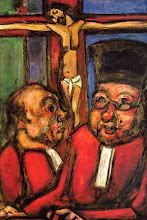
The Law of Christians is broken,
Blood by the hands of hell profusely shed like rain,
And the throat of Cerberus bellows songs of joy.

Angelbertus, Versus de Bella que fuit acta Fontaneto

Fracta est lex christianorum
Sanguinis proluvio, unde manus inferorum,
gaudet gula Cerberi.
Showing posts with label St. Augustine of Hippo. Show all posts

Sunday, March 21, 2010

St. Augustine of Hippo: The Natural Law as the Eternal Law in Man

THE ETERNAL LAW WAS AT THE HEART of St. Augustine's conception of law and of order, in the area of morality, and in the area of human law. Augustine's conception of the "eternal law" is one that encompasses the eternal plan of the world, a product of divine reason and divine will, a law which governs the entire abyss of the cosmos, including the very abyss of the cosmos within man, not with an arbitrary will, but within a divine ordering that is manifestive of reason, nay, even more: love. The existence of this eternal law is seen in the sheer magnitude and ordering of the cosmos, in the course of the stars and planets, and in the growth of plants and movements of beasts. It is inscribed in a particularly powerful way in the human soul as the natural law, the inward compulsion towards the moral life; its voice is conscience, and its imperium the good. In this next area of blog postings we will discuss St. Augustine, and review his concepts of the eternal law and the natural law. St. Augustine will be the last of Church Fathers whose work on the natural law we will review, and will close out our current series of the natural law in the Church Fathers.

St. Monica, St. Augustine's Mother

St. Augustine, Aurelius Augustinus Hipponensis (354-430), is a giant in Christian thought. He was a Romanized African, a Berber, born in the ancient provincial Roman city of Tagaste, now modern day Souk Ahras (سوق أهراس‎) in the country of Algeria. St. Augustine was the product of a Christian mother--herself a saint--St. Monica, and a pagan father, Patricius by name. Augustine received a classical education, but the influence of his mother did not seem to take on the young Augustine. Probably as a result of the influence of his father, or perhaps the result of his peers, or perhaps the result of young passions too difficult to tame, or perhaps a combination of all three, Augustine soon rejected the Catholicism of his mother, and immersed himself in pagan thinking and pagan libertinism.

Icon of St. Augustine of Hippo

While studying rhetoric, Augustine had an intellectual conversion at the age of nineteen as he was reading Cicero's dialogue Hortensius, a work that is--alas--now lost. This sparked his interest in philosophy and in the life of the mind, but it did not change his hedonistic life style, and it did not bring him back to the Church, at least not at once.

Eventually, Augustine went to Carthage, where he studied rhetoric. In belief and in morals he continued the life of a pagan. He took to carousing, to womanizing, eventually spurning even marriage, and settling down with concubine, with whom he lived for almost thirteen years, and who gave him a son named Adeodatus. Later, as we shall see, in his Confessions, he complained about the unruly life of both the students and professors at Carthage. He taught in Tagaste, and then in Carthage, where he founded a school of rhetoric. After nine years in Carthage, he went to Rome, believing that he would best further his career there. Disappointed in Rome by the lack of paying students, he eventually went Milan where he obtained a prestigious position as professor of rhetoric at the imperial court there. Not very nobly, he abandoned his concubine, hoping to get into a marriage that was more socially acceptable, but he soon broke off his engagement and began a relationship with another concubine. Da mihi castitatem et continentiam, sed noli modo. During this time, Augustine became interested in the Manichee sect, a sect he was later to reject, largely because a disappointing meeting with one of the leaders of the sect, Faustus of Mileve.

After leaving Manicheeism, Augustine plummeted into the depressive depths of skepticism. "He fell into a profound depression," Pope John Paul II states in his Apostolic Letter on St. Augustine, "and indeed despaired of ever coming to know the truth." Augustinum Hipponensem, I (herein AH). However, he did not stay long in the sloughs of skepticism, but, prompted by, and responding to, the internal promptings of God's grace, and as a result of the combined efforts of his mother, the encouragement of his friend Simplicianus, his reading of the Neoplatonists who tore him from materialism, and his hearing of the homilies of the great St. Ambrose, bishop of Milan (all of whom were agents of God's actual grace), St. Augustine began his journey back to Christianity and to the Catholic Church.

Mosaic of St. Augustine (=St. Austin)

The internal crisis which eventually resolved itself into Augustine's accepting Christ and his Church came about by his reading of the life of St. Anthony of the Desert and the voice of a child, or perhaps an angel. The event is profoundly moving, and his told by St. Augustine himself in Book 8 (Paragraphs 28 and 29) of his Confessions (Outler, trans. with revisions) Here he speaks of what John Paul II called being "struck by the lightning-flash of grace." AH, II:
Now when deep reflection had drawn up out of the secret depths of my soul all my misery and had heaped it up before the sight of my heart, there arose a mighty storm, accompanied by a mighty rain of tears. That I might give way fully to my tears and lamentations, I stole away from [my friend] Alypius, for it seemed to me that solitude was more appropriate for the business of weeping. I went far enough away that I could feel that even his presence was no restraint upon me. This was the way I felt at the time, and he realized it. I suppose I had said something before I started up and he noticed that the sound of my voice was choked with weeping. And so he stayed alone, where we had been sitting together, greatly astonished. I flung myself down under a fig tree--how I know not--and gave free course to my tears. The streams of my eyes gushed out an acceptable sacrifice to thee. And, not indeed in these words, but to this effect, I cried to thee: "And you, O Lord, how long? How long, O Lord? Will you be angry forever? Oh, remember not against us our former iniquities." For I felt that I was still enthralled by them. I sent up these sorrowful cries: "How long, how long? Tomorrow and tomorrow? Why not now? Why not this very hour make an end to my uncleanness?"

I was saying these things and weeping in the most bitter contrition of my heart, when suddenly I heard the voice of a boy or a girl I know not which--coming from the neighboring house, chanting over and over again, "Pick it up, read it; pick it up, read it" [tolle lege, tolle lege]. Immediately I ceased weeping and began most earnestly to think whether it was usual for children in some kind of game to sing such a song, but I could not remember ever having heard the like. So, damming the torrent of my tears, I got to my feet, for I could not but think that this was a divine command to open the Bible and read the first passage I should light upon. For I had heard how [Saint] Anthony, accidentally coming into church while the gospel was being read, received the admonition as if what was read had been addressed to him: "Go and sell what you have and give it to the poor, and you shall have treasure in heaven; and come and follow me." By such an oracle he was forthwith converted to thee.

So I quickly returned to the bench where Alypius was sitting, for there I had put down the apostle's book when I had left there. I snatched it up, opened it, and in silence read the paragraph on which my eyes first fell: "Not in rioting and drunkenness, not in chambering and wantonness, not in strife and envying, but put on the Lord Jesus Christ, and make no provision for the flesh to fulfill the lusts thereof." [Rom. 13:13-14] I wanted to read no further, nor did I need to. For instantly, as the sentence ended, there was infused in my heart something like the light of full certainty and all the gloom of doubt vanished away.
The event was one of transformation. Augustine sold all his inheritance, gave up his women, his hope for future advancement in the secular world, and returned to Africa where he began to live a monastic life with a group of his friends. Tragically, his son died soon after his conversion. Eventually, he was ordained a priest in the Hippo Regius (modern date Annaba (عنابة), Algeria. He was later ordained coadjutor bishop Hippo in 395, and upon succeeding to that post at the death of the existing bishop, St. Augustine remained as bishop of Hippo until his death at 430.

His labors on behalf of the Church and Christ show an indefatigable spirit. Unbelievably prolific in light of his episcopal duties which he took extremely seriously, and to which he devoted himself sedulously, St. Augustine left myriad works of various kinds. He had polemical works against the Arians, Donatists, Manichaeans, and Pelagians. He had doctrinal works such as his De doctrina christiana (On Christian Doctrine), De Trinitate (On the Trinity), or De libero arbitrio (On Free Choice of Will). He also wrote moral and practical works such as De mendacio (On Lying), De bono coniugali (On the Good of Marriage), and De sancta virginitate (On Holy Virginity). He penned works on Scripture, including commentaries on Genesis, St. Paul's Letter to the Romans, Jesus' Sermon on the Mount (De sermone Domini in monte), and his celebrated commentary on the Psalms, Enarrationes in Psalmos. He also authored some more personal works such as his Soliloquies and his famous Confessions. He also penned a massive work on Christianity and history and political philosophy, De Civitate Dei, On the City of God, a work that he described as his magnum opus et arduum. He left numerous letters and numerous homilies. Most men could not read through it all in a lifetime.

St. Augustine, Bishop of Hippo

The effect of his teachings on the Church were great when he authored his works, and they remain significant to this day. As John Paul II stated it in his Apostolic Letter on St. Augustine, he "has been present ever since in the life of the Church and in the mind and culture of the whole western world." AH, pref. His notions of creation (ex nihilo), of grace, of original sin, of free will, of evil as the privity of good, of the natural law, of "just war," of marriage and its goods--one could recite a dozen more--all remain de rigeur for the theologian and religious scholar. There is scarcely any part of Catholicism, or of Western thought for that matter, that is unaffected by him. These works, along with the three unfinished works remaining at his death at seventy-six years of age, are evidentiary of his "sleepless diligence and to his unconquerable love for the Church." AH, III.

St. Augustine did not prepare a treatise dedicated to law. As Crowe stated it in his book on the history of the Natural Law: "St. Augustine . . . wrote no distinct treatise on law [, but] he provided almost all the elements of a formal scholastic Tractatus de legibus." Crowe, at 62. What this means, of course, is that St. Augustine's teaching on the eternal law, the natural law, and the interplay between these and human law, must be gleaned from his writings, which are numerous, and certainly beyond the grasp of this author. It is important, therefore, to remember John Paul II's warning, which is no less true for St. Augustine's teaching on law than it is for any other of his subjects: "It is difficult to venture forth upon the sea of Augustine's thought, and even more difficult to summarize it--this indeed is almost impossible." AH, II.

With that caveat firmly in mind, we will begin that review by focusing on the references to the eternal law in St. Augustine's Confessions, a work, that John Paul II described as one "that is simultaneously autobiography, philosophy, theology, mysticism and poetry, a work in which those who thirst for truth and know their own limitations have always discovered their own selves." AH, I. The eternal law, one might add, will be part of every man or woman's autobiography, even if, God forbid, he or she should reject it. It will be part of everyone's philosophy and theology, those worthy of the name. It will be at the heart of true mysticism, and will be the center of any poetry that speaks of the true and the good.

Saturday, January 16, 2010

Girolamo Zanchi on Human Law, Part 3

Girolamo Zanchi


ZANCHI CONCLUDES HIS TREATMENT on the relationship between human or political law and the natural law by addressing the issue of the construction or enforcement of human law, and by pointing out two significant distinctions between human law and the natural law.

With respect to the first issue, Zanchi insists that the natural law has a role in the application of human law in certain situations where the law--if enforced according to the letter--results in injustice. His reasoning as as follows.

Human laws, that is, positive laws of the State, have as their aim the promotion of the common good. On occasion, however, enforcement of the letter of this law may actually result in "the ruin of those people for whose sake it was enacted," thus contradicting its purpose. There are therefore instances where the "letter of the law" should not be followed; rather, the "purpose of the law and the spirit of the law-giver must be examined and followed." This appears to be an application by Zanchi of the legal maxim salus populi suprema lex est, the welfare of the people is the supreme law, a principle as old as the Roman Twelve Tables (Compare Cicero, De Legibus, 3.3.8 ("ollis salus populi suprema lex esto")

As an example of such an instance, Zanchi supposes a human law that provides that no person is allowed to open the city gates if the city is being besieged. Obviously, this law is unobjectionable from a general perspective, and it seeks to protect the citizens and promote the common good when the city is under seige by preventing the city from being occupied by enemy force. Thus, this law would derive from the natural law.

Zanchi then posits the situation where the city is under seige, and the city's army is outside the walls engaged in battle with the opposing army. The city's army retreats and seeks entry into the safety of the very city which they are defending. If the letter of the law is obeyed in this circumstance, the city's army will be slaughtered and without its army the city will ultimately be captured, defeating the law's purpose and the natural law. "[W]ho does not see that in such a case the city gates must be opened despite the letter of the law . . . .?" (345) Clearly, the letter of the law ought not to be followed in such and similar instances, but the purpose of the law, the intent of the legislator, and the natural law override the law's letter.

Justinian's Codex recognized this principle (1.14.5): "There is no doubt that he violates the law, who, adhering to its letter, violates its spirit . . . ." (Non dubium est in legem committere eum, qui verba legis amplexus contra legis nititur voluntatem . . . .). Similarly, this principle is carried forward in the teaching of the Church fathers and ecclesiastics, and applies in the context of divine law as well as human law. "Some law-followers," Zanchi states, "have actually sinned against the will of God" even when externally obeying the letter of the divine law itself because they act against its principle, its spirit. As examples of this, Zanchi cites the various encounters between Jesus and the Pharisees and Scribes related in the Gospel. These are examples where the letter of the law and the spirit of the law conflict. Thus, plucking heads of grain on the Sabbath did not violate the divine injunction to keep the Sabbath day holy (Mark 2:23-28; Matt. 12:1-7), nor did curing a man on the Sabbath (Matt.12:9-14), since they conformed to the purpose of the law, and the enforcement of the letter of the law contradicted its purpose.

Zanchi thus concludes:
Laws are enacted from natural law for the common good and the welfare of human beings, and only for as long as they do so do they have the power to obligate. If, therefore, it should happen that by sticking to the letter of the law, we act against the welfare of human beings, we have acted more against the law than in accordance with it.

(346) However, Zanchi cautions that this principle is not to be used without some restriction. The power to determine in the first instance when enforcement of the letter of the law violates the natural law--and therefore ought not to be obeyed--is with the authorities, assuming that they may coveniently be available. "When, however," the authorities "cannot be easily consulted and there is a danger in delay, and the case of the law is clear to each person," then in such instance "it is appropriate for the person involved, to whom the responsibility falls, or on whom the burden of the State is conferred," when the purpose "of the law is lost, to follow his own interpretation of the law." (346)

Zanchi completes his treatment of human laws by pointing out two fundamental distinctions between the human law and the natural law. The first is that, while human law changes, the natural law does not and cannot. The second difference is that human law only governs external acts, whereas the natural law covers both external and internal acts. He explores those two issues.

First, Zanchi observes that the natural law is unchanging, whereas human law changes depending on the contingencies of time, place, and personality. For this reason, there may be disagreement between human law and natural law. The natural law cannot change for the very simple reason that it "is simply certain, general eternal aspects of God's will, the revelation of the rule for doing and avoiding, written on the hearts of human beings." (347) Human laws, on the other hand, "cannot be eternal and unchangeable because their circumstances," in terms of "place, time, and personality" vary. (347) This distinction between the two is what makes St. Augustine state in his De libero arbitrio (On Free Will) [1.6.14.48] that temporary laws may be suspended for a time (Appellemus ergo istam legem, si placet, temporalem, quae quamquam iusta sit, commutari tamen per tempora iuste potest.)

It follows that human laws must change to conform to the natural law. Human law must therefore change in two situations. First, the development in human reason, as a community advances from relative imperfection to relative greater perfection, demands that the human law be adapted to reason's development. Laws ought to reflect the same development one sees in philosophy or other sciences. Second, differences and varieties in people, communities, or States require different laws adapted to their specific situations. As an example of how the state of a people affects laws, Zanchi again refers to St. Augustine. If a people is virtuous, it may be acceptable for them to elect their own magistrates. However, if the people become depraved, then allowing them to elect their own magistrates may result in the election of criminals, and so the law allowing for participatory elections should be changed. (De Libero Arbitrio, 1.6.14.45-46)

[Zanchi then applies this principle to the Church, and gives as an unfortunate example the selection of ministers; however, here he displays the prejudice of the Reformers which fails to give sufficient deference to the teachings of Christ on Church governance and its constitution.]

How, then, can human laws change, but the natural law not change?

The response to this . . . is quite simple: Anything that human laws retain from natural law cannot be changed, but anything that differs from it because of the particular circumstances and that impedes the public good more than it advances it must be changed. In addition, human laws by their own nature have their own individual circumstances. Thus, because circumstances change, it follows that the [human] law can change entirely too. Still, natural law maintains its general principles without any particular circumstances. Thus, it remains immutable.

(348) The second big difference between the natural law and human law is that the natural law is broader, more extensive than human law. The natural law "prohibits all vices and crimes, in general, both internal and external ones." Thus, the natural law "regulates not only external worship but also internal worship." (348) Likewise, the natural law, in particular the "Golden Rule," prohibits not only external injury to our neighbor, but internal injuries, such as nursing hatred and envy. "Love is commanded," by the natural law, "because we, ourselves, want to be loved."

In contradistinction with the natural law which governs both external and internal fora, human or political laws only relate to "external crimes" and "external duties." (349) Human laws do not reach into the inner part of man. The reason for this is that human laws have limited scope and purpose. Since human or political laws look only toward promoting the common good, they do not look at the private good of an individual except perhaps accidentally.

Moreover, even in externals, human law is limited. There is a prudential aspect in human law that is absent in the natural law. Human laws simply cannot prohibit every external wrong without resulting in greater harm to the common good. Human laws can only prohibit those wrongs that prudently can be prevented. Where something cannot be prevented, either as a result of human nature, custom, or the people's wishes, human law ought not be applied because it would be vain and fruitless or would result in greater harm. Thus Proverbs 30:33: "Pressing the nose produces blood" (qui vehementer emungitur elicit sanguinem). Zanchi suggests that Christ recognized this principle when, as related in Matthew 9:17, he says that if new wine is put into old wineskins, the old wineskins will burst and the wine will be lost. The new wine represents "harsher and stronger ideas," and if people are not ready for them "the people will fall from bad to worse and become more corrupt" by trying to hoist these ideas upon them. Thus, human or political law requires prudent and wise application. This element of human laws gives rise to one of the more important principles of human legislation: "It is essential that the laws be possible. By possible I mean, in accordance with both nature and the customs of the people." (349).

In conclusion, Zanchi's treatment of the natural law is substantially more traditional and classical than Calvin's treatment, though it appears more influenced by the Protestant Reformers' ideas than Vermigli, whose doctrines were reviewed in earlier posts on this blog. Zanchi's treatment, however, is much more complete and methodical than Calvin's and Vermigli's treatment of the natural law. Zanchi, nevertheless, does provide some basis for a Protestant tradition of the natural law, a tradition that, as we discussed in earlier blogs, Karl Barth vehemently, and perhaps--applying strictly the underlying principles of the Reformer's theology--logically rejected.

Doctrines of the natural law will invariably be affected by one's theological or philosophical presuppositions. Theological error will often find outlet in a false view of the natural law. Thus, for example, Calvin's theological error with respect to the depravity of man marred his view of natural law. A fortiori, Barth's theological error entirely blinded him to the continuing validity of the natural law. Similarly, one's philosophical presuppositions can affect one's doctrine of the natural law. Thus, someone with a nominalist or materialist, mechanistic philosophy (as distinguished from someone with a realist philosophy or a philosophy open to the existence of God) will be seriously hampered in his ability to grasp the possibilty eternal or natural law. Theological and philosophical traditions, in addition to our own culture's customs and our own internal passions and vices, can render our vision astigmatic, myopic, hyperopic . . . indeed, can make us even blind to the fullness of the eternal and the natural law, just as it can blind us to the Gospel.

Thursday, December 17, 2009

Augustine: Natura Gratiaque aut Gratia Naturaque

The Catholic St. Augustine

THE DOCTOR OF GRACE, SAINT AUGUSTINE, SOUNDLY REJECTS Karl Barth's view of the total depravity or corruption of man's nature, the unreliability or irrelevancy of the natural law, and the doctrine of sola gratia. In this blog posting, St. Augustine's balanced viewpoint as found in his book Nature and Grace (written in response to Pelagius's book Nature) is presented as a balanced theory of the interplay between Grace and Nature, Grace and Law.

It should be kept in mind that Augustine's Nature and Grace was a polemic against Pelagius's book Nature (which essentially denied the need for supernatural Grace). (Barth's opposition to the natural law doctrine is that it detracts from the doctrine of Grace, and essentially leads to Pelagianism, and so it is interesting to compare Barth's response to St. Augustine's response.)

In his Retractions, St. Augustine discusses how Pelagius defended human nature "in opposition to the grace of God" (hominis naturam contra Dei gratiam), and how he sought in his response "not [to] defend grace in opposition to nature," but rather sought to show grace as nature's complement, a "grace by which nature is set free and ruled" (gratiam non contra naturam sed per quam natura liberatur et regitur) (I/23, p. 204, quoting Retractions II, 68(42)). Barth's mistake was to oppose grace to nature when confronting adversaries--real or imagined--that he felt opposed nature to grace. In contrast to Barth's either/or approach, St. Augustine chose a more balanced both/and response to nature's threat against grace, a via media that linked the two together.

St. Augustine views man's nature as vitiated, but not entirely destroyed, since Adam's fall. Man's nature is like that of a "man whom robbers left half-dead on the road" (semivivum latrones in via reliquerunt). "Injured and seriously wounded," gravibus saucius confossusque vulneribus, man's nature "cannot rise up to the peak of righteousness," non ita potest ad iustitiae culmen ascendere, as it was "able to come down from there," sicut potuit inde descendere, and even if at the inn, that is, even if Christian, "he is still undergoing treatment," etiam si iam in stabulo est adhuc curatur. Thus, for Augustine, all men are injured, and in urgent need of a divine Samaritan's and Physician's aid, to transfer them from the roadside, provide them medication, and assure them confinement in an inn while they heal. (I/23, No. 50(43), p. 250) Man's need for Christ the Divine Physician is essential, and the Cross of Christ is not rendered vain by a doctrine that salvation is obtained through natural means.

Man's wounded nature thus cries for a divine physician, and yet withal it does not decry its fundamental dignity:

The God who is his creator is also his savior. Hence, we should not praise the creator so that we are forced to say, indeed so that we are found guilty of saying, that the savior is unnecessary. We should, then, honor human nature with the praises it deserves, and we should refer those praises to the glory of the creator. But we should be grateful that he created us in such a way that we are not ungrateful that he heals us. We should attribute our defects which he heals, not to God's work, but to the human will and his just punishment. As we admit that it was within our power that they not occur, so we should admit that it lies in his mercy rather than in [our] own power that they be healed.
Ipse est autem Creator eius qui Salvator eius. Non ergo debemus sic laudare Creatorem, ut cogamur, immo vere convincamur dicere superfluum Salvatorem. Naturam itaque hominis dignis laudibus honoremus easque laudes ad Creatoris gloriam referamus; sed quia nos creavit, ita simus grati, ut non simus, quia sanat, ingrati. Vitia sane nostra, quae sanat, non divino operi, sed humanae voluntati iustaeque illius vindictae tribuamus; sed ut in nostra potestate fuisse ne acciderent confitemur, ita ut sanentur in illius magis esse misericordia quam in nostra potestate fateamur.
(I/23, No. 39(34), p. 244)

In his response to Pelagius, though he stresses mankind's need for Grace, Augustine insists on the value of Nature in a manner at odds with Barth. Augustine thus navigates between the Charybdis of Pelagius's sola natura, and the Scylla of Barth's sola gratia, preserving the role of the law of Grace and the law of Nature. Augustine's doctrine may therefore be summarized as natura gratiaque aut gratia naturaque. Augustine insists that the life of a Christian is nature and grace, grace and nature. Either way, nature was part of the equation. While St. Augustine insists on the necessity of grace in the matter of salvation and sanctification, he equally insists that man's nature, though severely injured by the Fall, retains sufficient amounts of its original image so as to be a natural source of God's law, that is, his reasoned, even naturally revealed will. For St. Augustine, the Christian life requires a cooperation between the Spirit and Grace, and the natural moral law.

In navigating between the shoals of grace and nature, St. Augustine is the better guide. If we follow Barth we shall founder and, in denying the Natural Law, ultimately deny the Gospel.


The Calvinist Karl Barth

(English translation is taken from Volume I/23 of The Works of Saint Augustine (Hyde Park: New City Press, 1997). Citations are to paragraphs and page numbers. The Latin text is taken from the excellent web page dedicated to the works of St. Augustine, http://www.augustinus.it/latino/)

Saturday, December 12, 2009

May all our laws be farious!

THE WORD NEFARIOUS is common enough. The etymology of nefarious is itself interesting, and reveals a gap in our language. The word nefarious comes to us from Latin nefarius, a combination of the negative prefix "ne" (=not) and "fari" (=speak). In Latin, the word nefarius was an adjective derived from the noun nefas, the word for crime or great wickedness. The word nefas is a compound word derived from the combination of ne (not) and fas (right, divine law, divine speech). Fas is perhaps the Western equivalent to the Eastern notion of dharma, or the Greek themis. As St. Isidore defined it in his Etymologies: Fas lex divina est, ius lex humana. Etym. V, ii. 2. Fas is divine law, ius is human law. The Roman historian Livy states in Book 33 of his History of Rome regarding the Isthmian Games and in reference to the Romans: "There is," people said, "one nation which at its own cost, through its own exertions, at its own risk has gone to war on behalf of the liberty of others. It renders this service not to those across its frontiers, or to the peoples of neighbouring States or to those who dwell on the same mainland, but it crosses the seas in order that nowhere in the wide world may injustice and tyranny exist, but that right and equity and law may be everywhere supreme. (ubique ius fas lex potentissima sint) By this single proclamation of the herald all the cities in Greece and Asia recover their liberty." Livy, 33.33, 7. The notion of fas carried with it the notion that there was a law (fas) above the law (lex and ius). Accordingly, someone who was nefarius was someone who engaged in nefas, that is one who was not in accord with, who had departed from, the divine law or divine utterance (fas). In Latin there was a common saying: per fas aut (or et) nefas, meaning through right or wrong, or as we may say it, by hook or by crook.

It is unfortunate that the positive notion of farius did not also come into our language. In other words, though a law may be said to be nefarious, it would be a neologism to say that a law is farious or in accord with divine law. Though the adjective farious is not commonly used in the English as meaning in accord with divine law, it has found its way into common use in the fields of biology or botany. The word farious is used by biologists and botanists in the sense of arrangement, order, or ways. Thus, bifarious is an adjective that describes plants pointing in two ways, or in two rows. The word also finds use in unifarious (one part, row, ordering, or ranks), trifarious (three ranks), quadrifarious (arranged in four ranks), quinquefarious (five), septifarious (seven), and omnifarious, or plurifarious (many orderings or ranks). More commonly, we see the concept in the word multifarious, a word which has found its way in common English usage, and which means including many parts or things, a great multiplicity of parts or ways or orderings.


White Veratrum (Veratrum album)
and its trifariously arranged leaves

Used in its original sense, a nefarious law is no law at all, something with which St. Augustine in his On the City of God, St. Thomas in his Summa Theologiae, or Martin Luther King in his "Letter from Birmingham Jail" would be in agreement. A farious law, on the other hand, is a law consonant with divine law, with the natural law. A farious law is one that binds in conscience, for even human law, if consonant with divine law, binds in conscience. A farious law is one that is not crooked or out of the way, but, quite the opposite, is straight, singular, and on the way.

May all our laws be farious!

Sunday, July 5, 2009

Universal Ethic-Convergences 6-The Development of Christian Tradition


1.4. The development of Christian tradition

26. For the Fathers of the Church the sequi naturam [follow nature] and the sequela Christi [following of Christ] are not opposed. To the contrary, they generally adopted the Stoic idea according to which nature and reason indicated to human beings their moral obligations. To follow nature was to follow the personal Logos, the Word of God. In fact, the doctrine of the natural law supplied a base which biblical morality completed. Moreover, it served to explain how the pagan, independently from biblical revelation, possessed a conception of morality regarded as positive. This is indicated in the view that the teachings of nature corresponded with the teachings of Revelation: "From God come the law of nature and the law of revelation, which are aggregately one."(29) Nevertheless, the Fathers of the Church do not adopt purely and simply the Stoic doctrine, but they modified it and developed it. On the one hand, the anthropology of biblical inspiration sees man as the imago Dei [image of God], the fullness of truth of which was revealed in Christ, and this concept prohibited reducing the human person to a simple element of the cosmos. Called to communion with the living God, humankind transcended the cosmos simply by integrating itself in it. On the other hand, the harmony of nature and of reason was not founded upon the immanent vision of a pantheistic cosmos, but on the common reference to the transcendent wisdom of the Creator. To act in accordance with reason meant to follow the orientation that Christ, as divine Logos, had placed in man through the logoi spermatikoi [seeds of the Word] in the human reason. To act against reason constituted an offense against this orientation. Very significant is the definition of St. Augustine: "The eternal law is the divine reason or the will of God, which commands preservation of the natural order and forbids its disturbance."(30) More precisely, according to St. Augustine, the rules of a straight life and of justice are expressed in the Word of God, which imprints them in the heart of man "in the manner a seal that is impressed upon wax from signet ring without leaving the ring."(31) In addition, in the Fathers the natural law was included within the ambit of salvation history, which distinguished different states of nature (original nature, fallen nature, restored nature), in which the natural law is realized in diverse manners. The patristic doctrine of the natural law was transmitted to the medieval age, together with the related concept of the “right of the people (ius gentium)," according to which there existed, outside the Roman law (ius civile), universal principles of right or law which regulated the relations between all peoples and were obligatory upon all.(32)


27. In the medieval age the doctrine of natural law reached a certain maturity, and took on a “classic” form, which constitutes the background of all the discussions that follow. It was characterized by four elements. In the first place, in conformity with the nature of scholastic thought that sought to obtain truth from wherever it could be found, it assumed the previous reflections on the natural law, pagan or Christian, and attempted to propose a synthesis. In the second place, in conformity with the systematic nature of the scholastic thought, it placed the natural law in a general metaphysical and theological framework. The natural law was understood to be a participation of the rational creature in the divine eternal law, thanks to which he entered in a knowing and free manner in the designs of Providence. The natural law was not considered a completely closed and entire set of moral rules, but a source of constant inspiration, present and operative in the various stages of the economy of salvation. In third place, with the place of conscience in the proper weighing of man's nature, which was in part tied to the rediscovery of Aristotelian thought, the scholastic doctrine of the natural law considered the ethical and political order as an order of reason, a work of human intelligence. It defined for itself an autonomous place, distinct yet not separate, in relation to the order of religious revelation.(33) Lastly, to the eyes of the theologians and of the scholastic jurists, the natural law constituted a point of reference and a criterion in light of which the legitimacy of the positive laws and of particular customs could be assessed.


(29) Clement of Alexandria, Stromata, I, c. 29, 182, 1 [«Sources chrétiennes», 30, 176].


(30) St. Augustine, Contra Faustum, XXII, c. 27 [PL 42, col. 418]: "Lex vero aeterna est ratio divina vel voluntas Dei, ordinem naturalem conservari iubens, perturbari vetans. For example, St. Augustine condemns the lie, because it goes directly against the nature of language and its role in being the sign of thought; cf. Enchiridion, VII, 22 [Corpus christianorum, Latin series, 46, 62]: "Now clearly, language, in its proper function, was developed not as a means whereby men could deceive one another, but as a medium through which a man could communicate his thought to others. Wherefore to use language in order to deceive, and not as it was designed to be used, is a sin." (Albert C. Outler, trans.)(Et utique verba propterea sunt instituta non per quae invicem se homines fallant sed per quae in alterius quisque notitiam cogitationes suas perferat. Verbis ergo uti ad fallaciam, non ad quod instituta sunt, peccatum est.).

(31) St. Augustine, De Trinitate, XIV, XV, 21 [Corpus christianorum, series latina, 50 A, 451]: "Where indeed are these rules written, wherein even the unrighteous recognizes what is righteous, wherein he discerns that he ought to have what he himself has not? Where, then, are they written, unless in the book of that Light which is called Truth? Whence every righteous law is copied and transferred (not by migrating to it, but by being as it were impressed upon it) to the heart of the man that works righteousness; as the impression from a ring passes into the wax, yet does not leave the ring. (Arthur West Haddan, trans.) (Ubinam sunt istae regulae scriptae, ubi quid sit iustum et iniustus agnoscit, ubi cernit habendum esse quod ipse non habet? Ubi ergo scriptae sunt, nisi in libro lucis illius quae veritas dicitur, unde omnis lex iusta describitur et in cor hominis qui operatur iustitiam non migrando sed tamquam imprimendo transfertur, sicut imago ex anulo et in ceram transit et anulum non relinquit?).

32) Cf. Gaius, Institutes, 1. 1 (II sec. d.C.) (ed. J. Reinach, «Collection des universités de France», Paris, 1950, 1): "Quod vero naturalis ratio inter omnes homines constituit, id apud omnes populos peraeque custoditur vocaturque ius gentium, quasi quo iure omnes gentes utuntur. Populus itaque romanus partim suo proprio, partim communi omnium hominum iure utitur."

(33) St. Thomas Aquinas distinguishes clearly the political order whose natural foundation is reason, and the religious and supernatural order founded upon the grace of revelation. He puts himself in opposition to the Muslim and Hebrew medieval philosophers that attributed to revelation an essential political role. Cf. Quaestiones disputatae de veritate, q. 12, a. 3, ad 11: "The society of men, inasmuch as it is ordered to the end of eternal life can preserve itself only with the laws of belief, whose start is prophecy. [...] But since this end is supernatural, or its laws ordered to such end, or prophecy is its foundation, it will be supernatural. Instead, the law by which human society ought to be governed is ordained to the civil good, and it obtains its basis with the principle of natural right placed in man. (Societas hominum secundum quod ordinatur ad finem vitae aeternae, non potest conservari nisi per iustitiam fidei, cuius principium est prophetia [...] Sed cum hic finis sit supernaturalis, et iustitia ad hunc finem ordinata, et prophetia, quae est eius principium, erit supernaturalis. Iustitia vero per quam gubernatur societas humana in ordine ad bonum civile, sufficienter potest haberi per principia iuris naturalis homini indita.)

Friday, May 22, 2009

The Natural Law in Birmingham Jail

ON APRIL 16, 1963, MARTIN LUTHER KING, JR., authored his famous letter from his cell in the Birmingham City Jail. He was confined there after being arrested for planning a non-violent protest against racial segregation by the City of Birmingham, Alabama, and its downtown retailers. King was arrested by the Birmingham Public Safety Commissioner, Bull Connor, for parading without a permit, and spent 11 days in jail. The letter was in response to a statement ("A Call for Unity") made by white Alabama clergymen who advised that the civil rights movement should focus on the use of judicial means to correct injustices, and not street demonstrations. The letter, based upon traditional notions of Natural Law, includes such unforgettable lines such as: "Injustice anywhere is a threat to justice everyhwere." In the letter, Martin Luther King, Jr. quotes St. Augustine of Hippo's Dialogue On the Free Choice of the Will (De Libero Arbitrio, Book 1, section 5 (1.5.11.33): Nam lex mihi esse non videtur, quae iusta non fuerit. ("For a law that is unjust does not seem to me to be a law at all"). Dr. King also makes reference to St. Thomas Aquinas and his teaching on the Natural Law, which is a direct reference to the so-called "Treatise on Law," that is, Questions 90-97 of the Prima Secundae (Part I-II) of his Summa Theologica.


. . . .

One may well ask: "How can you advocate breaking some laws and obeying others?" The answer lies in the fact that there are two types of laws: just and unjust. I would be the first to advocate obeying just laws. One has not only a legal but a moral responsibility to obey just laws. Conversely, one has a moral responsibility to disobey unjust laws. I would agree with St. Augustine that "an unjust law is no law at all."

Now, what is the difference between the two? How does one determine whether a law is just or unjust? A just law is a man made code that squares with the moral law or the law of God. An unjust law is a code that is out of harmony with the moral law. To put it in the terms of St. Thomas Aquinas: An unjust law is a human law that is not rooted in eternal law and natural law. Any law that uplifts human personality is just. Any law that degrades human personality is unjust.

. . . .


For a copy of the "Call to Unity," to which Dr. King replied, click here.

For a copy of the full text of Dr. King's Letter from Birmingham Jail, click here.