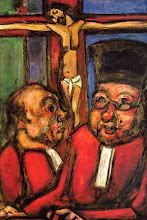
Angilbert (fl. ca. 840/50), On the Battle Which was Fought at Fontenoy

The Law of Christians is broken,
Blood by the hands of hell profusely shed like rain,
And the throat of Cerberus bellows songs of joy.

Angelbertus, Versus de Bella que fuit acta Fontaneto

Fracta est lex christianorum
Sanguinis proluvio, unde manus inferorum,
gaudet gula Cerberi.
Showing posts with label Pre-Moral Goods. Show all posts

Sunday, August 26, 2012

The Stoics and Virtue: The Adiaphora

ALTHOUGH THE STOIC PHILOSOPHERS took their inspiration from Socrates, sidestepping the developments of Plato and Aristotle, their contribution to virtue theory was the addition of the notion of logos or reason underlying the entire virtue inquiry.  However, the Stoic thinkers did not disdain Plato or Aristotle in their entirety.

For example, the Stoic thinkers accepted the four-fold division of Plato, and thought it convenient to divide virtue into the four cardinal virtues that Plato had identified: fortitude, temperance, prudence, and justice.  They also followed the notion that these virtues were related to each other and mutually supported each other.  The Stoics found that the inter-relatedness of the virtues also applied to their corresponding vices.

The Stoics, however, rejected the Aristotelian moderation of virtue/vice distinction.  Whereas Aristotle saw vice and virtue as two extremes to a continuum, with most of mankind in between the two extremes, the Stoics saw virtue and vice as all-or-nothing qualities.  One either was virtuous in toto or not, and if not, one was vicious.  This led to a sort of moral rigorism for which the Stoics were famous.  As Diogenes Laertius put it in his work on the life of the philosophers (Vitae, 7.127), "'while the Peripatetics [Aristotelians] say that progress lies between virtue and vice,' the Stoics'believed there is nothing between virtue and vice.'"  Houser, 19 (quoting Laertius).

Cicero--himself a disciple of the Stoic moral school--described this Stoic position in his De finibus (3.14.48) thus:

For just as those who are submerged in the ocean cannot breath, whether they are so close to the surface that they are just about to emerge or they are down deep . . . so too whoever is making a little progress toward the habit of virtue is no less in misery than one who has progressed not at all.

(quoted in Houser, 19)

The Stoic Chrysippus

Another contribution of the Stoic school is that they did not adopt Plato's "philosopher king" (philosophos basileus) or Aristotle's "great-souled" man (spoudaios) as the exemplar of the virtuous soul.  These notions were too tied to the political life of the polis or were too practical in perspective.  Rather, consistent with their Socratic emphasis and their notion of the logos as the underlying standard, the Stoics looked toward the wise man or sage (sophos) as the paradigm of the virtuous human.
By putting a cosmic and cosmopolitan twist on Socrates' search for universal definitions, the Stoics thought [the sage's] single-minded devotion to the logos allowed [the sage] to submit with equanimity to death, seemingly the worse of evils . . . . The Stoic sages was conceived as a paragon of moral virtue.
Houser, 19.

It should be noted that the Stoic sage's equanimity before death in his devotion to the logos was a quality that was quite compatible with the martyr's devotion to the Logos made flesh, Jesus the Lord, which led him to spurn death and witness to the truth.  The heroism of the sage and the heroism of the martyrs were thus analogous.

The Stoics recognized that virtue was not only something that made a man extrinsically excellent (in his relations ad extra), but that virtue was something that pertained to the inner life and so made a man excellent in his interior life (ad intra).  Indeed, it was the inner aspect of virtue which was emphasized.  Thus virtue's intrinsic goodness is not necessarily measured by results, but rather by what is right and good.  The Stoics therefore came to see virtue as its own reward, irrespective of consequences or happiness.  The Stoic philosopher Zeno, for example, "concluded that virtues are not one among many things that are intrinsically good, they are the only things that are good intrinsically (agathon, kalon; honestum); and likewise th only thing intrinsically bad is vice (kakia; vitium)."  Houser, 20.

Diogenes Laertius (Vitae, 7.102-3) summarized the Stoics' view thus:

The virtues--prudence, justice, courage, temperance, and the others--are good (agatha); and their opposites--imprudence, injustice, and the others--are bad (kaka); neither good nor bad are those things which neither benefit nor harm, such as life, health, pleasure, beauty, strength, wealth, good, reputation, noble birth, and their opposites death, disease, pain, ugliness, weakness, poverty, bad reputation, low birth, and such things . . . . For these things are not good, but things indifferent (adiaphora) in the category of preferred things (proegmena).  For just as heating, not cooling, is a property of the hot, so benefiting, not harming, is a property of the good; but wealth and health do not benefit any more than they harm; therefore, neither wealth nor health is a good.

(quoted in Houser, 20).  The Stoics therefore saw a great many goods as pre-moral goods to which a sage ought to be indifferent; whereas Plato and especially Aristotle tended to see man and his good (happiness) as more a blend of extrinsic and intrinsic qualities.  The Stoic man could be "happy" lacking all things but virtue.  The Aristotelian man could not be "happy" even if virtuous, if he was lacking health and a certain level of wealth.

As we shall see in the next posting, this scheme of the Stoics--which labeled a whole host of things seen as intrinsically good in the Platonic-Aristotelian analysis as morally indifferent.  In order to explain which humans gravitated to such supposedly indifferent goods and avoided such supposedly indifferent evils, the Stoics had to develop some explanation.  They therefore developed a sort of dualistic moral theory that distinguished between animal impulse and desire tied to man's animal nature and the higher reason-based nature of rational man.

Saturday, March 19, 2011

Natural Law's Modern Cousin Germain: To Know is Good

THE TERM "BASIC VALUE" IS A FUNDAMENTAL term in the Finnisian construct of natural law. For Finnis, basic values are: (i) self-evident and unquestionable without lapsing into unreason; (ii) pre-moral; and (iii) the basis of all moral judgments. In his book Natural Law and Natural Rights, Finnis begins his sally into this concept by choosing one such basic value--knowledge--from the larger set of basic values he identifies later on in his work: life, knowledge, play, aesthetic experience, sociability (friendship), practical reasonableness, and "religion" (scare quotes are Finnis's).

The "knowledge" that Finnis has in mind as basic good is speculative knowledge, that is "knowledge as sought for its own sake from knowledge as sought only instrumentally," knowledge that "is of truth," and not because it is useful. NLNR, 59. It is that thirst for knowledge that arises "out of curiosity, the pure desire to know, to find out the truth about [something] simply out of an interest in or concern for truth and a desire to avoid ignorance or error as such." NLNR, 60. It is, in fact, the knowledge that is spurred by what Aristotle identifies as wonder, θαυμάζω (thaumazō).*

Knowledge is the satisfaction of the "inclination or felt want that we have when, just for the sake of knowing, we want to find out about something." NLNR, 60. Knowledge justifies its own self, as it is not an instrumental good. It is simply good to gain knowledge. Good simpliciter. It is simply bad not to have it and remain in ignorance of the truth. While some knowledge may be more worth knowing than other knowledge (whether the philosophy of natural law is true is more important that the sexual habits of a snail darter), and while some value knowledge differently than others (the PhD will view things differently from the man waiting for food in the soup kitchen line), and while the pursuit of knowledge may sometimes have to be put off (man does not live by knowledge alone), and while it cannot be "pursued by everybody, at all times, in all circumstances," and while it is not "the only general form of good, or [even] the supreme form of good," it remains undeniably true:

[T]o say that knowledge is a value** is simply to say that reference to the pursuit of knowledge makes intelligible (though not necessarily reasonable-all-things-considered) any particular instance of the human activity [of seeking knowledge] and commitment involved in such pursuit.

NLNR, 62. Ultimately, we can say that "knowledge" is a basic value or good, which is the same thing as saying it is an aspect of human flourishing, because the opposite is insupportable rationally. Who can intelligibly support the general statement that knowledge is evil?*** Who can say we are better off, generally speaking, being ignorant? It is a basic good because it satisfies itself; it pulls itself up by its own bootstraps, as it were. "To avoid it [the self-evident nature of the proposition that knowledge is good and that knowledge ought to be pursued], I have to be arbitrary." NLNR, 72. By definition, being arbitrary is being unreasonable. When we justify a particular act (say reading a biography on Cardinal Newman, or going to college and taking a course on African Studies, or googling the term "synapses") by saying that we want simply to know, the statement is intelligible and final. Generally, nobody can answer, at least not unless other circumstances warrant, "That's unreasonable!" The self-evident good of knowledge is a final answer, a legitimate end, a stopping point, a one-need-not-go-any-further to the question why are you doing the act? Knowledge is therefore a bonum honestum as distinguished from a bonum utile or a bonum delectabile, a for-its-own-sake good, as distinguished from a merely useful good or merely pleasurable one.

Is it not the case that knowledge is really a good, an aspect of authentic human flourishing, and that the principle which expresses its value formulates a real (intelligent) reason for action? It seems clear that such is indeed the case, and there are not sufficient reasons for doubting it to be so. The good of basic knowledge is self-evident, obvious. It cannot be demonstrated, but equally it needs no demonstration.

Finnis, 64-65. One must not confuse the question of whether knowledge is a basic good with different questions, such as what are the physical, biological, or psychological aspects (the causes, pre-conditions, and/or concomitants) of that question. Whether knowledge is a basic good or value is not determined by whether the quest for knowledge is spurred by some psychological need, or stymied by some physical handicap, or part of some biological protective mechanism. Even more so, one ought to confuse the question of whether knowledge is a basic good with the question of whether one has any feelings of certitude with respect to that proposition. These are different questions. "The soundness of an answer to a particular question is never established or disconfirmed by the answer to [an] entirely different question."† NLNR, 65.


To say knowledge is not a good
is like saying this is not a picture of a pipe

The basic value or good of knowledge is not founded on "fact," but on self-evidency, which is not to say that it does not have its "factual" components and support. (That something may be self-evident does not mean that it has no factual reality. By being self-evident it does not become a non-fact and anti-fact.) But the value or good of knowledge ought not to be predicated upon such facts, for that would be a lapse into "is" which does not support an "ought."†† So even such observations of fact that "all men desire to know" or that "the human is wired to know" or that man has a "psychological need to know" or "the most exemplary men desired to know" are not the bases for the basic value of knowledge, though they may be a reflection of it as a basic value. Such facts are evidentiary of the basic value, but are not the source of its foundation.

Since knowledge is a basic value or basic good, it follows that it can be the basis for a practical principle: since knowledge is a basic good, knowledge is something good to have, and that good ought to be pursued and ignorance avoided. There is therefore a translation of the self-evident principle "knowledge is a basic good" to the self-evident principle "knowledge, as a basic good, ought to be pursued." Basic practical principles are not rules, but rather provide a form of orientation to one's practical reasoning which can be "instantiated (rather than applied [as rules]) in indefinitely man, more specific, practical principles and premisses."††† NLNR, 63.

"The principle that truth is worth knowing and that ignorance is to be avoided is not itself a moral principle." It is a pre-moral principle, one that is foundational to the making of moral judgments.

In closing his chapter on knowledge as a basic good, Finnis shows how knowledge is unique relative to the other basic goods in that one can show that denying its self-evidency is self-defeating. Any argument that knowledge is not self-evidently good is bound to fail, is self-contradictory, and ends in an intellectual cul-de-sac, a sack's end.

In addressing this issue, Finnis identifies three kinds of propositions: (1) intrinsically self-defeating propositions; (2) pragmatic self-defeating propositions; and (3) operationally self-refuting propositions.

Intrinsically self-defeating propositions are internally inconsistent because they contain their own contradiction. The examples given by Finnis are: "I know that I know nothing." "It can be proved that nothing can be proved." "All propositions are false." These are like saying A = not A.


Pragmatically self-defeating statement

Those propositions that are pragmatically self-defeating which are defeated by the circumstances in which they are stated. Finnis gives the example of a person singing "I am not singing" as such a proposition. The statement could be true if, for example, it is said or if it is written. He also calls it a "performative inconsistency," which he defines as an "inconsistency between what is asserted by a statement of facts that are given in and by the making of the statement." An example of this may be René Magritte's La trahison des images (The Treason of Images), with its famous depiction of a pipe with the statement "Ceci n'est pas une pipe" ("This is not a pipe"). Or perhaps even more accurately, the statement "Nothing is written in stone" inscribed on stone.

The final group of propositions, operationally self-defeating propositions, are not logically incoherent, but are "inevitably falsified by an assertion of them." NLNR, 74. They are a form of performative inconsistent statements (see above) but but are inconsistent with the fact arising from their very assertion (and not from a fact extrinsic to them). Examples of these are: "I do not exist," which is immediately falsified in its mere assertion. As another example, Finnis gives the proposition: "No one can put words (or other symbols) together to form a sentence."
Operationally self-refuting propositions have a quite definite reference and so can be (and inevitably are) false. They have a type of performative inconsistency; that is, they are inconsistent with the facts that are given in and by any assertion of them. An operationally self-refuting proposition cannot be coherently asserted, for it contradicts either the proposition that someone is asserting it or some proposition entialed by the proposition taht someone is asserting it.
NLNR, 74.

To state that knowledge is not a good is operationally self-defeating. If one asserts "knowledge is not good," then presumably one believes that the knowledge that "knowledge is not good" is good to know. So how can knowledge be both not good to know and yet good to know? Thus the skeptic to the proposition "knowledge is good" finds himself in an operationally self-defeating situation. Unless one relishes in living a life of absurdity, which itself is unreasonable, self-defeating positions ought to be abandoned.

In summary, Finnis states that the proposition that knowledge is a basic good and ought to be pursued is self-evident. Its contrary, that knowledge is not a basic good and ought not to be pursued is operationally self-defeating. The self-evident nature of the proposition that knowledge is good and ought to be pursued, then, has the tags or indicia of objective truth. It is pre-moral in the sense that it is a "given" that exists before the moral decision which must use practical reason to make moral decisions regarding the entire ensemble of basic goods, including, but not limited to knowledge.

______________________________
*Aristotle, Metaphysics, 982a.
**Finnis uses the term "good" in both a particular sense (as a reference to "some particular objective or goal" a "particular object of a particular person's desire,choice, or action") as wells as in its broad general sense (good in general). He reserves the term "value" as the "general form of good that can be participated in or realized in indefinitely many ways on indefinitely many occasions." NLNR, 61. He admittedly strays from St. Thomas: "Aquinas's exposition of his ethics particularly suffers for want of a term reserved for signifying [value as a general form of good, the aspect or description under which particular objects are (or are regarded as) good]." Why the word "value" is needed and good is not sufficient is not really explained.

***Knowledge is not an absolute good without regard to circumstances. It may be inappropriately pursued as, for example, when it contradicts charity or a more important or immediate duty. Thus, a husband who studies his philosophy while his wife is choking on a piece of meat next to him is pursing the good of knowledge in an improper way. There are other forms of knowledge that may not be properly pursued, and thus give rise to the vice of curiositas, NLNR, 76, which is a corruption of knowledge or false knowledge. There is knowledge that may be called Promethean or Faustian or Sadian: the best means of torturing one's captive, for example, or knowledge regarding perverse sexual techniques. Was the Marquis de Sade's knowledge good? See generally Roger Shattuck's Forbidden Knowledge: From Prometheus to Pornography (New York: St. Martin's Press, 1996).
†This principle becomes particularly important with respect to the basic good of life. Whether life is a basic good is an entirely different question than the biological, psychological, and/or physical pre-conditions or concomitants of that question. "Value" is something different from St. Thomas's bonum commune, bonum generale, bonum universale, or even just plain bonum.
I ask myself the question: does self-evidency take us out of the land of "is" into the land of "ought"? Cannot self-evidency relate to descriptive matters (something cannot both be and not be at the same time and same way seems to be a reality that is descriptive, not prescriptive. "Knowledge is a basic good," seems likewise to be a descriptive, not prescriptive statement. There are, true, some self-evident statements that are "oughts," for example, "good ought to be pursued, and evil avoided." But "knowledge is good" is not such a statement. What Finnis does is to reformulate the self-evident proposition "knowledge is a basic good or value" into another self-evident proposition that "knowledge is a basic good or value that ought to be pursued." The latter formulation is an "ought." (Another way of saying this is that Finnis changes a speculative principle into a practical principle.) Yet what is the difference between translating self-evident descriptive propositions to self-evident prescriptive propositions and a classical natural law proponent translating descriptive propositions (e.g., the sexual organs' functions are ordered to procreation) to prescriptive propositions (the sexual organs ought to be used in conformity with that order)? How does Finnis move from a pre-moral principle (knowledge is good) to a moral principle (knowledge ought to be pursued)? Why is Finnis allowed the translation from is to ought but not the traditionalist? Why is Finnis allowed to argue: "It is equally irrelevant for the sceptic [read Hume] to argue that values cannot be derived from facts. For my contention is that, while awareness of certain 'factual' possibilities is a necessary condition for the reasonable judgment that truth is a value, still that judgment itself is derived from no other judgment whatsoever." NLNR, 73.
†††The word "instantiate" is not a word in common use, but is an important concept. It is the particularization, one "instance," of a larger, general, abstract concept, idea, value, or transcendental such as being, good, beauty. Thus, Michelangelo's "Pietà" at the Basilica of St. Peter at the Vatican City may be said to be an artistic, sculptural instantiation of the maternal sorrow that Mary had for her son Jesus (cf. Luke 2:35), just as Luis de Morales's "Pietà" housed at the Real Academia de Bellas Artes de San Fernando, Madrid, Spain, is an artistic, painted instantiation of the same maternal lament and grief. Similarly, Mike's decision to study philosophy by picking up St. Thomas Aquinas's Summa Theologiae is an instantiation of the practical pursuit of the basic good or value of knowledge. Cindy's decision to study the difference between pinnately compound leaves and palmately compound leaves by picking up and perusing Loudon's An Encyclopedia of Plants is another (different and unique) instantiation of the same practical pursuit of the basic good or value of knowledge. Both Cindy's decision and Mike's decision participate in the same more general practical pursuit of the basic good or value of knowledge. They are therefore both "good" pursuits in their unique, particular ways. This decision to participate in a basic good Finnis calls "commitment." Commitment is "that sort of participation-in-a-value which is never finished and done with (except by abandonment of the commitment) and which takes shape in a potentially inexhaustible variety of particular projects and actions, each with its particularized first premiss of practical reasoning." So both Mike and Cindy are "committed" to the pursuit of the same basic good of knowledge. While they share in same premise: to pursue knowledge and eradicate ignorance is good, and so participate in, and are committed to, the same good, it is reflected in two particular ways--picking up the Summa and picking up Loudon's Encyclopedia--of a "potentially inexhaustible variety of particular projects and actions."