Angilbert (fl. ca. 840/50), On the Battle Which was Fought at Fontenoy

The Law of Christians is broken,
Blood by the hands of hell profusely shed like rain,
And the throat of Cerberus bellows songs of joy.

Angelbertus, Versus de Bella que fuit acta Fontaneto

Fracta est lex christianorum
Sanguinis proluvio, unde manus inferorum,
gaudet gula Cerberi.
Showing posts with label Golden Rule among Ancient Greeks. Show all posts

Sunday, April 25, 2010

Golden Rule Among the Ancient Greeks: Plato against Vergeltungsdenken

THE SOPHIST ISOCRATES IS FREQUENTLY GIVEN THE HONOR of having been the first Greek to promote the "Golden Rule" ethic with some clarity. We saw, however, that the rule as promoted by Isocrates was intertwined with the Greek principle of Vergeltdungsdenke, or "repayment thinking." Under this ethic, one was to do good to one's friends, and was to do evil to our enemies. It was also intertwined with and "us" versus "them" mentality, arising from the internecine warfare between the Greek city states, and, perhaps equally important, the outright prejudice against everything non-Greek, that is, anything barbarian. Thus the world was parted into two, one favored, and one disfavored. Such greater self-regarding, other-exclusionary ethic was inconsistent with the Golden Rule being a general ethical principle. One feels that Isocrates used the rule as a slogan, and not a principle.

With Socrates and Plato (it is hard to tell the two apart, since Socrates is, in the main, presented to us through Plato's dialogues), there appears to have been something different injected into the mix. This "something different" can be seen in three of Plato's dialogues: the Cirto, the Phaedo, and the Laws. (See Wattles, 32-36.)

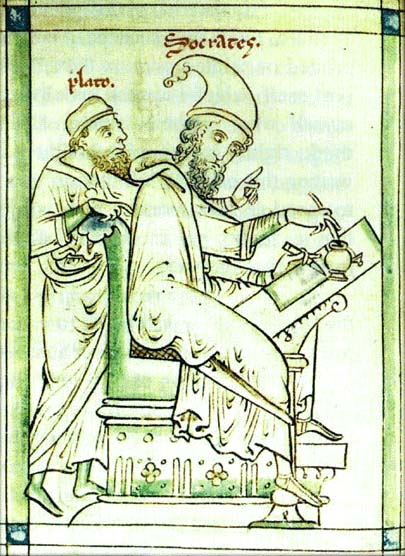
Plato and Socrates from Medieval Manuscript

In the Platonic dialogue Crito, the issue of justice and injustice is broached in a dialogue between Socrates and his friend Crito. Socrates has been condemned to death by his fellow Athenians, and Crito visits Socrates before the sentence has been carried out to persuade him to escape from prison, flee Athens to a safe harbor at Thessaly/ Thereby, Crito argues, he will spare him the embarrassment of not being able to save his friend. Moreover, Socrates will both spare himself from death, and preserve himself for his friends. But Socrates, who applied reasoning to the moral life, and advanced the notion that virtue (In Greek: aretē, or ἀρετή) was a form of knowledge, and thus it could be taught (Cf. Meno), applies reason to Crito's arguments and finds them wanting. The opinions of men ought not to be regarded in answering the question of right or wrong; it is only the opinions of good men, the wise that ought to be considered. The opinions of the vulgar, or the opinions of the unthinking crowd therefore ought to be safely bracketed from the decision of right or wrong. Socrates rejects the argument that, by fleeing against the laws and judgment of his fellow Athenians, he is acting in accordance with justice. In approaching this question, Socrates begins with a principle that rejects outright the Greek Vergeltdungsdenke, or "repayment thinking" ethic:
Socrates: Then we must do no wrong?

Crito: Certainly not.

Socrates: Nor when injured injure in return, as the many imagine; for we must injure no one at all?

Crito: Clearly not.

Socrates: Again, Crito, may we do evil?

Crito: Surely not, Socrates.

Socrates: And what of doing evil in return for evil (τί δέ; ἀντικακουργεῖν κακῶς πάσχοντα), which is the morality of the many (ὡς οἱ πολλοί φασιν)--is that just or not (δίκαιον ἢ οὐ δίκαιον)?

Crito: Not just.

Socrates: For doing evil to another is the same as injuring him?

Crito: Very true.

Socrates: Then we ought not to retaliate or render evil for evil to anyone, whatever evil we may have suffered from him. But I would have you consider, Crito, whether you really mean what you are saying.
Crito 49c. (Jowett, trans.) Then, in the remainder, Socrates applies this principle by personifying the Athenian law and asking whether the law itself (which represents the multitude of Athenians), though it has harmed him by condemning his to death, it had before that done him well, and it would be, in any event, harmed by his escape. He is not to do good to the law (obey it) when it favors him, and to harm the law (disobey it) when it disfavors him. The irony that Socrates rejects the morality of the vulgar, only to end up captive to the will of the vulgar, ought not to escape us. But Socrates's points "remains true, regardless of the controversy about the degree of irony present here." Wattles, 33.

The dialogue Phaedo presents Socrates in similar context. He is being visited by his friends in prison as the death sentence is imminently to be carried out. In this dialogue, the issue of immortality and the legitimacy of suicide looms large. What is particularly fascinating about this dialogue is that Socrates applies the Golden Rule in analyzing our relationship to God. Socrates applies what may be called an analogia moralis or analogia moralium, a moral analogy or analogy of morals in coming to the conclusion that suicide is wrong. Again, the Socratic irony (which always is nearby) is apparent: it is unjust to commit suicide, but it is nevertheless just to suffer the unjust sentence under law which requires forcible suicide by the drinking of hemlock.

The dialogue, in this case between Cebes and Socrates, accepts the existence of the gods and the afterlife. It assumes, further, that we have a duty to the gods, indeed God (in the singular) (τὸ θεοὺς εἶναι ἡμῶν τοὺς ἐπιμελουμένους, Phaedo, 62b); Wattles, 35. We are, as it were, chattels of the gods, Phaedo, 62b, and, just as if we would be upset if one of our possessions destroyed itself, so, likewise, would God be upset if we destroyed ourselves through suicide.
“Well then,” said he, “if one of your chattels should kill itself when you had not indicated that you wished it to die, would you be angry with it and punish it if you could?”

“Certainly,” he replied.
(Phaedo, 62c) (Fowler, trans.) In the dialogue, then, the Golden Rule, which can be applied in relationships which contain a relationship of subordination and not strict equality, is extended by analogy into the context of the relationship between man and God. How is it that we would want a subordinate to act towards us, were we in the position of the a superior or superordinate? The answer to that question may be analogized so as to answer what our duties to God ought to be. Under this concept, the Golden Rule is applicable in guiding our relationship to God. (While there is real insight here, one must remember that the Golden Rule is content neutral, or as Wattles calls it "free-floating," Wattles, 36-37, and so it can be easily corrupted, or improperly recruited, by not being properly founded upon a greater ethic or, worse, upon an erroneous ethic. Thus, for example, a follower of Satan, or one who entertains the erroneous concept of a violent, tyrannical Allah, would apply the Golden Rule with vicious results.)

Stained Glass Window showing The Good Samaritan by Marc Chagall


The "Golden Rule" thinking is also applied by Plato in the context of relationships between men of commerce, where there is equality of relationship, and in the assessment of good laws. Plato does this in his Laws, in addressing the laws that ought to govern property:
In the next place our business transactions one with another will require proper regulation. The following will serve for a comprehensive rule:—as far as possible, no one shall touch my goods nor move them in the slightest degree, if he has in no wise at all got my consent; and I must act in like manner regarding the goods of all other men, keeping prudent mind.
Laws, 913a (Bury, trans.) So does the Athenian say.

In his application of the Golden Rule thinking, Plato avoids the Vergeltdungsdenke of the masses, the hoi polloi, which infected the formulation of that rule, or at least its application, in Isocrates. Rejecting any Protagorean notion that man is the proper measure of things, Plato rests his application of the Golden Rule on a greater ethic. In Plato:
The person using the golden rule thinking, Socrates or the Athenian, is virtuous, loyal to the highest conceivable standard of goodness. The conditions that block the objection [that one ought not to make man the measure of things] are, first, that no free-floating golden rule is presented as a sufficient moral measure; and, second, that the wants of Socrates and the Athenian are hardly unregulated--they both strive for the divine measure. Such idealism would facilitate the insight necessary to apply the golden rule appropriately. Ennobled wants do not exceed what is fair.
Wattles, 36.

The Golden Rule by Norman Rockwell

Saturday, April 24, 2010

Golden Rule Among the Ancient Greeks: Isocrates Struggling against Vergeltungsdenken

AS WE NOTED IN OUR LAST POSTING, THE GREEKS WERE ENCUMBERED by a particularly strong social inheritance of Vergeltungsdenken, "repayment thinking." Their culture is not the only one that suffered from it; it is rather common corruption in the moral make up of man. Indeed, it was found alive and well in Palestine well after Socrates, Plato, and Aristotle engaged with it in battle in ancient Greece. Jesus himself mentions this common, popular norm of morality only to reject it: "You have heard that it hath been said, Thou shalt love thy neighbour, and hate thy enemy. But I say to you, Love your enemies: do good to them that hate you: and pray for them that persecute and calumniate you: That you may be the children of your Father who is in heaven, who maketh his sun to rise upon the good, and bad, and raineth upon the just and the unjust." Matt. 5:43-44.

But the Word of God made flesh did not walk about in ancient Athens or Sparta to combat their Vergeltungsdenken. But there did come a time where the Greeks, using reason, questioned their cultural and religious inheritances, and the values they presupposed. All things were subjected to the reasoning, the Socratic method of unremitting questioning (elenchus) by the Philosopher. The writings of the poets, in particular Homer, were considered quasi-scriptural. Positively, the Greeks had the system builders Socrates, Plato, and Aristotle who, though critical of convention, believed that reason, at least in a limited way, could come to grips with objective truth. Negatively, the Greeks had the relativistic attackers of conventional morality: the Cynics and their cousins, the Sophists. Though both Socrates, Plato, and Aristotle, in their way, and the Sophists, in their way, tried to overcome or at least challenge the popular Vergeltungsdenken, their influence was insufficient to fully reverse the moral inertia they faced. As Jeffrey Wattles summarizes Albrecht Dihle's view of it in Die Goldene Regel, despite some success at ameliorating the worst of this ethic, "the Greek golden rule remained captive to repayment thinking." Wattles, 197, n. 5.

The Sophists are painted poorly by Socrates and Plato. Their insights (for example their distinction between law as convention, nomos, and nature, physis) were poisoned by their relativist ethic founded on a skeptical view of the world. They distinguished between convention and nature, and so contributed to progress in the notion of the natural moral law, but their rejection of objective truth, and their dishonesty with words, is what makes even today the term "sophistry" full of negative connotations:
But all was false and hollow; though his tongue
Dropp’d manna, and could make the worse appear
The better reason, to perplex and dash
Maturest counsels.
So Milton, in his Paradise Lost (II.112). There is a certain irony, then, the Golden Rule was first ushered into the Greek intellectual scene by the Sophist Isocrates (436-335 B.C.). It was Isocrates "who, more than anyone else, was responsible for the burst of golden rule thinking that entered the fourth-century Greek culture." Wattles, 27.

Not particularly convincingly, Wattles suggests that there are glimmers of the Golden Rule in Calypso's promise to Odysseus in Homer's Odyssey [V.184-91[, in Thales's teachings as found in Diogenes Laertius [Lives, IX.1], and in the story of King Maendrius of Samos in Herodotus [III, c. 142]. But the first seems an individual promise, not a general principle of morality. The second appears to be an injunction against hypocrisy, and not a rule of behavior in the treatment of others. The last appears to be an expedient political principle, less moral than civil or political in nature.

Bust of Isocrates (Pushkin Museum)

The great sophist rhetorician and son of a flute maker, Isocrates (436-338 B.C.), appears, at least superficially, an exception. Isocrates enunciates the Golden Rule ethic implicitly in various of his works, including the Agineticus (Αιγινητικός), To Demonicus (Πρὸς Δημόνικον), and To Nicocles (Πρὸς Νικόκλεα). In one of his works in particular, his Nicocles or the Cyprians (Νικόκλης ἢ Κύπριοι), the formulation of the rule is particularly strong. But these should be understood within their context and in light of his master work, the Panegyricus published circa 380 B.C. Read as a whole, one has to agree with an early commentator and translator of Isocrates's works, J. H. Freese, made in reference to Isocrates's To Demonicus, but which is equally true of Isocrates's works as a whole.
[T]he standard of morality--at times not a very lofty one but curiously mixed-- adopted by the author, which may be assumed to have been at least on a level with the average standard of the age. Sagacious and worldly reflections worthy of Lord Chesterfield stand side by side with the precepts of an exalted morality
The Orations of Isocrates, J. H. Freese, trans. (London: Forge Bell & Sons, 1894), 2. In other words, Isocrates the Sophist may, from a moral standpoint, be too practical to be ideal.

Aegineticus: At the close of his argument to the jury in his Aegineticus Isocrates pleads the jurors before whom he argues, τῶν ἄλλων τῶν εἰρημένων τὰ δίκαια ψηφίσασθαι, καὶ τοιούτους μοι γενέσθαι δικαστάς, οἵων περ ἂν αὐτοὶ τυχεῖν ἀξιώσαιτε, "to give a just verdict, and prove yourselves to be for me such judges as you would want to have for yourselves." (George Norlin, trans.) Isocrates, Aegineticus, 51. Though limited to the external forum of a lawsuit, the plea sounds very like at least a shade of the principle behind the Golden Rule.

To Demonicus: This speech, which appears to be a moral exordium of sorts, is addressed to the Cyprian Demonicus, son of Hipponicus. Amidst, his hotchpotch of advice and moral maxims, Isocrates makes the following statement.
Conduct yourself toward your parents as you would have your children conduct themselves toward you.

τοιοῦτος γίγνου περὶ τοὺς γονεῖς, οἵους ἂν εὔξαιο περὶ σεαυτὸν γενέσθαι τοὺς σεαυτοῦ παῖδας.
To Demonicus, 14. (George Norlin, trans.)

To Nicocles:, This oration was given in honor of Nicocles, son of the King of Salamis Cyprus, Evagoras. It aims at giving advice to the prince who would be king regarding the duties of a monarch to his subjects. Here, Isocrates extends beyond the familial economy and the relationship between parent and child, to the larger forum of relationships between states.
Whatever advice you would give to your children, consent to follow it yourself.

μιμοῦ τὰς πράξεις. ἃ τοῖς αὑτοῦ παισὶν ἂν συμβουλεύσειας.

Deal with weaker states as you would expect stronger states to deal with you.

οὕτως ὁμίλει τῶν πόλεων πρὸς τὰς ἥττους, ὥσπερ ἂν τὰς κρείττους πρὸς ἑαυτὸν ἀξιώσειας.
To Nicocles, 38, 24. (George Norlin, trans.)

Perhaps the strongest phrasing of the Golden Rule is in Isocrates's Nicocles or the Cyprians. This is a speech aimed at the aristocracy of Cyprus, apparently following the accession of Nicocles to the thrown of that island. Its purpose is, in a sense, the opposite of the earlier speech, as it seeks to give advice to the subjects in their relationship to their king.
Do not do to others that which angers you when they do it to you. Practice nothing in your deeds for which you condemn others in your words.

ἃ πάσχοντες ὑφ᾽ ἑτέρων ὀργίζεσθε, ταῦτα τοὺς ἄλλους μὴ ποιεῖτε. περὶ ὧν ἂν ἐν τοῖς λόγοις κατηγορῆτε, μηδὲν τούτων ἐν τοῖς ἔργοις ἐπιτηδεύετε.
Nicocles or the Cyprians, 61. (George Norlin, trans.)

The Good Samaritan by Jean-Francois Millet


Wrested from their context, these maxims appear to advance noble thoughts, but Isocrates's moral advice also seems at time shallow and opportunistic. As a whole, as a moral teacher, Isocrates pales before the sages Confucius and the Buddha, and the religious leader Rabbi Hillel, and, a fortiori, the Man-God Jesus. One perceives the truth of Wattles's observation regarding the Golden Rule:
Since the golden rule does not specify a particular moral standard, it can consort with social conventions whose mediocrity will evident only to a later age or another culture.
Wattles, 27. The Golden Rule requires a companion or corollary foundation, either in virtue and rite (such as in Confucianism), or upon a sort of moral idealism, reason, or friendship (as in Plato or Aristotle and the Stoics), or upon Scripture (as in Hillel's formulation or in example, as in Christ). This quality of the Golden Rule also explains why the liberal philosopher John Rawls's (1921-2002) formulation of the Golden Rule (his "veil of ignorance" theory) can lead him blindly to believe that abortion falls within his version of the rule. Abortion, it may be observed, is a reassertion of the Vergeltungsdenken ethic. In this instance, the fetus is being viewed as an "enemy" which therefore allows harm to be done to it. The fetus is an "enemy" that threatens the convenience or whatever other good or apparent good the mother (or anyone else which is putting pressure on her to made the decision, including a culture that has invested too much in a sexual revolution and seeks to avoid the natural social costs of such lack of strictures on sexual behavior) seeks to advance.

Finally, let us turn to Isocrates's Panegyricus. This political speech to be given within the context of a great public festival (hence the name, Panegyreis = public festival) was designed to persuade the warring Greek city-states, at a time when Sparta and Athens and their allies were at odds, to unify against their common Persian enemy. During the course of his speech, Isocrates praises the great statesmen of Athens who, in the exercise of their power held back their hand against the weaker, and he praises that virtue in terms clearly redolent of a "Golden Rule" ethic:
[T]hey exulted less in the exercise of power than they gloried in living with self-control, thinking it their duty to feel toward the weaker as they expected the stronger to feel toward themselves.

οὐχ οὕτως ἐπὶ ταῖς δυναστείαις μέγα φρονοῦντες, ὡς ἐπὶ τῷ σωφρόνως ζῆν φιλοτιμούμενοι, τὴν αὐτὴν ἀξιοῦντες γνώμην ἔχειν πρὸς τοὺς ἥττους ἥνπερ τοὺς κρείττους πρὸς σφᾶς αὐτούς.
Panegyricus, 81 (George Norlin, trans.)

While Isocrates applies a "Golden Rule" type thinking to praise the Athenians in the exercise of their political power over the other Greek poleis, one must keep in mind the context of his speech. That very context suggests that the moral principle he advises is limited by his intense parochialism, albeit one that looks beyond the polis of Athens and the polis of Sparta, or any other Greek polis, and advocates a larger pan-Hellenism. "I am here," he says, "to advise you concerning war against the barbarians, and harmony among ourselves." Panegyricus, 3. In other words, his Golden Rule applies within Hellas, but not outside of it. In this sense, Isocrates's formulation of the Golden Rule is as limited as any Golden Rule may be within traditional or fundamentalist Islam, which distinguishes between the moral treatment of the Muslim, the "People of the Book" (the ′Ahl al-Kitāb أهل الكتاب‎), and those outside those two categories.

In summary, if one expects to find a "Golden Rule" in any real sense in Isocrates, one will be disappointed. At best, we have a "blending of the golden rule with the pursuit of personal or factional advantage." Wattles, 31. We should remember, further, in assessing Isocrates, that he is comrade to sophists Callicles and Thrasymachus, who (in Plato's dialogue Gorgias and the first book of his Republic) advanced the rule law of might over right, which is nothing but amoralism. One wonders if such an ethic, though remaining suppressed in his speeches on the grounds of rhetoric, may not have been present in the heart of hearts of Isocrates. For the Greeks, any real effort at overcoming the Vergeltungsdenken, "repayment thinking" must wait until Socrates, Plato, and Aristotle, and even there, such teaching is fraught with inconsistency.

The Golden Rule by Norman Rockwell
Friday, April 23, 2010

Golden Rule Among the Ancient Greeks: The Problem of Greek Vergeltungsdenken

THE GOLDEN RULE HAD INAUSPICIOUS BEGINNINGS AND A CHECKERED HISTORY in the land of Hellas. Though the contribution of the Greeks to the wisdom of the world ought never to be underestimated, in the area of the Golden Rule it was markedly backward, especially when compared to the sophistication and maturity of thought displayed in the Confucian regime we have just reviewed. The development of the Golden Rule as a universal, moral principle was hampered in Greece by a number of historical idiosyncrasies. Specifically, the Greeks suffered various historical, cultural or conventional impediments to a full flowering of this concept. First, war was frequent among the Greeks, both among themselves and with their traditional enemies, the Persians. And where there is war, morals will suffer; as Cicero said, and as it is unfortunately the case, laws are silent in the times of war, which is one very good reason why war should be a last resort. In his book on the Golden Rule, Professor Jeffrey Wattles calls this the "ethic of factionalism." Wattles, 27. Second, the Greeks were encumbered by what Albrecht Dihle called called Vergeltungsdenken, what Wattles translates as "repayment thinking" or "repayment ethic," Wattles, 27, 30, a cultural or conventional impediment to the seeding, and certainly the full flowering, of the Golden Rule. The Greeks also suffered from an "us/them" bias, which hampered their ability to universalize their principles of right and wrong. They divided their world between Greek and the barbarian, the βάρβαρος or those rude of tongue and manners, and questionable humanity. In his Politics, Aristotle, quoting it would appear Euripides's play, Iphigenia in Aulis, states the common view of those outside the Greek domain: "It is meet that Hellenes should rule over barbarians," and adds the justification: the poets thought that the barbarians and the slave were by nature one, and together inferior to the Greek.
διό φασιν οἱ ποιηταὶ
“βαρβάρων δ᾽ Ἕλληνας ἄρχειν εἰκός,”
ὡς ταὐτὸ φύσει βάρβαρον καὶ δοῦλον ὄν.
Arist., Pol., 1252b.

Hesiod and Muse from the Palais Bourbon

One cannot imagine, for example, an ordinary Greek helping a barbarian that had been attacked by thieves in the manner that the good Samaritan handled the Jew in the parable of the Good Samaritan (Luke 10:25-37). And to suggest to the Greek that morality required such behavior would have been viewed as madness by them. Associated with their view against the barbarian, was the institution of slavery. As Frederick Douglass observed following the great Socratic tradition, the institution of slavery corrupts the slaveholder, as much as, or perhaps more than, the slave. Without the light of the Gospel, even as great a Greek as Aristotle could not say with the son of farmers, Abraham Lincoln, "As I would not be a slave, so I would not be a master."


Good Samaritan by Rembrandt

Aristotle's reference to the poets is not ill-placed, as they were the repository and voice of Greek culture. In fact, a brief turn to them reveals what may have been the greatest impediment to the Golden Rule taking root in any real fashion among the Greeks. It is quite evident from a review of Greek literary corpus that the Greeks were imbued with a Vergeltungsdenken, a "repayment thinking," that ran very deep. It ran every bit as deep as the typical American's belief in free speech, or freedom of religion, or the right to do what he wants with his or her body, all conventional notions that are simply accepted by us as absolutes uncritically. Only few Americans will stop to think that there may be moral restrictions on speech, on belief, and on the use of one's body and faculties. Those few who see that there are moral restrictions on these supposed rights will not be able to convince the many of their error in absolutizing these civil rights. As some of these conventional American views can hamper Americans in recognizing the natural moral law as it may relate to, say, defamation or detraction, the obligation to believe only what is the true and not just that which we find convenient or agreeable, divorce and remarriage, contraception or homosexuality, so likewise were the Greeks hampered by their Vergeltungsdenken. The moral well of the Greeks was severely poisoned, as it were, by the view that the moral law did not forbid, but even required one to do harm to one's enemies. "Ancient Greece was awash with the practice of doing good to one's friends and harm to one's enemies--cardinal virtues of the age." Wattles, 29. Potential citations to this principle are legion, and we shall satisfy ourselves with a few:

In his Work and Days, the poet Hesiod states:
Call your friend to a feast; but leave your enemy alone.
. . .
Be friends with the friendly, and visit him who visits you.
Give to one who gives, but do not give to one who does not give.

τὸν φιλέοντ᾽ ἐπὶ δαῖτα καλεῖν, τὸν δ᾽ ἐχθρὸν ἐᾶσαι:
. . .
τὸν φιλέοντα φιλεῖν, καὶ τῷ προσιόντι προσεῖναι.
καὶ δόμεν, ὅς κεν δῷ, καὶ μὴ δόμεν, ὅς κεν μὴ δῷ.
ll. 342-43; 352-54 (tr. Hugh G. Evelyn White).

Archilochus (ca. 680 BC - 645 BC), perhaps the first Western poet to write lyric poetry, and whose works survive mainly in fragments, left us enough fragments to make it clear that he had pronounced views on the had the handling of friends and enemies:
I know how to love those who love me,
how to hate the enemy.

One important thing I know,
How to repay with terrible evils the one who mistreats me.

ἐπ]ίσταμαί τοι τὸν φιλ[έο]ν[τα] μὲν φ[ι]λεῖν[,
τὸ]ν δ᾽ ἐχθρὸν ἐχθαίρειν τε [κα]ὶ κακο[στομέειν
μύ]ρμηξ.

ἓν δ᾽ ἐπίσταμαι μέγα,
τὸν κακῶς <μ᾽ ἔ>ρδοντα δέννοισ᾽ ἀνταμείβεσθαι κακοῖς.
Arch., 23:14-15, 126 (West).

The famous poet Pindar, equally recites the commonly accepted principle in one of his Pythian Odes:
Let me befriend a friend,
but against an enemy, I shall, as his enemy, run him down as a wolf does, stalking now here, now there, on twisting paths.

φίλον εἴη φιλεῖν:
ποτὶ δ᾽ ἐχθρὸν ἅτ᾽ ἐχθρὸς ἐὼν λύκοιο δίκαν ὑποθεύσομαι,
ἄλλ᾽ ἄλλοτε πατέων ὁδοῖς σκολιαῖς.
Pindar, Pythian Odes 2.83-85 (tr. William H. Race).

The Greek playwrights are no less brutal than the poets--the vengeance ethic of the poets is simply writ in dialogue or in chorus. Thus Aeschylus in his Libation Bearers:
ELECTRA. And is it right for me to ask this of the gods?
CHORUS. How could it not be right to repay and enemy with ills?

Ἠλέκτρα: καὶ ταῦτά μοὐστὶν εὐσεβῆ θεῶν πάρα;
Χορός: πῶς δ᾽ οὐ τὸν ἐχθρὸν ἀνταμείβεσθαι κακοῖς?
Aeschylus, Libation Bearers, 122-123 (tr. Herbert Weir Smyth).

Sophocles in his noble play, Antigone, expresses the common notion in the voice of his character Creon:
It is for this that men pray:
to sire and raise in their homes children who are obedient,
that they may requite their father's enemy with evil
and honor his friend, just as their father does.

τούτου γὰρ οὕνεκ᾽ ἄνδρες εὔχονται γονὰς
κατηκόους φύσαντες ἐν δόμοις ἔχειν,
ὡς καὶ τὸν ἐχθρὸν ἀνταμύνωνται κακοῖς
καὶ τὸν φίλον τιμῶσιν ἐξ ἴσου πατρί.
Sophocles, Antigone 641-644 (tr. Sir Richard Jebb).

Indeed, no law, much less a "Golden Rule," stands in the way of harming one's enemy, if Euripides's account of it in his play Ion is to be considered in the voice of Creusa's tutor:
But whenever someone wants to do harm to enemies,
no law stands in the way.

ὅταν δὲ πολεμίους δρᾶσαι κακῶς
θέλῃ τις, οὐδεὶς ἐμποδὼν κεῖται νόμος.
Euripides, Ion 1046-1047 (tr. Robert Potter).

Not only is there no law against harming enemies, the principle may have been viewed as obligatory, or so it would seem in the Greek speechwriter Lysia's (ca. 445-380 BC) speech "For the Soldier":
I considered it ordained that one should harm one's enemies and serve one's friends.

ἡγούμενος τετάχθαι τοὺς μὲν ἐχθροὺς κακῶς ποιεῖν.
Lysias 9.20 (tr. W.R.M. Lamb).

In his great work Republic, Plato initiates the dialogue between Socrates and Simonides by the following definition of the art of justice or righteousness (δικαιοσύνη, dikaiosyne):
“ . . . tell me the art that renders what to whom would be denominated justice.”
“If we are to follow the previous examples, Socrates, it is that which renders benefits and harms to friends and enemies.”
“To do good to friends and evil to enemies, then, is justice in his meaning?”
“I think so.”

“εἶεν: ἡ οὖν δὴ τίσιν τί ἀποδιδοῦσα τέχνη δικαιοσύνη ἂν καλοῖτο.”
“εἰ μέν τι, ἔφη, δεῖ ἀκολουθεῖν, ὦ Σώκρατες, τοῖς ἔμπροσθεν εἰρημένοις, ἡ τοῖς φίλοις τε καὶ ἐχθροῖς ὠφελίας τε καὶ βλάβας ἀποδιδοῦσα.”
“τὸ τοὺς φίλους ἄρα εὖ ποιεῖν καὶ τοὺς ἐχθροὺς κακῶς δικαιοσύνην λέγει.”
“δοκεῖ μοι.”
Plato, Republic 1.7.332d (tr. Paul Shorey).

The notion of limiting the Golden Rule to friends, and not to enemies, necessarily meant that the Golden Rule would be used in a utilitarian fashion: that is, the rule is to be applied when it favors me, but not when it does not. This is expediency, the opposite of morality; or it is tribalism, a sophomoric morality. And so Jeffrey Wattles in his The Golden Rule concludes, despite the efforts of the philosophers:
The golden rule had a difficult birth in the West . . . No author used a golden rule maxim as a hub around which to gather great themes. None proposed the rule as the leading principle of morality.
It is within this conventional and cultural view of morality that the Greeks references to a Golden Rule sort of ethic must be understood. That will be the topic of our next blog entries. What we will see is that the principle of the Golden Rule was injected into the Greek mix by the Sophist Isocrates. But the real efforts at overcoming the Vergeltungsdenken to which the Greeks were captive were made by Socrates and Plato (and later Aristotle), who challenged and judged the propriety of that moral principle. Though it was not until centuries later that such a principle was generalized, distilled of its cultural stain, and adopted in a more-or-less rarefied form by the Stoics. Until the Stoic effort, the little there was of the Golden Rule thinking remained "within the technology of self interest," Wattles, 30, and, as a result, culturally stillborn.


The Golden Rule by Norman Rockwell