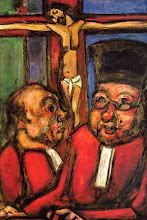
Angilbert (fl. ca. 840/50), On the Battle Which was Fought at Fontenoy

The Law of Christians is broken,
Blood by the hands of hell profusely shed like rain,
And the throat of Cerberus bellows songs of joy.

Angelbertus, Versus de Bella que fuit acta Fontaneto

Fracta est lex christianorum
Sanguinis proluvio, unde manus inferorum,
gaudet gula Cerberi.
Showing posts with label De legibus. Show all posts

Thursday, December 16, 2010

Natural Law in Cicero's De legibus, Part 6

IN BOOK TWO OF CICERO'S DE LEGIBUS, Atticus, Quintus, and Cicero move to an small island in the Fibrenus river about the size of a small palaestra, or sports arena. Before Cicero gets into the specifics of law, he recapitulates. Like a poet, who invokes the Muses, or, even he behind the Muses, invokes "from Jupiter the beginnings of song," so a jurist must invoke "Jupiter" as the source of law. The gods, then, are in charge of poetry and law. This is because law is, at its source, divine:

[L]aw was not brought up by human minds; that it is not some piece of legislation by popular assemblies; but it is something eternal which rules the entire universe through the wisdom of its commands and prohibitions. Therefore, they said, that first and final law is the mind of God who compels or forbids all things by reason. From that cause, the law which the gods have given to the human race has rightly been praised: it is the reason and mind of a wise being, suited to command and prohibition.

Legem neque hominum ingeniis excogitatam, nec scitum aliquod esse populorum, sed aeternum quiddam, quod universum mundum regeret imperandi prohibendique sapientia. Ita principem legem illam et ultimam mentem esse dicebant omnia ratione aut cogentis aut vetantis dei. Ex quo illa lex, quam di humano generi dederunt, recte est laudata: est enim ratio mensque sapientis ad iubendum et ad deterrendum idonea.

De leg., II.8. Law, then, unlike fire, was not stolen from the gods as if by some Promethean act of hubris. Law was a gift, part of the largess of the gods, part of what the gods intended for man. It is in fact something that men share with the gods. Men, to be sure, make their laws, as they did the Twelve Tables, the most basic foundation of Roman law. But there is a law more ancient, more noble, more fundamental than even the most sacred of all Roman laws.


Publius Horatius Cocles Defending the Sublicius Bridge: Following Natural Law

There is a law "coeval with the God who protects and steers the earth," aequalis illius caelum atque terras tuentis et regentis dei. De leg., II.9. This heavenly law is not written, but it has the force of law. It is this law that governed the courageous Horatius Cocles or that condemned Sextus Tarquinius's rape of Lucretia.
Reason existed, derived from nature, directing people to good conduct and way from crime; it did not begin to be a law only at the moment when it was written down, but when it came into being; and it came into being at the same time as the divine min. And therefore that true and original law, suitable for commands and prohibitions, is the right reason of Jupiter, the supreme god.

Erat enim ratio, profecta a rerum natura, et ad recte faciendum inpellens et a delicto avocans, quae non tum denique incipit lex esse quom scripta est, sed tum quom orta est. Orta autem est simul cum mente divina. Quam ob rem lex vera atque princeps, apta ad iubendum et ad vetandum, ratio est recta summi Iovis.
De leg., II.10. That law, which is divine in fons et origo, in its fount and origin, is also found in man, enfleshed as it were. It is found in semine, in seed, perhaps in all men. But it is found in full flower also in the mind of wise men, in mente sapientis.


Rape of Lucretia by Simon Vouet: Disobeying Natural Law

In fact the laws of men--the laws of human judges, human legislators, human princes--are not the preeminent example of law, but are law by participation, by "courtesy," by favor only: Quae sunt autem varie et ad tempus descriptae populis, favore magis quam re legum nomen tenent. ("The legislation that has been written down for nations in different ways and for particular occasions has the name of law more as a matter of courtesy than as a fact.") De leg., II.11. This is because the definition of law includes "choosing something just and right," in ipso nomine legis interpretando inesse vim et sententiam iusti et veri legendi. De leg., II.11. Therefore human laws are to have as their aim the common good, the safety of the state, the promotion of well-being and virtuous life of its citizens. Human laws are not laws at all if they are destructive or unjust to the people they intend to bind. Laws that damage and destroy are no more laws than rules among thieves. Quid quod multa perniciose, multa pestifere sciscuntur in populis, quae non magis legis nomen adtingunt, quam si latrones aliqua consensu suo sanxerint? Cicero asks rhetorically. De leg., II.12. They are no more to be called laws, than a wicked or ignorant doctor's poisons are to be called medicine. Cicero repeats:
Law, therefore, is the distinction between just and unjust things, produced in accordance with nature, the most ancient and first of all things, in accordance with which human laws are constructed which punish the wicked while defending and protecting the good.

Ergo est lex iustorum iniustorumque distinctio, ad illam antiquissimam et rerum omnium principem expressa naturam, ad quam leges hominum diriguntur, quae supplicio inprobos adficiunt, defendunt ac tuentur bonos.
De leg., II.13.

Given such a definition, neither laws of Titius and Appuleius nor the laws of Livius,* are to be considered laws at all. Human laws have to conform to the natural law, or they are not laws at all, and it matters not the motive of the legislator who trespasses the natural law.

From here, Cicero begins to particularize and enters into specific laws relating to Roman religious and civil life which will occupy the remainder of Book II and the greater part of Book III.

From this point, we shall politely beg leave from the dialogue of the Roman friends, and we shall leave the pleasant little island in the Fibrenus at a time shortly before the coming of Christ, to return to the 21st century to a time and a place where we eat of the evil fruit, an evil fruit that comes from having rejected the Ciceronian vision of natural law and its interaction with the positive law. We have traded the Ciceronian tradition for a positivism in law, a legal positivism which both Cicero and our Founding Fathers and everyone in between would have found a recipe for tyranny, arbitrary rule, and the inculcation of vice and injustice.

___________________________
*During their tribunates, Sextus Titius (ca. 99 B.C.) and his predecessor, Lucius Appuleius Saturninus (died ca. 100 B.C.), attempted to pass radical agrarian laws in the spirit of the Gracchi brothers which, in Cicero's view, apparently trespassed on property rights. Marcus Livius Drusus, tribune in 91 B.C., was of a similar radical reforming spirit.

Wednesday, December 15, 2010

Natural Law in Cicero's De legibus, Part 5

WE SAW THAT CICERO WAS CONVINCED that positive law is insufficient to govern man and that the inner discipline and sanction of the natural law is required. But Cicero reserves his greatest excoriation for those who are foolish enough to think that the positive law is the only source of right and wrong. If you would have argued that law is nothing other than convention to Cicero as, for example, John Austin or Jeremy Bentham or H. L. A. Hart may have argued, Cicero would have laughed in your face and indeed called you nothing short of stupid or mad, stultified and demented:


The Three Stooges of the Law per Cicero: Bentham, Austin, and Hart

The most stupid thing of all . . . is to consider all things just which have been ratified by a people's institutions or laws . . . . There is only one justice, which constitutes the bond among humans, and which was established by the one law, which is right reason in commands and prohibitions. . . . And if justice is obedience to the written laws and institutions of a people, and if (as these same people say) everything is to be measured by utility, then whoever thinks that it will be advantageous to him will neglect the laws and will break them if he can. The result is that there is no justice at all if it is not by nature, and the justice set up on the basis of utility is uprooted by that same utility: if nature will not confirm justice, all virtues will be eliminated. . . . To think that these things are a matter of opinion, not fixed in nature is the mark of a madman.

Iam vero illud stultissimum, existimare omnia iusta esse quae scita sint in populorum institutis aut legibus. . . . Est enim unum ius quo devincta est hominum societas et quod lex constituit una, quae lex est recta ratio imperandi atque prohibendi. . . . Quodsi iustitia est obtemperatio scriptis legibus institutisque populorum, et si, ut eidem dicunt, utilitate omnia metienda sunt, negleget leges easque perrumpet, si poterit, is qui sibi eam rem fructuosam putabit fore. Ita fit ut nulla sit omnino iustitia, si neque natura est et ea quae propter utilitatem constituitur utilitate alia conuellitur. Atqui si natura confirmatura ius non erit, virtutes omnes tollantur. . . . .Haec autem in opinione existimare, non in natura posita, dementis est.

De leg., I.42-43, 45. If all is convention, if all is determined by utility, then the law itself will be destroyed by convention or utility. There would be no grounds for liberality, for love of country, for piety, for any selfless acts or acts directed toward the common good. All these acts "arise because we are inclined to love other humans (propensi sumus ad diligendos homines), and that inclination, that diligence or love, is the foundation of justice (fundamentum iuris est)." De leg., I.43.

Justice arises from nature, and not from convention. Therefore, Cicero insists, the decisions of judges, the will of the majority, or the decree of the prince cannot define justice: a judge, a prince, the people cannot make it just to commit adultery, highway robbery, or forge wills. No, nature is above positive law. Indeed, nature is what serves as positive law's standard and judge: "But in fact we can divide good laws from bad laws by no other standard than that of nature." Atqui nos legem bonam a mala nulla alia nisi naturae norma diuidere possumus. De leg., I.44.

Man is no exception to the rule. Just like a horse or a tree is judged with reference to its nature, so man is judged with reference to his nature. We do not argue that a lame horse does not correspond to what a horse ought to be, or that a tree that has tree rot or blight is not living in accord with its nature. Nothing would suggest that man operates under a different rule. "For just as true and false, logical and illogical are judged in themselves and not be external considerations, so to a constant and consistent manner of life, which is virtue, and similarly inconstancy, which is vice, will be judged by their own nature." De leg., I.45. Man's character is judged in reference to virtue and vice, and virtue and vice, including justice and injustice, are judged in reference to nature. To suggest that man is not to be judged by nature, but by opinion, is, ultimately to propose that "men would be happy by opinion--and nothing dumber than that could possibly be said," Nam ni ita esset, beati quoque opinione essemus, quo quid dici potest stultius? De leg., I.46.

Justice, like all the virtues, "seeks no reward and no prize, and thus it is sought for itself," item iustitia nihil expetit praemii, nihil pretii. A man must not apprise justice by the profit in it, or whether it is in his interest, or if there be reward in it. If not cultivated for itself, then justice is not justice. "For that is the most unjust thing of all," id enim iniustissimum ipsum est, says Cicero, iustitiae mercedem quaerere, "to seek a reward for justice." De leg., I.49.

Cicero ends his first book of the De legibus by discussing the supreme good, the finis boni. It is, he admits, a matter of controversy among all the philosophers and their different schools. Cicero's brother Quintus is the one who summarizes the Ciceronian teaching and the Academic/Peripatetic (Platonic/Aristotelian) position and the Stoic position:

But certainly it is the case that it is the highest good either [according to the Platonic/Aristotelian schools] to live in accordance with nature, that is, to enjoy a moderate life equipped with virtue, or [according to the Stoics] to follow nature and live in accordance with what can be called its law, that is insofar as possible to do everything to accomplish the demands of nature, who wishes us to live in accordance with virtue as if it were a law.

De leg., I.56. The Socratic/Platonic/Aristotelian school stresses virtue, whereas the Stoic school stresses law. Which emphasis is left for another day among the three participants of the dialogue.

From the discussion of law in its most fundamental form, the parties now turn to how life ought to be lived, and here the focus is on the philosophical life. Wisdom ought to be loved, and the law ought to be learned, for the law is what corrects for vice and encourages virtue. For this, we need to know ourselves as the Delphi oracle declared. A man who searches inward will see in him the spark of divinity in him, a divinum ingeniumque in se, which sets him apart from the cosmos. He will recognize that it is a "great gift of the gods," tantoque munere deorum that he has this quality. This quality will be precious to him, and he will do all he can to develop it. He will also recognize it in those which share his nature. And the peroration of Cicero is long but magnificent, as he sings the praises of philosophy as tutor of all that is good in man:
And when he has studied the heaven, lands, seas, and the nature of all things, and has seen where they come from and where they are going and when and how they will perish, what in them is mortal and bound to die, what is divine and eternal; and when he has (so to speak) got a grip on the God who guides and rules these things (et regentem deum paene prenderit) and has recognized that he is not bound by human walls as the citizen of one particular spot but a citizen of the whole world as if it were a single city (sed civem totius mundi quasi unius urbis agnoverit)--then in this perception and understanding of nature, by the immortal gods, how he will know himself, as Pythian Apollo commands, how he will scorn an despise and think as nothing all those things which are commonly called magnificent! And he will fortify all these things as if by a fence through the method of argument, the knowledge of judging true and false, the science of understanding logical consequences and contradictions. And when he realizes that he is born for civil society, he will realize that he must use not just that refined type of argument but also a more expansive style of speaking, through which to guide peoples, to establish laws, to chastise the wicked and protect the good, to praise famous men and to issue instructions for safety and glory suited to persuading his fellow citizens, to exhort people to honor, to call them back from crime, to be able to comfort the afflicted, to enshrine in eternal memorials the deeds and opinions of brave and wise men together with the disgrace of the wicked. And all these great an numerous things which are recognized as present in man by those who wish to know themselves, the parent and teacher of them all is philosophy.
De leg., I.60-62.

In fact, later in his dialogue, in Book II, Cicero repeats this notion. It is the divine providence that is apparent in the cosmos, the reason by which all things--the course of the stars and planets, the seasons, the growth of plants and animals--are ordered that is the "proem to the law," legis prooemium, the prelude or precursor to human law.

What is more true than that no one ought to be so stupid and arrogant as to think that he has reason and a mind but not to believe the same of the heavens and the universe? Or to think that things which are barely understood by the greatest intelligence and reason are moved without reason? Anyone who is not compelled to be grateful by the order of the stars, the alternations of day and night, the balance of the seasons, the crops which grow for our enjoyment--why is it proper for someone like that to be counted human at all? And since all things endowed with reason are superior to those which lack reason, and since it is wrong to say that anything is superior to the natural universe, it must be admitted that the universe has reason. Who could deny that such opinions are useful when he understands how many things are secured by oaths, how conducive to safety are the religious guarantees of treaties, how many people have been kept from crime by the fear of punishment, how holy the bond of citizens one with another is, with the presence of the immortal gods as judges or as witnesses? This is the proem to the law, to use Plato's term.

De leg., II.16.*

__________________________________
*Plato, Laws 4:722d (νόμους δὲ ἄρτι μοι δοκοῦμεν λέγειν ἄρχεσθαι, τὰ δ᾽ ἔμπροσθεν ἦν πάντα ἡμῖν προοίμια νόμων.) "Yet it is only recently that we have begun, as it seems, to utter laws, and what went before was all simply preludes (prooimia) to laws."

Tuesday, December 14, 2010

Natural Law in Cicero's De legibus, Part 4

POSITIVE LAW ALONE IS TOO SLIM A CHORD with which to discipline man. The positive law needs the moral law as much as the moral law needs the positive law. It is true, the natural moral law has its own form of discipline and sanction, its own punishments, and does not need the positive law in that sense. Typically, it is not in human courts that such penalty for violation of the natural law is paid, since such courts "used not to exist anywhere and now do not exist in many places, and where they do, they are often corrupt." (non tam iudiciis—quae quondam nusquam erant, hodie multifariam nulla sunt, ubi sunt tamen, persaepe falsa sunt). De leg., I.40. The judgment and the sanction is elsewhere: it is by being "chased and hounded" by the Furies, but not the Furies of legend; rather, these Furies are the "pains of conscience and the tortures of deceit," angore conscientiae fraudisque cruciatu. De leg., I.40.

The tradition of being chased or hounded by conscience is old, as old perhaps as man. It raises its head early in the Book of Genesis. It is a recurrent them of literature, both ancient and modern, and it is an experience most of us have felt at one time or another. Edgar Allen Poe's unnamed narrator in his short story "The Tell Tale Heart" or Dostoevsky's character Raskolnikov in Crime and Punishment are, of course, two classic applications of the principle in regard to the crime of murder in Western literature. It survives in Denis Diderot, who, in his "Entretien d'un pere avec ses enfants; ou, du danger de se mettre au-dessus des lois" ("Conversation of a Father with His Children; or, the Danger of Setting Oneself above the Law") relates this conversation between a hatter whose sick wife has died after he cared for her for eighteen years and is left penniless, and who, against the positive law, intends to keep his dead wife's dowry and run off to Geneva where the French writs don't run, instead of returning it to her relatives. Diderot suggests that the money ought to be returned in accordance to law:
The hatter replied brusquely:
"No, Monsieur, I shall go away, I shall go to Geneva."
"And you expect to leave your remorse behind?"
"I don't know; but I shall go to Geneva."
"Go wherever you choose, conscience will infallibly follow you."

Le chapelier répliqua brusquement:
“ Non, monsieur, je m'en irai à Genève.
“ - Et tu crois que tu laisseras le remords ici?
“ - Je ne sais, mais j'irai à Genève.
“ - Va où tu voudras, tu y trouveras ta conscience.”*
Did the hatter avoid his conscience? The main characters in Poe's "The Tell Tale Heart" and Dostoevsky's Crime and Punishment do not. If the hatter did, did he also lose his humanity?

The positive law alone cannot curb the wicked or even the wicked in the good: even the first-time criminal will deny the crime, invent an excuse, avoid being caught, evade its jurisdiction. The positive law is too superficial a method to excise or discipline and sanction the criminal heart from the wicked.

What will a person do in the dark if he is afraid only of witnesses and judges?
What will he do in some deserted place if he encounters someone from whom he can steal a lot of gold, someone weak and alone?

Nam quid faciet is homo in tenebris qui nihil timet nisi testem et iudicem?
Quid in deserto quo loco nactus, quem multo auro spoliare possit, imbecillum atque solum?

De leg.,I.41. The Ciceronian theme is classic, and it is put forward in myriad ways and settings: in Plato's ring of Gyges which made its wearer invisible at will (Republic, 2.359a–2.360d) in the murder of the Mandarin by will in Honoré de Balzac's Le Père Goriot, in H. G. Wells's Invisible Man, in J. R. R. Tolkien's Ring of Gollum. How many, without the buttress of moral education and habit, without the pressures of social mores, without the promptings of conscience have the fortitude to be moral if there were absolutely no sanction attached to being immoral?

Only the just man has any chance at all. The man who has not learned to be naturally just, but who seeks his own self-interest, and does not think of others' interests, and is disciplined only by the positive law law, will have no inner law to stop him if he thinks he can get away with it and others will not hear of it. He will use the Ring of Gyges to commit adultery with his neighbor's wife. He will kill the Mandarin to get his riches. He will use his invisibility to spread a Reign of Terror. He will use the golden ring to assume absolute power. Without the natural law, the conscience, and their outward bulwark, their city wall, as it were--virtue--there is no way to stop the three-fold libido: the libido sciendi, the libido sentiendi ,and the libido dominandi.

___________________________
*Denis Diderot, "Entretien d'un pere avec ses enfants; ou, du danger de se mettre au-dessus des lois," translated by P N. Furbank, sub titulo "Conversation of a Father with His Children; or, the Danger of Setting Oneself above the Law," This Is Not a Story and Other Stories (Columbia: University of Missouri Press, 1991).

Monday, December 13, 2010

Natural Law in Cicero's De legibus, Part 3

CICERO ADDRESSES THE PERMANENT ARGUMENT against the existence of the natural law. It seems to follow the natural law as if it were its shadow, or its ape. If the natural law is so natural, then why do not all cultures and peoples follow it?


But the variety of opinions and the discord of humans disturb us; and because we do not have the same problems with our senses, we consider them to be certain by nature, but we say that because moral qualities seem different to different people and not even the same person always sees them the same way, they must be false.

De leg., I.47.

Senses, however, inform the mind in a manner that cannot be easily corrupted. On the other hand, reason and its ability to comprehend or grasp the natural law can. It is "distorted habits," "false opinions," "weak minds," "mental errors," our proneness to be "ensnared by pleasure" or "enticed to bad conduct" by a seeming good that do so. De leg.,I.31-32.
All sorts of traps are directed against our minds, either by those whom I just listed [a parent, a nurse, a teacher, a poet, or the stage], who take them when they are tender and inexperienced and corrupt and bend them as they wish, or by that which lurks entwined deep in all our senses, namely pleasure, which imitates the good but is the mother of all evils. Those who are corrupted by her blandishments do not perceive sufficiently well what things are good by nature, because these things lack the sweet itch of pleasure.
De leg., I.47.


Cicero

Cast these aberrations aside which can easily be explained, and it is apparent that men share in a nature. Without these impediments, "no one would be so like himself as all people would be like all others," sui nemo ipse tam similis esset quam omnes sunt omnium. De leg., I.29. One can define a human in a manner that encompasses all men, which itself proves that the dissimilarities are accidental, not substantive. That one distinguishing feature is reason, ratio, "the one thing by which we stand above the beasts," ratio, qua una praestamus belvis. De leg.,I.30. There are, in addition, other similarities: all men learn through their senses, abstract reality that way, and form concepts or ideas which are identical, albeit expressed in different languages. Even in their perversity, men show likeness. But if in perversity they show likeness, so also in their notions of the good:


What nation is there that does not cherish affability, generosity, a grateful mind and one that remembers good deeds? What nation does not scorn and hate people who are proud, or evildoers, or cruel, or ungrateful?

Quae autem natio non comitatem, non benignitatem, non gratum animum et beneficii memorem diligit? Quae superbos, quae maleficos, quae crudeles, quae ingratos non aspernatur, non odit?

De leg., I.32. "There is no person of any nation who cannot reach virtue with the aid of a guide." Nec est quisquam gentis ullius, qui ducem naturam nactus ad uirtutem peruenire non possit. De leg., I.30.

That guide is justice, "the sparks given by nature," tamquam igniculi . . . natura dati. "And I want it to be understood in this whole discussion that the justice of which I speak is natural." Atque hoc [ius] in omni hac disputatione sic intellegi volo, quom dicam naturam esse. De leg.,I.33.
But if human judgment corresponded to what is true by nature and men though nothing human alien to them (to use the poet's [Terence] phrase), then justice would be cultivated by all.

Quodsi, quo modo suntt natura, sic iudicio homines 'humani, ut ait poeta, nihil a se alienum putarent', coleretur ius aeque ab omnibus.
De leg.,I.33. The chain between nature and justice cannot be gainsaid: from nature to reason; from reason to right reason; from right reason to law; from law to justice. This chain exists in every man and in all men. Justice is therefore based upon nature.

The fact that justice is natural means that it binds all men, and all men equally. Accordingly, the virtuous man in any society will be just, and he will offer justice to his fellow, so that "he loves himself no more than the other," non in illo sese plus quam alterum diligat. De leg., I.34. Friendship and benevolence is the more natural state than hatred and selfishness. The "selfish gene" of Richard Dawkins is a corruption; by nature, man, by nature reasonable, is made to be just according to Cicero.

These are the foundational principles of all law. Cicero sits on the shoulders of giants before him,* and he gratefully recognizes his dependence upon them. He is in good company, and seeks to conserve or to preserve the patrimony of natural justice. But he excoriates and lambastes those who--like the Epicureans with their utilitarian calculus or those of the new Academy where skepticism and relativism reins supreme--teach and live in a manner that vitiates the natural law:


Those, however, who indulge themselves and are enslaved to their bodies, who judge everything that is to be sought or avoided in life by pleasures and pains--even if what they say is true (and there is no need for arguments about it here), we tell them to talk in their gardens, and we ask them to stand away for a little while from all bonds of civic society, of which they know nothing and have never wanted to know anything. . . .

De leg., I.39.

(continued)

______________________________________
*"All these people, whether they have stayed in the Old Academy with Speusippus, Xenocrates, and Polemo, or have followed Aristotle and Theophrastus, who agree with them in substance but use a slightly different type of argument, or those who, like Zeno, have changed the terminology without changing the substance, or even have followed the difficult and demanding system of Aristo, . . . all these people agree with what I have said." De leg., I.38.

Sunday, December 12, 2010

Natural Law in Cicero's De legibus, Part 2

CICERO FINDS THE ULTIMATE SOURCE OF LAW in a divine, not human, source. It is for this reason that law, in its most fundamental sense, is immutable. Cicero builds his philosophical view on a premise of a divine kinship between man and God, and in a divine providence. He asks his friend Atticus, who is apparently a follower of Epicurus, to grant him the assumption that "all nature is ruled by the force or nature or reason or power or mind or will (nutu, ratione, potestate, mente, numine)--or whatever other word there is that will indicate more plainly what I mean--of the immortal gods." De leg.I.21. An assumption his friend willingly complies giving him. There is, then, a supposition by Cicero of some sort of order, specifically a sort of providential and relational order, one that comes from outside of the natural order itself but in which we participate, that Cicero gets his friend to concede. This Ciceronian assumption is, of course, contrary to the teachings of Epicurus, who insisted that the gods are unconcerned with the goings on of men.

Not only is there communication between the world of divinity and the world of humanity and the cosmos as a whole. For Cicero, between the world of men and the world of the divine there is a communion, a link of likeness. For Cicero, the link between the gods and men is their joint sharing of reason.

And, therefore, since nothing is better than reason, and it is found both in humans and in God, reason forms the first bond between human and God. And those who share reason also share right reason; and since that is law, we humans must be considered to be closely allied to gods by law. Furthermore, those who share law also share the procedures of justice . . . .

Est igitur, quoniam nihil est ratione melius, eaque est et in homine et in deo, prima homini cum deo rationis societas. Inter quos autem ratio, inter eosdem etiam recta ratio et communis est: quae cum sit lex, lege quoque consociati homines cum dis putandi sumus. Inter quos porro est communio legis, inter eos communio iuris est.

De leg.,I.23. Between God and man, there is a communion of reason, of virtue, of law, and of justice. We are, in fact, within a single city or state, in political--nay, familial association as it were, with the divine order. It is a marvelous fact that of all nature, "men should be part of the family and race of gods," homines deorum agnatione et gente teneantur. De leg.,I.23. This part of man which he shares with the divine realm is found in his soul. He shares his material nature with the world at large, and his physical nature in particular does he share with perishable, mutable world of the brute animals. But man's soul is spiritual. By a divine gift, a munus divinum, man participates in the divine in an excellent way, having a kinship of sorts with the incorruptible, immortal realm of the immortal gods. Man is "sown throughout the earth," sparsum in terras, as so many seeds. De Leg., I.24.


William Blake's Ancient of Days

According to Estrada,* this notion of Cicero is a blending of the Stoic notion of the logos spermatikos, the divine seed, and the notion of creation in Plato's Timaeus (41c):
Not disregarding the intense doctrinal and linguistic resonances of the cosmic theological conception of the Stoa and, definitely on the teachings of this school about the "logos spermatikos" spread over everything existing, it is impossible not to pay attention also the presence of features typical of Platonic elaboration on this issue . . . In this connection, the remarkable influence of [Plato's] Timaeus is of particular interest, as revealed by these Ciceronian theses in De lebigus, and the speculative drift that this contributes with Cicero's elaboration beyond the strict immanence and corporalism of the first Stoa.
Estrada, 16-17.

This kinship between God and man shows itself in a universal tendency in man, even in a sort of Platonic recollection or anamnesis, to want relationship with the spiritual world, to worship God, though it be in various forms and through a glass darkly:
And thus out of so many species there is no animal besides the human being that has any knowledge of God, and among humans themselves there is no tribe, either civilized or savage, which does not know that it must recognize a God, even though it may not know what kind of God it should recognize.

Itaque ex tot generibus nullum est animal praeter hominem quod habeat notitiam aliquam dei, ipsisque in hominibus nulla gens est neque tam mansueta neque tam fera, quae non, etiamsi ignoret qualem haberi deum deceat, tamen habendum sciat.
De leg.,I.24. Moreover, man shares virtue with the gods. It is their joint venture in perfection that also is indicative of their shared dignity:

Furthremore, virtue is the same in human and God, and it is found in nother species besides; and virtue is nothing else than nature perfected and taken to it highest level.

Iam vero virtus eadem in homine ac deo est, neque alio ullo in genere praeterea.Est autem virtus nihil aliud, nisi perfecta et ad summum perducta natura: est igitur homini cum deo similitudo.

De leg., I.25. The world of the gods communicates with the world of men, and indeed is manifest in the provident care with which God seems to have provided for man. There is a fit between the world and man's needs and wants, and goods the earth provides, and this fit is evidentiary of providence and proof that the world is not something random, but, rather, has an end or purpose. Moreover, God's solicitude for man, and our kinship with the divine realm, is evidenced by the fact that man walks upright.
For although she made all other animate creatures face the earth for grazing, she made the human alone upright and rouse him to look on the sky, as if on his family and his former home; and she shaped the appearance of his face so as to mold in it the character hidden within.

Nam cum ceteras animantes abiecisset ad pastum, solum hominem erexit et ad caeli quasi cognationis domiciliique pristini conspectum excitauit, tum speciem ita formauit oris, ut in ea penitus reconditos mores effingeret.
De leg., I.26. Atticus comments that this basis seems far removed from questions of human justice and human law. Yet Cicero assures Atticus of its fundamental importance:

But of all things which are a subject of philosophical debate, there is nothing more worthwhile than clearly to understand that we are born for justice, and that justice is established not by opinion but by nature.

Sed omnium quae in hominum doctorum disputatione uersantur, nihil est profecto praestabilius, quam plane intellegi, nos ad iustitiam esse natos, neque opinione sed natura constitutum esse ius.

De leg., I.28. Man was born for justice. Justice is established by nature, not by opinion. These are the fundamental truths of a natural law jurisprudence. Anyone that suggests that something other than justice ought to occupy man is a liar. Anyone who suggests that justice is nothing but convention utters falsehood.

(continued)
___________________________
*Plato's Timaeus 41c:
Now so much of them as it is proper to designate 'immortal,' the part we call divine which rules supreme in those who are fain to follow justice always and yourselves, that part I will deliver unto you when I have sown it and given it origin.

καὶ καθ᾽ ὅσον μὲν αὐτῶν ἀθανάτοις ὁμώνυμον εἶναι προσήκει, θεῖον λεγόμενον ἡγεμονοῦν τε ἐν αὐτοῖς τῶν ἀεὶ δίκῃ καὶ ὑμῖν ἐθελόντων ἕπεσθαι, σπείρας καὶ ὑπαρξάμενος.

Saturday, December 11, 2010

Natural Law in Cicero's De legibus, Part 1

THE DE LEGIBUS (On the Laws) of Cicero is, beside his De republica, another classic text of the Ciceronian adaptation of the Greek doctrine of the natural law as it was passed down as if a family heirloom from Socrates, to Plato, to Aristotle, to the Stoics, and finally to be bequeathed to Rome and to the West through the largess of one of Rome's great lawyers. In the fullness of time it was co-opted and refined by St. Paul, who, like Philo the Jew, knew a sound philosophy when he saw one. And so it was engrafted into the Word of God, or perhaps the Word of God was engrafted to it. It is hard to tell since everything so beautifully intertwines, as if grace and nature, Christ and the philosophers' doctrines of natural law, were storybook lovers destined to fall into each other's arms.

Again in the De legibus we have the link in between divine Reason, the cosmos, and human nature as the underpinning or central chord of the human moral and legal order. In his De Legibus, a work that unfortunately was never completed, and those parts which were completed have not come to us complete, Cicero places us in a dialog between himself, his brother Quintus, and their friend Titus Pomponius Atticus. (Atticus was a real, not fictional character. He was in fact a close friend of Cicero, and the one whom he devoted his treatise on friendship De Amicitia.) Like Cicero's De republica, this dialog occurs at an estate, but this one is Cicero's own estate at Arpinum. The subject of the discussion among the characters is, as the title suggests, law, its nature, and the epistemological and methodological aspects of it. Book I sets the theoretical or philosophical underpinnings of law, while Books II and III enflesh those principles within the context of Roman law and practice. Cicero's theories of law are clearly based upon the Platonic, Aristotelian, and Stoic theory that underlay his earlier work, the De republica (On the Commonwealth). With our knowledge of history, there is a bit of wistfulness in the work, as less than a decade after the fictional dialog was written circa 51 B.C., Caesar crossed the Rubicon, initiating the civil war that ended the Roman Republic and eventually led to Caesar's dictatorship, his assassination, and the rise of the Roman Empire.


Cicero

As James Zetzel states in his introduction to the On the Laws, Book I of Cicero's De legibus "lent itself easily to Christian adaptation," and so influenced Christian theorists of the natural moral law reaching forward to both Thomas Aquinas and Hugo Grotius and beyond.* Books II and III, on the other hand, because of their particularized legal nature, influenced lawyers and jurists by promoting an analytical notion of legal analysis, as distinguished from a case-by-case or casuistic notion of legal analysis. Cicero sought to rationalize the system of Roman law, to find principles of law among the disparate parts, and thereby reconcile them into a greater whole. Without doubt, "the simple and relatively clear organization of his model code [in Books II and III] played a role," says Zetzel, "in the formation of classical Roman law and thus in European legal thinking since his time." De leg., xxiv.

Book I begins with a discussion about legend, and the difference between legend and history, all inspired by the Mariana quercus, the "Oak of Marius," an oak tree that legend tied to the great general and seven-time consul who haled from the region of Arpinium, Gaius Marius (157 B.C. - 86 B.C.). Cicero--both Atticus and Quintus suggest--ought to write a history of Rome, since good works are lacking in this area. But Cicero is still too occupied by the law, and by his duties to his clients, to undertake such a task, as it would require leisure, a leisure he does not have. But the law is something of which Cicero can speak, and so they friends decide to hear what Cicero has to say about the law. But they are not interested in the particulars of civil law, the law of "water running off roofs, or about shared walls." De leg.,I.14.** They want Cicero to discuss the law more deeply, to find its source and its standards, the font which gives all law life and the channels which give it direction. And so Cicero must go beyond the praetor's edict or the ancient Twelve Tables of the Roman law, beyond Roman foundations and Roman positive law and custom, to the very nature of law, the philosophical underpinnings of law, law's origins, iuris principia, the law before human law steps in to particularize. So Cicero describes from whence the discussion must start:

[I]n this discussion we must embrace the whole subject of universal justice and law . . . . We must explain the nature of law, and that needs to be looked for in human nature . . . .

[I]n hac disputatione tota causa est universi iuris ac legum . . . . Natura enim iuris explicanda nobis est, eaque ab hominis repetenda natura . . . .

De leg.,I.17.

What then is "law" at its most fundamental? Cicero draws on the opening lines of the Stoic philosopher Chrysippus's treatise On Law for his most basic definition on the command and prohibitory aspect of law:
[Therefore] [p]hilosophers have taken their starting point from law; and they are probably right to do so if, as these same people define it, law is the highest reason, rooted in nature, which commands things that must be done and prohibits the opposite. When this same reason is secured and established [perfected] in the human mind, it is law.

Igitur doctissimis viris proficisci placuit a lege, haud scio an recte, si modo, ut idem definiunt, lex est ratio summa, insita in natura, quae iubet ea quae facienda sunt, prohibetque contraria. Eadem ratio, cum est in hominis mente confirmata et perfecta, lex est.
De leg.,I.18.

The Chrysippian reference is classic, and perhaps it warrants quoting the original Greek text, as best as we know it, which Cicero had in mind when he wrote his dialogue:

Law is king of all things human and divine. Law must preside over what is honourable and base, as ruler and as guide, and thus be the standard of right and wrong, prescribing to animals whose nature is political what they should do, and prohibiting them from what they should not do.

ὁ νόμος πάντων ἐστί βασιλεύς θείων τε καὶ άνθρωπίνων πραγμάτων: δεῖ δὲ αυτόν προστάτην τε είναι τῶν καλών καὶ τῶν αισχρών καὶ άρχοντα καὶ ἡγεμόνα, καὶ κατά τοῦτο κανόνα τε είναι δικαίων καὶ αδίκων καὶ τῶν φύσει πολιτικών ζώων προστακτικον μὲν ὧν ποιητέον, απαγορευτικον δὲ ὧν οὐ ποιητέον.

Chrysippus, On Law.*** Cicero explores the basic notion of law further, since he is not satisfied with the command theory of law. While that theory may be superficially accepted, and common, and not in any manner wrong, it is superficial because it avoids the more important kernel, the germ, the real life-giving impetus behind law. Cicero therefore goes from this definition to the etymology of the Greek word for law, νόμος (nomos), and the Latin word for law, lex. Nomos, Cicero explains, is derived from the Greek word νέμω, nemō, to distribute or parcel out. The Greek concept of law, therefore, relates to the fundamental norm of justice: suum cuique tribuendo, giving each man his due. On the other hand, the Latin term for law is derived from lego, to choose, and therefore connotes the sense of selecting, choosing, deciding: a legendo. The Greeks emphasize equity, the Latins emphasize choice, and the law has both attributes. Nam ut illi aequitatis, sic nos delectus vim in lege ponimus, et proprium tamen utrumque legis est. De leg.,I.19. These features of law, implied in the words' very etymology, suggest that justice, right, is what is fundamental to law. This yields the following definition of law:
[L]aw is a power of nature, it is the mind and reason of the prudent man, it distinguishes justice and injustice.

Ea [lex] est enim naturae vis, ea mens ratioque prudentis, ea iuris atque iniuriae regula.
De leg.,I.19. Law, therefore, is found in man's nature, but not in all men, only in the mind and reason of the prudent man, the Aristotelian σπουδαῖος (spoudaios), the virtuous, rightly ordered man, not the φαῦλος (phaulos) the imprudent and wicked. The implication, naturally, is that not all impulse is law, but only those impulses that are controlled or ordered that rise out of a man who is seeking for the reasonable and the right and the good. It is that sort of man who can rightly distinguish between that which injures (iniuria) and is unjust, and that which is right (ius), and is therefore just.

But this is law as we find it in man. The source of law is beyond man, beyond the positive laws of any community, even beyond any community itself, Cicero explains to his two friends. To learn of the nature of justice we must go beyond the law found in the inner cosmos of the prudent man and beyond the law found in any just society or state in which one finds himself and begin "from that highest law, which was born aeons before any law was written or indeed before any state was established," ab illa summa lege capiamus exordium, quae, saeclis communis omnibus, ante nata est quam scripta lex ulla aut quam omnino civitas constituta. De leg.,I.19.

Cicero therefore finds law to be beyond human nature and beyond the nature of common life or the civil state. Cicero finds the source of law in nature simply, that is in reality itself. The roots of justice are in nature, in reality itself: "I will seek the roots of justice in nature." Repetam stirpem iuris a natura. De leg.,I.20.

(continued)
____________________________
*As mentioned in a prior posting on Cicero, Lex Vera: Sancte Cicero Ora Pro Nobis? the Church quoted Cicero in its discussion of the natural law in the Catechism of the Catholic Church. Cicero is the only pagan cited in the entirety of the whole text (although the text cited is Cicero's De republica, not his De legibus).
**English translations from De legibus are taken from Cicero, On the Commonwealth and On the Laws (James E. G. Zetzel, ed.) (Cambridge: Cambridge University Press, 1999).
***H. v. Arnim, Stoicorum veterum fragmenta, Stuttgart 1978-9, 3:77, no. 314. English translation from Long and Sedley, The Hellenistic Philosophers (Cambridge: Cambridge University Press, 1987), 432).