Angilbert (fl. ca. 840/50), On the Battle Which was Fought at Fontenoy

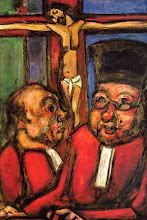
The Law of Christians is broken,
Blood by the hands of hell profusely shed like rain,
And the throat of Cerberus bellows songs of joy.

Angelbertus, Versus de Bella que fuit acta Fontaneto

Fracta est lex christianorum
Sanguinis proluvio, unde manus inferorum,
gaudet gula Cerberi.
Showing posts with label Definition of Law. Show all posts

Saturday, April 16, 2011

Natural Law's Modern Cousin Germain: Finnisian Definition of Law

FINNIS PROVIDES US A COMPREHENSIVE DEFINITION OF LAW that defines the central case of law that disappoints by its overt positivism:

[T]he term 'law' . . . refer[s] primarily to rules made, in accordance with regulative legal rules, by a determinate and effective authority (itself identified and, standardly, constituted as an institution by legal rules) for a 'complete' community, and buttressed by sanctions in accordance with the rule-guided and buttressed by sanctions in accordance with the rule-guided stipulations of adjudicative institutions, this ensemble of rules and institutions being directed to reasonably resolving any of the community's co-ordination problems (and to ratifying, tolerating, regulating, or overriding co-ordination solutions from any other institutions or sources of norms) for the common good of that community, according to a manner and form itself adapted to that common good by features of specificity, minimization of arbitrariness, and maintenance of a quality of reciprocity between the subjects of the law both amongst themselves and in their relations with the lawful authorities.

NLNR, 276-77. The reason I find this definition of law as the "central case" or "focal meaning" of law disappointingly narrow and positivistic is that it excludes from its definitional boundaries entire areas where classically law has been recognized to exist: the natural law and the eternal law. This definition is crafted by Finnis by referencing the requirements of practical reasonableness and by "certain empirical features of persons and their communities." NLNR, 277. Perhaps this definition--which Finnis states is an effort not "to explain a concept, but to develop a concept which would explain the various phenomena referred to (in an unfocused way) by 'ordinary' talk about law." NLNR, 279. But to whose talk has he been listening to? The positivist? It seems that he has not been listening to the Thomist.


While Finnis's definition may be a comprehensive definition of human law in its focal sense, it cannot be a definition of "law" in its focal sense when it excludes the laws of all laws: the eternal law, and the particularly human participation in that law, the natural law. And what is particularly curious is that Finnis is careful to note that the definition is crafted so as not to be univocal, but is intended to be vague enough to be usable in an analogical or "broad-sense" manner. The definition, then, can be analogized downward so that it can include more or less developed or more or less primitive legal-like institutions. But the definition is sufficiently univocal so as to exclude from its boundaries law looking upward,* so that there is no similar analogical use of it to refer to the higher eternal law and the natural law.

Indeed, Finnis admits as much be severing the natural law from his definition of law:
'Natural law'--the set of principles of practical reasonableness in ordering human life and human community--is only analogically law . . . .
But his use of "analogy" here is different from the use of analogy in terms of human institutions looking downward. NLNR, 280. Finnis is hesitant, even embarrassed to link the term "natural" to the term "law" as he has defined it, tolerating it only because "past thinkers" have used it. He suggests that, instead of using the term "natural law," we could use the term "'natural right', 'intrinsic morality','natural reason, or right reason in action', etc. But no synonyms are available for 'law' in our focal sense." NLNR, 280-81. Law as used by Finnis is improperly used when used of the natural "law" or the eternal "law." This seems to be a break in the tradition.

There is therefore both an inadequacy of Finnis's definition of "natural law" itself (defined as a "set of principles of practical reasonableness in ordering human life an human community"**) and an inadequacy of the term "law" as a term comprehensive enough to include within its meaning "law" as used in the notions of eternal law and natural law.

________________________
*It also excludes law in the sense of physical, biological, psychological laws (where "law" is used in a metaphorical sense, and excludes the "laws" associated with "arts and crafts and applied sciences" though the "similarity" between his definition of law and the law as used with reference to arts and crafts and applied sciences is "greater." NLNR, 280.
**Where is the legislator? Where is the promulgation? Where (in the event of disobedience) is the sanction?

Sunday, July 18, 2010

Flying Solo and the Natural Law: The Common Good as Part of the Moral Order

AN OVEREMPHASIS ON INDIVIDUALISM will usually land one outside the philosophy of natural law and even outside human law properly so called. That is one reason why the natural law philosophy is largely out of favor. Individualism may be defined in a variety of ways, but ultimately, individualism looks at the common good as something merely utilitarian or useful. That is, the common good, is "a mere means to the good of individuals," and outside of this has no independent justification. Simon, 97. The common good does lead to the private good of men, but it is a misinterpretation of its importance to view it as a means, and not an end in itself. By subordinating the common good to the individual good, that is by making it the desire of private good and private action, one misinterprets it, and in fact destroys the notion altogether. There must be a common desire and a common action behind a good, and not a multiple of private desires and common actions, if a good it to be called authentically common. Adam Smith's "invisible hand" which supposedly guides individual choice and individual demand and individual supply and leads to the common good is farcical of the common good. By definition, selfishness, even if it may accidentally or even frequently also benefit the commonwealth, is not conducive to common good, at least one strictly so called.

But more is required that mere common desire and common action for there to be a common good. In addition to common desire and common action, this good, to be common, also requires a distribution to individuals; the common good must not be kept apart from or segregated from the individuals that make up the community. So Simon concludes:
A thing which has the appearance of a common good, inasmuch as it cannot be realized without common desire and common action, is not a common good and may amount to sheer destruction if it is kept apart from the persons who make up the community. . . . The accomplishments of common desire and effort if left undistributed are actually kept out of society and denied the character of common good.
Simon, 98. Three things, then, in Simon's view must exist for a common good to be a common good in theory and fact: (i) a common desire, (ii) a common action, and (iii) a distribution, in some fashion, among the individuals who make up the commonality.

Simon draws from a stray comment of the Communist Manifesto to make a point (though not by any means advocating any of its principles!). "The bourgeoisie," Marx and Engles state, "has accomplished wonders far surpassing Egyptian pyramids, Roman aqueducts, and Gothic cathedrals." Both the Roman aqueducts and the Gothic cathedrals can be considered common goods, so long as they are not withdrawn from access by the public. All men may drink the water the aqueduct guides into the city, just like all men can drink the living waters by attending the cathedral. The pyramids, on the other hand, are not common goods. There was no equivalent distribution among the people of the sizable human labor that was expended on these monuments for the glory of the Pharaoh. "The Pyramids of Egypt are a rather clear example of an undistributed and undistributable common achievement." Such things still occur, they are often the result of "pork barrel" spending, as when "a road is built, at great public expense, for the service of a very few people." Simon, 99. This reminds one of the famous "Bridge to Nowhere," a 365 million project to link the town of Ketchikan (population 8,900) and the island of Gravina (population 50) in Alaska.

Given that there has to be some appropriate distribution of a common good among the population to retain its characteristic of a common good, Simon asks whether the common good becomes utilitarian relative to the good of the individual that participates in it. In other words, does it become a mere means? No, says Simon:
[T]he law of distribution which is that of the common good in no way prevents the common good from enjoying the character of an end, and of an end higher than the private good, and of the final end if the community under consideration has the character of a complete community.
Simon, 100-01. (That's why Aristotle referred to the common good (which he calls the "good of the polis") as "greater and more divine," κάλλιον δὲ καὶ θειότερον, than securing private good. Arist., Nic. Eth., 1094b8. This preeminence of the common good is derived from its "completeness" and "duration," qualities that we discussed in our previous blog posting.

Not only does the common good take precedence over the private good because of its relative duration and completeness, there is also a sense of hierarchy or ordering in the types of goods (and evils). Drawing upon the thought of Pascal in his Pensées, [frag. 792], Simon makes this point. In this fragment, Pascal expresses an important truth. While within certain orders goods may be incommensurable, across certain orders they may not. Some goods are of more fundamental value the others. There is a difference of kind between some goods and others, or some evils and others. Not all matters are differences in degree.
Pascal expresses, with his unique power of words, the great metaphysical and ethical truth that all good of a lower order falls sort of any good of a higher order.
Simon, 102.


This is a truth utterly forgotten by moderns, who are loathe to make judgment calls, as if all value is a matter of taste. For modern ears, the sentiments of St. Thomas or of Cardinal Newman are incomprehensible
The good of grace in a single soul is greater than the good of nature in the whole universe.

The Church . . . holds that it were better for the sun and moon to drop from heaven, for the earth to fail, and for all the many millions who are upon it to die of starvation in extremest agony, so far as temporal affliction goes, than that one soul, I will not say, should be lost, but should commit one single venial sin, should tell one willful untruth, though it harmed no one, or steal one poor farthing without excuse . . . she considers the action of this world and the action of the soul simply incommensurate, viewed in their respective spheres; she would rather save the soul of one single wild bandit of Calabria, or whining beggar of Palermo, than draw a hundred lines of railroad through the length of Italy, or carry out a sanitary reform in its fullest details in every city of Sicily, except so far as these great national works tended to some spiritual good beyond them.
S. T. Ia-IIae, q. 113, 9 ad 2; John Henry Cardinal Newman, Certain Difficulties Felt by Anglicans in Catholic Teaching (London: Longmans, Green & Co. 1891), Vol. I, 240.

Here is a traditional truth entirely lost, one shared by St. Thomas, Cardinal Newman, Pascal, and anyone that gives a moment thought to eternal verities: "[A]ny good of the higher order is greater than the totality of the good that the lower order admits of." Simon, 102. (It should be noted that this notion is entirely lost by the advocates of the "New Natural Law Theory such as Finnis, Grisez, and George, who hold all human goods to incommensurable and do not admit of this sort of hierarchy of goods.) The physical order is subordinate to the rational order, and the rational order is subordinate to the natural moral order, and the natural moral order is subordinate (though never contradictory) to the order of grace. So, for example, one should never intentionally kill an innocent human being even to save one's physical life, or to gain riches, or to acquire knowledge, because this would be to commit a moral evil to so as to gain advantage in the physical or rational orders, violating this hierarchy that prevents such confusing of orders.

Simon then asks the question of what order--physical or moral--the common good may be placed. When one hears the Ciceronian saying: salus populi suprema lex esto, the health of the people is the supreme law, which is nothing other than the principle that the common good of a people is the centerpiece of law, is this suprema lex a law of the physical or moral order? It is, Simon insists, a principle of moral order, and so supreme, but not absolutely. That the common good should be at the center of law, should be its end, is a supreme principle:
Supreme, indeed, not absolutely speaking for the order of charity [which I've characterized as the order of Grace, L.C.], in the words of Pascal, is above all the perfections of nature; but supreme in an order that it would be most inappropriate to designate as physical, material, or external. The common good of the civil society . . . [is in the] order of moral perfection, which remains essentially naturally and never should be confused with the order of charity (in the strictly theological sense which is that of Pascal) . . . . Of this common good it should not be said that it is the ultimate end absolutely speaking, for it is an ultimate within an order which is not itself ultimate.
Simon, 105. Simon then concludes:
[T]he common good indeed enjoys primacy over the private good of the individual, when both are of the same order, but that at the same time the common good is internal to man and by its very nature requires continuous distribution among the members of society. As such it is the end of the laws of the state. . . . If the purse of law is common, the cause also must be common. Thus the law is a rule of reason, relative to the common good which, on account of its relation to the common good, proceeds from the community. . . . [t]he making of law belongs either to the community as a whole or to someone who is in charge of the community. . . . [and] has to be promulgated, it has to be conveyed to the knowledge of those who are subject to the law.
Simon, 107-08, 109.

When one gathers together all the thoughts of Simon on human law, the analogate of law with which we are most familiar, he proposes, in fact, the definition of law of St. Thomas Aquinas:
Law is an ordinance of reason for the common good, promulgated by him who has the care of the community.

[Lex] est aliud quam quaedam rationis ordinatio ad bonum commune, ab eo qui curam communitatis habet, promulgata.
Simon, 109; Ia-IIae q. 90 a. 4 co.

Using his understanding of human law as the analogate, Simon now turns to what it may tell us of the natural law, the natural moral law.

Friday, June 5, 2009

St. Thomas Aquinas: Definition of Law, Promulgation

THE LAST REQUISITE for there to be a law--in addition to it being a rule of reason, issued by proper authority, and for the common good of a perfect society--is that it be promulgated. Thomas insists that promulgation is essential to law. Roman law insisted on promulgation as essential. And St. Thomas agrees with the Gratian Decretals (Distinctio IV, C. III.) which stated that "laws are established when they are promulgated" (leges instituuntur, cum promulgantur)


St. Thomas argues that since law involves a rule or measure, it must be imposed upon those who are to be ruled and measured by it. This requires knowledge, and so for the rule to be binding, the men and women that will be subjected to it have to be notified by promulgation. In a human context, not everyone will be present at the law's promulgation; some persons will be absent, and some may not even be born. Nevertheless, they would be bound to the law despite not being present during its promulgation. Though the law requires promulgation, they are bound by notice of it, either of the promulgation itself or notice of the law having been promulgated. The promulgation that takes place at one point in time extends to the future as a result of it being written. The fact that law is written means that it is "continually promulgated" (semper eam promulgat). It is for this reason, St. Thomas says, that Isidore of Seville stated in his Etymologies (v, 3; ii, 10) that "law (lex) is derived from "to read" (legere) because it is written" (lex a legendo vocata est, quia scripta est) See ST IaIIae, Q. 90, art.4.

Even the Natural Law is promulgated. The Natural Law is promulgated by God in the very fact that God instilled it into the mind or "heart" of man so as to be known by him naturally. ST IaIIae, Q. 90, art. 4, ad.1.

Thursday, June 4, 2009

St. Thomas Aquinas: Definition of Law, Authority

THE COMMON GOOD is the "first and foremost" (primo et principaliter) ordering which underlies law. We explored this in yesterday's posting. The fact that law is ordered is toward the common good suggests that only the "whole people" (totius multitudinis) who will be governed by it. Naturally, the "whole people" can be represented by someone who acts in their place and in their interest, a "viceregent" (gerentis vicem totius multitudinis). How the authority of the "whole people" is conveyed to any particular "viceregent" is not addressed by St. Thomas in these series of questions in the Summa Theologica. But regardless, it is the publically-recognized authority that has the right to issue laws. Reason alone does not make law, and so it does not belong to an individual qua individual to make law; it must be the reason of those in authority that makes law. ST IaIIae, Q. 90, art. 3, resp.


St. Thomas agrees with Aristotle that the intention of the lawgiver ought to lead men to virtue. Aristotle, Nicomachean Ethics, ii.1 Though an individual man (say a teacher, or priest) can held lead a man to virtue, unlike the lawgiver he has no coercive power to create an efficacious inducement to a life of virtue. Nicomachean Ethics, x. 9. Similarly, though a father may be head of his family, and he may issue orders or commands (aliqua praecepta vel statuta), these are not properly called laws (lex). Only the whole people, or the person to whom the whole people have assented to act on their behalf, have the authority to compel obedience, and, in a manner of speaking, to lead the population to virtue. ST IaIIae, Q.90, art. 3, resp.2, 3. That authority is found in a perfect community or society (communitas perfecta). ST IaIIae, Q.90, art. 3, resp.3.


Note:

The term "perfect society" or "perfect community" referred to by St. Thomas Aquinas does not mean a utopia, such as described by St. Thomas More in his Utopia, or by Plato in his Republic. This term is used differently in this context. The concept of the "perfect society" or "perfect community" (societas or communitas perfecta) in this context is one associated with political philosophy. A perfect society is a group that is self-sufficient or independent in its realm and has all necesary resources and conditions required to achieve its purposes. A society must thus be perfect in its end and in its means. A society perfect in its end is a society with a human purpose, complete and entire, that is, within its own order, sovereign, and so not subordinate to any higher good. A society perfect in its means is a society that has within its possession and control the means by which to achieve this purpose. In both end and means, the State is a perfect society, as is the Church founded by Christ. In his Apostolic Letter issued motu proprio and entitled Sollicitudo omnium ecclesiarum (1969), Pope Paul VI gave a good summary of the concept:

It is indisputable that the ends of Church and State belong to different orders, and that both are perfect societies, that is to say, they are independent in their respective spheres of action, and have proper means to achieve those ends. They possess their proper jurisdiction and all necessary means to achieve their ends. On the other hand, it must not be overlooked that they are both aiming at a similar welfare, namely that the people of God is to obtain eternal salvation . . .

Neque est infitiandum finem Ecclesiae et Rebus Publicis propositum diversi esse ordinis, atque Ecclesiam et Civitatem, in suo cuiusque ordine, esse societates perfectas, ac propriis inde pollere iuribus et mediis, suisque uti legibus, quacumque uniuscuiusque patet provincia. At verum est etiam utramque ad communis subiecti utilitatem agere, scilicet hominis, a Deo vocati ad salutem adipiscendam aeternam . . . .

Click here for a copy of Paul VI's motu proprio, Sollicitudo Omnium Ecclesiarum.

Wednesday, June 3, 2009

St. Thomas Aquinas: Definition of Law, The Common Good


THE LAW IS A PUBLIC THING, NOT A PRIVATE TOY. This is essentially St. Thomas Aquinas's teaching in the second article to question 90 in the "Treatise on Law." St. Thomas quotes the early encylopedist, St. Isidore of Seville, for the proposition that laws are not enacted for private benefit, but for the public good. Etymologies, v.21 (nullo privato commodo, sed pro communi civium utilitate conscripta).

St. Thomas observes that although reason is what directs the law, there must be something upon which reason is focused, the ultimate end or purpose (what is called the "final cause"). With respect to law, that focus must be the common good. The common good is based upon happiness; this happiness is "the principle in respect of all the rest." ST IaIIae, Q.90, art. 2, resp. From a natural perspective, this happiness is Aristotle's eudaemonia, what St. Thomas calls felicitas, felicity. From a supernatural perspective, this happiness is what is referred to as beatitude or eternal joy, what St. Thomas calls beatitudo.


The happiness that the law is concerned with is not any individual's happiness, but the happiness of the entire body politic, that is, the universal happiness, or happiness of the community (felicitatem communem). The law, therefore, must not have any particular individual's happiness as its end, but, rather, the happiness of the entire body politic. Quoting Aristotle, St. Thomas states that the only just law is that law which is adapted to produce and preserve happiness for the the body politic. See Aristotle, Ethics, v. 1. The law, can address individual things, and it may result in one particular individual's or one group's happiness. In itself, that is not defective so long as the law was ordained to the good of the community. It is only when the law is not it is ordered to the common good, but toward the good of a group or an individual, that it is "devoid of the nature of law" (non habeat rationem legis). ST IaIIae, Q. 90, art. 2, resp.; see also id. resps.1, 2. Thomas thus strikes a balance between individualism and collectivism.

Nathanael Culverwell describes what occurs when the law is ordered toward the common good


Law-givers should send out laws with Olive-branches in their mouths, they should be fruitful and peaceable; they should drop sweetness and fatness upon a land. Let not then Brambles make laws for Trees, lest they scratch them and tear them, and write their laws in blood. But Law-givers are to send out laws, as the Sun shoots forth his beams, with healing under their wings: and thus that elegant Moralist Plutarch speaks, God (says he) is angry with them that counterfeit his thunder and lightning, οὐσκηπτρον, οὐκεραυνὸν, οὐτρίαιναν; his Scepter, and his Thunderbolt, and his Trident, he will not let them meddle with these. He does not love they should imitate him in his absolute dominion and sovereignty; but loves to see them darting out those warm, and amiable, and cherishing ἀκτινοβολίαι, those beamings out of Justice, and goodness, and clemency. And as for Laws, they should be like so many green and pleasant pastures, into which these ποιμένεςλαων [shepherds of nations] are to lead their flocks, where they may feed sweetly and securely by those refreshing streams of justice, that run down like water, and righteousness like a mighty torrent. And this consideration would sweep down many cobweb-laws, that argue only the venom and subtilty of them that spin them; this would sweep down many an Achitophel's web and many an Haman's web, many an Herod's web; every spider's web that spreads laws only for the catching and entangling of weaker ones; such Law-givers are fit to be Domitian's play-fellows, that made it his Royal sport and pastime to catch flies, and insult over them when he had done. Whereas a Law should be a staff for a Commonwealth to lean on, and not a Reed to pierce it through. Laws should be cords of love, not nets and snares. Hence it is that those laws are most radical and fundamental, that principally tend to the conservation of the vitals and essentials of a Kingdom; and those come nearest the Law of God himself, and are participations of that eternal Law, which is the spring and original of all inferior and derivative laws. του ἀρίστου ἕνεκα πάντα τὰ νόμιμα [all laws exist for the sake of the good], as Plato speaks; and there is no such public benefit, as that which comes by laws; for all have an equal interest in them, and privilege by them. And therefore as Aristotle speaks most excellently, Νόμος ἐστὶ νους ἄνευὀρέξεως. A Law is a pure intellect, not only without a sensitive appetite, but without a will. ’Tis pure judgment without affections, a Law is impartial and makes no factions; and a Law cannot be bribed though a Judge may.

(from An Elegant and Learned Discourse of the Light of Nature, ed. Robert A. Greene and Hugh MacCallum, (Indianapolis: Liberty Fund, 2001) (spelling modernized).)

Tuesday, June 2, 2009

St. Thomas Aquinas: Definition of Law, Reason

ST. THOMAS ADDRESSES the definition of law in Question 90 of his so-called “Treatise on Law” (which is actually part of his Summa Theologica, specifically Questions 90-97 of the first part of the second part of this multi-volume work). St. Thomas first addresses the issue of whether the law is something that is based upon the faculty of practical reason of the law giver, or something else, in particular, the will of the law giver.


Relying principally on the insights in Aristotle’s Physics, St. Thomas concludes that law must principally pertain to reason, and not to the will. He reaches this conclusion because the “rule and measure” of all human acts must be the reason, since reason, and not will, is the proper faculty to direct the end of man. Since law is something that induces man to act, or restrains him from acting, it must accord with the “rule and measure” directing all human acts, which is reason. Ultimately, in St. Thomas's view, it is at the bar of reason to which law is answerable. Naturally, this determination would apply to all law. Thus Eternal Law, the Natural Law, Divine Law, and Human Law would all conform to Reason. Although the Natural Law and Human Law operate under the right reason of man, all manner of law is ultimately subject to conformity with the Divine Reason.

In his handling of the issue, it is apparent that St. Thomas recognizes that the word "law" may be used in an inexact sense. He observes that it is precisely in an imprecise sense that St. Paul uses it when he talks about the “law in my members” in Romans 7:23 to refer to the disposition or tendency toward sin that is referred to as concupiscence. This "law" is not actual law, since it is not based upon reason, but a disordered disposition. Nor is such law actually in the members of a human being, since reason is not be found in the bodily members, but only in the intellect Nevertheless, the term "law" may imprecisely be used to refer to concupiscence because it tugs on us though in a different manner than law, strictly defined, does. Similarly, the "laws of nature," such as scientific "laws," are not strictly laws, but are called laws only in a manner of speaking.

The reason that St. Thomas refers to in his definition of law is what is called the practical reason (ratio practica). This sort of reasoning should be distinguished from the speculative or theoretical reason. The speculative or theoretical reason, entirely intellectual, works by means of argument, applying syllogistic thinking to definitions and propositions to arrive at truths. Speculative or theoretical reason is thus used by humans to determine what is or what one ought to assent to or believe in, that is, what is true, and not what one is supposed to do, that is, to do good and avoid evil.

On the other hand, practical reason is the faculty that man uses to determine what he is supposed to do, and as such it informs us of what is good and what is evil. It relates to one's intent or end (purpose) in acting and is the basis or odering that end. (Some philsophers, such as David Hume, reject the suggestion that practical reason is able to determine what is good and what is evil, and they hold that practical reason is purely instrumental, but that is another issue for another day.)

Because practical reason relates to action, it is a combination of both reason and will. As R. J. Henle puts it: "The act of Practical Reason is a composite one and involves an interplay of will and intellect." R. J. Henle, S.J., ed. The Treatise on Law (Notre Dame: Notre Dame University Press, 1993), [314], 65.

Practical reason similarly uses a syllogistic thinking, applying it to definitions and propositions. But in the practical reason, the “universal propositions of the practical intellect that are directed to actions have the nature of law.” ST IaIIae Q.90, art.1, ad.2. Sometimes, these universal propositions are applied as a result of habit. At other times, these propositions are applied with full awareness and express consideration.

In assessing the interplay of reason and will in the faculty of practical reasoning, St. Thomas insists that reason is preeminent over will. Therefore, law pertains primarily to the reason, and not the will. In taking this position, St. Thomas rejects any implication to the contrary that may have been inferred in the Institutes of the Emperor Justinian. The legal text referred to by St. Thomas defined law in terms of the will of the emperor: Quod principi placuit legis habet vigorem. Inst., I.ii.6. (“Whatsoever pleases the sovereign has the force of law.”) In the Middle Ages, the Institutes and Digest (which with the other laws known as the Novellae) were known as the Corpus Juris Civilis or Codex of the Emperor Justinian. These laws were held in great esteem because of their antiquity and because of the reputation of Justinian as a Christian emperor (the Eastern Church considered him a saint). Justinian's Code, therefore, was to considered to be written reason (ratio scripta), and so was applied to human law as the Scriptures were applied to Divine belief. In his Summa Theologica, St. Thomas Aquinas calls the Emperor Justinian, "the Jurist," like he calls Aristotle, "the Philosopher."

St. Thomas rejects the notion that it is the will which moves us to act; rather, St. Thomas believes that the law is what commands and what forbids, and that this command is properly something pertaining to reason, and it is not something the will engages in except after reason has done its task. While the a person may will a certain end, the reason is what should determine that end, and which issues the command that ordains to that end. Without reason's ordering and guidance, there would be no rule of reason behind that act of will. In St. Thomas’s view, therefore Justinian "the Jurist" must be understood as implying that the will of the sovereign is in accord with some rule of reason. Otherwise, St. Thomas urges, "the sovereign’s will would savor of lawlessness rather than of law." Therefore, St. Thomas concludes, the source of moral obligations, and similarly legal obligations, are based upon a "reasonable will" (rationabile . . . voluntate) or a "will regulated by reason" (voluntate . . . ratione regulata). ST IaIIae, Q. 97, art. 3, resp.

It is apparent that St. Thomas's doctrine would exclude any theory of law that places something other than right reason at the helm of law, whether that something else is the will (even the alleged Divine will), convenience, custom, politics, power, freedom, the genius of the peoples, any idealogy, or anything else. Though these latter factors may have a role to play in fashioning human law, in St. Thomas's view they must always play a subordinate role to rightly-fashioned practical reason. (recta ratio practica).

The French scholar Jean Gerson (1363-1429) is in full compliance with St. Thomas when he states: "Lex est recta ratio practica secundum quam motus et operationes rerum in suos fines ordinatate regulantur." "Law is right practical reason according to which the mode and operations of things are regulated to their final end." Jean Gerson, Oevres Complètes, IX, ed. P. Glorieux (Paris, 1973), p. 134, quoted in Latin in Richard Tuck, Natural Rights Theories: Their Origin and Development (Cambridge: Cambridge University Press, 1981), 27.

In this, Aristotle, Cicero, St. Thomas Aquinas, and Jean Gerson are united. This teaching is our heritage.

Monday, June 1, 2009

St. Thomas Aquinas's Definition of Law

IN AN OFT-QUOTED DEFINITION, St. Thomas Aquinas defines law as "nothing other than a certain dictate of reason (rationis ordinatio) for the common good, made by him who has the care of the community and promulgated." ST. IaIIae, Q.90, art.4. Perhaps the most significant emphasis of this definition is that law is based upon reason, and not upon custom, will, politics, or power. Therefore, St. Thomas is clearly outside the voluntaristic camp, those who, like the medieval Ockham, sought the essence of law in God's will as distinguished from His reason. Similarly, he departs from those who suggest a command theory of law, the most notable of these being perhaps John Austin (1790–1859) who, seeking to disassociate the law from precepts of morality, in his The Province of Jurisprudence Determined (1832) defined law as the command of the sovereign backed by sanctions. St. Thomas Aquinas's emphasis on the practical reason as a source of substantive values also distinguishes him from philosophers such as David Hume, who rejected the role of practical reason in legislation, as he found it only instrumental ("Reason is, and ought only to be the slave of the passions," Treatise of Human Nature, 2.3.3.4). Similarly, the German jurisprudential scholar Rudolf von Jhering, who, in his Der Zweck im Recht, saw law as merely a "means to an end" without substantive component other than the convenience of the society works outside St. Thomas's frame of reference. Although St. Thomas recognizes the role of customary law, in it focal meaning, law is more than that which merely what steps out of the practice (Übung), conventions (Sitte), and customs (Gewonhneit) of a society, something that rises from an inner, silently-working forces, the innere, stillwirkende Kräfte, of a people's consciousness. St. Thomas would therefore not be in agreement with the likes of Frederich Carl von Savigny. The concept of law envisioned by St. Thomas radically departs from the Critical Legal Studies school which claims that law is indeterminate, and ultimately that "law is politics" and nothing else. Similarly, Michel Foucalt's view that all law is nothing but power is rejected by St. Thomas Aquinas in his definition of law.

It is not that these other theories do not have some truth to them, and perhaps in some fashion they even adequately explain law, or its abuse, or a certain characteristic of it, in certain times and places. They may be valuable in ascertaining law in a loose sense, or in a sense which is not its focal sense, i.e., its sensu lato. For St. Thomas, however, the issue was what the definition of law was in sensu stricto, in its principal focal meaning. For St. Thomas, the kernel, heart, and soul of the law is reason, above all other things. Thus, a "law" may be a command of the sovereign, may be the result of the political process, may be issued by the powerful against the weak, may be perfectly customary, and yet--if it does not conform to reason--it is not law in the strict sense. Rather, though it may have indicia of being a "law," it ought, in fact, be considered tantamount to violence. ST IaIIae, Q. 93, art. 3, ad. 2.