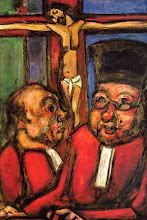
Angilbert (fl. ca. 840/50), On the Battle Which was Fought at Fontenoy

The Law of Christians is broken,
Blood by the hands of hell profusely shed like rain,
And the throat of Cerberus bellows songs of joy.

Angelbertus, Versus de Bella que fuit acta Fontaneto

Fracta est lex christianorum
Sanguinis proluvio, unde manus inferorum,
gaudet gula Cerberi.
Showing posts with label Natural Law and Family Life. Show all posts

Saturday, November 26, 2011

The Family Manifesto: Families of the World Unite!

THE COMPENDIUM OF THE SOCIAL DOCTRINE of the Church has a sort of social manifesto for the family. The political manifesto revolves around the notions of the "social subjectivity" and the "social priority" of the family. It suggests that the family as a institution has certain "family rights." It enjoins upon societies too often structured around false notions of individualism to re-think their basic premises, and to modify their economic, political, legal, and cultural institutions to accommodate the family.

The concept of "social subjectivity" is a concept that is intended to steer us in between two social errors: radical individualism or atomism, on the one hand, and socialism or collectivism, on the other. In the former, only the individual matters, the group does not. In the other, only the group matters, the individual does not. The notion of "social subjectivism" intends to place responsibilities on individuals and recognize their intrinsic dignity, but at the same time stress that whatever we do affects others. We necessarily exercise our subjectivity within society, hence the notion of "social subjectivity."

The notion of "social subjectivity" is a notion that includes not only individuals, but also families. Hence families are not separate cells unlinked with other families. There is, in fact "demonstrations of solidarity and sharing among families themselves," which ought to extend out into "various forms of participation in social and political life." (Compendium, No. 246) The notion "social subjectivity" understands that "people must not be considered only as individuals, but also in relation to the family nucleus to which they belong, the specific values and needs of which must be taken into due account." (Compendium, No. 254)


Una Familia by Fernando Botero

The concept of the "social priority" of the family is one where civil society recognizes the "priority and 'antecedence' of the family." The family ought to be the focus of all civil society, and it "should never fail in its fundamental task of respecting and fostering the family." (Compendium, No. 252) (quoting JP II, Familiaris consortio) Therefore, economic, social, political, legal, juridical, and cultural realms will focus on the family and recognize the priority of the family. This will call for a shifting of values in societies which have--for generations--structured their institutions with an eye toward individualism.

The notion "social priority" of the family means that the family ought to be understood to have preeminent rights to social recognition. The State and all society must recognize the family, must protect, appreciate, and promote the family, understood as the "natural society founded on marriage" between one man and one woman.

There ought to be no confusion between the family and those forms of cohabitation which mock it. The family, "understood correctly," is what is to receive social priority and which has family rights. This is not true for "all other forms of cohabitation which, by their very nature, deserve neither the name nor the status of family." (Compendium, No. 253)

A family is open to other families in solidarity, keeping in mind the common good:

This is a solidarity that can take on the features of service and attention to those who live in poverty and need, to orphans, the handicapped, the sick, the elderly, to those who are in mourning, to those with doubts, to those who live in loneliness or who have been abandoned. It is a solidarity that opens itself to acceptance, to guardianship, to adoption; it is able to bring every situation of distress to the attention of institutions so that, according to their specific competence, they can intervene.

(Compendium, No. 246)

The Church calls upon families to take an active, protagonistic role in forming society itself, in inculcating society and politics with its values. "Far from being only objects of political action," the Compendium states, "families can and must become active subjects." The Church asks families to unite, to work toward seeing that "the laws and institutions of the State not only do not offend but support and positively defendant the rights and duties of the family." (Compendium, No. 247)

The Compendium issues forth a cri-de-coeur that there be a "family politics," one that is transformative of civil society, including its economic, social, juridical, and cultural aspects, so that civil society serves the family's needs. Civil society must recognize the "social priority" of the family. "To this end, family associations must be promoted and strengthened." (Compendium, No. 247) Families have the right to associate with other families and with institutions to better fulfill their purpose, to protect their rights, and to foster the goods and advance their interests.

There is a particularly significant link between family life and economic life. Indeed, in less-industrialized societies the home is the center of economic life. A vestige of this is indicated by the very word economy, which comes from the Greek oikonomia, meaning household management. Even when the household is no longer the center of economic activity, there remains a "very special relationship" between family life and work, one that ought not be give short shrift. (Compendium, No. 249)

The family is in fact a focus, "one of the most important terms of reference," when assessing economic institutions and their morality. Economic institutions that harm the family are immoral. The economy was made for the family, not the family for the economy.

In fact, the existence of the family is what justifies private property. The relationship between labor and the family "has its roots in the relation existing between the person and his right to possess the fruit of his labor." A man is due the fruits of his labor, and he uses these to support his family. By saving money and acquiring property, a family both assures its freedom and is able to insulate against need or future economic demands. Therefore, labor and property concerns "not only the individual as a singular person but also as a member of a family, understood as a 'domestic society.'" (Compendium, No. 249)

The family must not be forgotten in the economic life of a nation. Family life is not independent of economic life as if they operate in two different moral realms. True, economic life must take into account economic laws and the "broad networks of production and exchange of goods and services that involves families in continuously increasing measure." (Compendium, No. 248) But economic life cannot be limited to a one-dimensionality, to a "market mentality" alone. Rather, the economy must be "the logic of sharing and solidarity" not only among families, but also across generations. For this reason, the family "must rightfully be seen as an essential agent of economic life." (Compendium, No. 248)

Work is the engine that feeds the family: "Work is essential insofar as it represents the condition that makes it possible to establish a family, for the means by which the family is maintained are obtained through work." (Compendium, No. 249) Obviously, it is work that allows the family to supported and maintained, and this not only is a monetary sense, "since a family afflicted by unemployment runs the risk of not fully achieving its end." (Compendium, No. 249)

To nurture and protect the intrinsic relationship between work and family, the Church proposes the notion of a "family wage," which she defines as "a wage sufficient to maintain a family and allow it to live decently." (Compendium, No.250) Maintenance goes beyond subsistence, and includes a notion there ought to be an amount beyond mere subsistence so as to allow a frugal and responsible family to save money and acquire property. The ownership of property by families is a "guarantee of freedom." (Compendium, No. 250)

How the "family wage" is achieved is something open to prudential judgment. Obviously, in a healthy economy a "family wage" will be the result of private agreement between and employer and an employee. But where this is not occurring for a variety of reasons, the wage can be supplemented by subsidies, tax credits to the employee or employer which encourage higher effective wages, or other "forms of important social provisions to help bring it about." (Compendium, No. 250)

In modern industrialized societies, one confronts the problem of unremunerated work. There is work done within the family--"housekeeping" by both wives and husbands--whose worth goes unpaid and often unrecognized. One has to recognized the value of "housekeeping" as work that directly contributes to the common good because it is "a service directed and devoted to the quality of life, constitutes a type of activity that is eminently personal and personalizing." (Compendium, No. 251) This work ought to be "socially recognized and valued," and this in concrete terms, through some sort of "economic compensation in keeping with that of other types of work." (Compendium, No. 251) Again, how this is achieved is something relegated to prudential judgment.

There has to be a greater symbiosis between the economy and the family so that families do not feel that they have to avoid having children to assure economic survival. "[C]are must be taken to eliminate all obstacles that prevent a husband and wife from making free decisions concerning their procreative responsibilities and, in particular, those that do not allow women to carry out their maternal role fully." (Compendium, No. 251)

While the State and civil society have as responsibility to safeguard family values, to "promote the intimacy and harmony within families," to assure "respect for unborn life," and to provide for "the effective freedom of choice in educating children," one must also remember the principle of subsidiarity. "[N]either society nor the State may absorb, substitute, or reduce the social dimension of the family; rather, they must honor it, recognize it, respect it, and promote it according to the principle of subsidiarity." (Compendium, No. 251)


Friday, November 25, 2011

The Family as the First School

THE FAMILY IS MAN'S FIRST SCHOOL, and it is within the family where man is formed "in the fullness of his personal dignity according to all his dimensions, including the social dimension." This includes cultural, ethical, social, spiritual, and religious values. One of the things the family has as its mission is to educate. By fulfilling its mission to educate, the family plays an irreplaceable role and advances the common good of a society. (Compendium, No. 238)

It is within the family where children are raised and formed as human beings. The parental role in this human formation is governed by love, a love which places itself "at the service of children to draw forth from them ("e-ducere") the best that is in them" and which "finds its fullest expression precisely in the task of educating." (Compendium, No. 239) That is why the family may be called the "first school."

Christian parents have a double duty. They must not see to the education of their children in natural virtues, in an authentic humanism. For the Christian, the family is not only the "first school," it is also a "garden" or a "first seminary" "in which the seeds of vocation, which God sows generously, are able to blossom and grow to full maturity."*

The parental duty to educate children comes tied to a right. Parents are the "original and primary" educators of their children, and their duties as well as their rights are "irreplaceable and inalienable."(Compendium, No. 239) The duty is non-delegable. The parent is ultimately responsible for his or her child. Though the parent may obtain the help of other persons or institutions, these always remain in loco parentis, in the parents' place. Importantly, this is a task shared by both parents, and so "the role of the father and that of the other are equally necessary." (Compendium, No. 242)


The State must recognize the preeminent role of the parents, particularly in the matter of religious and moral education of their young. Modernly, the State and its educational bureaucracy is invasive. It tends to be distrustful of parents, and often sets itself in opposition to the values of the parents. Particularly vicious is the relativistic and secular nature of modern education, a nature that is inspired by false educational philosophies and erroneous notions of separation of Church and State and interpretations of the Constitution's establishment clause.

Obviously, the parental charge to educate their children requires the help of civil and ecclesial authorities and scholastic institutions. But these are "agents of education," which means that they remain answerable to the parents as principals. "Parents have the right to choose the formative tools that respond to their convictions and to seek those means that will help them best to fulfill their duty as educators, in the spiritual and religious sphere also." (Compendium, No. 240)

In practice, parents are often stymied in their educational decisions. The system that is currently in place is weighted in favor of the public school, and parents are for financial reasons frequently unable to exercise real choice. The power to tax and the power to allocate tax revenue is entirely devoted to sustaining a public school system to the disadvantage of private, faith-based schools. This state of affairs is unacceptable:

"Parents should not have to sustain, directly or indirectly, extra charges which would deny or unjustly limit the exercise of this freedom." The refusal to provide public economic support to non-public schools that need assistance and that render a service to civil society is to be considered an injustice. "Whenever the State lays claim to an educational monopoly, it oversteps its rights and offends justice. . . . The State cannot without injustice merely tolerate so-called private schools. Such schools render a public service and therefore have a right to its financial assistance."

(Compendium, No. 241)**

The Compendium of the Social Doctrine of the Church insists that the family's educational rights includes the notion of "integral education." This includes the mandate that all education be directed to the proper formation of the human person "in view of his final end." It requires recognition of the virtues "of justice and charity." (Compendium, 242) This means that a God-less education is unacceptable. Man's final end is God, and inculcation of the virtue of justice and charity demand a theistic philosophy of education. Secular theories of education--such as the influential progressivist, pragmatist, empiricist theories of education advanced by John Dewey (1859-1952)--are unacceptable.

In the area of sex education, the parental role is particularly to be well-guarded. Sex education is to be presented "in an orderly and progressive manner," one that takes into account the age and maturity of the child. Additionally, sex education is to include "the human and moral values connected" to human sexuality. This means that disordered, immoral expressions of human sexuality--homosexuality, contraception, premarital sex, transgenderism and so forth--will not be taught as authentically human and moral life choices. The objective moral law as it relates to human sexuality ought not to be neglected. "Parents have the obligation to inquire about the methods used for sexual education in educational institutions in order to verify that such an important and delicate topic is dealt with properly." (Compendium, No. 243)

Children, of course, have the full dignity that is theirs as human persons. That dignity is to be respected and any rights that flow from that dignity protected. For this reason, "the rights of children must be legally protected within juridical systems."

One of the most fundamental rights of a child, his "first right," is to "be born in a real family." (Compendium, No. 244)*** With the development of genetic technology and with the recognition of homosexual civil unions and same-sex marriage, this right must be enforced. Children have a right to be conceived, born, and raised in families that are normal, not families that are based upon disordered an inauthentic human values.

Because of their relative weakness and inability to defend themselves, children are too often the victims of great injustice. Their rights are not infringed merely by inadequate access to food, medical care, and education. Their rights are all-too-often violated by such scourges as child labor, child trafficking, pedophilia, child pornography, and child marriage. These wrongs call forth from the Church a most strident demand:
It is essential to engage in a battle, at the national and international levels, against the violations of the dignity of boys and girls caused by sexual exploitation, by those caught up in pedophilia, and by every kind of violence directed against these most defenseless of human creatures. These are criminal acts that must be effectively fought with adequate preventive and penal measures by the determined action of the different authorities involved.
(Compendium, No. 245)

________________________________________
*Message of John Paul II for the XXXI World Day of Prayer for Vocations.
**Quoting the Holy See, Charter of the Rights of the Family, art. 5b and the Congregation for the Doctrine of the Faith's instruction, Libertatis conscientia, 94.
***Quoting from JP II, Address to the Committee of European Journalist for the Rights of the Child (13 January 1979).

Wednesday, November 23, 2011

The Family: Sanctuary of Life

THREE TO GET MARRIED was the name of a popular book written by Bishop Fulton J. Sheen. Marriage involves more than two parties: Man, woman, and the third party, often forgotten in what Bishop Sheen called the "dis-God-ed" generation, is God. The institution of marriage, one must not forget, is not one designed by the will of the parties. The parties enter into the institution by an act of self-donation which certainly requires free will; but they do not define the institution. The institution of marriage, like all of what is, is entirely dependent on God, the God who is the "author of marriage" and who "endowed it with various benefits and purposes."

One of the benefits of marriage is conjugal love. Here, too, God is its author and endowed it with various benefits and purposes. The benefits do not come without responsibilities. Perhaps the most apparent and perhaps the most abused modernly: "Conjugal love is by its nature open to the acceptance of life." (Compendium, No. 230)

Not only have severed the tie between sex and marriage, we have severed the tie between sex and procreation. Modern man has a penchant for separating things that ought to be together and putting things together that ought to be separate.

Holy Family by El Greco

Though sex and procreation are things human persons share with other animals, we must not be fooled that these acts are the same. Biological similarity is not ontological similarity. Whatever humans do involves persons, and this changes the entire matter. Sex involving persons is something entirely different from sex involving brute animals. One cannot forget that the procreative privilege given man is unique in that it leads to creation, together with God, of persons, that is, those with the image and likeness of God.

The Compendium of the Social Doctrine of the Church speaks of the "social subjectivity of the family." By its very nature, the family is subjected to society and is therefore subject to the laws of social life. Uniquely, the family is the fundamental cell where human life is transferred from generation to generation, almost in a manner that a baton is passed from runner to runner in a relay race.

This notion of marriage and family as the social vehicles for the "handing down" or tradendere of life itself has been largely lost. "It is necessary to rediscover the social value of that portion of the common good inherent in each new human being." (Compendium, No. 230)

Every human life generated within the family which travels through time is a boon to life in common. Human life continues to burn within families from generation to generation in a "communion of generations" much like the sacred fire of Vesta burned for generations in the beautiful circular Temple of Vesta in Rome attended by its vestal virgins. (Compendium, No. 237)

In this manner every child born to a family is a benefit not only his or her mother, father, brothers or sisters, but also to the entire community into which he or she is born. The family is the temple where the flame of life is transmitted. It is a temple dedicated to the Lord of Life. The family is naturally ordered to serve what John Paul II has called the Gospel of life, evangelium vitae. Every birth ought to declare: Life is good news!

The family is therefore an intensely spiritual society, and the conjugal act that is at the heart of the marriage which is its fire has a spiritual dimension which is forgotten. "Fatherhood and motherhood represent a responsibility which is not simply physical but spiritual in nature." Through motherhood and fatherhood "there passes the genealogy of the person, which has its beginning in God and which must lead back to him." (Compendium, No. 237) (quoting JP II, Gratissimam sane, 10)

"The family contributes to the social good in an eminent fashion through responsible motherhood and fatherhood, the spouses' special participation in God's work of creation." (Compendium, No. 232) For this reason, civil society--including the State--is obliged to assure that its customs and laws support it. Most fundamentally, neither the State nor civil society may impinge or in any manner "violate the right to life, from conception to natural death." Rather, the civil society and the State are obliged to "protect and promote it." (Compendium, No. 231)

Motherhood and fatherhood must be exercised responsibly, with full consideration of a proper hierarchy of values. This means that that married couples must be open to life. Granted, motherhood and fatherhood are not exercised in a vacuum. Couples are entitled to consider the "physical, economic, psychological, and social conditions" which they confront. These present the setting in which responsible parenthood is practiced. Within these constraints or opportunities, couples confront the gamut of possibility from the "duly pondered and generous decision to have a large family" to the "decision, made for serious reasons and in respect of the moral law, to avoid for a time or even indeterminately a new birth." (Compendium, No. 232)

The practice of responsible procreation, however, must be "in respect of the moral law." Some methods of responsible parenthood are to be rejected outright.

The "first to be rejected as morally illicit are sterilization and abortion." Abortion in particular "is a horrendous crime and constitutes a particularly serious moral disorder." Abortion, being an intrinsic evil, is far from being something of right. (Compendium, No. 233)

Any form of artificial contraception is likewise to be rejected. Anyone sensitive to "a correct and integral understanding of the person and of human sexuality" will recognize at once why and how seriously artificial contraception offends against the conjugal act and the natural moral law. "Rejecting contraception and using natural methods for regulating births means choosing to base interpersonal relations between the spouses on mutual respect and total acceptances, with positive consequences also for bring about a more human order in society." (Compendium, No. 233)

The choice to use contraception is not a moral option for the couple. A fortiori, the promotion of contraception by social institutions or States is immoral. "All programs of economic assistance aimed at financing campaigns of sterilization and contraception, as well as the subordination of economic assistance to such campaigns, are to be morally condemned as affronts to the dignity of the person and the family." (Compendium, No. 234) In this matter, both the U.N. and the U.S. may be the greatest offenders.

Responsible parenthood demands the exercise not of all options, but only of moral options, and the moral decisions do not only involve the decision to prevent conception. They also involve the decision to promote conception. There is no absolute "right to children," and no desire to be a mother or a father justifies immoral means to conceive them.

Modern technology has invaded the temple of the family in a sort of abomination of desolation which separates the procreative act from the unitive act and seeks to replace or substitute for the conjugal act. The upshot is that "the child comes about more as the result of an act of technology than as the natural fruit of a human act in which there is a full and total giving of the couple." (Compendium, No. 235) The immoral techniques that are immoral are legion: the donation of sperm or ova, surrogate motherhood, homologous and heterologous artificial fertilization, and so on. While there are some techniques that "end assistance to the conjugal act or to the attainment of its effects" which are legitimate, there are a whole host of illicit and immoral techniques that ought to be rejected. The ends do not justify the means.

One must also not forget that the child has certain rights to be born or raised within the confines of a natural family. "The unborn child must be guaranteed the best possible conditions of existence through the stability of a family founded on marriage, through the complementarities of the the two persons, father and mother." (Compendium, No. 235) Efforts to provide children to persons involved in some sort of civil union other than a family founded on the marriage of one man and one woman are to be shunned.

Finally, human cloning--defined as "the reproduction of a biological entity that is genetically identical to the originating organism"--is something to be abjured. Whether for reproductive or therapeutic purposes, human cloning is "contrary to the dignity of human procreation because it takes place in total absence of an act of personal love between spouses." It is an "agamic and asexual reproduction" unworthy of man. It represents, moreover, "a form of total domination of the reproduced individual on the part of the one reproducing it." It is a form of technological tyranny. (Compendium, No. 236)

Sunday, February 6, 2011

Pope Leo XIII on Socialism: Quod apostolici muneris

THE NATURAL LAW ALSO PROVIDED the foundation for Pope Leo XIII's encyclical on socialism, Quod apostolici munerus which was issued in 1878. In that encyclical, Leo XIII set himself against "that sect of men, who under various and almost barbarous names, are called socialists, communists, or nihilists." QA, 1. Socialists, communists, and nihilists "leave nothing untouched or whole which by both human and divine laws (quod humanis divinisque legibus) has been wisely decreed for the health and beauty of life." Spurning, then, the influence of natural and divine law, socialists "proclaim the absolute equality of all men in rights and duties." shunning any differences between the ruler and the ruled. On the domestic, familial front, they "debase the natural union of man and woman," naturalem viri ac mulieris unionem . . . dehonestant, and weaken its bond, vinculum . . . infirmant. They therefore weaken if not altogether sever the authority of the father as head of the family, and relationship between husband and wife, and between parents and children. Driven by their materialistic philosophy, they "assail the right of property sanctioned by natural law," jus proprietatis naturali lege sanctitum impugnant, which leads them "seize and hold in common whatever has been acquired either by title of lawful inheritance, or by labor or brain and hands, or by thrift in one's mode of life." QA, 1. It is these three errors--a false egalitarianism, a false notion of marriage and family life, and the rejection private property--that Leo XIII addresses in his encyclical Quod apostolici munerus. It is these three errors that come in the wake of the "plague of socialism," pestis Socialismi advanced by this "abominable sect," secta abominata. Cf. QA, 10, 11.


Fundamental Tenets of Socialism Against the Natural Law

As with much of our modern philosophical ills, Leo XIII finds the seed of socialism in the 16th century, specifically in the error of philosophical rationalism. Socialism (with which term we will use to include communism and political nihilism) is nothing less that a form of political rationalism. Rationalism, which entails a false, materialistic notion of reason, is intended to subvert revelation and to "overthrown the supernatural order." QA, 2. Disdaining religion and disdaining God, rationalism in the political realm has sought to found political institutions on the will of the people alone, without regard to God or his order. Under the guise that supernatural truths are hostile to reason, political rationalists have sought to remove from any public institution--including universities, the lyceums, the gymnasia--any mention of God and the supernatural order. Their view of life is entirely here-and-now, "limited to the bounds of the present," and gives utterly no weight to the concept of eternity or to "the rewards and punishments of a future and eternal life." QA, 2. In fine, they live sub specie temporis, under the light of the here-and-now, and not sub specie aeternitatis, under the light of eternity. And this they do even while "stealing the very Gospel itself with a view to deceive more easily the unwary." QA, 5. Like the devil who quoted scripture to tempt Christ, so do socialists frequently invoke alleged evangelical values while actually subverting them.

Socialists advocate in a sense altogether false "that nature has made all men equal," and so reject any office or laws or relations that are not predicated on their radical egalitarianism. While Pope Leo XIII acknowledges that the Gospel teaches an equality among men, the Gospel's notion is different from the equality advocated by the socialist:
[I]n accordance with the teachings of the Gospel, the equality of men consists in this: that all, having inherited the same nature, are called to the same most high dignity of the sons of God, and that, as one and the same end is set before all, each one is to be judged by the same law and will receive punishment or reward according to his deserts.

Contra vero, ex Evangelicis documentis, ea est hominum aequalitas, ut omnes eamdem naturam sortiti, ad eamdem filiorum Dei celsissiman dignitatem vocentur, simulque ut uno eodemque fine omnibus praestituto, singuli secundum eamdem legem iudicandi sint, poenas aut mercedem pro merito consecuturi.
QA, 5. Outside of this equality among men--an equality of human nature and an equality of our supernatural calling--there are palpable inequalities among men: and indeed, the inequality among men in these other particulars is part of the plan of God, especially the inequalities arising out of the relationship between those who govern and those who are governed.
The inequality of rights and of power proceeds from the very Author of nature, "from whom all paternity in heaven and earth is named." (Eph. 3:15)

Inaequalitas tamen iuris et potestatis ab ipso naturae Auctore dimanat, ex quo omnis paternitas in caelis et in terra nominatur.
QA, 5. Depending upon office, station, relation, and right order there may be various duties and rights, and so one person (for example a ruler, a bishop, or a father) will have rights over as well as duties to another (e.g., his subject, a layman, or a son), even while the latter (e.g., the subject, the layman, or a son) has rights over as well as duties to the former (e.g., the ruler, or a bishop, or a father).
For, He who created and governs all things has, in His wise providence, appointed that the things which are lowest should attain their ends by those which are intermediate, and these again by the highest. . . . [God] appointed that there should be various orders in civil society, differing in dignity, rights, and power (plures esse ordines, dignitate, iuribus, potestate diversos), whereby the State, like the Church, should be one body, consisting of many members, some nobler than others, but all necessary to each other and solicitous for the common good."
QA, 6.

Rulers are answerable to God for the use of their power. So does the book of Wisdom warn us: "For a most severe judgment shall be for them that bear rule," should they judge rightly or fail to keep the law of justice. Wisdom 6:6. Rebellion against even a rash and tyrannical ruler must not be countenanced ordinarily since to "allow an insurrection on private authority" results in greater ills not only because public order would be "only the more disturbed," but also because society would run the risk of taking "greater hurt therefrom." Therefore, even patience toward tyranny befits concern for the common good. Insurrection is not something to be engaged in lightly. There is, however, one exception:
But, if the will of legislators and princes shall have sanctioned or commanded anything repugnant to the divine or natural law, the dignity and duty of the Christian name, as well as the judgment of the Apostle, urge that "God is to be obeyed rather than man." [Acts 5:29]

Quod si legislatorum ac principum placita aliquid sanciverint aut iusserint quod divinae aut naturali legi repugnet, christiani nominis dignitas et officium atque Apostolica sententia suadent obediendum esse magis Deo quam hominibus.
QA, 7.

With respect to marriage and family life, Leo XIII insists that civil society, in particular the State, must recognize the importance of the family:
Even family life itself, which is the cornerstone of all society and government . . . . [T]he foundation of this society rests first of all in the indissoluble union of man and wife according to the necessity of natural law, and is completed in the mutual rights and duties of parents and children, masters and servants.

[E]tiam domestica societas, quae omnis civitatis et regni principium est . . . . Rectam hujus societatis rationem, secundum naturalis juris necessitatem in indissolubili viri ac miilieris unione primo inniti, et mutuis parentes inter et filios, dominos ac servos offîciis iuribusque compleri.
QA, 8.

The socialists "strive almost completely to dissolve this union," this fundamental cell of society. In particular they seek to remove any religious element from it, rejecting both its natural order and the Church's authority over it. This necessarily weakens the headship of the father over his wife and family, the authority of the parents over their children, and the reciprocal duties of the children to their parents. QA, 8. The family is a subtle instance of hierarchy within love and love within hierarchy.
Wherefore, as the Apostle has it, [Eph. 5:23] as Christ is the head of the Church, so is the man the head of the woman; and as the Church is subject to Christ, who embraces her with a most chaste and undying love, so also should wives be subject to their husbands, and be loved by them in turn with a faithful and constant affection. In like manner does the Church temper the use of parental and domestic authority, that it may tend to hold children and servants to their duty, without going beyond bounds. For, according to Catholic teaching, the authority of our heavenly Father and Lord is imparted to parents and masters, whose authority, therefore, not only takes its origin and force from Him, but also borrows its nature and character. Hence, the Apostle exhorts children to "obey their parents in the Lord, and honor their father and mother, which is the first commandment with promise"; [Eph. 6:1-2] and he admonishes parents: "And you, fathers, provoke not your children to anger, but bring them up in the discipline and correction of the Lord." [Eph. 6:4] Again, the apostle enjoins the divine precept on servants and masters, exhorting the former to be "obedient to their lords according to the flesh of Christ . . . with a good will serving, as to the Lord"; and the latter, to "forbear threatenings, knowing that the Lord of all is in heaven, and there is no respect of persons with God." [Eph. 6:5-9] If only all these matters were faithfully observed according to the divine will by all on whom they are enjoined, most assuredly every family would be a figure of the heavenly home, and the wonderful blessings there begotten would not confine themselves to the households alone, but would scatter their riches abroad through the nations."
QA, 8.

Controversial as it may modernly be, Pope Leo XIII clearly promotes the continuing validity of the so-called Haustafel, the "Domestic Code" found in St. Paul's Epistle to the Ephesians (5:22-6:5) and also in St. Paul's Epistle to the Colossians (3:18-41) and in St. Peter's First Epistle (1 Pet. 2:18-3:7).*

From marriage and the family, Pope Leo XIII addresses the socialists' rejection of private property. Basing itself on "the precepts of natural and divine law," the Church's doctrine concerns itself with the public and private good regarding the duty of government and the distribution of the goods that are necessary for human life and its flourishing. Socialists reject the natural right to private property, finding it to be an invention of man, a mere convention:
For, while the socialists would destroy the "right" of property, alleging it to be a human invention altogether opposed to the inborn equality of man, and, claiming a community of goods, argue that poverty should not be peaceably endured, and that the property and privileges of the rich may be rightly invaded, the Church, with much greater wisdom and good sense, recognizes the inequality among men, who are born with different powers of body and mind, inequality in actual possession, also, and holds that the right of property and of ownership, which springs from nature itself, must not be touched and stands inviolate.

Cum enim Socialistae ius proprietatis tamquam humanum inventum, naturali hominum aequalitati repugnans, traducant et communionem bonorum affectantes pauperiem haud aequo animo esse perferendam, et ditiorum possessiones ac iura impune violari posse arbitrentur; Ecclesia multo satius et utilius inaequalitatem inter homines, corporis ingeniique viribus naturaliter diversos, etiam in bonis possidendis agnoscit, et ius
proprietatis ac dominii ab ipsa natura profectum, intactum cuilibet et inviolatum esse iubet.
QA, 9.

That private property is recognized by revelation is clear from the divine laws against stealing and robbery. But the right to private property ought not to be grounds or excuse for neglecting the poor. On the contrary, the Church insists that they ought to be cared for, and she is constantly enjoining upon the rich "that most grave precept to give what remains to the poor; and she holds over their heads the divine sentence that unless they succor the needy they will be repaid by eternal torments." QA, 9. There is, to be sure, "the old struggle between the rich and the poor," but it is not solved by rejecting private property. The best method would seem to be the Christian formula which demands that the rich, like Christ, become poor for the sake of their brothers, and the poor recognize the blessings that Christ has put upon the sufferings of the poor and the rewards of eternal life.
[I]f this method is rejected or disregarded, one of two things must occur: either the greater portion of the human race will fall back into the vile condition of slavery which so long prevailed among the pagan nations, or human society must continue to be disturbed by constant eruptions, to be disgraced by rapine and strife, as we have had sad witness even in recent times.
QA, 9.
________________________________
*The Church continues to insist on the paternal headship of the family and the complementarity of the masculine (paternal) and feminine (maternal) roles in the family, but, especially during the pontificate of John Paull II, has elaborated the radical Christian concept of subjection, making it clear that "subjection" must not be understood as the world understands it. A good discussion of the Scriptural, Patristic, and Magisterial teaching on the headship of the father in the family may be found in the article The Authority of the Husband According to the Magisterium by Rev. Paul N. Check.