Angilbert (fl. ca. 840/50), On the Battle Which was Fought at Fontenoy

The Law of Christians is broken,
Blood by the hands of hell profusely shed like rain,
And the throat of Cerberus bellows songs of joy.

Angelbertus, Versus de Bella que fuit acta Fontaneto

Fracta est lex christianorum
Sanguinis proluvio, unde manus inferorum,
gaudet gula Cerberi.
Showing posts with label Nature and Grace. Show all posts

Wednesday, July 11, 2012

God's Glory Appears: Looking Back from Christ

EEVER SINCE HENRI DE LUBAC's view of nature and the supernatural, of nature and grace, there has been a sort of collapse of consensus among Catholic theologians in this area.  In their rejection of a hypothetical state of pure nature (but one with its own end and its own integrity, separate and apart from grace, though--in reality--there was never a time, and never will be a time where pure nature was intended to exist without being tied intimately to the supernatural life of grace), there has been a sort of conflation between nature and grace.

The result is that often grace itself has become naturalized, immanentized so that all are Rahnerian "anonymous Christians," all participate in grace in one way or another, and the uniqueness and importance of the Christ-event seems to have been compromised.  The Christ-event is simply the apex of this nature/grace muddle.  There is only one "existential order," a muddled natural-cum-supernatural one. Alternatively, nature seems to have disappeared from importance, and all is grace and supernatural.  Here, ethics ignores universal laws, any constraints of nature, and all becomes a one-and-one existential encounter.  Each man's path is his own path: man does not have a path he shares with others, a path which may be found by looking at what creation tells him.  "The encounter with God is such that it transforms worldly ethics and refuses the hegemony of natural law."  Steck, 101.  In short, things have become muddled.

In fact, things have become more than muddled.  In some cases, the collapse of the nature/supernature distinction has resulted in tendencies that are dangerous to say the least.  Witness this quasi-anarchical statement from Rahner:

And the ultimate meaning of this revelation [in Jesus Christ] is a calling of man out of this world into the life of God, who leads his personal life . . . as the tri-personal God, in inaccessible light. God is thereby bring himself immediately face to face with man with a demand and a call which flings man out of the course pre-established by nature . . . . [T]here arises the most immediate possibility that [God] might issue commands to mankind which are not at the same time the voice of nature, are not the lex naturae. And if God calls man in this command of his revealing word to a supernatural, supramundane life, . . . [then the world] is condemned to a provisional status, a thing of second rank, subject to a criterion which is no longer intrinsic or proper to it.

Steck, 101.*  While there is nothing objectionable per se in Rahner's statements taken singly, there seems some dangerous tendency arising from some sort of underlying deprivity.  Something smells rotten, sort of like when you open a refrigerator door and smell spoiled food.  You cannot at once find where the foul order might be coming from.  While most of the food is good, there is one piece that is not quite right.

Rahner's formula raises the possibility--only implied, but others have acted on it--that the natural moral law (the lex naturae) no longer binds.  It seems we all have become potential Abrahams who, in obedience to God, may be called to a one-on-one discipleship which requires us to act against the natural moral law.  If we are "flung out of the course pre-established by nature," if God's voice is "not at the same time the voice of nature," if the natural moral law "is condemned to a provisional status, a thing of second rank, subject to a criterion which is no longer intrinsic or proper to it," why in the wrong hands this is a recipe for Christian anarchy.

Whether von Balthasar's ethics is infected by this muddle is uncertain.  Steck believes that von Balthasar avoids a too-strict separation between nature and supernature/grace, but also avoids the problems associated with the modern tendency among the theologians of la nouvelle théologie, of conflation of the two orders of reality.  He navigates between Scylla and Charybdis and offers us the prospect of a perfect recipe for the nature/supernature conundrum.   I am uncertain whether this is the case.
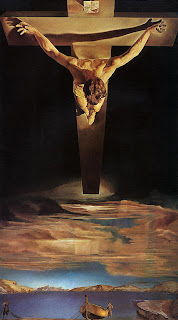
 Salvador Dali's Christ on the Cross According to St. John of the Cross

What von Balthasar seems to do is to seize on Karl Barth's insight that creation is the "external basis of the covenant," and the covenant between man and God in Christ's revelation is the "internal basis" of creation.  Steck, 103.  "Von Balthasar finds this description completely acceptable as a way of relating the two orders [of nature and grace], but believes that Barth himself does not always do full justice to creation."  Steck, 103.
Although there has always been only one human reality, i.e., the graced existence of the person called and destined to be one with Christ, it remains important [to von Balthasar] to preserve a conceptual distinction between the orders of creation and grace. This is necessary not so much in order to protect the gratuity of grace by postulating a "pure nature," sufficient and meaningful apart from grace, but to exclude any hint of what von Balthasar calls "theopanism," where creation is emptied of any ontological reality and instead all that is real in the covenantal encounter is attributed exclusively to the domain of grace. The distinction of the orders underscores that grace works in and through an order that has its own integral, albeit relative meaning, even while leading that order to its perfection.
Steck, 103.  Here's the problem for von Balthasar (which is common to the advocates of la nouvelle théologie).  "Since humanity has always existed within the call of the Word and the presence of the Spirit in the one economy of God, the 'nature' that grace presupposes," so the argument goes, "cannot be uncovered by bracketing the historical 'addition' of Christian revelation."  Steck, 104.

Von Balthasar therefore resists any kind of clear delimitation of nature and grace.  For him such distinction is as hopeless at it is sterile.  And yet he endeavors to preserve these categories in a manner.  He does this by "peer[ing] through the present economy, within the epistemological brackets of the Christ-event," and this allows us to make some "general observations about human existence apart from the full light of Christ."  Steck, 104.

Von Balthasar approaches the problem from the terminus ad quem looking backward, whereas the traditional Thomists might be said to look at the problem from the terminus ad quo looking forwards.  Is this a problem of whether we are to be Epimethius or Prometheus, a looking behind versus a looking ahead?  Is this a question of "what did Christ come to save?" versus a question of "what did Christ save?"

[I]nstead of starting from principles drawn from the revelation in creation to arrive at the revelation in the Word as the crown and summit," von Balthasar proceeds "in the reverse direction, from the revelation in the Word to that in creation," "by determining what the word of revelation itself presupposes and implies."

Steck, 104.**  "Christ is the 'one and only criterion,' 'by which we measure the relations between . . . grace and nature.'"

Using this technique of looking backwards from Christ, the "one and only criterion" by which the "relations between grace . . . and nature" might be gleaned, von Balthasar (in Steck's analysis) identifies three claims of the created order which are important in the ethical life: (1)  the created order gives rise to an agency (a human person) distinct from God; (2) God's call is perceived within creation in some manner; and (3) the creature's encounter with grace preserves, and does not destroy, the spheres of meaning in the created order, so the life of God in Christ is intelligible even when viewed from the created order.

We will discuss these three features in greater depth in our next posting.

____________________________________
*The quote is from Karl Rahner, "The Ignatian Mysticism of Joy in the World," in Theological Investigations, vol. 3 (London: Darton, Longman & Todd, 1967), 285-86. 
**The quotations are from von Balthasar's "The Implications of the Word," in The Word Made Flesh, Vol. 1 of Explorations in Theology (San Francisco: Ignatius Press, 1989), 48.


Wednesday, September 7, 2011

Veritatis Splendor: Part 34-Lex ipsa gratia vivificata est

THE MORAL LAW MAY BE DIFFICULT TO KEEP, particularly in certain circumstances. There are both external and internal circumstances that affect man's ability to exercise his freedom in a manner that conforms to the precepts of morality. But "[e]ven in the most difficult situations man must respect the norm of morality so that he can be obedient to God's holy commandment and consistent with his own dignity as a person." VS, 102.

A rose garden we have not been promised.

Certainly, maintaining a harmony between freedom and truth occasionally demands uncommon sacrifices, and must be won at a high price: it can even involve martyrdom. But, as universal and daily experience demonstrates, man is tempted to break that harmony: "I do not do what I want, but I do the very thing I hate... I do not do the good I want, but the evil I do not want" (Rom 7:15, 19).

VS, 102.

Man is thus "divided," and this "inner division" in man, of which any introspective person will be aware, is evidentiary or testamentary of a prior failure to acknowledge "the Lord as his Creator," and a wish "to be the one who determines, with complete independence, what is good and what is evil." VS, 102. Every man, then, bears the vestiges of a prior rebellion, the vestiges which easily attract temptations to ignore or trespass against God's commandments. There is in us an unfortunate disorder, a disorder which affects the entire man, his emotions, his physical desires, his will, and his intellect. Although revelation describes this as a "fall," revelation is not required to know that something is wrong. Observation and plain common sense tells us something is wrong, though reason alone may not give us the reason why this is case. That obvious fact is what led G. K. Chesterton in his book Orthodoxy to observe that original sin "is the only part of Christian theology which can really be proved."

The moral law, however, can be kept. God does not legislate the impossible, and it follows that the temptations that haunt man do not compel an act against the moral law. The temptations do not rob us of our free will:
But temptations can be overcome, sins can be avoided, because together with the commandments the Lord gives us the possibility of keeping them: "His eyes are on those who fear him, and he knows every deed of man. He has not commanded any one to be ungodly, and he has not given any one permission to sin" (Sir 15:19-20). Keeping God's law in particular situations can be difficult, extremely difficult, but it is never impossible. This is the constant teaching of the Church's tradition, and was expressed by the Council of Trent: "But no one, however much justified, ought to consider himself exempt from the observance of the commandments, nor should he employ that rash statement, forbidden by the Fathers under anathema, that the commandments of God are impossible of observance by one who is justified. For God does not command the impossible, but in commanding he admonishes you to do what you can and to pray for what you cannot, and he gives his aid to enable you. His commandments are not burdensome (cf. 1 Jn 5:3); his yoke is easy and his burden light (cf. Mt 11:30)."
VS, 102.

The law, however, cannot be kept without divine grace, and man sees "before him the spiritual horizon of hope," a hope that founded upon the confidence of the "help of divine grace," which cooperates with, and in fact buttresses, his freedom. Semper conceditur homini spiritalis via ad spem, divina gratia adiuvante atque humana libertate operam navante. VS, 103. Lex ipsa gratia vivificata est. The law itself is enlivened, is given life, by grace. Cf. VS, 103. In the moral life of man, law is its skeleton, and grace is its flesh.

God, of course, is the author of this grace, and he distributes it as he will. And yet he has provided in the Christian dispensation for some ordinary channels of this grace, channels which only the foolhardy, the ignorant, or the evil would forego:

It is in the saving Cross of Jesus, in the gift of the Holy Spirit, in the Sacraments which flow forth from the pierced side of the Redeemer (cf. Jn 19:34), that believers find the grace and the strength always to keep God's holy law, even amid the gravest of hardships. As Saint Andrew of Crete observes, the law itself "was enlivened by grace and made to serve it in a harmonious and fruitful combination. Each element preserved its characteristics without change or confusion. In a divine manner, he turned what could be burdensome and tyrannical into what is easy to bear and a source of freedom."*

VS, 103.

St. Andrew of Crete

The central act of God's grace is found in Christ, in his Redemption of all mankind. For this reason, the Pope insists that "[o]nly in the mystery of Christ's Redemption do we discover the 'concrete' possibilities of man." VS, 103. What John Paul II means by that is that the natural moral law should not be considered some ethereal, transcendent ideal way beyond man here-and-now. The ability to keep the moral law in all its fullness is not pie in the sky. The keeping of the moral law is achievable in the here-and-now, in the concrete circumstances, in the "categorical." The moral law is not some ideal which must be dumbed down, "adapted, proportioned, graduated to the so-called concrete possibilities of man."

But in speaking of the "concrete possibilities of man," and of the ability to keep the moral law, we must distinguish between what "man" we mean. "And of which man are we speaking? Of man dominated by lust or by man redeemed by Christ? VS, 103. This is the question rarely asked by both advocates and opponents of the natural law: when we talk about man's nature, what man are we referring to?

The man dominated by lust cannot keep the law, and it is not this man whose nature we appeal to. On the other hand, the man redeemed by Christ can keep the law, and it is this man whose nature is normative. And so the law's ideal, when applied to the "concrete possibilities of man," will force us to the recognition of a reality: "the reality of Christ's redemption. Christ has redeemed us!" VS, 103.

And what does this mean? The Redemption of man by Christ and the promise of forgiveness, provides man with the opportunity, one built on grace and powered by the Holy Spirit, of being free, free of the heavy hand of past wrongs, free of concupiscence, free to live a life awash in the splendor of moral truth.

[The Redemption of man by Christ] means that he has given us the possibility of realizing the entire truth of our being; he has set our freedom free from the domination of concupiscence. And if redeemed man still sins, this is not due to an imperfection of Christ's redemptive act, but to man's will not to avail himself of the grace which flows from that act. God's command is of course proportioned to man's capabilities; but to the capabilities of the man to whom the Holy Spirit has been given . . . .

VS, 103.

Even man's failure to enjoy these new-found possibilities given to him by Christus Redemmptor is governed by that Redemption. That perfection of Christ's redemption, if not seized by man in the first instance, may be seized by him in a second, since "though he has fallen into sin," the fallen "can always obtain pardon and enjoy [anew] the presence of the Holy Spirit" in all its fullness. VS, 103.

Christ's Redemption is perfect, but man remains imperfect. Part of that imperfection arises from man's weakness. Man, even the man of good will, even the man who lives in grace, remains weak. And so "appropriate allowance" must be made "both for God's mercy towards the sinner who converts and for the understanding of human weakness." VS, 104.

And yet this "appropriate allowance" is something worlds apart from compromise:
Such understanding never means compromising and falsifying the standard of good and evil in order to adapt it to particular circumstances. It is quite human for the sinner to acknowledge his weakness and to ask mercy for his failings; what is unacceptable is the attitude of one who makes his own weakness the criterion of the truth about the good, so that he can feel self-justified, without even the need to have recourse to God and his mercy. An attitude of this sort corrupts the morality of society as a whole, since it encourages doubt about the objectivity of the moral law in general and a rejection of the absoluteness of moral prohibitions regarding specific human acts, and it ends up by confusing all judgments about values.
VS, 104.

There is, in fact, a need to resist succumbing to the temptation of a reductio of the moral law to accommodate our weakness, our failures, or our sins. The moral law always tugs per aspera ad astra, from difficulties to the stars. It does not tug the other direction: per aspera de astris, by adversities down from the stars. The stars don't come down to man; rather, man must reach for the stars, in particular one star, the "star of Jacob," stella ex Iacob, the "bright morning star," the stella matutina that is Christ. Cf. Numbers 24:17-19; Rev. 22:16.

The biblical example of this appropriate attitude is the parable of the Pharisee and the tax collector (Luke 18:9-14). Had the tax collector, the publican been so disposed, he might have justified his sins through all manner of moral casuistry. He may have adopted the posture of the modern libertine. He may have adopted the stance of the modern proportionalist. He may have adopted the attitude of the Pharisee who felt "self-justified, finding some excuse for each of his failings" to the point that he was blind to them. But had our humble publican done so, in his self-justification would have remained in his sins, and he would have missed the opportunity for forgiveness and his opportunity at becoming free. "But his prayer does not dwell on such justifications," Pope John Paul II observes, "but rather on his own unworthiness before God's infinite holiness: 'God, be merciful to me a sinner!'" VS, 104.

Deus, propitius esto mihi peccatori! This is the attitude of a man about to be set free.

Here we encounter two different attitudes of the moral conscience of man in every age. The tax collector represents a 'repentant' conscience, fully aware of the frailty of its own nature and seeing in its own failings, whatever their subjective justifications, a confirmation of its need for redemption. The Pharisee represents a 'self-satisfied' conscience, under the illusion that it is able to observe the law without the help of grace and convinced that it does not need mercy.
VS, 104.

We must stand watch against becoming Pharisee. The sin of the Pharisee is not in maintaining the integrity of the law. The sin of the Pharisee is in self-justification, in adapting the law to his ability, in making the law come down to him, and so never seeing himself as a sinner in need of redemption, of forgiveness, of God's mercy.

All people must take great care not to allow themselves to be tainted by the attitude of the Pharisee, which would seek to eliminate awareness of one's own limits and of one's own sin. In our own day this attitude is expressed particularly in the attempt to adapt the moral norm to one's own capacities and personal interests, and even in the rejection of the very idea of a norm. Accepting, on the other hand, the "disproportion" between the law and human ability (that is, the capacity of the moral forces of man left to himself) kindles the desire for grace and prepares one to receive it. "Who will deliver me from this body of death?" asks the Apostle Paul. And in an outburst of joy and gratitude he replies: "Thanks be to God through Jesus Christ our Lord!" (Rom 7:24-25)

VS, 105.

St. Ambrose of Milan

Pope John Paul II ends this part of his encyclical with a prayer of Saint Ambrose which typifies and enshrines the attitude of the tax collector in its simple and total lack of self-justification before the Thrice Holy God:
What then is man, if you do not visit him? Remember, Lord, that you have made me as one who is weak, that you formed me from dust. How can I stand, if you do not constantly look upon me, to strengthen this clay, so that my strength may proceed from your face? When you hide your face, all grows weak (Ps 104:29): if you turn to look at me, woe is me! You have nothing to see in me but the stain of my crimes; there is no gain either in being abandoned or in being seen, because when we are seen, we offend you. Still, we can imagine that God does not reject those he sees, because he purifies those upon whom he gazes. Before him burns a fire capable of consuming our guilt (cf. Joel 2:3)

Quid est enim homo nisi quia visitas eum? Non ergo obliviscaris infirmum, memento quia pulverem me finxisti. Quomodo stare potero, nisi solidaturus hoc lutum semper intendas, ut de vultu tuo soliditas mea prodeat? “Cum averteris faciem, turbabuntur omnia” (Ps. 104 (103), 29): si intendas, vae mihi. Non habes quod in me aspicias nisi contagia delictorum: nec deseri utile nec videri est, quia dum videmur offendimus. Possumus tamen aestimare quia non repellit quas videt, quia emundat quos aspicit. Ignis ante eum ardet, qui crimen exurat (Cfr. Ioe. 2, 3)
VS, 105.**

The "Jesus Prayer," so beloved by the Orthodox, presents to us in a concise and precise way the attitude of a man who will be freed as he confronts the personal God, the only uncontingent and absolutely free Being, whose only limits are the Good which is the same as His Being:
Κύριε Ἰησοῦ Χριστέ, Υἱὲ τοῦ Θεοῦ, ἐλέησόν με τὸν ἁμαρτωλόν!
Domine Iesu Christe, Filius Dei, miserere me peaccatorem!
أيها الرب يسوع المسيح ابن الله, إرحمني أنا الخاطئ
(Ayyuha-r-Rabbu Yasū` al-Masīħ, Ibnu-l-Lāh, irħamnī ana-l-khāti’)
Տէր Յիսուս Քրիստոս Որդի Աստուծոյ ողորմեա ինձ մեղաւորիս!
Госпадзе Ісусе Хрысьце, Сыне Божы, памілуй мяне, грэшнага!
Pane Ježíši Kriste, Syne Boží, smiluj se nade mnou hříšným!
Herra Jeesus Kristus, Jumalan Poika, armahda minua syntistä.
Heer Jezus Christus, Zoon van God, ontferm U over mij, zondaar!
უფალო იესუ ქრისტე, ძეო ღმრთისაო, შემიწყალე მე ცოდვილი!
Herr Jesus Christus, Sohn Gottes, erbarme dich meiner, eines Sünders!
Viešpatie Jėzau Kristau, Dievo Sūnau, pasigailėk manęs nusidėjelio!
Mulej Ġesù Kristu, Iben ta’ Alla l-ħaj, ikollok ħniena minni, midneb!
Herre Jesus Kristus, forbarm deg over meg!
Panie Jezu Chryste, Synu Boga, zmiłuj się nade mną, grzesznikiem!
Господи Иисусе Христе, Сыне Божий, помилуй мя грешнаго!
Señor Jesucristo, Hijo de Dios, ten piedad de mi, que soy un pecador!
主耶穌基督,上帝之子,憐憫我罪人!
Seigneur, Jésus Christ, Fils de Dieu, aie pitié de moi, pécheur!
Ē ka Haku ‘o Iesu Kristo, Keiki kāne a ke Akua: e aloha mai ia‘u, ka mea hewa!
Uram Jézus Krisztus, Isten Fia, könyörülj rajtam, bűnösön!
Signore Gesù Cristo, Figlio di Dio, abbi misericordia di me peccatore!
主イイスス・ハリストス、神の子よ、我、罪人を憐れみ給え!
하느님의 아들 주 예수 그리스도님, 죄 많은 저를 불쌍히 여기소서
Wahai Isa-al-Masih, Putra Allah, kasihanilah aku, sesungguhnya aku ini berdosa!
Senhor Jesus Cristo, Filho de Deus, tende piedade de mim pecador!
Lord Jesus Christ, Son of God, have mercy on me, a sinner!

In all languages or one, the sentiment is the same, and humanity would be far better off if all men prayed the prayer in common.
_________________________________________
*The quotation is from St. Andrew of Crete's Oratio I, found in PG 95,805-06.
**Citation to St. Ambrose,
De interpellatione David, VI.6.22. [CSEL 32/2, 238-84]

Saturday, March 5, 2011

Avoiding Secularist Minimalism: Introduction

IN THE AREA OF NATURE AND GRACE, the Catholic must walk a via media, midway between the extremes of fideism, where all is grace, and a sort of naturalism, where all is nature. Luther is an example of one who erred by overemphasizing grace at the expense of nature. Pelagius is an example of one who erred by overemphasizing nature at the expense of grace. In the relationship between grace and nature we must adopt that wonderful axiom that seems to be at the heart of the Catholic system: when it comes to truths, it is not either/or, it is always both/and. Faith and Reason. God and Man. Freedom and Law. Nature and Grace.

It seems apparent then that our theology and our philosophy must be appropriately balanced. Theology--which deals with grace--must allow for nature: it cannot so guard jealously the totality of man so as to leave nothing of man for philosophy but dregs. Philosophy--which deals with nature--must allow for grace: it cannot regard nature as having no ordering to God as First Cause, as Final End, as Providential guide. In earlier posts, we saw how two of the most prestigious members of la nouvelle théologie, Henri de Lubac and Hans Urs von Balthasar, overemphasized grace and ended up deprecating or minimizing nature to the point that it was nothing but a lifeless stump, a dry twig, hardly something that a philosopher could use to find a proportionate end. Nature had to be released from the capture by grace through the application of a classical Thomist theological model.


Picasso's "Charnel House" (1945)


Once nature is given its due by theology, however, we run into the question of how is reason, apart from faith or in cooperation with faith, to work with nature? Some philosophical systems, it seems, are unable to affirm the reality of nature, to determine its proximate natural end, to find in it guidance and meaning. A foundational metaphysical error will stymie any effort at developing a philosophical construct based upon nature. A Humean, for example, would find no ends, no oughts in nature, so what a Humean takes from nature will be nothing other than a series of interesting but ultimately unmeaning facts. Someone in the analytic tradition, we saw in a prior posting, does not have the philosophical tools, the philosophical method, to get anything substantive out of nature. As Steven A. Long summarizes it in his book Natura Pura, we are "checking Christian theology into the Graveyard Motel," a Charnel House, if we rely upon the enlightenment philosophies which overemphasize individualism (at the expense of the universal) and reject philosophical realism. These are not the starting points for understanding nature, whether these be "the immolation of the adequatio intellectus ad rem in Cartesian rationalism, Kantian a priorism, Humean skepticism, or Hegelian dialectics--as though these constituted the natural starting point for human knowledge." Long, 142. Additionally, we have another concern. We want to make sure that once nature is released from those who are jealous of grace, we do not fall into the opposite camp. We do not want to end up with an overweening nature that essentially diminishes, if not altogether quenches, the importance of grace. It is this particular problem we will address in the next series of blog postings. What we shall see is that we have to recover a realistic philosophy. Here, like Thomistic theology helped save nature from grace, a Thomistic philosophy may help save grace from nature.

Steven A. Long summarizes the concept of nature that we want preserved:

[T]he doctrine of natura pura is the double doctrine (1) that even here and now, in the concrete order, there is impressed upon each human person a natural order to the proximate, proportionate, natural end from which the species of man is derived, which is distinct from the final and supernatural end and (2) that this ordering could have been created outside of sanctifying grace and without the further ordering of man to supernatural beatific vision (the famed hypothesis of Cajetan [which we saw was the hypothesis of St. Thomas himself], although, from the beginning, the actual concrete order has been first one of man created in grace, and then subsequently fallen from grace, and restored and elevated in grace.

Long, 142-43. Long's greatest concern (and it ought to be the concern of every Christian) is to assure that nature is not captured by a "secularist minimalism," a danger which is very real given the philosophical presuppositions that confront us since the Enlightenment and its philosophies which can be unable to grasp, or can be positively hostile to, a notion of nature, especially a theonomic notion of nature, a notion of grace, and a notion of nature and grace.

Long defines "secularist minimalism" as follows:
Secularist minimalism is the privatization of revelation through a denial of its contribution to public life, law, culture, and the life of the mind--as though it were of a purely private import. It is particularly the denial that the Church's authoritative interpretation of the moral law, preaching, and witness to the life of supernatural faith, hope, and charity, and of all the virtues, can in any sense serve as a norm for public life.
Long, 143. Secularist minimalism might be said to be a form of social Pelagianism.

Long approaches this concern through the prism of three thinkers: Jacques Maritain, Jean Porter, and David Schindler, Jr. Jacques Maritain is chosen as representative of 20th century Thomism. Maritain advocated a notion of a "minimal purely practical consensus" in the order of nature which Long finds incompatible, or at least in undesirable tension with, Maritain's own espousal of Thomist principles. Jean Porter is chosen as a type of modern theologian who has sought to balance classical scholastic analysis with modern thought. David Schindler, Jr. is chosen as representative of the "Communio Circle."* Long sees in all three thinkers a characteristic or quality which affects their thought. These authors, and of course many who have learned from them or who hold the same presuppositions, "tend[] toward overstating the consaguinity of the theses of natura pura and of secularist minimalism in public life."

In practical terms, what this means is that Maritain, Porter, and Schindler would give short shrift to grace and revelation in public life. Gratia and the revelata, grace and revelation--and by implication the Ecclesia, the Church, especially in her role of authoritative interpreter of the natural law--end up having no real role.

___________________________________________
*By "Communio Circle," Long refers to part of an international theological movement generally guided by the ideas espoused in the journal entitled Communio: International Catholic Review. The journal Communio was founded in the 1970s through the efforts of Joseph Ratzinger, Hans Urs von Balthasar, Henri de Lubac, Walter Kasper, Louis Bouyer, and others associated with la nouvelle théologie. The journal Communio was offered as an orthodox antidote to its theological rival, the journal Concilium, which--under that mantra "spirit of Vatican II," which seems to be a blanket excuse for, or an exoneration of, all manner of intellectual and theological sins--had by then ventured into heterodoxy. Concilium, a journal founded in 1965, was founded by Johann Baptist Metz, Anton van den Boogaard, Paul Brand, Marie-Dominique Chenu, Yves Congar, Karl Rahner, Edward Schillebeeckx, and Hans Küng. It seems that la nouvelle théologie ended up in a rift with advocates of Communio on one side and advocates of Concilium on the other.

Tuesday, March 1, 2011

Balthasar's Theological Vacuoule, Part 5

BALTHASAR RANKS HIMSELF WITHIN the historical range of prior efforts at defining the relationship between nature and grace. He views himself as a within the moderate wing, but what is really telling is that he puts the traditional Thomistic teaching at the extreme.

VON BALTHASAR
The range of views stretch all the way from Ripalda to Billot: at one extreme is Ripalda's version, according to which every act, no matter how remote from or misdirected toward it is with respect to our supernatural goal, is borne up by grace (entitative). The middle ground is occupied by those systems (with varying emphases) in which a nature that functions at first purely naturally is "intercepted" at some point by grace and directed to its supernatural end. Finally there is the other extreme--and extreme it is, as it has hardly any adherents, or even could have, for that matter--which leaves room for a full-blown (if subordinate) finality of pure nature in the de facto world order (as in Billot).


It is remarkable that Balthasar should rank Billot's Thomistic views as "extreme" and without "any adherents," in that Billot's rendition of the relationship between nature and grace was traditionally Thomistic. More than being Billot's "extreme" view, it was "as a matter of prosaic fact the reading of most of the Dominican commentators--and the preponderant number of Jesuit commentators [including Billot]--of Aquinas." Long, 80. It is, in fact, not Billot's view that is in the minority, but, at least when a historical and doctrinal perspective is taken into consideration, the view of de Lubac and Balthasar which decidedly is the odd man out. Long, 80. It is almost axiomatic Catholicism to maintain that "[n]ature and natural ends, do not suddenly vanish upon the promulgation of the lex nova, because grace does not destroy, but perfects nature (i.e., nature and the hierarchy of natural ends actually exist)." Long, 80.


Louis Cardinal Billot
Extremist in Nature and Grace?

Balthasar persists in his attack on the concept of pure nature:

VON BALTHASAR
It only confuses things when we try to equate fallen human nature with some "pure nature" that stands outside the order of grace, quite apart from the fact that this hypothetical concept of pure nature cannot be given any content and thus is unsuited to serve as a model for a condition of nature that actually does obtain.


It is true that human nature is fallen, at least in the light of Revelation we recognized it, although we see its consequences about us every day. But Balthasar here confuses two related, but distinct senses of "pure nature." Pure nature--natura pura--can be used in a narrow sense to refer to human nature in a state or in a condition that lacks supernatural grace, that is nature as fallen. But pure nature--natura pura--can also be used to refer more broadly to human nature as human nature "in precision [abstracted from] from supernatural grace but is then affirmed in all the varying states in which it may be found." Long, 81. In other words, pure nature may be understood in a manner other than mere hypothetical. Pure nature in this more general sense, then, can include prelapsarian human nature, post-lapsarian human nature, both before Christ's coming and after Christ's redemptive death. It includes the nature that, following Christ's redemptive death, is restored to sanctifying grace in baptism. It would include the hypothetical human nature as it would have existed if God not joined it de facto with grace, and includes the de facto human nature, human nature as it in fact exists, which has both its natural order and its supernatural order. The term nature has myriad senses since human nature is found in a variety of historical (or hypothetical) conditions: "The condition of pure nature is only a hypothesis; but human nature simpliciter--pure nature in the sense of all that defines human nature as such--is found in all who have the nature, irrespective [of] the condition in which they have it, regardless of the with what impairment or blessings they enjoy it." Long, 81. That understanding of human nature, though Balthasar seeks to distance himself from it and mark it extreme, is behind the authentic teaching of St. Thomas.

After his extensive treatment of Hans Urs von Balthasar's tendentious treatment of the Catholic position on nature and grace, Long concludes:

In Balthasar's theology, nature, it appears is to remain a geometric point fit only to terminate the line of grace but having no magnitude of its own. This is a position that is not properly speaking the error of fideism, but is nonetheless perhaps more serious precisely because it is so distortive of the categories in terms of which fideism is identified. For the incredibly powerful and soaring elements of Balthasar's theology, it is this Achilles' heel that most imperils his achievement, by way of causing the subtle and profound dislocation of its foundational elements.

Long, 83. Balthasar's deficient view of human nature may explain why, despite his monumental output, he "never intensively and extensively develops moral theology." Long, 83. How could he? He stripped human nature of any and all of its content, leaving an empty shell, nay, not even an empty shell, a shadow, no, not even a shadow, a small, insignificant point, a dot, a pinprick. And you can have more luck figuring out how many angels can dance on the head of a pin, than figuring out how to build a natural moral law from the point of a pin.

________________________________________
*By Ripalda, Balthasar is referring to the Spanish Jesuit theologian Juan Martínez de Ripalda (1594-1648). Ripalda joined the Jesuits in 1609, taught philosophy at Monforte and theology at Salamanca. From Salamanca he was called to Madrid where he taught moral theology at the Imperial College. Eventually, he was named censor to the Inquisition and became the confessor for the famous Conde de Olivares, minister of King Philip IV. He was an opponent of Baius.
**By Billot, Balthasar means the French Jesuit Louis Cardinal Billot (1846-1931). Between 1879 through 1882, Billot taught at the Catholic University of Angers. He took his final vows as a Jesuit in 1883, while at the Jesuit Scholasticate of the Isle of Jersey where he taught. In 1885, Billot became a professor of dogmatic theology at the Pontifical Gregorian University in Rome. In 1909, he was named a consultor to the Holy Office. Billot was an advocate of Thomistic scholasticism, and was a moving force in drafting the encyclical
Pascendi Dominici Gregis of Pope St. Pius X. Billot was created Cardinal in 1991 by Pope St. Pius X. In 1923, he was appointed a member of the Pontifical Biblical Commission. Eventually, his strong support for the conservative movement Action Française led to disagreements between him and Pius XI who condemned the movement. It led to his resignation of the cardinalate in 1927. Billot therefore died at age 85, a simple priest at the Jesuit Novitiate of Galloro, near Ariccia, at the age of 85.

Monday, February 28, 2011

Balthasar's Theological Vacuoule, Part 4

HANS URS VON BALTHASAR APPEARS to have been convinced that the concept of pure nature had to be abandoned as an inadequate theological concept. In his book on the theology of Karl Barth, he sets forth his understanding of the Catholic position on the nature/supernature complex, but his understanding of it appears to deviate from the inherited Thomistic synthesis.

VON BALTHASAR
[T]he concept of a pure nature cannot be exactly specified. Based on the belief that it is possible to give a clear exposition of interwordly structures in their eidos, at least up to a certain point, some people then think they have discovered purely natural and purely isolable relationships. Then they feel justified in continuing this construction and likewise in drawing conclusive boundary lines, even going so far as to specify the relationship of this hypothetical "being" to God and its ultimate fate! But it is obvious how questionable the results of this are. For were do we get the right to understand these interwordly structures as if they were disengaged from transcendence? How can you drain marriage, for example, or the whole of mortality of its concrete relation to God and the Last Things? The only end we know in our de facto world is our supernatural one. So how can we so blithely maintain that the world possesses a self-sufficient definitive ground of fulfillment apart from this end? Only God, God alone, can have the final word. The fact that grace is free in its relation to nature does not suffice for making pure nature so governing a concept.


In this excerpt, Balthasar correctly states that the concept of nature cannot be exactly specified. But, then, what can? There is nothing it seems that can ever be exactly comprehended if for no other reason that we don't know God's mind on the matter. But that's not the point. With that sort of standard, we would be relegated to agnosticism in knowledge. There is even a little "irrationalism" in Balthasar in taking this view. Long, 72.


Creation of Man and Woman
Fresco by Giusto di Giovanni Menabuoi (ca. 1390)
Baptistry of the Cathedral, Padua, Italy.

The point is that the concept of pure nature can be sufficiently specified to be intelligible, that it can be recognized as an ontological reality. While we will never know pure nature since God saw fit to order nature from the beginning by raising it up with supernatural grace to another order, God did not by all that terminate the internal integrity of the natural order. Nor does it mean that nature is now meaningless, as it retains its own order and its own end separate and apart from the end with which it has been endowed through grace. Nature was not destroyed when God joined with it sanctifying grace. "To be further ordered," Long notes, "is not not to be, nor is is to be naturally unknowable." Long, 73.

Interesting is Balthasar's challenge to the reader: "For where do we get the right to understand these interwordly structures as if they were disengaged from transcendence?" It is interesting because of what is implied or what is assumed. It assumes that "pure nature" is "disengaged from transcendence," that man, in his nature, is not ordered toward the transcendent. But this materialist atheonomic notion of human nature is foreign to Catholic tradition. Pure nature has its own order, an order that has a relative albeit not absolute ordering to God; after all, pure nature retains its spiritual (rational) character which reaches upwards as well as outward. Through reason alone, that is as part of a specific part of his nature, man can know God as First Cause, and he can recognize that this God-as-First-Cause is worthy of veneration, to be prayed to, and even adored. More, even the free will of man--a natural faculty--achieves its freedom while being acted upon by God. Therefore, both in his intellect and in his will, natural man--though, granted, it is a hypothetical or abstracted concept since in the concrete or de facto world we do not see it alone--is ordered toward God. It is this denuded notion of human nature--a notion which is wrong--which lies at the heart of the Balthasarian discomfiture with the notion of pure nature. "Balthasar possesses a non-theonomic concept of nature, and so to overcome this one must hotwire nature to grace." Long, 75. Had he comprehended the theonomic aspect of man's nature--theonomic even without sanctifying grace--he might have been less defensive and more open to traditional thought on the matter. The problem was that Balthasar did not, and in his anxiety or "overweening exigency to avert the dangers of naturalism" he ended up throwing out the baby with the bathwater.

Balthasar's defensiveness shows itself in hyperbole (or, as Long puts it, it "surpasses hyperbole"): "The only end we know in our de facto world is our supernatural one," Balthasar says. The "only end"? Taken literally, of course, this is untrue. We know many ends that are not the final end, the finis ultimus. When we wake up in the early morning and stumble toward our kitchen to get a cup of coffee we must certainly know, even through our fog, that we have the intent of pouring ourselves a cup of coffee. From this most mundane of ends to the end of knowing God as First Cause, many knows myriad ends that are other than the supernatural one.

Balthasar's statement is more than hyperbolical. It is also inaccurate in a theological sense since we do not know de facto our end, for we shall only know our end when we achieve the beatific vision. What is de facto known, and this through Revelation, is that God created our nature with its specific order and end, and that he conjoined with it at the time of our creation, a supernatural destiny, one of predicated on unmerited grace, a sanctifying grace that included with it the promise of Heaven of the beatific vision of God. Moreover, man's natural end must be known, for if it is not, then man cannot know who he is and what he has received by being given the gift of sanctifying grace. It is man's natural end which defines who he is as a species. Additionally, as Long shows, to suggest that there is no such thing as human nature throws a potential wrench in the works of the entire Nicean and Chalcedonian Christological construct. How can we say that there are two natures--man and God--in the person of the Christ when we don't know what the nature of man is? It would seem that the analogia fidei would have warned Balthasar that he ought not to have taken the extreme position that it was impossible to know what human nature is.

The Balthasarian dismissal of pure nature has more than doctrinal ramifications. It has some serious effects upon morality, which is particularly our focus. As Long observes:

To hold that human nature is not intelligible in its species in distinction from grace . . . is also to imply that no definitive distinction can be made between our natural rational participation in the eternal law that is know as the natural law and that essentially higher participation of the eternal law which is that of the lex nova [new law] and gratia [grace].

Long, 74.

Such an empty concept of nature has two undesired effects. First, it empties nature out of any ontological thickness and seems to make it more a "remainder of dialectics," a leftover of theological arguments of days of yore. A hangover from too much drinking of the wine of scholasticism, from which la nouvelle théologie was supposed to be the much-needed Alka-Seltzer. Plop. Plop. Fizz. Fizz. Oh what a relief it is!

But this eagerness to escape the clutches of neo-scholasticism, this effort at relief, if careless or hurriedly done so that essential truths are neglected or denied, has serious consequences for the notion of analogical thinking, so central to Sts. Augustine and Thomas:
[I]f there is no distinct ratio or nature, there is nothing to be treated analogously in any traditional sense of the term, and the resultant construction is a dialectical orchestration perhaps closer to Hegel than to Augustine or Aquinas.
Long, 74.

Worse, the Balthasarian dismissal of pure nature as a pipe dream actually works against what he is trying to do: protect the supernatural end of man. "[T]he effect of the unilateral suppression of nature in behalf of grace is the implicit reductio of grace to the natural level." Long, 74. In the long run, it serves to naturalize grace, which means to cheapen it.

In case someone were to accuse Long of being unfair to Balthasar, we can just let Balthasar keep talking. It is unquestionable that, as Long puts it, "Balthasar undertakes the decisive and final rejection of natura as primordial revelation in preference for a more controllable variable of natura as merely the minimum prerequisite to grace, 'createdness as such' and the 'antechamber that is not of itself the grace of participation.'" Long calls these the "capstone" paragraphs in Balthasar's formulation of the Catholic position on nature and grace in his Theology of Karl Barth.

VON BALTHASAR
While we do not need to describe it in great detail, this image of the servant who has been simultaneously clothed in the grace of friendship captures the contrast between nature and grace. Nature is to be sought in that minimum that must be present in every possible situation where God wants to reveal himself to a creature. And that minimum is expressed by the term analogia entis. If there is to be revelation, then it can only proceed from God to the creature--to a creature that precisely as a creature does not include revelation in its conceptual range. The "nature" that grace presupposes is createdness as such.

We shall call this concept of nature the formal concept of nature. This minimum is therefore the presupposition of all grace because its necessity must be prior to the facticity of any and all revelation. As revelation takes place, nature is set off from it as the antechamber that is not, of itself, the grace of participation. When the inconceivably free event of grace occurs, it becomes simultaneously clear how truly gratuitous this frees of all gifts really is and how much it does not have to be.


This notion of Balthasarian scarequote "nature" is thin indeed. It is a concept where nature is a "mere dialectical limit concept or posit." Long, 79. But one has to ask, is human "nature" nothing but "createdness" as such? So the nature of man which allows him to enjoy the gift of grace is "createdness as such," the same createdness of a rock, a scarecrow, a carrot, and a dog? How is man's nature capax Dei, capable of God, if it just "createdness as such"? Balaam's ass enjoyed the same, and surely it isn't in heaven?

So [for Balthasar] nature is merely a negation of the participation of grace, an empty place for grace, generically [not specifically] necessary prior to the gift of revelation and yet vacuous: blank Newtonian space for the reception of the revelata.

Long, 77.

Manifestly, we have here no concept of human nature as something integral in itself, an ontologically positive object, with its own relative, proportionate end. But there has to be something more to human nature than "createdness as such" to be a meaningful repository or recipient of that grace. In man, God wrought more than "createdness as such," God wrought man, man with a specific nature.

What that specific nature is is what Balthasar appears to have decided not to divine. No, not even not divine. It appears that nature is something Balthasar decided not even to understand.

(continued)

Sunday, February 27, 2011

Balthasar's Theological Vacuoule, Part 3

THERE IS A TENDENCY TOWARD REDUCTIONISM of nature in Hans Urs von Balthasar's understanding of nature within the greater question the nature/supernature complex.

VON BALTHASAR
The theological concept of nature is primarily a negative one: it draws a boundary line. It can only be distilled into a pure state through a process of subtraction, because God's initial creation was already supernatural to begin with and continued to remain so after the Fall.


The greater of what Balthasar states here is unobjectionable. It is true that, in the light of Revelation, we know our nature both prelapsarian and postlapsarian was created with the supernatural life already bound with it by God's own plan. But these comments suggest almost as if everything is taken up into the supernatural sort of as if the natural salt dissolves into a supernatural sea. This is precisely the sort of monophysitistic image that is provided by the notion of distilling. You have to boil out the alcohol of the supernatural life, and the dregs that you are left with after subtracting out the supernatural is what nature is. It is a residue.


Hans Urs von Balthasar

There seems to be a conceptual disorder here. It is as if for Balthasar nature is not "first" in being, but the admixture of natural life and the supernatural life of man are together "first" in being. However, as Long states, it appears essential to maintain that "created nature is ontologically prior to the reception of grace even if the two are temporally simultaneous, because it requires a created receiver of grace to receive grace." Long, 67. Long's greatest grievance in the paragraph about is the image of "subtraction." He insists that a proper conceptual feel of nature would view the process of visualizing nature prescinded from grace would be a process of "abstraction," and not one of "subtraction." For Balthasar, it seems that nature is nature only when combined with grace, but nature is nature whether it had been combined with grace or not.

VON BALTHASAR
Now common sense claims to know what nature is. But the more exactly it tries to grasp it, the more difficult--nay impossible--it becomes to isolate it neatly from the other dimension: supernatural grace. But it is equally difficult to espy the negative effects on the realm of nature of the loss of grace. The question, for example, how far "ignorance and hardship belong to natural existence," how much concupiscence, disease, death (and the forms that death takes) are the result of sin or are part of the definition of being human and animal; but also questions about marriage, community, the State, our relation to a God who might not have revealed himself in in his personal, interior life, the necessity for prayer in a natural state (which many people deny, for good reasons), the eschatological fate of the soul, resurrection of the body, Last Judgment, eternal bliss: all such questions addressed to pure nature are simply unanswerable.


There are four great grievances against this paragraph. First, is the suggestion that distinguishing nature from grace is more than just difficult, but "impossible." To suggest that there is no understanding of nature apart from grace, that it is "impossible," is simply an untenable proposition. This theological despair at knowing nature apart from grace simply does not accord with Catholic tradition which has always felt itself able to abstract a notion of pure nature, a nature that hypothetically could have existed without the gift of sanctifying grace in which it was actually in history bound. The Catholic tradition also has seen nature has having its own integrality and end, even apart from grace, albeit subordinate to the grace and the supernatural end to which it is lifted up. There is in nature a capax Dei, a specific sort of potentiality of obedience (potentia obedentialis),* one which reason is able to distinguish and to grasp as something intelligible. Certainly, there is no real question of "impossibility."

The fault is apparent when Balthasar suggests that nature-apart-from-grace knows no necessity of prayer, that reason would not alone compel nature to worship God as First Cause. But this denial is given harsh treatment by Long:

[T]his denial is utterly contrary to right reason. As Aguinas shows with masterful orthodoxy, public worship and prayer is owed to the Creator from whom every public and private benefit is derived, and the virtue of religion falls under the natural good of justice . . . . Balthasar . . . has somehow missed the presence of the natural knowability of God as Creator . . . and the datum that from this natural knowledge devolve natural duties in justice to God.

Long, 69.

This agnosticism of nature-apart-from-grace that Balthasar seems to advocate has significant practical results, especially in the area of natural law. Granted, some of the questions are unknown to and unknowable to nature: the Fall, Redemption, the Resurrection, Eternal Life. These are matters that are part of the revelata, that are revealed and are mysteries beyond nature's reason of which nature is ignorant. But certainly not all of these areas is nature or nature's reason ignorant. Insofar as nature is unknown, then the natural law is unknown, and this is exactly what Balthasar seems to be saying: "[Q]uestions about marriage, community, the State . . . addressed to pure nature are simply unanswerable." The difficulty of some of these questions--especially the further one gets from fundamentals--is acknowledged by all in the field, but the impossibility? What this position suggests is there is a complete inability of Christians to speak with non-Christians on the matter of the practical life. Dialogue on the moral life basis of reason is in vain. We are forever caught in the shoals of a moral fideism. This is contrary to the practice of the Church and her understanding of herself as custodian of the natural moral law, a law that is founded upon the nature of man.
[A]ll such questions [about marriage, community, the State, etc.] will be unanswerable for someone who has jettisoned the doctrine of the adequatio of mind and thing in behalf of a modal supernaturalization of nature so complete as to suggest that, apart from its ordering to grace, there is nothing in the real order present to be known.
Long, 70. This is a radical error, an one which seems to have infected the great Balthasar.

VON BALTHASAR
To be sure, there are any number of theologians who do not hesitate to come forth with a ready-made answer to all these questions. One should once more bear in mind, however, that it would only occur to theologians in their work as theologians to pose such a question. But as soon as they come up with something remotely pertinent to this questions, they inevitably give us a "system of pure nature," that is, merely a pale, phantasmagoric double image, a hollow phantom of the real, existing world order. The success with which this pale film was lade over the real order has only meant "the loss of feeling for the infinite qualitative different between grace and nature."


One senses here a bit of the chauvinism of the agnostic in this paragraph, a chauvinism where the agnostic holds himself superior for his ability to grasp that he knows nothing certainly. The chauvinism of the agnostic seems unbecoming in a Catholic. It is a different virtue than the humility of the man who knows that there is truth, that he has got a little bit of it, although he is never fully the master of it. Is the man who says that all men are bound by the natural moral law never intentionally to take the life of an innocent man regardless of the gain an ignoramus with "ready-made" facile answers? Is the man who insists that marriage is, by natural law, an exclusive union between one man and one woman someone who can be brushed off as one with "ready-made" answers?

The language here is hostile. Those who claim to prescind an order of nature from the complex of nature and grace wherein God has put nature simply come out with a "hollow phantom," a "pale phantasmagorical double image." Granted, it may be that Balthasar is concerned with assuring the preeminence of the supernatural life of man, but the best way to preserve the preeminence of the supernatural life is not by deprecating the natural life of man, as it is the natural life of man which is taken up, raised, lifted up and made to bloom, in the life of supernatural grace which God, in his infinite largess, has deigned to give to man. To acknowledge a natural life in man does not mean the supernatural life is demoted or seen as "only a kind of Doppelgänger." Long, 71. These are non sequuntur. There is no reason that a balanced, articulated view of nature and supernature cannot be maintained, one that fully respects the integrity of the natural order and the preeminence and marvel of the supernatural calling which draws the nature into the very bosom of the Trinitarian life of God: Father, Son, and Holy Ghost.

(continued)

______________________________
*For the concept of obediential potency, see our blog postings Natura Pura: Human Nature Unaided, Natura Pura: St. Thomas in a Nutshell, Part 1, Natural Pura: St. Thomas in a Nutshell, Part 2, and Balaam's Ass and Stained Glass: The Concept of Specific Obediential Potency.

Saturday, February 26, 2011

Balthasar's Theological Vacuoule, Part 2

CONTINUING FROM OUR LAST POSTING with Steve A. Long's critical analysis of the Swiss Catholic theologian Hans Urs von Balthasar's misconstruction of nature and grace and their relationship in the latter's work The Theology of Karl Barth, we initially focus on a text that seems to have a grasps of the two different orders along traditional lines. In this context, Balthasar is speaking about St. Augustine's contribution to the nature-and-grace issue:

VON BALTHASAR
But he [St. Augustine] was quite well aware, as were all the Fathers, that this unity [between the natural life and supernatural life] that was the foundation of Adam's existence was itself no necessary synthesis but a de facto one. It belongs to the very essence of the creature that it must indeed be a creature, but not a creature who has been exalted to a new order by grace; by nature a creature is the "servant" but not the "friend" of God.


These sorts of comments are clearly within Catholic orthodoxy, and, though inconsistent with some of his other statements, indicate for Long Balthasar's "rectitude and orthodoxy of intention." Long, 61. There is no suggestion whatsoever that Balthasar sees that nature requires of God grace by the necessity of justice in such a manner that it would be unjust for God to have withheld sanctifying grace speculatively from man at his origin. In fact, elsewhere he touches upon the problem of such a concept. If nature without grace led to beatitude, "then we could conceive of a creature to whom God would have to be gracious. And that would mean that it would no longer be a creature." The "necessity" of grace to nature is a de facto and not de jure one, a "necessity" that God imposed upon himself by the sheer gratuity of supernatural life given to man above and beyond his natural life at his origins. Whatever fault with find with Balthasar's doctrine the area of nature and grace, that fault is unintentional.


Hans Urs von Balthasar

Similar statements suggest the same conclusion. Witness, for example, the following unimpeachable understanding of the Thomistic concept:

VON BALTHASAR
God's real world order is the de facto unity of two materially distinguishable and distinct orders that can be differentiated in analysis but are still not separate in reality.


So it is clear that Balthasar sees sanctifying grace not as a natural endowment, but as a free gift of God to man. But the proposition that sanctifying grace is a gift of God and not a natural endowment does not quite reach the essential point in the relationship between nature and grace. This position could allow for grace and supernatural beatitude to be the only natural end of man. And therefore it does not exclude the implication that God may be under the necessity of justice to provide sanctifying grace and the beatific vision, a position that would appear to have been condemned by Pius V in his Bull Ex omnibus afflictionibus (1567) against Baius. The only way to assure that one does not fall into the condemned proposition that sanctifying grace is something owed us in strict justice and without which nature would be penalized is to maintain, in addition to the principles that grace is gratuitous and not a natural endowment, that nature has a end distinct from the end of supernatural grace. There must be a natural end and a supernatural end or else we would seem to lapse willy nilly into Baianism.

In the absence of the affirmation of the existence and intelligibility of a proportionate natural end distinct from supernatural beatitude, it appears that a necessity of justice comes to pertain to the need of man for grace, even if this derivative-implied consequence is not desired. And it is necessitation in justice, and not merely as contrary to free and personal act, that is rejected in the Church's anathematization of the error of Baius.

Long, 62. Though it is true that as God willed it, we are in fact created with nature and sanctifying grace jointly, and so unrepented sin leads to punishment in the form of loss of the beatific vision, this was not necessarily so, but so only because God determined at the inception of man's creation to join the two. Had God decided not to link sanctifying grace and the beatific vision in man at his creation, there would have been no punishment therein.

Unfortunately, Balthasar it seems disdains or is at least highly distrustful of any abstraction of pure nature from the "complex in which it will be found, and from its mode of existence." Long, 63.

VON BALTHASAR
Above all, it is quite obvious, and it is becoming ever more striking, that when we use this concept [of pure nature]--which expresses the essence of what it means to be a creature--it cannot be neutral in either its philosophical or theological usage.


It is true that "nature" understood theologically (in the light of revelation) will be understood in a manner differently than when understood philosophically (in the light of reason alone), and so we are not dealing with a "neutral" term "hovering" over both theology and philosophy. "There are," after all, "more things in heaven and earth . . . than are dreamt of in . . . philosophy." No one in the orthodox Christian patrimony would have thought otherwise.

But this philosophical understanding of nature is not to be given short shrift. Indeed, the supernatural end of man cannot be known without the natural end of man. Why? Because the very distinction of supernatural presupposes knowledge of the natural. Something is "super" nature. "One cannot contrast two things where only one is to be found." It takes two to tango, and these two dancers in the life of man as God in fact created him, are his nature as known by reason (philosophy) and his "supernature," the sanctifying grace which will afford man beatific vision and the knowledge and union with God, as known by faith (theology). Nature, then is not "the theologian's posit; it is God's effect," which is to say, it is not something merely assumed, postulated, contrived, or figmental, but something altogether real, something with "ontological density." Long, 64.

It is a mistake of tremendous proportions to reject the notion of man's "pure nature" as being something real, albeit something that in God's dispensation, is ordered by gift to a supernatural destiny. The result is to define nature negatively, as "not grace." Nature is something more than "not grace."

It is also an error to use "Hegelian" dialectic to suggest through fuzzy reasoning that nature has not its own end separate, albeit subordinate to, man's supernatural end, but is in some way already on the way to the supernatural as if it is intrinsic to it. The fog in this sort of thinking is visible: nature is not grace, but nature is "not grace," and so we may define nature in relation to grace; consequently, we may say that nature is on the way to be grace. Cf. Long, 66. This dissolution of being and nature, which are substantive concepts, into relational terms is erroneous.
Nature as such is not on the way to grace save insofar as under the actual ordering causality of grace itself--which is true of man's creation in grace! But this does not negate but affirms the distinct and intelligible divine gift of nature.
Long, 66.

VON BALTHASAR
The positive definition of grace can only be given through grace itself. God must himself reveal what he is within himself. The creature cannot delimit itself in relation to this Unknown reality. Nor can the creature, as a theologically understood "pure" nature, ever know wherein it specifically is different from God. Only the light of revelation can draw this distinction and make this clear--not a philosophy that ascends from the world to God, or even (especially!) the mysticism of a Plotinus.


While it is true that "(sanctifying) grace can only be given through grace (of revelation) itself," Balthasar seems to elide the equally necessary truth that there is, in addition to the grace revealed by grace, an "aboriginal gift," namely, "created nature," a nature that has an ontological density, an intelligibility graspable by reason alone without although not to the exclusion of grace. In the order of creation, it is possible to "delimit" oneself in relation to God the unknown. We can obviously distinguish between creature and Creator, even though we may have no positive knowledge of the Creator as something other than that He is First Cause, pure Act, and we are not. This is a delimitation.

(continued)

Friday, February 25, 2011

Balthasar's Theological Vacuoule, Part 1

EVEN THE REDOUBTABLE Swiss theologian Hans Urs von Balthasar,* unquestionably one of the great Catholic theologians of the 20th century, shared in de Lubac's error on the distinction between nature and grace. De Lubac was not alone in his conflation of the orders of grace and of nature with the resulting deprecation of the order of nature. In his book Pura Natura, Steven A. Long shows convincingly that Balthasar's famous analysis of the Protestant theologian Karl Barth contains a deficient ("deeply flawed"), if at times, inconsistent notion of nature and grace, one that has abandoned the Thomist doctrine that accords both human nature and divine grace a separate, real order, with real separate ends, and attempts to reconcile them by subordinating, or perhaps better, superordinating, the natural to the supernatural. Steven A. Long's critique of Balthasar's work is respectful, even apologetic, but withering. It is perhaps this error in Balthasar's work, and the similar error in de Lubac's work, that explains, until rescued by John Paul II's encyclical Veritatas splendor, the weakness of Catholic moral theology over the last generation.


Hans Urs von Balthasar

Long focuses on Balthasar's work The Theology of Karl Barth.** Since the Protestant theologian Karl Barth was so uniquely hostile to the doctrine of the natural law, Balthasar's treatment of Barth would be an opportune condition for investigating Balthasar's own viewpoint, particularly the second chapter of section three of that work, entitled "The Concept of Nature in Catholic Theology." Long calls it the "mother load of Balthasar's rich reflections on nature and grace." Long, 54. In Long's view, nature for Balthasar is merely a "postscript," indeed, maybe not so much as that, perhaps more like "the equivalent of a theological vacuoule or empty Newtonian space, a placeholder for grace." Long, 55.

The best approach for synopsizing Long's critique is to identify those portions of Balthasar's work that are criticized, identify those portions with which Long is critical by number, and then summarize Long's observations of those portions.

VON BALTHASAR
[A]s a created being of nature, man has no other goal than the supernatural vision of God. It is essential to realize that Thomas does not regard this as a hypothetical goal. Indeed he knows of a finis naturalis, meaning a fulfillment corresponding to the immanent structure of human powers. But he sees this fulfillment either as a goal for this life as opposed to the next, in the Aristotelian tradition, the ideal of the seeker after wisdom. Or he sees it as the cognition verpertina [evening knowledge] [sic] [should be vespertina] as opposed to a cognitio matutina [morning knowledge], in the Augustinian tradition where this distinction first arose. Or finally, he might have meant it in the sense of a distinction between the praemium essentiale [essential reward] and praemium accidentale [accidental reward] internal to a supernatural glory. But Thomas never entertains, even hypothetically, a final goal that could be unmoored from the supernatural vision of God. According to his medieval presuppositions, it would have been impossible for him even to make the conceptual distinction implied by this problem.


"But Thomas never entertains, even hypothetically, a final goal that could be unmoored from the supernatural vision of God." This, of course, is a conspicuous error. St. Thomas explicitly "entertains . . . hypothetically" precisely this. In his Quodlibetal questions (I, q. 4, a. 3, resp.), St. Thomas says in no uncertain terms: *** "But because it was possible for God to have made man in a state of pure nature, it is useful to consider how far natural love could be extended." There are other examples which Long cites to and quotes. Long, 57. On this "strategic point" it appears Balthasar has "accepted an erroneous reading" of St. Thomas. Long, 57.

More generally, the three various interpretations of what St. Thomas may have meant by positing a natural end of man do not do justice to the Thomistic teaching, though they are not inconsistent with it. They just do not seem to go far enough to touch what St. Thomas intended. St. Thomas plainly sees the natural order as have a final end that specifies who man is, and and end that is wholly valid, entire, ontologically thick, and integral in itself, even though, by God's free gift, it is raised into the supernatural life. This rich understanding of what St. Thomas envisioned for the nature of man, particularly its theonomic nature, seems to be lacking or at least not entirely embraced by Balthasar. There is already a discomfiture with a theonomic order in nature. Whatever ordering or end is in nature is immanent, which suggests no natural ordering with the transcendent without recourse to supernatural grace.

VON BALTHASAR
To pose such a hypothesis, to maintain that a graceless order of nature or creation is at least possible, only became urgent for theology when a heretic wanted to make the fluid bond between nature and the supernatural a forced and juridic one.(1) This happened when Baius chose to derive a de jure compulsory right to grace understood as a strict requirement (debitum) from nature based on the de facto configuration of both orders, which were linked because of free grace, not necessity.(2) This conclusion gave birth to 'natural theology' in the modern sense of the term, that is, to a theology of "natura pura."(1)


(1) If Balthasar suggests that the first time the hypothetical notion of nature prescinded from a supernatural order came in response to Baius in the 16th century, he is clearly wrong. As Long observes and prior postings on this subject have made amply clear, St. Thomas entertained the concept of pure nature, a natura pura, in distinguishing between the natural orders and the supernatural orders which, at his creation, were joined in man. Therefore, this hypothetical conception is at least as old as the 13th century.

(2) Having erred on the position of St. Thomas, Balthasar appears to suggest that the notion of a hypothetical possibility of a "graceless order of nature or creation" first came to pass in opposition to the heresy of the Franciscan theologian Baius or Michel de Bay (1513-1589), a heresy called Baianism. Some of Baius's false propositions were condemned in the papal bull issued by Pope St. Pius V, Ex omnibus afflictionibus (1567), which condemnation was reaffirmed by Pope Gregory XIII in his bull Provisionis nostrae (1579). Baianism, whose critical errors stem from the relationship between nature and grace within the contexts of man's Creation, Fall, and Redemption, seems to be a confused and unacceptable amalgam of unreconciled Pelagianism, Calvinism, Lutheranism, and Socinianism, which, of course is defining one ism with four isms and is not very helpful. But the topic of Baianism is for another day, since it is Balthasar we look at in this post.

Though Balthasar is correct enough when he states that grace cannot be considered a necessity of nature, but a free gift to nature, that may not be enough fully to quench the Baian flame. That the gift of grace may be free and not a necessity of nature, does not quite fully answer the question of, as Long puts it, "there is a necessity of justice that it [grace and supernatural life] be given." Long, 58. Is grace like oxygen, a free gift and yet an evident necessity to our nature? Withholding oxygen from a man would seem a punishment, perhaps even an injustice. Similarly, is withholding grace from man a punishment, or even an injustice? This would seem to be the conclusion if supernatural beatitude is man's natural end.

(continued)
_______________________________
*I call Hans Urs von Balthasar (1905-1988) "redoubtable" because he is a formidable Catholic theologian and was deeply loyal to the Magisterium if at times, as may befit a speculative theologian, on edge, perhaps even with a foot over the boundary [I refer here to his controversial and "apocatastastical" Was dürfen wir hoffen (What Dare We Hope?) and Kleiner Diskurs über die Hölle (A Little Discourse on Hell)]. Balthasar was Swiss, having been born in Lucerne, and grew up in a Catholic family. He was a brilliant, cultured man, steeped in European classics, with a great love for music ("my youth was defined by music," he wrote), had a passion for Mozart, and had perfect musical pitch. (At one point in his life, he gave away his record player and entire works of Mozart because he had memorized the entire corpus and could picture both the scores and hear the music in his mind with completely fidelity.) He entered the Jesuit novitiate in 1928, and, dissatisfied with the state of Thomistic scholasticism ("languishing in the desert of neo-scholasticism," as he put it) ventured, through the influence of de Lubac, "beyond the scholastic stuff to the Fathers of the Church," and into the nouvelle théologie. Balthasar was ordained to the Catholic priesthood in 1936. His ventures in the at first distrusted nouvelle théologie, his support of the mystic Adriene von Speyr (for whom he was confessor), and his other activities found disfavor with his Jesuit superiors, and he postponed his annual vows to the Jesuits and later left the order in 1950. His post-Jesuit career met with practical difficulties which he eventually overcame. He devoted himself to teaching and to writing. His writings were prolific and immense in scope and in subject matter. Perhaps his greatest achievement was his fifteen-volume trilogy, Herrlichkeit: Eine theologische Ästhetik (The Glory of the Lord: A Theological Aesthetics). He was a peritus for the second Vatican Council, was a member of the papal International Theological Commission from its establishment in 1969, and was the founder of the St. John's Community (Johannes Gemeinschaft) and its publishing house. He also was a founder of the international Catholic journal Communio. In 1988, Balthasar was chosen by John Paul II to be a cardinal, but, two days before his elevation, on June 26, 1988, he died.
**Karl Barth was inveterately hostile to the concept of natural law. We have written about this in our postings, Karl Barth's Response to Natural Law: Nein!, Karl Barth's Tin Ear: Notes, But No Melody (which drew the ire of Barthian George Hunsinger), and Karl Barth: Rubbing Out the Image of God in Man.
***Sed quia possibile fuit Deo ut hominem faceret in puris naturalibus, utile est considerare ad quantum se dilectio naturalis extendere possit. Quod., I, q. 4, a. 3, resp.