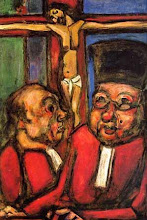
Angilbert (fl. ca. 840/50), On the Battle Which was Fought at Fontenoy

The Law of Christians is broken,
Blood by the hands of hell profusely shed like rain,
And the throat of Cerberus bellows songs of joy.

Angelbertus, Versus de Bella que fuit acta Fontaneto

Fracta est lex christianorum
Sanguinis proluvio, unde manus inferorum,
gaudet gula Cerberi.

Friday, June 19, 2009

"Law Like Love"--3rd Myth--Progressives and Liberals

The grandchildren put out a treble tongue,
Law is the senses of the young.

The grandfather—symbol of the wisdom of the old or of the past—is not the only one whose answer is rejected by Auden. Similarly the grandchild—symbol of the progressive, liberal, and seemingly unmoored and tinkering reformer—has an ideal of law that is equally objectionable. The treble tongue of the grandchildren referenced by Auden has an ambiguity in it.[i] It is treble in the sense that it is high-pitched, immature, a symbol of the fickleness and shallowness typical of youth. The voice of the young who reject the traditions of their elders lacks the depth and the reliability of the basso continuo. It is also treble in the sense of triple; the triple tongue being perhaps a reference to a serpent that traditionally was pictured as having a triple tongue, an ore trilingui.[ii] In advocating their senses as the foundation of law—law based on emotivism[iii]—and rejecting the role of practical reason and the traditions of their elders in the construction of their law, the youth, i.e., moderns, speak the words of the devil. Law as custom or tradition, viewed by moderns as antiquated, and rejected by our world which—since (seminally) the Renaissance and Reformation and (expressly) in the Enlightenment—has rejected the Aristotelian notion of virtue and man as a political animal. The result has been a subjectivism and relativism in ethics and, by extension, in law, which is well-nigh crippling in terms of dialogue and moral consensus and progress. (MacIntyre)

If both the traditions of the elders and the emotivism of youth are inadequate sources of Law, then where do we go? To Revelation? To the Church? To a Theocracy?

[i] Ambiguity is a recurring feature in Auden’s poetry. Anthony Hecht, The Hidden Law: The Poetry of W. H. Auden (Cambridge: Harvard University Press, 1993), 10.
[ii] Cf. Horace, Book III, Ode XI, v. 20; Book II, Ode XIX, v. 31.
[iii] Emotivism in ethics (also known as the emotive theory) is the meta-ethical theory that value judgments—which include moral judgments and by extension law—do not state facts, but, are rather merely expressions of emotions. The philosophical “father” of emotivism in ethics is G. E. Moore (see, e.g., his Principia Ethica and Ethics). and the theory was popularized by A. J. Ayer in his book Language, Truth and Logic. As Alasdair MacIntyre defines it: “'Emotivism is the doctrine that all evaluative judgments and more specifically all moral judgments are nothing but expressions of preference, expressions of attitude or feeling, insofar as they are moral or evaluative in character.” Alasdair MacIntyre, After Virtue (Notre Dame Press), 10-11. The theory is clearly horribly subjective, rejects the principles of an objective ethics, and thus precludes any rational discussion on ethics, right and wrong, and the true and the good. It results in “Children afraid of the night / Who have never been happy or good.” Auden, "September 1, 1939"

"Law Like Love"--2nd Myth--Traditions of the Elders

Law is the wisdom of the old,
The impotent grandfathers feebly scold;

These “impotent grandfathers” are reactionaries who base the law on the customs of the ancients, who want to undo the present and return to times past. In Auden’s view, this represents an abandonment of reason and prudence, and relies on an ideology, a dogma that insists that everything old or done in times past is ipso facto good.

Auden calls this unthinking, reflexive conservatism “impotent.” Law based upon pure senectitude, the flaccid holding of times past, and not on Reason. This is not the wisdom of the ancients applied and adopted to new circumstances. This is not a vision of Law based upon a virile or perenially-true philosophy, but a vision of Law that borders on the doddering babblings of a feeble senility, a view of Law that suffers from sclerosis. That, at least, is how Auden refers to its advocates.

One cannot help but think that Auden, in these short two verses, refers to the criticism of the Benthamite Sydney Smith (1771-1845),[i] as found in his Fallacies of Anti-Reformers, and adopts them as his own:

Our Wise Ancestors—The Wisdom of Our Ancestors—The Wisdom of Ages Venerable Antiquity—Wisdom of Old Times.—This mischievous and absurd fallacy springs from the grossest perversion of the meaning of words. Experience is certainly the mother of wisdom, and the old have, of course, a greater experience than the young; but the question is who are the old? and who are the young? Of individuals living at the same period, the oldest has, of course, the greatest experience; but among generations of men the reverse of this is true. Those who come first (our ancestors) are the young people, and have the least experience. We have added to their experience the experience of many centuries; and, therefore, as far as experience goes, are wiser, and more capable of forming an opinion than they were. The real feeling should be, not can we be so presumptuous as to put our opinions in opposition to those of our ancestors? but can such young, ignorant, inexperienced persons as our ancestors necessarily were, be expected to have understood a subject as well as those who have seen so much more, lived so much longer, and enjoyed the experience of so many centuries? All this cant, then, about our ancestors is merely an abuse of words, by transferring phrases true of contemporary men to succeeding ages. Whereas (as we have before observed) of living men the oldest has, caeteris paribus, the most experience; of generations, the oldest has caeteris paribus, the least experience. Our ancestors, up to the Conquest, were children in arms; chubby boys in the time of Edward I; striplings under Elizabeth; men in the reign of Queen Anne; and we only are the white-bearded, silver-headed ancients, who have treasured up, and are prepared to profit by, all the experience which human life can supply. We are not disputing with our ancestors the palm of talent, in which they may or may not be our superiors, but the palm of experience in which it is utterly impossible they can be our superiors. And yet, whenever the Chancellor comes forward to protect some abuse, or to oppose some plan which has the increase of human happiness for its object, his first appeal is always to the wisdom of our ancestors; and he himself, and many noble lords who vote with him, are, to this hour, persuaded that all alterations and amendments on their devices are an unblushing controversy between youthful temerity and mature experience!—and so, in truth they are—only that much—loved magistrate mistakes the young for the old, and the old for the young—and is guilty of that very sin against experience which he attributes to the lovers of innovation.

****

What was the wisdom of the single age which enacted the law, compared with the wisdom of the age which proposes to alter it? What are the eminent men of one and the other period? If you say that our ancestors were wiser than us, mention your date and year. If the splendor of names is equal, are the circumstances the same? If the circumstances are the same, we have a superiority of experience, of which the difference between the two periods is the measure. It is necessary to insist upon this; for upon sacks of wool, and on benches forensic, sit grave men, and agricolous persons in the Commons, crying out: “Ancestors, ancestors! hodie non! Saxons, Danes, save us! Fiddlefrig, help us! Howel, Ethelwolf, protect us!” Any cover for nonsense—any veil for trash—any pretext for repelling the innovations of conscience and of duty![ii]

Yet Auden’s criticism of the knee-jerk conservative view of law as tradition does not put him in the camp of the progressives or liberals or Benthamites who seem to advocate of change for change’s sake, and give no weight to inherited customs which often define a people. This is clear from the two immediately following verses to which we next turn.

[i] Sydney Smith, an English clergyman, eventually became prebendary of Bristol and Canon of St. Paul’s. He was considered to be one of the cleverest men of his age. In one of his many works, Smith reviewed Jeremy Bentham’s Book of Fallacies: From the Unfinished Papers of Jeremy Bentham. Notably, Auden was editor of, and wrote an introduction to, a book of selected writings of Sydney Smith, and so would have been intimately familiar with him. See W. H. Auden, ed. Selected Writings of Sydney Smith (London: Farrar, Staus & Cudahy, 1956).
[ii]http://smith.classicauthors.net/FallaciesOfAntiReformers/FallaciesOfAntiReformers1.html.

Thursday, June 18, 2009

"Law Like Love"--1st Myth--Materialists and Hedonists

Law, say the gardeners, is the sun,
Law is the one
All gardeners obey
To-morrow, yesterday, to-day.

The first myth of Law, which is not Auden’s view and is the first general theory he implicitly criticizes, is that of the “gardeners.” Who are these gardeners to which Auden refers? The noun “gardeners” may be a reference to the school of the materialistic and hedonist Epicureans, followers of the ancient Greek philosopher Epicurus of Samos (341-270 b.c.). Like Plato, who established his Academy, Aristotle, who established his Lyceum, and Zeno who established the Stoa Poikile, Epicurus formed his own school that was called The Garden. The inscription at the gate that led to The Garden according to Seneca read “here our highest good is pleasure.”[i] Good and evil were defined by a cost/benefit analysis of pleasure and pain, and justice defined in a social-contract sense of a compact neither to harm nor be harmed. Epicurus taught that the gods were unconcerned with the affairs of men, and so should have no bearing on the formation of laws.

It is doubtful that Auden intended to focus on the Greek Epicureans. Surely, Auden’s gardeners include the modern disciples of Epicurus. The hedonist, atomist notions of Law of Epicurus have enjoyed a modern resurrection. One may find the ancient Greek doctrine in Liberal robes in the consequentialists or utilitarians or their predecessors, such as Hume, Bentham, and Mill, who advanced passion, or pleasure (or avoidance of pain) as the principle of morality, and hence of law. This has had a particular resurgence in the "Law and Economics" group, perhaps the most significant advocate being Judge Posner. This hedonistic ghost was also taken by Locke who robed it in traditional natural law clothes, and through Locke it came to Jefferson, and through Jefferson it made it into our traditions as one of our jurisprudential inheritances. There it meshed like an uneasy patch on the traditional notions of natural law that were part and parcel of the common law and the philosophical inheritances of a (Graeco-Roman) Classical and Roman Catholic past.

Law is the sun which guides the seasons, and which we cannot fight, the Law which we are compelled to obey. We must not resist this Nature but submit to her, as Epicurus might say.[ii] But this Nature is not one with a design, a telos or end under the guidance of a Providential and personal God who is transcendent; ultimately, it is the Nature of a clock fashioned by (at best) the impersonal Deist God whose cogs and wheels we are; or perhaps the nature of Chaos, that is, of the random order of chance in a universe which knows no God. Fate, moira (μοῖρα), is what's behind it all, including law. "The sun will not transgress its boundaries; otherwise, the guardians of Justice, the Furies, will find out," says Heraclitus. Herac. fr. 94. After all, Epicurus was, like many of our modern philosophers, an atomist who rejected the immortality of the soul and the providence of the gods. Without a meaningful nature to guide them, they are materialists or individualists, perhaps the followers and children of Voltaire, who in his Candide, had his hero tend to his own garden.

After such a passing glance at the hedonists and materialists, Auden then turns his gaze upon the traditionalists.


[i] Seneca, Epistle XXI.
[ii] Cf. Vatican No. 21.

"Law Like Love"-Introduction

Pace Holmes, that brilliant ideologue and jurist, and his influential Path of the Law which spurned all forms of mystery in Law,[i] there remains all the same a certain mystery in Law. The mystery of Law rises to greet us when we try to define what Law is, when we try to grapple with the philosophical ideal behind Law, that is, universal Law or a related concept, the end or telos of Law. This enigma even faces us when we tackle something simpler, such as trying to fathom the central case of human law, that is, the definition, behind the many forms or variants of law that are found among the communities of mankind. It is also there when we try to formulate the argument as to why and when, if at all, human laws demand our respect, that is, bind us in conscience.

The halls of academia and the annals of history are strewn with the corpses of legion theories on what Law is, or in some cases, theories that doubt that there is any Law at all. Modernly, many of the theories advanced by philosophers and legal scholars sound flat. Under the banner of being scientific or philosophically rigorous or neutral, they are practically atheistic and amoral; they are hopeless and dull, do not inspire the imagination, much less obedience. They never talk about love.

Modern efforts appear wholly to ignore what may be called the vertical component of Law. Invariably, the modern theorists reject traditional concepts of natural moral law which embrace the notions of God, that we are made in his image, and that he has ordered his creation, that is, nature—including our own—, with a purpose and design which informs us of His will, and which ought to be respected. The modern theories of jurisprudence avoid the hard questions by definitional léger de main, skirting by the role that God or our status as creatures with a given nature might play in the understanding Law. Inspired by a philosophical nominalism or by philosophical existentialism, they base their premises on there being no such thing as nature that ought to constrain our radical liberty; existence precedes essence, and our nature is what we want it to be. Though complex, and presented in prolix, technical prose, these modern theories, despite a surfeit of sophistication, have a bland even sour aftertaste. Most fail to justify how Law binds us and why. The majority espouses some sort of positivistic philosophy that shuns the question of how Law is related to the moral and spiritual life of man; that majority is impatient with the distinction and the analogy between human law and human morals, and so they cut the corpus callosum between the two to simplify their task. As if to ignore the massive overlap between the two.

While modern theories ignore the vertical component of the question of Law, they do not neglect what may be called the horizontal component of the question of Law. The horizontal component focuses on the question of the interaction between individual and community. Here the field is commanded by a liberalism, whether economic or moral, which emphasizes the individual at the expense of the community, liberty at the expense of order, rights at the expense of duties. The emphasis in the individual results in but a little voice given to the communitarian aspects of human life which may constrain rampant individualism: the institutions of marriage, of family, inherited culture and traditions, and the needs of the greater community, i.e., the common good.

The answer to the question of what Law is seems to be found in that boundary between reason and mystery, between nature and convention, between matter and spirit. Like all things authentically human, the law participates in a dual life, both heavenly and mundane, individual and communal. So perhaps it is moderns’ refusal to countenance mystery in its various jurisprudential theories that lead to their one-dimensional blandness.

It was precisely this blended land of mystery and reason where Law’s meaning is to be found that intrigued the poet, Wystan Hugh Auden (1907-1973), and led to his thoughtful and insightful poems he wrote in 1939 and 1940: “Law Like Love,” “The Hidden Law,” and “New Year Letter.”[ii] Those poems were written when Auden was crossing the threshold: away from the materialistic communism he had espoused into the Christianity of his parents that he had rejected in his youth.[iii] In that poem, and a companion poem, “The Hidden Law,” Auden distinguishes between human or positive law and the natural Law, a theme he also treated at great length in his collection of poems entitled The Double Man, especially in the poem “New Year Letter.”[iv] In these poems, Auden’s message is that, because Law interacts with matters human and divine, and individual and communal, one cannot say “Law is” anything; rather, one must recognize the mystery in Law and speak analogically. At best one can say “Law [is] like” something. Auden adopts the Isaiahan or Pascalian image of the mysterious, hidden God—the hidden God, the Deus absconditus of Isaiah and Pascal—in his encounter with the mystery of Law. For Auden, Law participates in the very life of the divinity and so shares in his mystery. Law is a Lex abscondita, a hidden Law. Auden’s message is Augustinian: Si comprehenderis non est Lex. If you understand it by equating it with a copula is and not by an imperfect analogy, you have misunderstood it. Law is like love. Law is mystery. Law is both in the heart of one man, and in the midst of the group.

“Law, Like Love” is a poem broken into two clear sections. The first explores the various false theories, the myths as it were, of Law. The second and final part of the poem ends by offering its own very personal and yet universal solution to the concept of Law.

[i] E.g., O. W. Holmes, The Path of the Law 10 Harv. L. Rev. 457 (1897) reprinted in Oliver Wendell Holmes, Collected Legal Papers (New York: Harcourt, Brace & Howe, 1920), 167. “When we study law we are not studying a mystery . . . .” Auden might respond with Galileo’s quip: Epur si muove, and yet it does. As Profesor Vining has put it: “Law has not accepted the spirit of the age that (in Keat’s words) would climb an Angel’s wings and empty the haunted air.” Joseph Vining, The Authoritative and the Authoritarian (Chicago: University of Chicago Press, 1986), 5, 39.
[ii] W. H. Auden, “Law Like Love,” “The Hidden Law,” and “New Year Letter,” in Collected Poems (New York: Vintage International, 1991), 262-64, 264, 199-243. (Edward Mendelson, ed.). When published in the collection The Double Man, the poem “New Year Letter” was accompanied by significant notes which are not published in the Collected Poems. See W.H. Auden, The Double Man (New York: Random House 1941), 75-162. “Law Like Love” was dated September 1939. “The New Year Letter” was completed between January and April 1940. “The Hidden Law” was dated Autumn 1940. Though published (untitled) as a note to “The New Year Letter” in The Double Man, “The Hidden Law,” also appeared under the title Aera sub Lege in 1945. See Collected Poems, 905. These were close to Auden’s formal reception into the Anglican Church in 1940. Arthur Kirsch, Auden and Christianity (New Haven: Yale University Press, 2005), xiii. Though stemming from a family bristling with Anglican clergymen, Auden lapsed at 13, only to re-acquire his faith about twenty years later. Kirsch, 6. However, though Auden’s Christianity matured after his initial return, at this time his transformation was in its infancy. Mendelson described it thus: “[Auden’s] beliefs took the form of a lonely existentialist Protestantism quite unlike the communal rituals of the Anglo-Catholicism he had abandoned at fifteen.” Mendelson, Later Auden, xviii. Auden gradually accepted the more ritualized and traditional Anglo-Catholicism. But both in terms of faith and morals, however, Auden’s Christianity was always highly idiosyncratic, and unfortunately suffered from both a lack of orthodoxy and moral integrality. For example, he expressed reservations, even hostility, to the doctrines of the Virgin Birth and Immaculate Conception. Kirsch, 44. He also appears to have adopted a Patripassion view of Christ’s suffering, and harbored doubts about the Resurrection. Kirsch, 4, 174. Though he struggled with it (calling it “crooked love”) and sought to understand its origin, rationalize it, or even overcome it, see, e.g., Mendelson, Early Auden, 59, at the end of the day he never appears to have reconciled his homosexuality with the moral teachings of the Church and the Scriptures that proscribed such misuse of the sexual faculties. There is a certain scandal that can be placed on his feet. He was not chaste, and had multiple lovers, and at least one reasonably long-term homosexual relationship (with a man called Chester Kallman) he even considered to be “marital.” Mendelson, Later Auden, 43 ff. Later in life, he appears to have developed a firmer notion of homosexuality’s moral wrongness. Kirsch, 172-73. His failure to overcome it remains a very unfortunate blot on this moral poet’s life, and one that has to be considered in assessing his work.
[iii] At the time he wrote the poems “Law Like Love,” “The Hidden Law,” and “New Year Letter,” Auden’s Christianity was incipient. His Christianity was influenced by the writings of Søren Kierkegaard, and was one very subjective in its emphasis. It shunned dogma and the need to be in communion with an ecclesial body. Auden later learned the value of the communal life in the life of a Christian, and joined the Episcopal Church.
[iv] John Fuller, W. H. Auden: A Commentary (Princeton: Princeton University Press, 1998), 250.

"Law Like Love"

While we wait on the remaining articles relating to Ecstasis and Telos and Levering's book (I do have to practice law), I'll post W. H. Auden's poem entitled "Law Like Love," and some reflections on it I wrote some time ago. The poem was published in a book of poems entitled Another Time. Commentary will follow.


Law, say the gardeners, is the sun,
Law is the one
All gardeners obey
To-morrow, yesterday, to-day.

Law is the wisdom of the old,
The impotent grandfathers feebly scold;
The grandchildren put out a treble tongue,
Law is the senses of the young.

Law, says the priest with a priestly look,
Expounding to an unpriestly people,
Law is the words in my priestly book,
Law is my pulpit and my steeple.

Law, says the judge as he looks down his nose,
Speaking clearly and most severely,
Law is as I've told you before,
Law is as you know I suppose,
Law is but let me explain it once more,
Law is The Law.

Yet law-abiding scholars write:
Law is neither wrong nor right,
Law is only crimes
Punished by places and by times,
Law is the clothes men wear
Anytime, anywhere,
Law is Good morning and Good night.

Others say, Law is our Fate;
Others say, Law is our State;
Others say, others say
Law is no more,
Law has gone away.

And always the loud angry crowd,
Very angry and very loud,
Law is We,
And always the soft idiot softly Me.

If we, dear, know we know no more
Than they about the Law,
If I no more than you
Know what we should and should not do
Except that all agree
Gladly or miserably
That the Law is
And that all know this
If therefore thinking it absurd
To identify Law with some other word,
Unlike so many men
I cannot say Law is again,

No more than they can we suppress
The universal wish to guess
Or slip out of our own position
Into an unconcerned condition.
Although I can at least confine
Your vanity and mine
To stating timidly
A timid similarity,
We shall boast anyvay:
Like love I say.

Like love we don't know where or why,
Like love we can't compel or fly,
Like love we often weep,
Like love we seldom keep.