Angilbert (fl. ca. 840/50), On the Battle Which was Fought at Fontenoy

The Law of Christians is broken,
Blood by the hands of hell profusely shed like rain,
And the throat of Cerberus bellows songs of joy.

Angelbertus, Versus de Bella que fuit acta Fontaneto

Fracta est lex christianorum
Sanguinis proluvio, unde manus inferorum,
gaudet gula Cerberi.
Showing posts with label Jesus Christ. Show all posts

Saturday, January 16, 2010

Girolamo Zanchi on Human Law, Part 3

Girolamo Zanchi


ZANCHI CONCLUDES HIS TREATMENT on the relationship between human or political law and the natural law by addressing the issue of the construction or enforcement of human law, and by pointing out two significant distinctions between human law and the natural law.

With respect to the first issue, Zanchi insists that the natural law has a role in the application of human law in certain situations where the law--if enforced according to the letter--results in injustice. His reasoning as as follows.

Human laws, that is, positive laws of the State, have as their aim the promotion of the common good. On occasion, however, enforcement of the letter of this law may actually result in "the ruin of those people for whose sake it was enacted," thus contradicting its purpose. There are therefore instances where the "letter of the law" should not be followed; rather, the "purpose of the law and the spirit of the law-giver must be examined and followed." This appears to be an application by Zanchi of the legal maxim salus populi suprema lex est, the welfare of the people is the supreme law, a principle as old as the Roman Twelve Tables (Compare Cicero, De Legibus, 3.3.8 ("ollis salus populi suprema lex esto")

As an example of such an instance, Zanchi supposes a human law that provides that no person is allowed to open the city gates if the city is being besieged. Obviously, this law is unobjectionable from a general perspective, and it seeks to protect the citizens and promote the common good when the city is under seige by preventing the city from being occupied by enemy force. Thus, this law would derive from the natural law.

Zanchi then posits the situation where the city is under seige, and the city's army is outside the walls engaged in battle with the opposing army. The city's army retreats and seeks entry into the safety of the very city which they are defending. If the letter of the law is obeyed in this circumstance, the city's army will be slaughtered and without its army the city will ultimately be captured, defeating the law's purpose and the natural law. "[W]ho does not see that in such a case the city gates must be opened despite the letter of the law . . . .?" (345) Clearly, the letter of the law ought not to be followed in such and similar instances, but the purpose of the law, the intent of the legislator, and the natural law override the law's letter.

Justinian's Codex recognized this principle (1.14.5): "There is no doubt that he violates the law, who, adhering to its letter, violates its spirit . . . ." (Non dubium est in legem committere eum, qui verba legis amplexus contra legis nititur voluntatem . . . .). Similarly, this principle is carried forward in the teaching of the Church fathers and ecclesiastics, and applies in the context of divine law as well as human law. "Some law-followers," Zanchi states, "have actually sinned against the will of God" even when externally obeying the letter of the divine law itself because they act against its principle, its spirit. As examples of this, Zanchi cites the various encounters between Jesus and the Pharisees and Scribes related in the Gospel. These are examples where the letter of the law and the spirit of the law conflict. Thus, plucking heads of grain on the Sabbath did not violate the divine injunction to keep the Sabbath day holy (Mark 2:23-28; Matt. 12:1-7), nor did curing a man on the Sabbath (Matt.12:9-14), since they conformed to the purpose of the law, and the enforcement of the letter of the law contradicted its purpose.

Zanchi thus concludes:
Laws are enacted from natural law for the common good and the welfare of human beings, and only for as long as they do so do they have the power to obligate. If, therefore, it should happen that by sticking to the letter of the law, we act against the welfare of human beings, we have acted more against the law than in accordance with it.

(346) However, Zanchi cautions that this principle is not to be used without some restriction. The power to determine in the first instance when enforcement of the letter of the law violates the natural law--and therefore ought not to be obeyed--is with the authorities, assuming that they may coveniently be available. "When, however," the authorities "cannot be easily consulted and there is a danger in delay, and the case of the law is clear to each person," then in such instance "it is appropriate for the person involved, to whom the responsibility falls, or on whom the burden of the State is conferred," when the purpose "of the law is lost, to follow his own interpretation of the law." (346)

Zanchi completes his treatment of human laws by pointing out two fundamental distinctions between the human law and the natural law. The first is that, while human law changes, the natural law does not and cannot. The second difference is that human law only governs external acts, whereas the natural law covers both external and internal acts. He explores those two issues.

First, Zanchi observes that the natural law is unchanging, whereas human law changes depending on the contingencies of time, place, and personality. For this reason, there may be disagreement between human law and natural law. The natural law cannot change for the very simple reason that it "is simply certain, general eternal aspects of God's will, the revelation of the rule for doing and avoiding, written on the hearts of human beings." (347) Human laws, on the other hand, "cannot be eternal and unchangeable because their circumstances," in terms of "place, time, and personality" vary. (347) This distinction between the two is what makes St. Augustine state in his De libero arbitrio (On Free Will) [1.6.14.48] that temporary laws may be suspended for a time (Appellemus ergo istam legem, si placet, temporalem, quae quamquam iusta sit, commutari tamen per tempora iuste potest.)

It follows that human laws must change to conform to the natural law. Human law must therefore change in two situations. First, the development in human reason, as a community advances from relative imperfection to relative greater perfection, demands that the human law be adapted to reason's development. Laws ought to reflect the same development one sees in philosophy or other sciences. Second, differences and varieties in people, communities, or States require different laws adapted to their specific situations. As an example of how the state of a people affects laws, Zanchi again refers to St. Augustine. If a people is virtuous, it may be acceptable for them to elect their own magistrates. However, if the people become depraved, then allowing them to elect their own magistrates may result in the election of criminals, and so the law allowing for participatory elections should be changed. (De Libero Arbitrio, 1.6.14.45-46)

[Zanchi then applies this principle to the Church, and gives as an unfortunate example the selection of ministers; however, here he displays the prejudice of the Reformers which fails to give sufficient deference to the teachings of Christ on Church governance and its constitution.]

How, then, can human laws change, but the natural law not change?

The response to this . . . is quite simple: Anything that human laws retain from natural law cannot be changed, but anything that differs from it because of the particular circumstances and that impedes the public good more than it advances it must be changed. In addition, human laws by their own nature have their own individual circumstances. Thus, because circumstances change, it follows that the [human] law can change entirely too. Still, natural law maintains its general principles without any particular circumstances. Thus, it remains immutable.

(348) The second big difference between the natural law and human law is that the natural law is broader, more extensive than human law. The natural law "prohibits all vices and crimes, in general, both internal and external ones." Thus, the natural law "regulates not only external worship but also internal worship." (348) Likewise, the natural law, in particular the "Golden Rule," prohibits not only external injury to our neighbor, but internal injuries, such as nursing hatred and envy. "Love is commanded," by the natural law, "because we, ourselves, want to be loved."

In contradistinction with the natural law which governs both external and internal fora, human or political laws only relate to "external crimes" and "external duties." (349) Human laws do not reach into the inner part of man. The reason for this is that human laws have limited scope and purpose. Since human or political laws look only toward promoting the common good, they do not look at the private good of an individual except perhaps accidentally.

Moreover, even in externals, human law is limited. There is a prudential aspect in human law that is absent in the natural law. Human laws simply cannot prohibit every external wrong without resulting in greater harm to the common good. Human laws can only prohibit those wrongs that prudently can be prevented. Where something cannot be prevented, either as a result of human nature, custom, or the people's wishes, human law ought not be applied because it would be vain and fruitless or would result in greater harm. Thus Proverbs 30:33: "Pressing the nose produces blood" (qui vehementer emungitur elicit sanguinem). Zanchi suggests that Christ recognized this principle when, as related in Matthew 9:17, he says that if new wine is put into old wineskins, the old wineskins will burst and the wine will be lost. The new wine represents "harsher and stronger ideas," and if people are not ready for them "the people will fall from bad to worse and become more corrupt" by trying to hoist these ideas upon them. Thus, human or political law requires prudent and wise application. This element of human laws gives rise to one of the more important principles of human legislation: "It is essential that the laws be possible. By possible I mean, in accordance with both nature and the customs of the people." (349).

In conclusion, Zanchi's treatment of the natural law is substantially more traditional and classical than Calvin's treatment, though it appears more influenced by the Protestant Reformers' ideas than Vermigli, whose doctrines were reviewed in earlier posts on this blog. Zanchi's treatment, however, is much more complete and methodical than Calvin's and Vermigli's treatment of the natural law. Zanchi, nevertheless, does provide some basis for a Protestant tradition of the natural law, a tradition that, as we discussed in earlier blogs, Karl Barth vehemently, and perhaps--applying strictly the underlying principles of the Reformer's theology--logically rejected.

Doctrines of the natural law will invariably be affected by one's theological or philosophical presuppositions. Theological error will often find outlet in a false view of the natural law. Thus, for example, Calvin's theological error with respect to the depravity of man marred his view of natural law. A fortiori, Barth's theological error entirely blinded him to the continuing validity of the natural law. Similarly, one's philosophical presuppositions can affect one's doctrine of the natural law. Thus, someone with a nominalist or materialist, mechanistic philosophy (as distinguished from someone with a realist philosophy or a philosophy open to the existence of God) will be seriously hampered in his ability to grasp the possibilty eternal or natural law. Theological and philosophical traditions, in addition to our own culture's customs and our own internal passions and vices, can render our vision astigmatic, myopic, hyperopic . . . indeed, can make us even blind to the fullness of the eternal and the natural law, just as it can blind us to the Gospel.

Tuesday, July 21, 2009

Universal Ethic-Jesus Christ, the End of the Natural Law 2-The Logos Incarnate, the Living Law


5.1. The "Logos" Incarnate, the Living Law

103. Thanks to the natural light of reason, which is a participation in the divine Light, men and women are in a position of scrutinizing the intelligible order of the universe to discover therein the expression of the wisdom, the beauty, and the goodness of the Creator. As a result of this knowledge, they can insert themselves in such order with moral acts that conform to it. Now, thanks to a deeper understanding of God’s design of which the Creator is the fitting prelude, the Scriptures teach the believer that this world was created by the Logos, from him and with him, the Word of God, the beloved Son of the Father, the uncreated Wisdom, and that the world finds in Him life and subsistence. In fact the Son is "image of the invisible God, the first-born of all creation, since in him (en auto) were created all things, in the heavens and on earth, those visible and those invisible . . . . All things were created by means of Him (di’ auton), and in His sight (eis auton). He is before all things, and all exist in Him (en auto)" (Col. 1:15-17).(89) The Logos is therefore the key of creation. Man, created in the image of God, carries in himself a special imprint of this personal Logos. And so he is called to be conformed with and assimilated into the Son, "the first born among all his brothers" (Rom. 8:29).

104. But because of sin, man made a bad use of his freedom, and he has thus distanced himself from the source of wisdom. Having done so, man has distorted the knowledge that he otherwise would have been able to have of the objective order of things, even of the natural order. Men, knowing that their works are evil, hate the light and elaborate false theories to justify their sins. (90) So the image of God in man is seriously darkened. Even if men’s nature prompts them still to a realization in God (the creature cannot pervert itself to the point of being completely unable to recognize the many signs that the Creator offers of Himself in creation), at the same time the fact is that men are seriously damaged by sin so that they fail to appreciate the profound meaning of the world, and instead view it in terms of pleasure, of money, or of power.

105. With his salvific Incarnation, the Logos, taking on a human nature, restored the image of God and restored man to to that same image. So Jesus Christ, the new Adam, carries to completion the original design of the Father regarding man, and at the same time reveals man to himself. “The truth is that only in the mystery of the incarnate Word does the mystery of man take on light. For Adam, the first man, was a figure of Him Who was to come, namely Christ the Lord. Christ, the final Adam, by the revelation of the mystery of the Father and His love, fully reveals man to man himself and makes his supreme calling clear. . . . He Who is "the image of the invisible God" (Col. 1:15),(21) is Himself the perfect man. To the sons of Adam He restores the divine likeness which had been disfigured from the first sin onward. Since human nature as He assumed it was not annulled, by that very fact it has been raised up to a divine dignity in our respect too.”(91) Jesus Christ manifests therefore in His person an exemplary human life, in full conformity with the natural law. So he is the ultimate criterion to decipher correctly what are the authentic natural desires of man, when they are not concealed by the distortions introduced by sin and from disordered passions.


106. The incarnation of the Son was prepared by the economy of the old Law, sign of the love of God for His people Israel. According to some of the Fathers, one of the motives behind God giving to Moses a written law was to remind men of the exigencies of the natural law written in their hearts, but which was partially obscured and cancelled by sin.(92) This Law, which Judaism has identified with pre-existing Wisdom which presides over the destiny of the universe,(93) thus put forth, within the capacity of men marked by sin, the concrete practice of true wisdom, which consists in the love of God and of one’s neighbor. It contained liturgical and positive legal precepts, but also moral prescriptions, summarized in the Decalogue, which corresponded to the implications of the natural law. So the Christian tradition saw in the Decalogue a privileged and always valid expression of the natural law.(94)

107. Jesus Christ has not "come to abolish but to give full completion" to the Law (Matt 5:17).(95) As it appears in the Gospel texts, Jesus "taught like one with authority and not like the scribes" (Mark 1:22), and did not hesitate to relativize, or even to abolish, some of the particular and temporary dispositions of the Law. But He also confirmed the essential content and, in His person, carried out to perfection the practice of the Law, taking on for love the different types of precepts—moral, cultural, and legal—of the Mosaic Law, which corresponded with the three functions of prophet, priest, and king. St. Paul affirms that Christ is the end (telos) of the Law (Rom 10:4). Telos has here a double sense. Christ is the "end" of the Law, in the sense that the Law is pedagogical means which ought to lead mankind to Christ. But moreover, for all those who through faith live in Him by the Spirit of love, Christ "puts an end" to the positive obligations of the Law which were appended to the requirements of the natural law.(96)


108. In fact, Jesus expressed in different manners the ethical supremacy of Love (carità), which unites inseparably the love of God and the love of neighbor.(97) Love (carità) is the "new commandment" (John 13:34) that recapitulates all the Law and provides the key of interpretation for it: "From these two commandments depend all the Law and the Prophets" (Matt. 22:40). It also reveals the profound meaning of the golden rule. “Do not do to anyone that which you do not want done to you” (Tobit 4:15) becomes with Christ the commandment of love (amore) without limit. The context in which Jesus cites the golden rule determines in depth its comprehension. It is found at the center of a section that begins with the commandment: "Love your enemies, do good to those who hate you” and ends with the exhortation: “Be merciful as your Father in heaven is merciful.”(98) Going beyond the rule of commutative justice, in the shape of a challenge, it invites one to take the initiative of a love which is a gift of self. The parable of the good Samaritan is characteristic of this Christian application of the golden rule: the center of interest passes from the care of oneself to the care of the other.(99) The Beatitudes and the Sermon on the Mount explain the manner in which one ought to live the commandment of love, in thanksgiving and in the awareness of the other, elements proper of the new perspective assumed by Christian love. So the practice of love surpasses every closure and every limit. It gains a universal dimension and an incomparable force, since it renders the person capable of doing that which would be impossible without love.

109. But above all, Jesus carries to completion the law of love in the mystery of His holy Passion. Here, like Love incarnate, it reveals in a plenary human way what love is and what things it implies: to give life for those which one loves.(100) "Having loved his own who were in the world, he loved them to the end" (John 13:1). Through the obedience of love to the Father and through desire for His glory which consists in the salvation of men, Jesus accepts the suffering and the death of the cross for the benefit of sinners. The same person of Christ, Logos and incarnate Wisdom, so becomes the living law, the supreme rule for every Christian ethic. The sequela Christi [following of Christ], the imitatio Christi [imitation of Christ] are the concrete ways to realize the Law in all of its dimensions.


(89) Cf. also John 1:3-4; 1 Cor 8:6; Heb. 1:2-3.

(90) Cf. John 3:19-20; Rom. 1:24-25.

(91) Vatican II, pastoral Constitution
Gaudium et spes, n. 22. Cf. Irenaeus of Lyons, Against the heresies, V, 16.2 [Sources chrétiennes, 153, 216-217] : "For in times long past, it was said that man was created after the image of God, but it was not [actually] shown; for the Word was as yet invisible, after whose image man was created, Wherefore also he did easily lose the similitude. When, however, the Word of God became flesh, He confirmed both these: for He both showed forth the image truly, since He became Himself what was His image; and He re-established the similitude after a sure manner, by assimilating man to the invisible Father through means of the visible Word.”

(92) Cf. St. Augustine, Enarrationes in Psalmos, LVII, 1 [Corpus christianorum, series latina, 39, 708] : " Inasmuch as the hand of our Maker in our very hearts hath written this truth, ‘That which to thyself thou wouldest not have done, do not thou to another.’ Of this truth, even before that the Law was given, no one was suffered to be ignorant, in order that there might be some rule whereby might be judged even those to whom Law had not been given. But lest men should complain that something had been wanting for them, there hath been written also in tables that which in their hearts they read not. For it was not that they had it not written, but read it they would not. There hath been set before their eyes that which in their conscience to see they would be compelled; and as if from without the voice of God were brought to them, to his own inward parts hath man been thus driven. (Quandoquidem manu formatoris nostri in ipsis cordibus nostris scripsit: “Quod tibi non vis fieri, ne facias alteri”. Hoc et antequam lex daretur nemo ignorare permissus est, ut esset unde iudicarentur et quibus lex non esset data. Sed ne sibi homines aliquid defuisse quaererentur, scriptum est et in tabulis quod in cordibus non legebant. Non enim scriptum non habebant, sed legere nolebant. Oppositum est oculis eorum quod in conscientia videre cogerentur; et quasi forinsecus admota voce Dei, ad interiora sua homo compulsus est)". Cf. St. Thomas Aquinas, In III Sent., d. 37, q. 1, to. 1: In III Sent., d. 37, q. 1, a. 1: "Necessarium fuit ea quae naturalis ratio dictat, quae dicuntur ad legem naturae pertinere, populo in praeceptum dari, et in scriptum redigi [...] quia per contrariam consuetudinem, qua multi in peccato praecipitabantur, iam apud multos ratio naturalis, in qua scripta erant, obtenebrata erat"; Summa theologiae, Ia-IIae, q. 98, art. 6.

(93) Cf. Sir 24:23 (Vulgate: 24:32-33).

(94) Cf. St. Thomas Aquinas, Summa theologiae, Ia-IIae, q. 100.

(95) The Byzantine liturgy of St. John Chrysostom expresses well the Christian conviction when it places on the mouth of the priest that blesses the deacon in the thanksgiving after communion: "Christ our God, You Who are the completion of the Law and of the Prophets, and You Who have completed the whole mission received from the Father, replenish our hearts with delight and joy, in every time, now and always, for ever and ever. Amen."

(96) Cf. Gal 3:24-26: “Therefore the Law has become our tutor to lead us to Christ, so that we may be justified by faith. But now that faith has come, we are no longer under a tutor. For you are all sons of God through faith in Christi Jesus." On the theological notion of completion, cf. Pontifical Biblical Commission, The Hebrew People and Their Holy Scriptures in the Christian Bible, especially n. 21.

(97) Cf. Matt. 22:37-40; Mark 12:29-31; Luke 10:27.

(98) Cf. Luke 6:27-36.

(99) Cf. Luke 10:25-37.

(100) Cf. John 15:13.


Universal Ethic-Jesus Christ, End of the Natural Law 1-Introduction


Chapter V:

Jesus Christ, End of the Natural Law

101. Grace does not destroy nature but heals it, comforts it, and leads it to its full realization. Therefore, even if the natural law is an expression of reason common to all men and can be presented in a consistent and true manner on the philosophical level, it is not outside the order of grace. Its requirements are present and operative in the different theological states that reach through to a humanity affected by the history of the salvation.


102. The design of salvation, of which the eternal Father has the initiative, was realized with the mission of the Son Who gave to men a new Law, the law of the Gospel. This Law of the Gospel consists principally in the grace of the Holy Spirit operating in the hearts of the faithful to sanctify them. The new Law aims above all to induct men into participating in the Trinitarian community of the divine persons, but, at the same time, it assumes and realizes in an eminent manner the natural law. In a certain way, it clearly recalls the requirements which can be obscured by sin or ignorance. In another way, freeing him from the law of sin--on account of which “there is in me the desire of the good, but not the capacity to carry it out" (Rom 7:18)—it gives to men the real capacity of surpassing their selfishness so as to carry out fully the humanizing requirements of the natural law.


Monday, May 11, 2009

"Quid est veritas?"

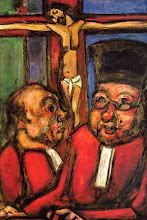
On May 5, I posted a blog regarding Lyotard and his notion of "differend." Continuing on that theme, it ought not to astound us that we are not understood by our contemporaries. Our Lord was similarly not understood by the religious authorities and the civil authorities of His day. He was shunned by the Sanhedrin in the person of Caiphas. He was shunned by Rome in the person of Pontius Pilate. They did not speak the same language. They did not share the same "rule." They were not on equal ground, and so it was forseeable that Christ would be condemned by law. Christ's presence before the Sanhedrin and before Pilate was not a "litigation," but it was a "differend."

In Georges Roualt's "Christ Before Pilate," the poignant scene of the Lord before the Roman Procurator is the French painter's subject. Christ bound by Roman law, is before the representative of Roman law. Pilate is dressed in the judicial robes of red, not unlike the judges in France at the time of Rouault's flourishing. Horrible irony: the author of Law and the fount of Justice is before the dispenser of human law, and He goes unrecognized. The positive human law, and the human judge of that law, has forgotten the source of his authority. He has forgotten the source of his authority, even when he is reminded of it by the Lord. "You would have no authority over me, unless it had been given you from above." (John 19:11) The message does not register, because Pilate has power, and this message is not one that is received by power, or enforced by power, but it is enforced by conscience, the listening to that still, small voice in the human heart which is easily supressible. We must render to Caesar the things that are Caesar, and render to God the things that are God's. (Matthew 22:21) But in the final analysis, all things are God's, since Caesar would have no authority, unless it came from God. In our contemporary world, Christ's message once again goes unheard. It is as though we are Christ before Pilate. Though our fundamental documents presuppose that God is the author of our laws and the source of our government's power, in practice our modern political and legal systems presuppose the opposite. That is why, in a complete disregard of the Natural Law, the State can arrogate to itself the power to define who is human. That allows it to decide who lives and who dies, chosing to defend the life of those who are outside the womb, but letting those that have not yet travelled through the birth canal die. That is why the State has the gall to suppose that it can define marriage in a manner that is against the Natural Law.

Rouault shows no face upon his Christ, and this is fitting. Christ is a victim; he is unrecognized by human law and the human judge. He is no man. He is no God. Certainly the Divinity of the Lord is entirely outside the possible frame of reference of Pontius Pilate. He senses that the man before him has no guilt, but this sense is not strong enough to overcome his practical habit. Pilate is, above all else, a pragmatist, one wholly insensitive to the things of the spirit. It is Pilate's pragmatism, his blindness to things transcendent, his inability to see (much less embrace) Christ, that allows him to issue the unjust sentence against his own God. That is why Rouault depicts Pilate faceless. The man who has misused his power and misused the law to effect the highest injustice has made himself inhuman. He no longer has a human face. By not recognizing the Holy Face of Christ, he has made his own face unrecognizable. Anything human has been rubbed off. Human law and its human dispensers, will only be human--will only have human faces--if they recognize the Lord and recognize His Law.