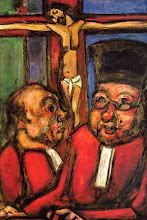
Angilbert (fl. ca. 840/50), On the Battle Which was Fought at Fontenoy

The Law of Christians is broken,
Blood by the hands of hell profusely shed like rain,
And the throat of Cerberus bellows songs of joy.

Angelbertus, Versus de Bella que fuit acta Fontaneto

Fracta est lex christianorum
Sanguinis proluvio, unde manus inferorum,
gaudet gula Cerberi.
Showing posts with label Search for Universal Ethics: A New Look at Natural Law. Show all posts

Wednesday, July 22, 2009

Universal Ethic-Conclusion


Conclusion

113. The Catholic Church, aware of the necessity for men to search in common the rules of a life together in justice and in the peace, desires to share with the religions, wisdoms and philosophies of our time the resources of the concept of natural law. We call natural law the foundation of a universal ethics that we try to extract from the observation of and reflection upon our common human nature. It is the moral law written in the heart of men and of which humanity always takes greater and greater conscience the more history advances. This natural law has not nothing static in its expression; it does not consist in a list of definitive and unchanging precepts. It is a source of inspiration that gushes forth always in the search for an objective foundation for a universal ethic.


114. Our conviction of faith is that Christ reveals the fullness of man, realizing it in His person. But such revelation, however specific, reaches and confirms elements that are already resident in the rational thought of the wisdom of humanity. Therefore, the concept of natural law is first of all philosophical and, as such, it allows for a dialogue which, in respect of the religious convictions of each, is able to appeal to that which is universally human in all human beings. An exchange on the level of reason is possible when one tries to test and to state what is common to guide all men who have been given reason and to establish the requirements of life in society.

115. The discovery of the natural law answers the search for a humanity that always strives to give itself rules for the moral life and for life in society. This life in society concerns an arc of connections that range from the family cell to international relations, passing through the economic life, civil society, and the political community. To be able to to be recognized by all men and in all the cultures, the rules of behavior in society should have their source in the same human person, in his needs, in his inclinations. Such norms, elaborated with the reflection and supported by right, are to be thus internalized by all. After World War II, the nations of all the world knew enough to give themselves a Universal Declaration of the Rights of Man, which suggests implicitly that the source of inalienable human rights is found in the dignity of every human person. The present contribution has no other end than to help to ponder on this source of personal and collective morality.

116. Offering our contribution to the search for a universal ethic, and proposing a rationally justifiable foundation, we want to invite experts and spokespersons of the great religious, wisdom, and philosophical traditions of humanity to proceed to an analogous work derived from their own sources to arrive to a common recognition of universal moral norms that are based on a rational approach on reality. This work is necessary and urgent. We should be able to tell each other, beyond our religious convictions and the variety of our cultural premises, what are the fundamental values of our common human nature, so as to work together to promote understanding, reciprocal recognition, and peaceful cooperation between all the members of the human family.


(The subject "Toward the Search for a Universal Ethic: A New Look at the Natural Law" was submitted to the study of the International Theological Commission. In preparation for this study, a subcomssion was formed composed of the Most Excellent Monsignor Roland Minnerath, of the Most Reverend Professors: p. Serge-Thomas Bonino, O.P. (President of the Subcomission), Geraldo Louis Borges Hackmann, Pierre Gaudette, Tony Kelly CssR, Jean Liesen, John Michael McDermott, SJ, of professors, Dr. Johannes Reiter and Dr. Barbara Hallensleben, with the collaboration of s.e. mons. Luis Ladaria, SJ, secretary general, with the contributions of the other members as well. The general discussion was itself carried out on the occasion of the full sessions of the same CTI, had in Rome, in October 2006 and 2007 and in December 2008. The document was unanimously approved by the Commission in the session of December 1-6, 2008, and was then submitted to its president, William J. Cardinal Levada, who has given his approval for the publication.)

Universal Ethic-Jesus Christ, the End of the Natural Law 3-The Holy Spirit and New Law of Freedom


5.2. The Holy Spirit and the New Law of Freedom

110. Jesus Christ is not only an ethical model to imitate, but with His mystery and in His paschal mystery, He is the Savior that gives to men the real possibility of carrying out the law of love. In fact, the paschal mystery culminates in the gift of the Holy Spirit, the Spirit of love common to the Father and to the Son, that unites the disciples amongst themselves, to Christ, and finally to the Father. "Since the love of God was poured in our hearts by means of the Holy Spirit" (Rom 5:5), the Holy Spirit becomes the inner principle and the supreme rule of the acts of the believer. They fulfill spontaneously and in just manner all the requirements of love. "Walk by the Spirit, and you will not carry out the desires of the flesh” (Gal 5:16). Thus is completed the promise: "I will give you a new heart and put a new spirit with you; and I will remove the heart of stone from your flesh and give you a heart of flesh. I will put My Spirit within you and cause you to walk in My statutes, and you will be careful to observe My commandments" (Ez. 36:26-27).(101)


111. The grace of the Holy Spirit constitutes the main element of the new Law or the Law of the Gospel.(102) The preaching of the Church, the celebration of the sacraments, the dispositions taken from the Church to favor among her members the development of the life in the Spirit: all are directed to the personal growth of every believer in the sanctity of love. With the new Law, which it is essentially an internal law, "the perfect law, the law of the freedom" (James 1:25), the desire of autonomy and of freedom in truth that is present in the heart of man reaches here the most perfect realization. From the most intimate of the person, where Christ is present and where the Spirit transforms, is born one’s moral acts.(103). But this freedom is at the service of love: "For you were called to freedom, brothers; only do not turn your freedom into an opportunity for the flesh, but through love serve one another" (Gal 5:13).

112. The new Law of the Gospel includes, takes on, and carries to completion the requirements of the natural law. The orientations of the natural law are not therefore norms external in respect to the new Law. They are a constituent part of it, even if secondary and ordered to the main element, that is, the grace of Christ.(104) So it is through the light of enlightened reason now illuminated by a live faith that man recognizes better the orientations of the natural law, which indicate to him the way to the full development of his humanity. Thus it is that the natural law, on the one hand, maintains "a fundamental connection with the new law of the Spirit of life in Christ Jesus and, on the other hand, offers an ample base for dialogue with persons of other orientations or of other formations, in view of the search for the common good."(105)


(101) Cf. also Jer. 31:33-34

(102) Cf. St. Thomas Aquinas,
Summa theologiae, Ia-IIae, q. 106, art. 1: " Now that which is preponderant in the law of the New Testament, and whereon all its efficacy is based, is the grace of the Holy Ghost, which is given through faith in Christi. Consequently the New Law is chiefly the grace itself of the Holy Ghost, which is given to those who believe in Christi. (Id autem quod est potissimum in lege novi testamenti, et in quo tota virtus eius consistit, est gratia Spiritus sancti, quae datur per fidem Christi. Et ideo principaliter lex nova est ipsa gratia Spiritus sancti, quae datur Christi fidelibus)".

(103) Cf. ibid, Ia-IIae, q. 108, art. 1, ad 2: "Since then the grace of the Holy Ghost is like an interior habit bestowed on us and inclining us to act aright, it makes us do freely those things that are becoming to grace, and shun what is opposed to it. Accordingly the New Law is called the law of liberty in two respects. First, because it does not bind us to do or avoid certain things, except such as are of themselves necessary or opposed to salvation, and come under the prescription or prohibition of the law. Secondly, because it also makes us comply freely with these precepts and prohibitions, inasmuch as we do so through the promptings of grace. It is for these two reasons that the New Law is called "the law of perfect liberty" (James 1:25). (Quia igitur gratia Spiritus sancti est sicut habitus nobis infusus inclinans nos ad recte operandum, facit nos libere operari ea quae conveniunt gratiae, et vitare ea quae gratiae repugnant. Sic igitur lex nova dicitur lex libertatis dupliciter. Uno modo, quia non arctat nos ad facienda vel vitanda aliqua, nisi quae de se sunt vel necessaria vel repugnantia saluti, quae cadunt sub praecepto vel prohibitione legis. Secundo, quia huiusmodi etiam praecepta vel prohibitiones facit nos libere implere, inquantum ex interiori instinctu gratiae ea implemus. Et propter haec duo lex nova dicitur lex perfectae libertatis, Iac 1:25)

(104) Id., Quodlibeta, IV, q. 8, to. 2: "The new law, law of liberty and constitute of the moral precepts of the natural law, from the articles of belief and from the sacraments of grace (Lex nova, quae est lex libertatis [...] est contenta praeceptis moralibus naturalis legis, et articulis fidei, et sacramentis gratiae)".

(105) John Paul II,
Speech of January 18, 2002, in AAS 94 (2002) 334.


Tuesday, July 21, 2009

Universal Ethic-Jesus Christ, End of the Natural Law 1-Introduction


Chapter V:

Jesus Christ, End of the Natural Law

101. Grace does not destroy nature but heals it, comforts it, and leads it to its full realization. Therefore, even if the natural law is an expression of reason common to all men and can be presented in a consistent and true manner on the philosophical level, it is not outside the order of grace. Its requirements are present and operative in the different theological states that reach through to a humanity affected by the history of the salvation.


102. The design of salvation, of which the eternal Father has the initiative, was realized with the mission of the Son Who gave to men a new Law, the law of the Gospel. This Law of the Gospel consists principally in the grace of the Holy Spirit operating in the hearts of the faithful to sanctify them. The new Law aims above all to induct men into participating in the Trinitarian community of the divine persons, but, at the same time, it assumes and realizes in an eminent manner the natural law. In a certain way, it clearly recalls the requirements which can be obscured by sin or ignorance. In another way, freeing him from the law of sin--on account of which “there is in me the desire of the good, but not the capacity to carry it out" (Rom 7:18)—it gives to men the real capacity of surpassing their selfishness so as to carry out fully the humanizing requirements of the natural law.


Monday, July 20, 2009

Universal Ethic-The Natural Law and the State 6-Political Order is Temporal and Rational


4.6. The political order is a temporal and rational order

96. If the political order is not the place of ultimate truth, yet it must be open to the continuous search for God, for truth, and for justice. The "legitimate and healthy laicism of the State”(87) consists in the distinction between the supernatural order of theological faith and the political order. The latter can never be confused with the order of grace to which men are called to adhere to freely. It is bound rather to the universal human ethic inscribed in human nature. The State must therefore promote that which is necessary for the full realization of that human life for the people that compose it, and that includes some spiritual and religious values, such as freedom of its citizens to decide in their relationship with the Absolute and of the supreme good. But the State, in which the common good is of a temporal nature, cannot procure supernatural goods which are of an entirely different order.

97. If God and every transcendence were to be excluded from the political horizon, there would be no staying the power of man over man. In fact, the political order often presents itself as an ultimate horizon of mankind’s reason for being. Ideological and totalitarian regimes have demonstrated that such a political order, without a transcendent horizon, is not humanly acceptable. This transcendence is bound to that which we call the natural law.

98. The political-religious mixtures of the past, like the experiences of the totalitarian governments of the 20th century, have led, thanks to a healthy reaction, to reevaluate today the role of reason in politics, conferring thus a new relevance to the Aristotelian-Thomistic discourse over the natural law. Politics, that is the organization of the State and the elaboration of its collective projects, derives out of the natural order, and should carry out a rational discussion that is open to transcendence.

99. The natural law that is the foundation of the social and political order demands an adherence not of faith but of reason. Certainly, the same reason is often darkened by passion, by contradictory interests, by prejudices. But the constant reference to the natural law pushes toward a continuous purification of reason. Only in this manner can the political order avoid the insidiousness of the arbitrary, of particular interests, of the organized lie, of the manipulation of the spirit. The reference to the natural law detains the State from yielding to the temptation of absorbing civil society and of subjecting men to an ideology. It also keeps the State from becoming a Welfare State (uno Stato provvidenza) which deprives persons and community of every initiative and relieves them of all responsibilities. The natural law contains the idea of a State of right that is structured according to the principle of subsidiarity, respecting the interactions between persons and intermediate and moderating institutions.(88)

100. The great political myths were unmasked with the introduction of the rule of reason and the recognition of the transcendence of the God of love who forbids the adoration of the political order established over the earth. The God of the Bible wanted the order of creation so that all men, conforming themselves to the law which is inherent in them, may seek Him freely and, after having found Him, project over the world the light of grace which is its end.

(87) Cf. Pius XII, Speech of March 23, 1958, in AAS 25 (1958) 220.

(88) Cf. Pius XI, Encyclical
Quadragesimo anno, nn. 79-80.


Sunday, July 19, 2009

Universal Ethic-The Natural Law and the State 5-Political Order is Not Eschatological Order


4.5. The political order is not the eschatological order

93. In the history of human society, the political order was often understood as a reflection of a transcendent and divine order. So the ancient cosmologies were based on and justified political theologies in which the sovereign ensured the ligature between the cosmos and the human universe. What was sought to be done was to introduce the universe of men into the preestablished harmony of the world. With the apparition of biblical monotheism, the universe was understood as being obedient to the laws that the Creator had provided it. The order of the State was obtained when the laws of God were respected, besides those inscribed in hearts. Over a long period of time, forms of theocracies prevailed in societies which organized themselves according to the principles and values received from their holy books. No distinction was made between the sphere of revealed religion and the sphere of the organization of the State. But the Bible desacralized human power, even though through a sort of theocratic difusion over various centuries, the essential distinction between the political order and religious order was obscured, even in Christian environments. On this subject, it is necessary to distinguish the situation of the Old Testament, in which the divine law given by God was also the law of the people of Israel, from that of the New Testament, which introduces the distinction and relative autonomy of the religious and political orders.

94. The biblical revelation invites humanity to consider that the order of creation is a universal order in which all of humanity participates, and that such order is accessible to reason. When one talks about natural law, one is making reference to that certain order willed by God and included in human nature. The Bible places a distinction between the order of creation and the order of grace which gives access to faith in Christ. Now, the order of the State is not this definitive and eschatological order. The political field is not that of the Heavenly City, a free gift of God. It derives from the imperfect and transitory order in which men live, advancing in history independently from their fulfillment in the afterlife. According to St. Augustine, those within the earthly city are mixed: placed side by side are the just and the unjust, the believers and the non-believers.(86) They should live together in time according to the rules of their nature and the capacity of their reason.

95. The State is not able to claim for itself an ultimate purpose. It cannot impose either a global ideology, or a religion (even if secular), or a unified system of thought. The ambit of the final purpose is not civil society, it is a matter of religious organizations, of philosophy, and of spirituality; these ought to contribute to the common good, reinforcing the social bonds and promoting universal values upon which the very political order is founded. This is not the task of bringing to earth the reign of God to come. It can anticipate it with progress in the field of the justice, of solidarity, and of the peace. It cannot want to establish it with compulsion.


(86) Cf. St. Augustine, De Civitate Dei, I, 35 [Corpus christianorum, series latina, 47, 34-35].


Universal Ethic-The Natural Law and the State 4-Natural Right and Positive Right


4.4. Natural right and positive right

91. Positive right should make an effort of carrying out the requirements of natural right. It does this in the form of conclusions (natural right prohibits murder, positive right prohibits abortion), or through determinations (the natural right prescribes that the guilty ought to be punished, criminal positive law determines the punishment to be applied to all classes of crimes).(82) Inasmuch as they derive truly from natural rights and therefore from the eternal law, human positive laws obligate in conscience. In the contrary case, they do not so obligate. “If the law is not just, it is not even a law.”(83) The positive law is able, or rather ought to, change to remain faithful to its proper calling. In fact, in a certain way, there exists a progress of human reason which, little by little, grasps a better consciousness of what is more suitable for the good of the community. On the other hand, the historical conditions of the life of society change themselves (for good or evil), and the law must adapt to itself to those.(84) So the legislator should determine what is just in concrete historical situations.(85)

92. Natural rights are measures of human relations prior to the will of the legislator. They are given because men live in society. Natural right is what is naturally just before any legal formulation. It is expressed particularly in the subjective rights of the person, like the right with respect to one’s life, to the integrity of the person, to religious freedom, to freedom of thought; the right to form a family and to educate children according to one’s own convictions; the right to associate with others, and to participate the life of the community. . . . These rights, to which contemporary thought attaches great importance, have their source, not in the fluctuating desires of individuals, but in the very structure of human beings and in their humanizing relations. The rights of the human person emerge, therefore, from the just order that should reign in the connections between the men. To recognize these natural rights of man means to recognize the objective order of human relations founded upon the natural law.


(82) Cf. St. Thomas Aquinas, Summa theologiae, Ia-IIae, q. 95, art. 2.

(83) St. Augustine. De libero arbitrio, I, V, 11 [Corpus christianorum, series latina, 29, 217]: "In fact, it seems to me not to be a law, that which is not right"; St. Thomas Aquinas, Summa theologiae, Ia-IIae, q. 93, art 3, ad 2: "Human law has the nature of law in so far as it partakes of right reason; and it is clear that, in this respect, it is derived from the eternal law. But in so far as it deviates from reason, it is called an unjust law, and has the nature, not of law, but of violence. (Lex humana intantum habet rationem legis, inquantum est secundum rationem rectam, et secundum hoc manifestum est quod a lege aeterna derivatur. Inquantum vero a ratione recedit, sic dicitur lex iniqua, et sic non habet rationem legis, sed magis violentiae cuiusdam)”; Ia-IIae, q. 95, art. 2: "Consequently every human law has just so much of the nature of law, as it is derived from the law of nature. But if in any point it deflects from the law of nature, it is no longer a law but a perversion of law. (Unde omnis lex humanitus posita intantum habet de ratione legis, inquantum a lege naturae derivatur. Si vero in aliquo a lege naturali discordet, iam non erit lex sed legis corruptio).”

(84) Cf. St. Thomas Aquinas, Summa theologiae, Ia-IIae, q. 97, art. 1.

(85) According to St. Augustine, the legislator, to do a good work, should consult the eternal law; cf. St. Augustine, De vera religione, XXXI, 58 [Corpus christianorum, series latina, 32, 225] : "The temporal lawgiver, if he is wise and good, consults the eternal law, that no man can judge, so that according to its unchanging norms he is able to recognize what at that moment it is fitting to command or to prohibit. (Conditor tamen legum temporalium, si vir bonus est et sapiens, illam ipsam consulit aeternam, de qua nulli animae iudicare datum est; ut secundum eius immutabiles regulas, quid sit pro tempore iubendum vetandumque discernat)". In a seculariezed society, in which not all recognize the signs of this eternal law, the search, the defense, and the expression of the natural right by means of the positive law guarantees its legitimacy.


Saturday, July 18, 2009

Universal Ethic-The Natural Law and the State 3-Natural Law to Natural Right


4.3. From the natural law to the natural right

88. The natural law (lex naturalis) expresses itself as natural right (ius naturale) when the relation of justice between men is considered: relations between physical and moral persons, between persons and public power, and relations of all men with the positive law. One passes from the anthropological category of natural law to the legal and political category of the organization of the State. Natural right is the measure inherent in the agreement between members of the society. It is the immanent rule and measure of human interpersonal and social relationships.

89. Right is not arbitrary: the requirement of justice, which derives from the natural law, is previous to the formulation and to the issuance of right. It is not right that decides what is just. Not even politics is arbitrary: the norms of justice do not arise out of a contract established between men, but their provenance is prior, from the very nature of the human being. Natural right is the anchorage of human law to the natural law. It is the horizon the function of which is to regulate the human legislator when he issues rules as part of his mission in service of the common good. In such a sense, he honors the natural law inherent in the humanity of man. To the contrary, when natural right is negated, only the will of the legislator makes law. In such circumstance, the legislator is no longer the interpreter of what is just and good, but he attributes to himself the prerogative of being the ultimate criterion of what is just.

90. Natural right is not ever a measure fixed once and for all. It is the result of an evaluation of the changeable situations in which men live. It formulates a judgment of practical reason which considers what is just. Natural right, the legal expression of the natural law in the political order, appears as it were the measure of just relations between the members of the community.


Universal Ethic-The Natural Law and the State 2-Measure of the Political Order


4.2. The Natural Law, Measure of the Political Order

86. Society organized in view of the common good of its members responds to the requirements of the social nature of the person. The natural law appears then like the normative horizon towards which the political order is called to move. It is defined as the ensemble of values that appear as humanizing for a society. When placed in the social and political ambit, values cannot be those of a private, ideological, or confessional nature, but refer back to all citizens. These express not a vague concensus between citizens, but are founded upon the requirements of the citizens' common humanity. So that society correctly meets its proper mission of service to persons, it should promote the realization of their natural inclinations. The person is therefore prior to society, and society is humanizing only if answers to the expectations written in the person insofar as he is a social being.

87. Such natural ordering of society to the service of the person is distinguished, according to the social doctrine of the Church, by four values that are derived from the natural inclinations of the human being, and that design the contours of the common good that society should promote; namely, freedom, truth, justice, and solidarity.(81) These four values correspond to the requirements of an ethical order that conforms to the natural law. If any of these is found to be lacking, the State tends toward anarchy or the reign of the stronger. Freedom is the first condition of the political order that is humanly acceptable. Without the freedom of following one’s conscience, of expressing one’s opinions, and of following one’s projects there is not a human State, since the search for the private good always should articulate itself to the promotion of the common good of the State. Without the search for and the respect of truth, there is no society, but the dictatorship of the strongest. The truth, which is not anyone's property, allows human beings to converge towards a common objective. If the truth does not prevail of itself, the most clever will impose “his own” truth. Without justice, there is not society, but the reign of violence. Justice is the most high good that the State is able to promote. It supposes that one always strain toward what is just, and that right (diritto) is applied with attention to particular cases, because equity (l’equità) is the greatest expression of justice. Finally, it is necessary that society regulate itself in the way of solidarity, assuring mutual help and responsibility for the fortunes of others, and arranging things so that the goods which society disposes may answer to the needs of all.


(81) Cf ibid., n. 37; Pontifical Council of Justice and Peace, Compendium of the Social Doctrine of the Church, nn. 192-203.


Universal Ethic-The Natural Law and the State 1-The Common Good


Chapter IV: The Natural Law and the State

4.1. The Person and the Common Good


83. Approaching the political order of society, we enter into the space regulated by right (It. diritto, Fr. droit). In fact, right appears when multiple persons enter into relations. The entry of the person into society illuminates the essential distinction between the natural law and natural right.

84. The person is at the center of the political and social order because he is an end and not a means. The person is a being that is social by nature, not by choice or in virtue of pure contractual convention. To realize himself, a person has need of an interlacing of relations that he establishes with other persons. He finds himself in the center of a network formed by concentric circles: the family, the environment in which which he lives and works, communities of neighborhoods, the nation, and finally the humanity.(78) The person gets from each of these circles the necessary elements for his proper growth, and at the same time himself contributes to their improvement.

85. Since human beings have the vocation of living in society with others, they have in common a ensemble of goods to pursue and values to defend. This is what is called the “common good.” If the person is an end in himself, society has the end of promoting, consolidating and developing its own common good. The search for the common good agrees with the State’s mobilization of the energies of all of its members. At the first level, the common good can be understood as the ensemble of conditions which must be granted to persons in order to be always more of a human person.(79) To articulate these in their exterior aspects—economy, security, social justice, education, access to the work, the spiritual search, and others—, the common good is always a human good.(80) At a second level, the common good is that which directs the political order and the State itself. The good of all, and of each in particular, this expresses the public dimension of the human good. Society can define itself through the type of common good that it intends to promote. In fact, if one deals with the essential requirements of the common good of any society, the vision of common good evolves within the same society as a function of the conceptions of the person, of justice, and of the role of public power.


(78) Cf. Vatican II, pastoral Constitution Gaudium et spes, nn. 73-74. The Catechism of the Catholic Church, n. 1882, states that "Certain societies, such as the family and the state, correspond more directly to the nature of man.”

(79) Cf. John XXIII, Encyclical Mater et Magistra, n. 65; Vatican II, pastoral Constitution Gaudium et spes, n. 26 § 1; Declaration Dignitatis humanae
, n. 6.

(80) Cf. John XXIII, Encyclical Pacem in terris, n. 55.


Friday, July 17, 2009

Universal Ethic-Perception of Moral Values 4-Roads Towards a Reconciliation


3.4. Roads Towards a Reconciliation

76. To give the notion of natural law all its meaning and all its force as a foundation of a universal ethic, it is necessary to turn, with a view of wisdom, to an ordering properly metaphysical, capable of embracing simultaneously God, the cosmos, and the human person so as to reconcile them in a unity of analogy of being, thanks to the idea of creation as participation.

77. It is above all essential to develop a non-competitive ideal of the articulation between the divine causality and the free activity of the human subject. The human subject realizes himself by freely becoming part the providential action of God, and not in opposition to it. He should discover with reason and then assume and be lead freely toward the realization and deep dynamisms that define nature. In fact, human nature is defined by all the ensembles of dynamisms, of tendencies, of internal orientations in which freedom is born. In fact, freedom supposes that the human will is “put under tension” by the natural desire of good and the last end. Free will exercises itself then in the choice of the finite objects which agrees with the reaching of such end. In the relationship with these goods, which exercise an attraction that is not determining, the person preserves his mastery of his very choice on account of his innate openness to the absolute Good. Freedom is not therefore an absolute self-creator of itself, but an eminent property of every human subject.

78. A philosophy of nature that considers the intelligible depth of the sensed world and, above all, a metaphysics of creation serves then to overcome the dualist and Gnostic temptation of abandoning nature’s moral significance. From such point of view, it is necessary to overcome the limiting vision that the dominant technical culture leads one to have against nature, so as to rediscover the moral message of which nature is the bearer as a work of the Logos.

79. Nevertheless, the rehabilitation of nature and of bodiliness (corporeity) in ethics should not be equated to a “physicalism” of any kind. In fact, some presentations of the natural law seriously negate the necessary integration of the natural inclinations in the unity of the person. In neglecting to consider the unity of the human person, these absolutize the natural inclinations of the different "parts" of the human nature, approaching them without hierarchization and failing to integrate them in the unity of the global plans of the subject. Now, as John Paul II explains it, “natural inclinations take on moral relevance only insofar as they refer to the human person and his authentic fulfillment.”(73) Today, therefore, it is necessary to keep in mind together two truths. On the one hand, the human subject is not a union or juxtapositions of natural diverse and autonomous inclinations, but is a whole substance and person called to respond to the love of God and to unify himself through a recognized orientation toward an ultimate end which hierarchizes the partial goods manifested in the various natural tendencies. Such a unification of natural tendencies as a function of the superior spiritual end, that is to say, such humanization of the dynamisms written in human nature, does not constitute at all a violence done to them. To the contrary, it is the fulfillment of a promise already inscribed in them.(74). For example, the high spiritual value that is shown in the gift of oneself in the reciprocal love of the spouse is already inscribed in the very nature of the sexual body, which discovers in this spiritual realization its ultimate reason for being. On the other hand, in this organic whole, all parts preserve a proper and irreducible meaning, of which reason must take account of in the development of the global plan of the person. The doctrine of the natural moral law has to therefore affirm the central role of reason in the actualization of a properly human plan of life, together with the consistency and the proper meaning of the pre-rational natural dynamisms.(75)

80. The moral meaning of the pre-rational natural dynamisms appears in full light in the teaching on the sins against nature. Certainly, every sin is against nature insofar as it opposes itself to right reason and obstructs the authentic development of the human person. Nevertheless, some behaviors are judged in a special manner to be sins against nature in the measure in which they contradict more directly the objective sense of the natural dynamisms that the person should assume in the unity of his moral life.(76) So deliberate and willed suicide goes against the natural inclination to preserve one’s actual existence and make it bear fruit. So also some sexual practices oppose themselves directly to the end inscribed in the sexual body of man. Therefor, they contradict also the interpersonal value which should promote a responsible and fully human sexual life.

81. The risk of absolutizing nature reduced to pure physical or biological component, and of neglecting the proper intrinsic vocation of being integrated in a spiritual project, menaces today some radical tendencies of the ecological movement. The irresponsible exploitation of nature on the part of human agents that seek only economic profit, and the dangers that weigh against the biosphere justly raise questions of conscience. Nevertheless, the “deep ecology” constitutes an excessive reaction. This advances a supposed equality of all living species, without recognizing any longer any particular role of the human being, and that, paradoxically, weakens the responsibility of man towards the biosphere of which he is part. In even more radical manner, some are united in considering the human being as a destroying virus which would harass the integrity of nature, and refuse him any meaning and any value in the biosphere. It arrives then at a sort of totalitarianism which excludes human existence in its specificity, and condemns legitimate human progress.

82. One is not able to make an adequate reply to the complex question of ecology except within a framework of a more profound understanding of the natural law, which gives value to the connection between the human person, society, culture and the equilibrium of the bio-physical sphere in which the human person is embodied. An integral ecology should promote that which is specifically human, valuing together the world of nature in its physical and biological integrity. In fact, even if man, as a moral being which seeks the truth and ultimate goods, transcends his actual immediate environment, he does so accepting the special mission of keeping watch over the natural world and of living in harmony with it, of defending its vital worth without which he is unable to maintain human life in the biosphere of this planet.

(73) John Paul II, Encyclical Veritatis splendor, n. 50.

(74) The duty of to humanize the nature in man is inseparable from the duty to humanize external nature. This justifies the immense efforts by men to emancipate themselves from the forces of physical nature in the measure in which they obstruct the development of the properly human values. The struggle against illness, the prevention of hostile natural phenomena, the enhancement of the standards of living, are works that of themselves attest of the greatness of man called to replenish the earth and to subject it. (cf. Gen. 1:28). Cf. Vatican II, Pastoral Constitution Gaudium et spes, n. 57.

(75) Reacting to the danger of physicalism, and fairly insisting on the decisive role of reason in the elaboration of the natural law, some contemporaneous theories of the natural law neglect, or rather refute, the moral meaning of the pre-rational natural dynamisms. The natural law is called "natural" only in reference to the reason, which defines the entirety of the nature of man. To obey the natural law is therefore reduced to acting in reasonable manner, that is to say, to apply to all behaviors a univocal ideal of rationality obtained only through practical reason. This means identifying wrongly the rationalilty of the natural law with the sole rationality of human reason without taking into account the rationality immanent in nature.

(76) Cf. St. Thomas Aquinas, Summa theologiae, IIa-IIae, q. 154, art. 11. The moral evaluation of the sins against nature must take into account not only their objective seriousness, but also of the subjective dispositions, often extenuating, of those who commit them.
(77) Such an integral ecology puts forth questions to every human being and every community in view of a new responsibility. It is inseparable from an global orientation respectful of the requirements of the natural law.

Thursday, July 16, 2009

Universal Ethic-Theoretical Foundations 3-Nature, Man, God

3.3. Nature, Man, and God: From Harmony to Conflict

69. The concept of natural law proposes the idea that nature is the bearer of an ethical message for man, and constitutes an implicit moral norm which human reason actualizes. The vision of the world, within which the doctrine of natural law has developed and finds still today its sense, implies the reasoned conviction that there exists a harmony between the three essences which are God, man, and nature. Within such a perspective, the world is perceived as an intelligible whole, unified, by common reference from the beings which compose it, to a founding divine principle, a Logos. Beyond the impersonal and immanent Logos proposed by Stoicism and presupposed by modern natural science, Christianity affirms that the Logos is personal, transcendent, and creative. "It is not the elements of the cosmos, the laws of matter, which ultimately govern the world and mankind, but a personal God governs the stars, that is, the universe; it is not the laws of matter and of evolution that have the final say, but reason, will, love—a Person.”(68) The divine personal Logos—the Wisdom and the Word of God—is not only the intelligible transcendent Origin and Model of the universe, but also the one than maintains it in a harmonious unity and which conducts it towards its end.(69) With the dynamism that the He has inscribed within being, the Creative Word orients it toward its full realization. This dynamic orientation is none other than the divine government which carries out in time the plan of Providence, that is to say, of the Eternal Law.

70. Every creature participates in its manner in the Logos. Man, since he is defined by reason or logos, participates in the Logos in an eminent manner. In fact, through reason, he is in a position of internalizing freely the divine intention manifested in the nature of things. He expresses it for himself in the shape of a moral law that inspires him and orients him to proper acts. In such a perspective, man is not “the other” of nature. To the contrary, he establishes with the cosmos a bond of familiarity founded upon a common participation in the divine Logos.

71. For different historical and cultural reasons, that are in particular associated with the evolution of ideas during the late Middle Ages, such view of the world has lost its cultural preeminence. The nature of things is no longer law for modern man and is no longer a reference for ethics. In the metaphysical level, the substitution of the concept of the univocity of being to the concept of the analogy of being and then nominalism has undermined the foundation of the doctrine of creation as a participation in the Logos which provided the reason for a certain unity between man and nature. The nominalist universe of William of Ockham reduces itself to a juxtaposition of individual realities without profundity, because every real universe, that is, all the principles of communion between beings, is denounced as a linguistic illusion. On the anthropological level, the developments of voluntarism and the correlative exaltation of subjectivity, defined as the freedom of indifference in front of every natural inclination, dug a chasm between the human subject and nature. Presently, some think that human freedom is essentially the belief that what man is by nature does not count for anything. Therefore, the subject ought to refuse whatever meaning he did not personally select, and that to decide for oneself is that which defines man. Man, therefore, has more and more understood himself as a "denatured animal," an anti-natural being that, the more he opposes himself to nature, the more he affirms himself. Culture, proper to man, is then defined not as a humanization or transfiguration of nature with spirit, but as a negation, pure and simple, of nature. The principle result of such evolution is the schism of the real into three separate, or rather opposed, spheres: nature, human subjectivity, and God.

72. With the eclipse of metaphysics of being, the only metaphysics capable of founding upon reason the differentiated unity of the spirit and material reality, and with the growth of voluntarism, the realm of the spirit was placed in radical position to the realm of nature. Nature was not considered any longer as an epiphany of the Logos, but rather “the other” of the spirit. It was reduced to the field of bodiliness (corporeity) and strict necessity, a bodiliness (corporeity) without depth, because the world of the body was identified with extension, certainly regulated by intelligible mathematical laws, lacking any teleology or immanent end or finality. Cartesian physics, and then Newtonian physics, spread the image of inert matter that obeys passively the laws of universal determinism which the divine Spirit imposed on it and which human reason can recognize and master perfectly.(70) Only man can infuse a sense and a direction to this amorphous and insignificant mass that he manipulates with technology toward its proper end. Nature ceased to be patroness of life and of wisdom, and became the place in which man affirmed his Promethean powers. This vision seemed to give value to human freedom, but in fact, opposing both freedom and nature, robbed human freedom of any objective norms for its conduct. This led to the idea of a human creation of total arbitrariness, or rather, to nihilism pure and simple.

73. In such a context, where nature does not contain any longer any immanent teological rationality, and seems to have lost all affinity or relations with the world of the spirit, the logical passage from knowledge of the structures of being to moral obligations appears to be effectively impossible, and falls under the criticism of “natural sophism or paralogism (naturalist fallacy)” as denounced by David Hume, and later, George Edward Moore in his Principia Ethica (1903). In fact, the good is divided from being and from truth. Ethics is separated from metaphysics.

74. The evolution of the understanding of the relation of man with nature has also translated itself in the revival of a radical anthropological dualism which opposes the spirit and the body, since the body is in whatever way the “nature” of every one of us.(71) Such a dualism manifests itself in the refusal to recognize any human and ethical significance in the natural inclinations that precede the decisions of individual reason. The body, a reality adjudged extraneous to the subjectivity, becomes a pure "to have," an object manipulated by technology as a function of the interests of the individual subjectivity.(72)

75. Besides, through the emergence of a metaphysical conception in which human acts and divine acts enter into competition, because they are understood in a univocal way, and are placed, wrongly, on the same level, the legitimate affirmation of the autonomy of the human subject implies that God has excluded himself from the sphere of human subjectivity. Every reference to a norm coming from God or from nature as an expression of the wisdom of God, that is, “heteronomy,” is perceived as a threat to the autonomy of the subject. The notion of natural law appears then incompatible with the authentic dignity of the subject.

(69) Cf. also Athanasius of Alexandria, Traité contre les païens, [Against the Pagans] 42 ["Sources chrétiennes", 18, 195]) : "Like a musician who accords the lyre in unison with the the art of sharp notes with flat notes, middle notes with other notes, in order to perform one melody, such is the Wisdom of God, the Word, who tends to the universe as if it were a lyre, uniting beings of the air with those of the earth, and the beings of the sky with those of the air, combining together the parts; leads all things with by its command and with its will; produces so all beauty and harmony, one world and one order of the world.”

(70) The physis of the ancients, taking action upon the existence of a certain non-being (matter), preserved the contingency of earthly reality and resisted the pretensions of human reason to impose upon reality a purely rational deterministic order. So it left open the possibility of a real action of human freedom in the world.

(71) Cf. John Paul II,
Letter to Families to , n. 19: The philosopher who formulated the principle of "Cogito, ergo sum,” "I think, therefore I am," also gave the modern concept of man its distinctive dualistic character. It is typical of rationalism to make a radical contrast in man between spirit and body, between body and spirit. But man is a person in the unity of his body and his spirit. The body can never be reduced to mere matter: it is a spiritualized body, as man's spirit is so closely united to the body that he can be described as an embodied spirit.

(72) The ideology of gender, that denies any anthropological or moral meaning to the natural difference of the sexes, is based upon this dualist perspective. Cf. Congregation for the Doctrine of the Faith,
Letter to the Bishops of the Catholic Church on the Collaboration of Man and of Woman in the Church and in the World, n. 2: “In order to avoid the domination of one sex or the other, their differences tend to be denied, viewed as mere effects of historical and cultural conditioning. In this perspective, physical difference, termed sex, is minimized, while the purely cultural element, termed gender, is emphasized to the maximum and held to be primary. . . . While the immediate roots of this second tendency are found in the context of reflection on women's roles, its deeper motivation must be sought in the human attempt to be freed from one's biological conditioning. According to this perspective, human nature in itself does not possess characteristics in an absolute manner: all persons can and ought to constitute themselves as they like, since they are free from every predetermination linked to their essential constitution.”

Wednesday, July 15, 2009

Universal Ethic-Theoretical Foundations 2-Nature, Persons, and Freedom

3.2. Nature, persons, and freedom

64. The notion of nature is especially complex, and is not completely unambiguous. In philosophy, Greek thought regarding physis plays a certain role. In it, nature refers to the principle of specific ontological identity of a subject, i.e., the essence by which it is defined together with its intelligible and stable characteristics. Such essence is given the name nature, above all when it is proposed as the internal principle of movement which orients the subject toward its realization. The notion of nature does not make reference to a static fact, but signifies the dynamic real principle of the development of the subject and of its specific activity. The notion of nature was developed initially with the thought of material and sensible reality, but it is not limited to such a “physical” ambit, and it applies analogically to spiritual reality.

65. The idea according to which beings possess a nature is imposed upon the spirit when it wants to give a reason of the immanent finality of beings and of the regularity which is perceived in their mode of acting and of reacting.(65) Considering beings as natures means recognizing their proper consistency and affirming that they are centers of relative autonomy in the order of being and acting, and not simple illusions or temporary constructions of consciousness. But these "natures" are not ontological unities closed within themselves and simply juxtaposed one against the other. They act upon each other, maintaining between themselves complex causal relationships. In the spiritual order, persons weave together in intersubjective relationships. Natures form therefore a net and, in the final analysis, an order, that is to say, a unified series which refers to a principle.(66)

66. With Christianity, the physis of the ancients was re-thought and integrated in a grander and more profound vision of reality. On the one hand, the God of the Christian revelation is not a simple component of the universe, an element of the great All of nature. To the contrary, He is the transcendent and free Creator of the universe. In fact, the finite universe cannot be founded upon itself, but it points towards the mystery of an infinite God, who through love has created it ex nihilo [out of nothing] and remains free to intervene in the course of nature any time that he wills. On the other hand, the transcendent mystery of God is reflected in the mystery of the human person as an image of God. The human person has the capacity of consciousness and of love; he is given freedom, is capable of entering into communion with others, and is called by God to a destiny which transcends the finality of physical nature. The human person completes himself in a free and gratuitous relationship of love with God who realizes himself in history.

67. With its insistence on freedom as a condition of the response of man to the initiative of the love of God, Christianity has contributed in a decisive manner to the place given to the notion of the person in philosophical discourse, so as to give it a decisive influence in ethical doctrine. In addition, the theological exploration of the Christian mystery has led to a very significant deepening of the philosophical subject of the person. First, the notion of a person serves to designate the distinctions of the Father, the Son and the Holy Spirit in the infinite mystery of the one divine nature. Second, the person is the point where--with the respect to the distinction and the distance between the two natures, divine and human--the ontological unity of the Man-God, Jesus Christ, is established. In Christian theological tradition, the person presents two complementary aspects. On the one hand, according to the definition of Boethius take up by scholastic theology, the person is an “individual substance (existence) of rational nature."(67) This refers to the unity of an ontological subject which, being of spiritual nature, enjoys a dignity and an autonomy which manifests itself in a consciousness of himself, and in the oneness of a ontological subject that, being of spiritual nature, enjoys of a dignity and of an autonomy that is shown in the conscience of himself and in the free mastery of his own acts. On the other hand, the person manifests himself in his capacity of entering into relationships: the person exercises his acts within the intersubjective order of community and of love.

68. The person is not opposed to nature. To the contrary, nature and person are two notions which complement each other. From one perspective, every human person is a unique realization of human nature understood in a metaphysical sense. Form another perspective, the human person--in the free choices with which he answers in the concrete of his "here and now" to his unique and transcendent vocation--assumes the orientations provided by his nature. In fact, nature places the conditions on the exercise of freedom, and indicates an orientation with respect to the choices that the person ought to accomplish. Reflecting upon the intelligibility of his nature, the person thus there discovers the ways of his own realization.

(65) The theory of evolution, which tends to reduce the species to a precarious and provisional balance in the flow of what is to come, does it not replace perhaps radically this concept of nature? In fact, whatever may be its value on the level of empirical biological description, the notion of species responds to a permanent requirement of philosophical explanation of the living. Only recourse to a formal specification, irreducible to a sum of the material properties, is able to provide reasons of the intelligibility of the internal functioning of a living organism considered as one totally coherent.

(66) The theological doctrine of original sin highlights strongly the real unity of human nature. Human nature cannot be reduced to a simple abstraction of a sum of real individuals. Rather, human nature is indicated as a totality which embraces all men who share in the one same destiny. The simple fact of being born (you are born) puts us in lasting relations of solidarity with all other men.

(67) Boethius, Treatise Against Eutyches and Nestorius, c. 3 [PL 64, col. 1344]: “Persona est rationalis naturae individua substantia.” Cf. St. Bonaventure, Commentaria in librum I Sentantiarum, d. 25, a. 1, q. 2; St. Thomas Aquinas, Summa theologiae, Ia, q. 29, a. 1.

(68) Benedict XVI, Encyclical
Spe salvi, n. 5.


Tuesday, July 14, 2009

Universal Ethic-Theoretical Foundations 1-Experience to Theory


Chapter 3:

The Theoretical Foundations of the Natural Law

3.1. From Experience to Theory

60. The spontaneous acquisition of fundamental ethical values which express themselves in the precepts of the natural law constitutes the point of departure of the process that leads the moral subject through the judgment of conscience which formulates what are the moral requirements that impose themselves in his concrete situation. It is the competence of the theologian and of the philosopher to take up this experience of the acquisition of first principles of ethics so as to establish its the value and found it upon reason. The recognition of these philosophical or theological foundations does not, however, make conditional the spontaneous adherence to common values. In fact, the moral subject can carry out practically the orientations of the natural law without being capable, on the ground of some particular intellectual conditioning, of comprehending explicitly the natural law’s ultimate theoretical foundations.

61. The philosophical justification of the natural law presents two levels of coherence and of depth. The idea of a natural law is justified first of all on the plane of observation as reflected in the anthropological constants that characterize a humanization of persons and a harmonious social life. The reflected experience, transmitted by traditional wisdom, philosophy, or from the human sciences, presents agreement as to some of the required conditions because some demonstrate better the proper human capacity in his personal and communal life.(59) So it is recognized that certain behaviors express an exemplary excellence in the way of life and are better able to realize one’s authentic humanity. These define the broad lines of a properly moral ideal of a virtuous life “according to nature,” that is to say, in manner that conforms to the profound nature of the human subject.(60)

62. Nevertheless, only the assumption of the metaphysical dimension of the real is able to provide to the natural law its fullness and complete philosophical justification. In fact, metaphysics proposes to understand that the universe contains within itself the ultimate explanation of its existence, and manifests the fundamental structure of what is real: the distinction between God, the self-existent Being, and those other beings that obtain from Him their existence. God is the Creator, the free and transcendent source of all other beings. These receive from Him, "by measure and number and weight" (Wisdom 11:20), existence according to a nature that defines them. Creatures are therefore the epiphany of the wisdom of a personal creator, of a foundational Logos that is expressed and is revealed in them. "Every creature is a divine word, because it is a word of God," writes St. Bonaventure.(61)

63. The Creator is not only the beginning of the creatures but also the transcendent end towards which they tend by nature. So creatures are enlivened by a dynamism that carries them to realize themselves, each it is own fashion, in the union with God. Such dynamism is transcendent in the measure in which proceeds from the eternal law, that is to say, from the plan of divine providence that exists in the spirit of the Creator.(62) But it is also immanent, because it is not imposed from the outside upon creatures, but it is inscribed in their very nature. The purely material creatures realize spontaneously the law of their essence, while spiritual creatures realize it in personal manner. In fact, they internalize the dynamisms which define them and orient them freely towards their own complete realization. These express themselves as fundamental norms of their moral acts—properly said, it is the moral law—and they freely undertake the effort to realize it. The natural law is defined as a participation in the eternal law.(63) It is mediated in part by the inclinations of nature, expressions of the creator’s wisdom, and in part by the light of of human reason which interprets and which is itself a participation created by the the light of the divine intelligence. The ethics thus presents itself as if it were a “participated theonomy.”(64)


(59) For example, experimental psychology highlights the importance of the active presence of the parents of one and the other sex for the harmonious development of the personality of the child, or still the decisive role of the paternal authority for the construction of his or her identity. Political history suggests that the participation of all in decisions that regard the community is generally a factor that favors social peace and political stability.

(60) At this first level, the expression of the natural law sometimes makes abstraction to an explicit reference to God. Certainly, being open to transcendence has a part in virtuous behaviors that ought to attend a complete man, but God is not necessarily recognized as the foundation and the source of the natural law, nor as the last end that mobilizes and hierarchizes the different virtuous behaviors. This inexplicit recognition of God as ultimate moral norm, seems to like moral rule last seems to prevent the "empirical" approach to the natural law of constituting itself as a moral doctrine properly so called.

(61) St. Bonaventure entarius in Ecclesiasten, cap. 1 («Opera omnia, VI», ed. Quaracchi, 1893, p. 16): "Verbum divinum est omnis creatura, quia Deum loquitur."

(62) Cf. St. Thomas Aquinas, Summa theologiae, Ia-IIae, q. 91, art. 1: “Law is nothing else but a dictate of practical reason emanating from the ruler who governs a perfect community. Now it is evident, granted that the world is ruled by divine providence . . . that the whole community of the universe is governed by a divine plan. Wherefore the very idea of the government of things in God the ruler of the universe has the nature of law. And since the divine plan’s conception of things is not subject to time but is eternal . . . therefore it is that this kind of law must be called eternal. (Nihil est aliud lex quam quoddam dictamen practicae rationis in principe qui gubernat aliquam communitatem perfectam. Manifestum est autem, supposito quod mundus divina providentia regatur [...], quod tota communitas universi gubernatur ratione divina. Et ideo ipsa ratio gubernationis rerum in Deo sicut in principe universitatis existens, legis habet rationem. Et quia divina ratio nihil concipit ex tempore, sed habet aeternum conceptum [...], inde est quod huiusmodi legem oportet dicere aeternam).”

(63) Cf. ibid, Ia-IIae, q. 91, art. 2: "Unde patet quod lex naturalis nihil aliud est quam participatio legis aeternae in rationali creatura.”

(64) John Paul II, Encyclical Veritatis splendor, n. 41. "The teaching on the natural law as the foundation of an ethics is accessible by reference to natural reason. History attests to it. But, in fact, this teaching reached its full maturity only under the influence of the Christian revelation. First of all, because the understanding of the natural law as a participation in the eternal law is closely bound to a metaphysics of creation. Now, this, although it is of accessible by philosophical reason, it is truly presented and explained only under the influence of biblical monotheism. And then because Revelation, for example through the Decalogue, explains, confirms, refines and entire the fundamental principles of the natural law.” {editor's note: This quotation is not from Veritatis splendor, n. 41}

Monday, July 13, 2009

Universal Ethic-Perception of Moral Values 6-Moral Dispositions and Concrete Acts


2.6. The moral dispositions of the person and his concrete acts

55. To arrive at a right evaluation of what to do, the moral subject must possess a certain number of internal dispositions that serve to allow him to be open to the demands of the natural law and also be well-informed about the facts of his concrete situation. Within the context of pluralism, which is our circumstance, we are more aware of the fact that one cannot construct a morality founded upon the natural law without reflecting on the inner dispositions or virtues that enable the moralist to elaborate an adequate rule of action. That is even truer for the subject who is impacted personally by the action, and who must formulate a judgment of conscience. So it is not unexpected that there has been a contemporary revival of a “morality of virtue” inspired by the Aristotelian tradition. Insisting thus on the moral qualities demanded by an adequate moral reflection, the important role that diverse cultures attribute to the figure of the sage is recognized. He enjoys a special capacity of discernment by the measure in which he possesses the inner moral dispositions required to formulate an adequate ethical judgment. A discernment of this type should characterize the moralist when he is forced to concretize the precepts of the natural law, just as every autonomous subject is required to do to make a judgment in conscience and to formulate an immediate concrete norm to govern his action.

56. Morality cannot therefore limit itself to producing simply rules. It must also favor the formation of the subject affected by the action so that he is able to adapt the universal precepts of the natural law to the concrete conditions of existence in different cultural contexts. Such capacity is assured by the moral virtues, in particular, that of prudence, which integrates the singularity needed to guide the concrete act. The prudent man should possess not only knowledge of the universal, but also knowledge of the particular. To indicate well the actual character of this virtue, St. Thomas Aquinas does not hesitate to say: "If one is to have only one of the two kinds of knowledge, it is preferable that he have knowledge of the particular reality, since it is closer to the action before him.”(58). Through the use of prudence one tries to penetrate with reason the contingency that is always mysterious so as to adapt oneself to reality in the most precise manner possible, to assimilate the multiplicity of circumstances, to record the most faithfully as possible a unique and indescribable situation. Such an objective requires diverse operations and abilities which prudence must actuate.

57. Nevertheless, the individual should not lose himself in the concrete and in the particular, as is the approach of "situation ethics." He should discover the "straight rule of action" and establish an adequate rule of action. This straight line is derived from first principles. He should think on the first principles of practical reason, but must also rely on the moral virtues to open and render the promptings of his will and sensible affections connatural with the various human goods. It is this which indicates to the prudent man what ends he ought to pursue in the daily flow of his life. At this point the individual will be in a position of formulating the concrete rule that is required and of conferring upon the given action a light of justice, of fortitude, or of temperance. One may speak here of the exercise of an "emotional intelligence": the rational powers, without losing their specificity, are exercised within the the emotional field, so that the whole of the person is pledged to moral action.

58. Prudence is indispensable to the moral subject because of the flexibility required in the adaptation of the universal moral principles to diverse situations. But such flexibility does not authorize seeing in prudence a sort of easy compromise with respect to moral values. To the contrary, it is precisely through prudent decisions that the concrete requirements of moral truth are expressed in the subject. Prudence is a necessary passage for authentic moral obligation.

59. Within a pluralistic society such as ours, this a perspective is invested with an importance that is unable to be overestimated without undergoing considerable damage. In fact, this perspective was born from the fact that moral science cannot supply to the subject agent a rule that can be applied adequately and, as it were, automatically to a concrete situation; only the conscience of the subject, the judgment of his practical reason, can formulate the immediate rule of action. But at the same time, this perspective does not ever abandon conscience to subjectivity alone: conscience opens itself to the moral truth in such manner that its judgment is adequate. The natural law is not able therefore to to be presented as a ready-fashioned ensemble of rules that are imposed a priori upon the moral subject, but is an objective source of inspiration for the process, eminently personal, of making decisions.


(58) Cf. Id., Sententia libri Ethicorum, Lib. VI, 6 (ed. Leonina, t. XLVII, 353-354): "Prudence does not consider only the universal, in which there is not action; but should know the particular, since it is active, that is to say, the principle of action. Now, the action is on the particular. So some that do not have universal knowledge are very active in some special reality in which they have a universal knowledge, because they have the experience of this particular reality. . . . Since therefore prudence is active reason, it is necessary that the prudent man have knowledge of both, namely of the universal and the particular; or, if he is to have one alone, it is better that he have knowledge of the particular, since it is is closer to the action. (Prudentia enim non considerat solum universalia, in quibus non est actio; sed oportet quod cognoscat singularia, eo quod est activa, idest principium agendi. Actio autem est circa singularia. Et inde est, quod quidam non habentes scientiam universalium sunt magis activi circa aliqua particularia, quam illi qui habent universalem scientiam, eo quod sunt in aliis particularibus experti. [...]. Quia igitur prudentia est ratio activa, oportet quod prudens habeat utramque notitiam, scilicet et universalium et particularium; vel, si alteram solum contingat ipsum habere, magis debet habere hanc, scilicet notitiam particularium quae sunt propinquiora operationi)".


Sunday, July 12, 2009

Universal Ethic-Perception of Moral Values 5-Application of Common Precepts


2.5. The application of the common precepts: historicity of the natural law

53. It is impossible to remain on the general level which is that of the first principles of the natural law. In fact, moral reflection needs to lower itself and throw its light upon the concrete level of action. But the more it confronts concrete situations, the more its conclusions are characterized by a note of variability and uncertainty. It is not unusual therefore that the concrete application of the precepts of the natural law can take on different shapes in different cultures, or even in different periods within the same culture. It suffices to remember the evolution of moral reflection on matters like slavery, interest on loans, the duel, or capital punishment. At times, such evolution leads to a better understanding of the moral requisites. Also, at times, the evolution of the political or economic situation leads to a new evaluation of particular rules that had been established previously. In fact, morality occupies itself with contingent reality which evolves in time. Although he lived in a Christian time, a theologian of the likes of St. Thomas Aquinas had a very clear perception. “The practical reason,” he wrote in his Summa Theologiae, “is occupied with contingent matters, about which human actions are concerned: and consequently, although there is necessity in the general principles, the more we descend to matters of detail, the more frequently we encounter defects. . . . In matters of action, truth or practical rectitude is not the same for all, as to matters of detail, but only as to the general principles: and where there is the same rectitude in matters of detail, it is not equally known to all. . . . And this principle will be found to fail the more, according as we descend further into detail.”(57)

54. Such perspective renders an account of the historicity of the natural law, whose concrete applications can vary over time. At the same time, it opens a door to the reflection of the moralists, inviting dialogue and discussion. This is all the more necessary because, in moral matters, pure deduction by syllogism is not adequate. The more the moralist confronts concrete situations, so much the more should he run back to the wisdom of experience, an experience which integrates the contributions of other sciences and grows with contact with women and men affected by action. Only this wisdom of experience is able to consider the multiplicity of circumstances, and to arrive at an orientation regarding the way to what is good hic et nunc [here and now]. The moralist (this is the difficulty of his work) should return to the combined resources of theology, of philosophy, as well as human, economic, and biological sciences to recognize adequately the facts of a situation and to identify correctly the concrete requirements of human dignity. At the same time, he must be especially attentive to safeguard the basic facts with the precepts of natural law that remain unaffected by cultural variations.

(57) St. Thomas Aquinas, Summa theologiae, Ia-IIae, q. 94, art. 4: "Ratio practica negotiatur circa contingentia, in quibus sunt operationes humanae, et ideo, etsi in communibus sit aliqua necessitas, quanto magis ad propria descenditur, tanto magis invenitur defectus [...]. In operativis autem non est eadem veritas vel rectitudo practica apud omnes quantum al propria, sed solum quantum ad communia, et apud illos apud quod est eadem recititudo in propriis, non est aequaliter omnibus nota. [...]. Et hoc tanto magis invenitur deficere, quanto magis ad particularia descenditur.”