
MODERN MAN SEEMS TO BE AVERSE TO AUTHORITY, thinking erroneously that recognizing authority and being obedient to it is ipso facto a curb on his freedom. But this is a serious mistake because this attitude will blind us to a part of the Gospel: "All authority in heaven and on earth has been given to me. Therefore go and make disciples of all nations, baptizing them in the name of the Father and of the Son and of the Holy Spirit and teach them to obey everything I have commanded you." Matt.28:18-20. Christ is the repository of all authentic authority, and if view authority as incompatible with freedom we cannot know Jesus, who is the source of true freedom.
This commission to preach the Gospel and teach all nations has, in a way, been given to the entire Church. And yet it resides in a particular, central, and unique and irreplaceable way in the body of bishops.
VS, 114 (quoting Dogmatic Constitution on the Church Lumen Gentium, 25).
Here, the Pope comes full circle, returning back to the meditation on the rich young ruler with which he began his encyclical. The Bishops are to be like Christ and are to reply honestly and fully to the question which is on the lips, and, if not on the lips, in the heart of every man: "What good must I do to have eternal life?:
The rich young ruler, when he asked this question, turned to Christ:
Therefore, when modern man asks this question, where is the voice of Christ to be found?
VS, 117.
The novelty of what confronts Christianity is highlighted by the circumstances which brought forth the Pope's encyclical Veritatis splendor. Other encyclicals have handled the issue of morals, but in the history of the Church, there has been no felt need to have an encyclical which handled the fundamental aspects, the foundation of the Church's moral teaching. It is remarkable that the Church confronts a situation where man's moral makeup is being denied, not only by the occasional libertine, or by those outside her communion, but even by a large cadre of her own theologians. And so the Church, acting through her head, the Pope, finds it necessary to take a step that is novel, unprecedented. "This is the first time, in fact," the Pope tells us, "that the Magisterium of the Church has set forth in detail the fundamental elements of this teaching, and presented the principles for the pastoral discernment necessary in practical and cultural situations which are complex and even crucial." VS, 115.
What has brought upon the felt need for the encyclical that sought to affirm the basic characteristics of freedom, of its intimate link with moral truth, the natural law, and grace as components of our adoption into Christ? The Pope felt the need to affirm that there are such things as moral absolutes. "Each of us can see the seriousness of what is involved, not only for individuals but also for the whole of society, with the reaffirmation of the universality and immutability of the moral commandments, particularly those which prohibit always and without exception intrinsically evil acts." VS, 115. Acceptance of absolute norms is sort of a litmus test of whether our understanding of moral reasoning is right. Once we abandon the notion of absolute norms we have abandoned the Gospel, at least in its important moral component.
Those who reject the notion of exceptionless norms injure themselves and condemn themselves to a moral regime which is not authentically human. More, they incapacitate themselves to hearing the entire fulness of the Gospel, hamstringing their ability to live, in a manner fully and free, the Gospel, at whose heart is the promise of authentic freedom in truth:
VS, 115.
The notion that there are exceptionless norms, moral absolutes is not popular. But popular or not, it is part of the Gospel, and it is therefore a duty of the Bishops to see that this truth is preached, faithfully and in its fullness and proper context. This moral truth--that there are certain boundaries of behavior which cannot be breached without violating the truth of what man is and what he is mean to be--is not a message of law for law's sake: it is a message of law for God and for man's sake, for in the area of moral truth, the interests of both God and man align. What God wills is good for man.

The theologians play a vital supportive component of this episcopal duty; they are vital resource to the bishop. And yet, the theologians do not have, as it were, an office independent of the bishop. In the exercise of their discipline, the moral theologians are not some sort of Übermensch, a man above faith, above rules. Quite the contrary, the theologians, like the most humble layman, remain under the guiding authority of the bishop:
What is true of the individual theologian is true of Catholic institutions:
VS, 116. The bishops of the Church, then, are to make sure that there are no theologians or Catholic institutions who, like wolves in sheep's clothing, do not hide under the mantle "Catholic" when they reject fundamental aspects of "Catholic" teaching.
The episcopal task is onerous. The three-fold office of the bishop is difficult when confronting a world that has denied moral absolutes. But the Pope asks his bishops to have confidence in the dignity of their office, and in the importance of their task. It is a task for which they have been anointed:
The moral life leads to Christ, the "follow me" is the invitation of Christ, and our following him is what leads us to virtue, to happiness, to union with God. One human being followed Christ in a supereminent way, and it is to this person, Mary, to whom the Pope turns in closing his encyclical Veritatis splendor. We will review this Marian coda of the encyclical in our last and final installment of this series on this encyclical.
This commission to preach the Gospel and teach all nations has, in a way, been given to the entire Church. And yet it resides in a particular, central, and unique and irreplaceable way in the body of bishops.
Among the principal tasks of Bishops the preaching of the Gospel is pre-eminent. For the Bishops are the heralds of the faith who bring new disciples to Christ. They are authentic teachers, that is, teachers endowed with the authority of Christ, who preach to the people entrusted to them the faith to be believed and put into practice; they illustrate this faith in the light of the Holy Spirit, drawing out of the treasury of Revelation things old and new (cf. Mt 13:52); they make it bear fruit and they vigilantly ward off errors that are threatening their flock (cf. 2 Tim 4:1-4).
VS, 114 (quoting Dogmatic Constitution on the Church Lumen Gentium, 25).
Here, the Pope comes full circle, returning back to the meditation on the rich young ruler with which he began his encyclical. The Bishops are to be like Christ and are to reply honestly and fully to the question which is on the lips, and, if not on the lips, in the heart of every man: "What good must I do to have eternal life?:
In the heart of every Christian, in the inmost depths of each person, there is always an echo of the question which the young man in the Gospel once asked Jesus: "Teacher, what good must I do to have eternal life?" (Mt 19:16).VS, 117.
The rich young ruler, when he asked this question, turned to Christ:
Replying to the question: "What good must I do to have eternal life?" Jesus referred the young man to God, the Lord of creation and of the Covenant. He reminded him of the moral commandments already revealed in the Old Testament and he indicated their spirit and deepest meaning by inviting the young man to follow him in poverty, humility and love: "Come, follow me!" The truth of this teaching was sealed on the Cross in the Blood of Christ: in the Holy Spirit, it has become the new law of the Church and of every Christian [nova Ecclesiae omniumque Christifidelium lex est facta].VS, 114.
This "answer" to the question about morality has been entrusted by Jesus Christ in a particular way to us, the Pastors of the Church; we have been called to make it the object of our preaching, in the fulfillment of our munus propheticum [prophetic office]. At the same time, our responsibility as Pastors with regard to Christian moral teaching must also be exercised as part of the munus sacerdotale [priestly office]: this happens when we dispense to the faithful the gifts of grace and sanctification as an effective means for obeying God's holy law, and when with our constant and confident prayers we support believers in their efforts to be faithful to the demands of the faith and to live in accordance with the Gospel (cf. Col 1:9-12). Especially today, Christian moral teaching must be one of the chief areas in which we exercise our pastoral vigilance, in carrying out our munus regale [kingly office].
Therefore, when modern man asks this question, where is the voice of Christ to be found?
When people ask the Church the questions raised by their consciences, when the faithful in the Church turn to their Bishops and Pastors, the Church's reply contains the voice of Jesus Christ, the voice of the truth about good and evil. In the words spoken by the Church there resounds, in people's inmost being, the voice of God who "alone is good" (cf. Mt 19:17), who alone "is love" (1 Jn 4:8, 16).
VS, 117.
The novelty of what confronts Christianity is highlighted by the circumstances which brought forth the Pope's encyclical Veritatis splendor. Other encyclicals have handled the issue of morals, but in the history of the Church, there has been no felt need to have an encyclical which handled the fundamental aspects, the foundation of the Church's moral teaching. It is remarkable that the Church confronts a situation where man's moral makeup is being denied, not only by the occasional libertine, or by those outside her communion, but even by a large cadre of her own theologians. And so the Church, acting through her head, the Pope, finds it necessary to take a step that is novel, unprecedented. "This is the first time, in fact," the Pope tells us, "that the Magisterium of the Church has set forth in detail the fundamental elements of this teaching, and presented the principles for the pastoral discernment necessary in practical and cultural situations which are complex and even crucial." VS, 115.
What has brought upon the felt need for the encyclical that sought to affirm the basic characteristics of freedom, of its intimate link with moral truth, the natural law, and grace as components of our adoption into Christ? The Pope felt the need to affirm that there are such things as moral absolutes. "Each of us can see the seriousness of what is involved, not only for individuals but also for the whole of society, with the reaffirmation of the universality and immutability of the moral commandments, particularly those which prohibit always and without exception intrinsically evil acts." VS, 115. Acceptance of absolute norms is sort of a litmus test of whether our understanding of moral reasoning is right. Once we abandon the notion of absolute norms we have abandoned the Gospel, at least in its important moral component.
Those who reject the notion of exceptionless norms injure themselves and condemn themselves to a moral regime which is not authentically human. More, they incapacitate themselves to hearing the entire fulness of the Gospel, hamstringing their ability to live, in a manner fully and free, the Gospel, at whose heart is the promise of authentic freedom in truth:
In acknowledging these commandments [including the exceptionless norms, those that prohibit always and without exception], Christian hearts and our pastoral charity listen to the call of the One who "first loved us" (1Jn 4:19). God asks us to be holy as he is holy (cf. Lev 19:2), to be — in Christ — perfect as he is perfect (cf. Mt 5:48). The unwavering demands of that commandment are based upon God's infinitely merciful love (cf. Lk 6:36), and the purpose of that commandment is to lead us, by the grace of Christ, on the path of that fullness of life proper to the children of God.
VS, 115.
The notion that there are exceptionless norms, moral absolutes is not popular. But popular or not, it is part of the Gospel, and it is therefore a duty of the Bishops to see that this truth is preached, faithfully and in its fullness and proper context. This moral truth--that there are certain boundaries of behavior which cannot be breached without violating the truth of what man is and what he is mean to be--is not a message of law for law's sake: it is a message of law for God and for man's sake, for in the area of moral truth, the interests of both God and man align. What God wills is good for man.

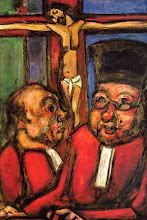
Beware of wolves in sheep's clothing!
'Catholic' theologians and institutions in masquerade!
'Catholic' theologians and institutions in masquerade!
The theologians play a vital supportive component of this episcopal duty; they are vital resource to the bishop. And yet, the theologians do not have, as it were, an office independent of the bishop. In the exercise of their discipline, the moral theologians are not some sort of Übermensch, a man above faith, above rules. Quite the contrary, the theologians, like the most humble layman, remain under the guiding authority of the bishop:
In carrying out this task we [bishops] are all assisted by theologians; even so, theological opinions constitute neither the rule nor the norm of our teaching. Its authority is derived, by the assistance of the Holy Spirit and in communion cum Petro et sub Petro with Peter and under Peter], from our fidelity to the Catholic faith which comes from the Apostles. As Bishops, we have the grave obligation to be personally vigilant that the "sound doctrine" (1 Tim 1:10) of faith and morals is taught in our Dioceses.VS,116.
What is true of the individual theologian is true of Catholic institutions:
A particular responsibility is incumbent upon Bishops with regard to Catholic institutions. Whether these are agencies for the pastoral care of the family or for social work, or institutions dedicated to teaching or health care, Bishops can canonically erect and recognize these structures and delegate certain responsibilities to them. Nevertheless, Bishops are never relieved of their own personal obligations. It falls to them, in communion with the Holy See, both to grant the title "Catholic" to Church-related schools, universities, health-care facilities and counseling services, and, in cases of a serious failure to live up to that title, to take it away.
VS, 116. The bishops of the Church, then, are to make sure that there are no theologians or Catholic institutions who, like wolves in sheep's clothing, do not hide under the mantle "Catholic" when they reject fundamental aspects of "Catholic" teaching.
The episcopal task is onerous. The three-fold office of the bishop is difficult when confronting a world that has denied moral absolutes. But the Pope asks his bishops to have confidence in the dignity of their office, and in the importance of their task. It is a task for which they have been anointed:
Through the anointing of the Spirit this gentle but challenging word becomes light and life for man. Again the Apostle Paul invites us to have confidence, because "our competence is from God, who has made us competent to be ministers of a new covenant, not in a written code but in the Spirit... The Lord is the Spirit, and where the Spirit of the Lord is, there is freedom. And all of us, with unveiled faces, reflecting the glory of the Lord, are being changed into his likeness from one degree of glory to another; for this comes from the Lord, the Spirit" (2 Cor 3:5-6, 17-18).VS, 117.
The moral life leads to Christ, the "follow me" is the invitation of Christ, and our following him is what leads us to virtue, to happiness, to union with God. One human being followed Christ in a supereminent way, and it is to this person, Mary, to whom the Pope turns in closing his encyclical Veritatis splendor. We will review this Marian coda of the encyclical in our last and final installment of this series on this encyclical.