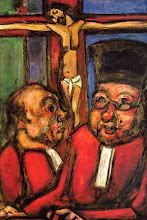
Angilbert (fl. ca. 840/50), On the Battle Which was Fought at Fontenoy

The Law of Christians is broken,
Blood by the hands of hell profusely shed like rain,
And the throat of Cerberus bellows songs of joy.

Angelbertus, Versus de Bella que fuit acta Fontaneto

Fracta est lex christianorum
Sanguinis proluvio, unde manus inferorum,
gaudet gula Cerberi.
Showing posts with label Private Property. Show all posts

Saturday, December 24, 2011

Our Lords the Poor

THE EARTH AND ITS FRUITS were made for men, and not for any one man. It is for this reason that all goods--even those legitimately and morally possessed by individual men through the institution of private property--have a "universal destination," one which orders them to the common good.

Christianity redeems and saves man entire, not just man in part. It therefore frees man from not only from his need, but also in his plenitude. This means that it redeems him with respect to his possessions. A Christian will possess his goods in a manner differently from other men, and a Christian society will view property differently from a non-Christian society.

There is, first and foremost, an awareness by spiritual writers that money and property present an intrinsic danger in that man's love of them may be disordered, inordinate, cupidinous. "For the love of money [φιλαργυρια, cupiditas] is the root of all evils; it is through this craving that some have wandered away from the faith." (1 Tim. 6:10) "Evil is seen in the immoderate attachment to riches and the desire to hoard." (Compendium, No. 329)

Though money and property are, in themselves good, they must be held and used in a manner that is fitting with the common good, with love of neighbor, and sub specie aeternitatis, under the light of eternity. Witness, for example, the warning of Pope St. Gregory the Great in his Pastoral Rule:

They, therefore, that make haste to an inheritance in the beginning cut off from themselves the lot of blessing in the end; since, while they crave to be increased in goods here through the iniquity of avarice, they become disinherited there of their eternal patrimony. When they either solicit very much, or succeed in obtaining all that they have solicited, let them hear what is written. What is a man profited, if he should gain the whole world, but lose his own soul?

St. Gregory the Great, Liber Regulae Pastoralis, Lib. III, Ad. 21, Cap. 20


St. Nicholas distributing alms to the poor

That the rich man's possession of goods is a channel for him to practice proper stewardship and charity towards his less fortunate neighbor is a central theme in Christian practice from its inception. "'How could we ever do good to our neighbor,' asks St. Clement of Alexandria, 'if none of possessed anything?'" (Compendium, No. 329).* St. Basil the Great reminds the rich in his flock to open the doors of their storehouses so that their "riches reach the homes of the poor."** In his Pastoral Rule, Pope St. Gregory the Great, admonishes those who inordinately hold on to their goods and ignore the plight of the poor:
Those who neither desire what belongs to others nor bestow what is their own are to be admonished to consider carefully that the earth out of which they are taken is common to all men, and therefore brings forth nourishment for all in common. Vainly, then, do those suppose themselves innocent, who claim to their own private use the common gift of God; those who, in not imparting what they have received, walk in the midst of the slaughter of their neighbors; since they almost daily slay so many persons as there are dying poor whose subsidies they keep close in their own possession. For, when we administer necessaries of any kind to the indigent, we do not bestow our own, but render them what is theirs; we rather pay a debt of justice than accomplish works of mercy.
St. Gregory the Great, Liber Regulae Pastoralis Lib. III, Ad. 22, Cap. 21

So the Old Testament prophets, the teachings of Christ, and the call of the Church Fathers all seem to coalesce into the same message: wealth is a great good, but presents an ever-present temptation to those who are in possession of it. It profits nothing for a man to have the whole world, and lose his soul. Wealth must be used in a manner that is properly ordered, underneath the auspices of the great and good God, the wise dispenser of all things. Above all, wealth in a rich man is a means for the practice of virtue, including that most sublime virtue of the poor for the love of God, of charity.

The wealthy Christian will view the poor in the manner of Blessed Fra' Gerard, founder of the Knights of Malta. The poor are our Lords. Domini nostri pauperes. With his wealth he will serve them.
_________________________________________
*Citing St. Clement's Homily "What Rich Man Will Be Saved?" 13 PG 19, 618.
**Compendium No. 329 (quoting St. Basil, Homilia in Illud Lucae, Destruam Horrea Mea, 5 PG 31, 271).


Sunday, November 13, 2011

Property is Yours, Mine, and Ours

WITH RESPECT TO PROPERTY, the Church's social doctrine balances two principles: the universal destination of goods and the right to private ownership. As a matter of natural law, the Church recognizes that there is such a thing as private property, that property may be divided into "mine" and "yours." How else, for example, could one justify the divine Commandments which are at the same time one of natural law, "You shall not steal" and "You shall not covet your neighbor's goods"?

At the same time, all property, whether it is "mine" or "yours," is in a different and yet real sense also "ours," or, in the words the Compendium of the Social Doctrine of the Church, has a "universal destination" to the common good. Ultimately, the notion of the "universal destination" of all goods comes from the Lord's dominion over all property, including that property which is "mine" and "yours." "The earth is the Lord's, and everything in it." (Psalm 24:1; 1 Cor. 10:26) "The principle of the universal destination of goods is an affirmation of God's full and perennial lordship over every reality and of the requirement that the goods of creation remain ever destined to the development of the whole person and of all humanity." (Compendium, No. 177)

The right to private property, though "sacred and inviolable" as Leo XIII stated,* is not therefore absolute. If it were absolute, private property could be owned and used in complete disregard of obligation to God and to our neighbor. And if that were true, no one could complain of the inhumanity, not to mention the injustice and lack of charity, of the rich man who sits on his hoard of bread while those around him starve. Yet to chastise that sort of behavior is exactly what St. John and St. James and most of us would naturally do. "He who has the goods of this world and sees his brother in need and closes his heart to him, how does the love of God abide in him?" (1 John 3:17) "If a brother or a sister be naked and in want of daily food and one of you say to them, 'Go in peace, be warm and filled,' yet you do not give them what is necessary for the body, what does it profit?" (James 2:15-16) Who but the Midases of this world would not add their voices to this?

The Parable of Dives and Lazarus
Codex Aureus Epternacensis (Goldenes Evangeliar) ca. 1035-40 A.D.

Both James and John seem implicitly to be referring to Jesus' parable of the relationship between the rich man and the beggar Lazarus. Aren't their complaints against the rich for their misuse of property in disregard of the poor the same fault that Jesus placed upon the rich man who disregarded Lazarus? None of the statements of Sts. John and James or nothing of Jesus' parable would make sense to us if we did not already recognize that the poor have some moral claim upon our private property. This moral claim comes from our implicit awareness of the "universal destination" of goods.

Private property must never be absolutized, for it then becomes an idol, an end, and not a means. "Those people and societies that go so far as to absolutize the role of property end up experiencing the bitterest type of slavery. . . . Owners who heedlessly idolize their goods. . . become owned and enslaved by them. Only by recognizing that these goods are dependent on God the Creator and then directing their use to the common good, is it possible to give material goods their proper function as useful tools for the growth of individuals and peoples." (Compendium, No. 181)

Private ownership of property does not absolve us from using that property in a morally right way. "The universal destination of goods entails obligations on how goods are to be used by their legitimate owners." (Compendium, No. 178) There are obvious moral duties associated with private ownership, and these moral duties have reference to the common good, and in particular the poor. Because of these moral duties, the right to private property is relative, not absolute, and the common good has a claim on it. Yet again the existence of these moral duties attendant to property ownership does not mean that all property is owned in common, and we have no right to private ownership.

Some ways to understand the interaction between private ownership of property and property's "universal destination" are along the lines of thinking of the latter as a sort of mortgage, claim, limitation, or trust. Private property has a sort of covenant or limitation that runs with it, what John Paul II in his Encyclical Sollicitudo rei socialis--drawing from prior teaching even as far back as St. Ambrose and the Apostle John**--called a "social mortgage." Private property, while truly owned by individuals, is held in trust for the common good. Though the property may be "mine," it never quite loses its tie to the common good, to its "universal destination" to which the "mine" is answerable.

The notion of the universal destination of goods is based upon the notion that in its original grant to mankind of the world, "God gave the earth," not to any one man or group of men to the exclusion of others, but "to the whole human race for the sustenance of all its members, without excluding or favoring anyone." (Compendium, No. 171) There is therefore an original "universal right to use the goods of the earth," a "right to common use," which leaves its imprint on all property, even that property privately owned. This original grant survives the matrix of private property. There is therefore always a residue of claim, this "social mortgage," in any property privately owned that requires all property to be "shared fairly by all mankind under the guidance of justice tempered by charity." (Compendium, No. 171) It is this residue of a claim that is the source of moral obligations we may have--above that of pure self interest--in the use of our property.

But one should not understand this notion of the universal destination of goods as a denial of the the natural right to private ownership of goods, of which the Church has been a great defender against the ideologies of Communism and Socialism. Pope Leo XIII could not have been more clear: "The fact that God has given the earth for the use and enjoyment of the whole human race can in no way be a bar to the owning of private property." (Rerum novarum, No. 8)

The Church has made it clear that the universal destination of goods is not a right to common ownership. "Universal destination and utilization of goods does not mean that everything is at the disposal of each person or of all people, or that the same object may be useful or belong to each person or of all people." (Compendium, No. 173) The Church "excludes recourse to forms of 'common and promiscuous dominion.'"*** (Compendium, No. 176) In other words, it is wrong to think that this universal destination of goods allows one to disrespect the natural right of private ownership and the human institutions and variety of positive laws that govern or clarify those rights.

Therefore, the universal destination of goods does not justify the wrongful taking of private property--whether by individuals or governments--even if it be purportedly for the common good. It is, rather, depending upon the circumstances, a sort of more or less loose or strict limitation, burden, "mortgage," or claim upon the private owner's use of the property he owns. In making use of his property, the private owner cannot disregard this universal destination. Ultimately, private property has something more than a mere private function: it has a social function, a social role.

At the same time, private property should not be viewed as an end, but it is a means--and by all measures the most efficient means--to implement the universal destination of goods. "Private property, in fact, regardless of the concrete forms of regulations and juridical norms relative to it, is in the essence only an instrument for respecting the principle of the universal destination of goods; in the final analysis, therefore, it is not an end but a means." (Compendium, No. 177)

The notion of the universal destination of goods includes not only natural goods, such as land, minerals, and their fruit and products, but derived goods: those obtained through our labor or our ingenuity. It includes what the Compendium calls "new goods," goods engendered by "knowledge, technology, and know-how." (Compendium, No. 179) Therefore, it also includes credit, financial instruments and money, intellectual property such as technology and scientific knowledge, which too often is overly protected by positive laws giving rise to monopolies and other barriers that prevent this knowledge from being being fairly at the disposal of all mankind. When, for example, does a huge pharmaceutical company's right to charge an exorbitant price for the formula of a drug that can cure the ills of mankind end? Do the sick not have some claim upon it? There is something unpalatable about having the the secret to reduce our neighbor's suffering, and refusing to share it unless someone puts a lot of money in one's pocket.

It is this social mortgage which justifies, for example, taxes on private property by the public authorities so that it may be used to assure that all citizens have access to basic social services such as food, shelter, healthcare, education, security, and so forth, to the extent that they are unable to provide these for themselves from the property that they have or the labor of their bodies. It is also what is behind the justification for eminent domain powers or what justifies the State's right to regulate the use of our property.

The universal destination of the goods has a particular force when it pertains to the poor, the hungry, the needy, the homeless, those without adequate health care, and those whose life seems hopeless for want of any goods requisite for human flourishing. "The principle of the universal destination of goods requires that the poor, the marginalized, and in all cases those whose living conditions interfere with their proper growth should be the focus of particular concern." (Compendium, No. 182)

Poverty, however, is not only material poverty. It includes cultural, religious, and spiritual poverty. (Compendium, No.184)

While it may be true that the poor will, until Christ's second coming, always be with us, the poor are to be viewed as a sacred trust. Our treatment of the world's poor will be a standard by which we will be judged. (Compendium, No. 183; cf. Matt.25:31-46) The poor are to be loved, and they exert a "special form of primacy" in the exercise of our charity and in our considerations of what is just. (Compendium, No. 182)

The preferential option for the poor and the urgent claim it has on our conscience, in both charity and justice, and in the proper use of our goods is perhaps best summarized by the 6th century Pope St. Gregory the Great (ca.540-604):
When we attend to the needs of those in want, we give them what is their, not ours. More than performing works of mercy, we are paying a debt of justice.

Nam cum qualibet necessaria indigentibus ministramus, sua illis reddimus, non nostra largimur; iustitae potius debitum solvimus.

Regula Pastoralis, 3,21: PL 77,87.


__________________________________________
*Leo XIII, Rerum novarum, No. 40.
**St. John and St. Ambrose are quoted by Pope Paul VI in his encyclical
Populorum progressio: "He who has the goods of this world and sees his brother in need and closes his heart to him, how does the love of God abide in him?" [1 John 3:17] Everyone knows that the Fathers of the Church laid down the duty of the rich toward the poor in no uncertain terms. As St. Ambrose put it: 'You are not making a gift of what is yours to the poor man, but you are giving him back what is his. You have been appropriating things that are meant to be for the common use of everyone. The earth belongs to everyone, not to the rich.' [De Nabute, c. 12, n. 53: PL 14. 747] These words indicate that the right to private property is not absolute and unconditional."
***The
Compendium erroneously cites to Leo XIII's Rerum novarum, 11, for this phrase. In fact, the phrase shows up in section 7 of the Italian version of Rerum novarum (poiché quel dono egli lo fece a tutti, non perché ognuno ne avesse un comune e promiscuo dominio, bensì in quanto non assegnò nessuna parte del suolo determinatamente ad alcuno, lasciando ciò all'industria degli uomini e al diritto speciale dei popoli.). In the English translation, it is found in paragraph 8, not translated as "common and promiscuous," but translated thus: "For God has granted the earth to mankind in general, not in the sense that all without distinction can deal with it as they like, but rather that no part of it was assigned to any one in particular, and that the limits of private possession have been left to be fixed by man's own industry, and by the laws of individual races." The Latin text of this phrase is found in Paragraph 7: "Deus enim generi hominum donavisse terram in commune dicitur, non quod eius promiscuum apud omnes dominatum voluerit, sed quia partem nullam cuique assignavit possidendam, industriae hominum institutisque populorum permissa privatarum possessionum descriptione." I would translate the Latin thus: "For God granted the earth to humankind in common, that is to say, not in the sense that it may be promiscuously handled by all as they desire, but rather that no part was assigned to any one in particular, leaving the assignment and limits of private possession to be determined through man's industry and and through the various people's institutions and laws."

Friday, October 14, 2011

Duns Scotus: On Property and Social Contract

SCOTUS DID NOT WRITE A POLITICAL TREATISE, nor did he comment on anyone's prior political work such as St. Thomas commented on Aristotle's Politics. However, Scotus addresses the issue of private property during the course of his discussion of confession, specifically, the issue of whether someone needs to make restitution of property to receive absolution from the sin of theft or unjust taking of property. In addressing this question, Scotus goes into a brief excursus on private property, its fons and origo, and this takes him briefly into the origin of human government which he sees as the origin of private property. Succinctly, Scotus appears to depart from the common teaching that private property arises out of a natural law right. Rather, for Scotus, the right to private property is entirely one of positive law.

Scotus's treatment of private property and human government is found in distinctio 15 of the Ordinatio IV (q. 2). It is also mentioned in the parallel section of his Paris Lectures (qq. 2-4).

Blessed Duns Scotus Contemplating the Immaculate Conception

Scotus accepted the common teaching that, prior to the Fall of man, all things were owned in common, there being, under the natural law at the time, no such thing as private property. It was this state of original justice that drove the communal aspect of ownership in the early Christian Church and the shunning of private ownership by his own religious order, the Franciscans. After the Fall, however, private ownership as a general rule seems to have become the norm, and even common ownership such as in the early Church or among the religious, derives, not as a matter of natural law, but as a matter of common consent or religious doctrine, and Scotus asks why this is:

I ask: What is the source of distinct ownership such that this may be called "mine" and that "yours"? For all injustice through misappropriation derives from this as well as all justice through restitution.

Ordinatio IV, dist. 15, q.2 (Wolter, 219)

The answer to that question leads Scotus to a series of six conclusions. They are of significance because of their departure from ordinary teaching that private property is part of the natural law. Equally significant is Scotus's early social contractism or government by consent as it relates to the origin of human government.

The notion that prior to the Fall, ownership of property among humankind was in common rather than in the form of private property (Scotus's first conclusion) is adopted by Scotus both as a matter of authority (he cites to Gratian's Decrees, dist. 7, ch. 1, his causa 12, q. 1, and to St. Augustine's Commentary on the Gospel of John). But he also seeks to understand the rationale behind this belief. Given the purpose of property (to contribute to human flourishing) and the lack of disorder in paradisaical man, it seems that no one would have taken more than he needed from the commonality, and no one would have used force to take from others. However, "after the Fall of man, this law of nature of holding all things in common was revoked." Ordinatio IV, dist. 15, q. 2 (Wolter, 220). This is Scotus's second conclusion.

The reason behind the post-lapsarian revocation of common ownership is, for Scotus, two-fold. First, contrary to matters prior to the Fall, common ownership after the Fall would not have lead to peace, but would have acted against it. Covetousness raised its ugly head, and common ownership would have led to warfare as the covetous man sought to take more from the commonality than he required, and would have defended against others' use of it. The result would have been unequal distribution of goods, with the powerful obtaining more than their fair share. In such circumstances, private property is a superior institution than communism.

The revocation of the natural law of common ownership after the fall meant that something else had to replace that law. The revocation does not necessarily imply that a certain system is compelled. Thus, the revocation allowed merely "permission . . . to appropriate and divide up what had been common," and no particular form of private property or division was required either by natural or divine law other than a broad requirement of justice. Since the source of private property does not seem to come from either divine or natural law, Scotus believes it comes from positive human law. "[I]t seems more plausible to say this [the division of common property] was effected by positive law than the law of nature [and] the first division of property was brought about by some positive legislation." Ordinatio IV, dist. 15, q. 2 (Wolter, 221) (This is Scotus's third conclusion.)

Any positive law that parcels out property and creates private property requires both authority and the exercise of prudence or practical right reason, and so Scotus addresses those issues. Scotus's fourth conclusion is that the just division of common property into private property, and institution of human positive law, "requires of its legislator" "prudence and authority." The prudence is required of the legislator so that "he might dictate what ought to be established for the community according to practical right reason." Id.

This requires just authority, and Scotus asks the question where such just authority may be found. This leads him to the question of the origin of civil or political authority. First, Scotus distinguishes between two kinds of authority: paternal authority and political authority. Political authority he further divides into two general divisions: political authority vested in one person and political authority vested in a group.

Paternal authority is of natural law institution, and it remains unaffected by the Fall as a source of authority:

[P]aternal authority is just be natural law in virtue of which children are bound to obey their parents. Neither was this revoked by any positive Mosaic or Gospel law, but rather it was confirmed.

Id.

Political authority ought to be distinguished from paternal authority:
Political authority, however, which is exercised over those outside [the family], whether it resides in one person or in a community, can be just by common consent and election on the part of the community. [This authority] has to do with those who live together, even though there is no consanguinity or close relationship between them. Thus, if some outsiders banded together to build a city or live in one, seeing that they could not be well governed without some form of authority, they could have amicably agreed to commit their community to one person or to a group, and if to one person, to him alone and to a successor who would be chosen as he was, or to him and his posterity. And both of these forms of political authority are just, because one person can justly submit himself to another or to a community in those things which are not against the law of God and as regards which he can be guided better by the person or persons to whom he has submitted or subjected himself than he could by himself.
Id. (Wolter, 221-22)

This teaching of Scotus is historically significant. As C. R. S. Harris puts it:
Scotus is important in the history of political science as one of the pioneers of modern social theory. His doctrines [on social contractism] bear a strong resemblance to the late teachings of Locke. Scotus' account of the social contract is a philosophical analysis of the origin of society. Society, he held, was naturally organized into family groups; but when paternal authority was unable to enforce order, political authority was constituted by the people. Accordingly, [for Scotus] all political authority is derived from the consent of the governed.
(quoted in Wolter, 74)

This civil or political authority, justly originated in common consent, would therefore be authorized to pass just laws. (Fifth conclusion.) This conclusion sets Scotus up to address the issue of the source of private property.

From the institution of civil or political authority and its authority to pass just laws, private property is justified:

The first division of ownership could have been just by reason of some just positive law passed by the father or the regent ruling justly or by a community ruling or regulating justly, and this is probably how it [the regulation of property into private ownership once the natural law of common ownership was revoked] was done.

Id. (Wolter, 222)

The source of private property, then, is from human positive law, and is the result of the lacuna, or absence, of either natural or positive divine law after the revocation of the natural law of common ownership occurred after the Fall of mankind (sixth conclusion).

Saturday, April 2, 2011

Natural Law's Modern Cousin Germain: Distributive Justice, Part 1

JUSTICE MAY BE SAID TO BE PART of the requirements of practical reasonableness arising from life within community. It is intricately related to the notion of the common good. Indeed, Finnis defines justice as:

An ensemble of requirements of practical reasonableness that hold [sic] because the human person must seek to realize and respect human goods not merely in himself and for his own sake but also in common, in community.

NLNR, 161. Finnis identifies three elements always found in justice: (i) other-directedness; (ii) duty; and (iii) equality. Each of these elements deserves a little elaboration.

"Other-directedness" identifies the fact that justice involves relationships with other persons, and thus involves inter-subjective or inter-personal relationships. Strictly speaking, one cannot be just to himself; there must be at least two persons and a practical situation or some interaction between them for justice to enter into the scene. (The expression "doing justice to oneself" is "justice" only loosely, and involves a sort of artificial division of self. Indeed, this is what Plato does in comparing the justice among men with the "justice" within man. In his famous description, Plato divides man into three "selves" or component of self: reasonableness, desire, and spiritidness: justice within the state is nothing other than justice within the soul write large: "καὶ δίκαιον δή," he tells Glaucon in his Republic, οἶμαι φήσομεν ἄνδρα εἶναι τῷ αὐτῷ τρόπῳ ᾧπερ καὶ πόλις ἦν δικαία." “Just too . . . I presume we shall say a man is in the same way in which a city was just.” Rep. IV, 441d.)


From William Blake's "Marriage of Heaven and Hell"

The question of duty is intrinsic to nature: it involves the notion of "debt" or debitum, and "owing" of something to someone. Famously, justice is defined as suum cuique, to give to each his own, which implies debt or obligation. Duty has another face: right. Where there is right there is duty; where there is duty there is right. Justice implies right; injustice implies wrong.

Equality is a third element in justice. However, the term equality must not be taken in a strict sense, but in an analogical sense. The equality is a fitting equality, and includes a sense of proportion or fittingness, or of equilibrium or balance. The equality here is not a Procrustean equality: the equality here is encapsulated in the Blakean insight: "One law for the lion and ox is oppression."

In a sense, any failure of practical reasonableness by an individual who is living in community will affect relations in the community. Accordingly, this is why "justice" as a virtue is frequently seen to comprehend or include all other virtues. This justice, which is more a quality of character (habitus) might be defined as "in its general sense," as an "always a practical willingness to favour and foster the common good of one's communities." NLNR, 165.

Finnis adopts the traditional classifications of justice: distributive justice and commutative justice. This traditional division reaches as far back as Aristotle, who himself divided his treatment of justice into distributive justice (διανεμητικὸν δίκαιον or dianemētikon dikaion) (Nicomachean Ethics, 1132b28; 1132b 24, 32) and "corrective" justice (διορθωτικόν δίκαιον or diorthōtikon dikaion) (e.g., Nicomachean Ethics, 1131a1, 1131b25, 1132b25) which dealt with the relationships between individuals, the synallagmata (συναλλάγματα) or contractual arrangements between citizens. We shall discuss distributive justice in this posting and the next, and commutative justice following that.

Justice in the abstract is not really justice; there must be justice in the concrete circumstances of life in the community. Justice is not a vague internal disposition alone; it is an active virtue that is found within the concrete circumstances of life in common and therefore is intrinsically tied with the common good. As one particularizes from general justice, one may identify two broad classes of problems that arise in co-ordinating the "ensemble of conditions for individual well-being in community" which give rise to the classical division of general justice into two basic prongs of particularized justice: distributive justice and commutative justice.

First, there are issues arising from the distribution of resources and burdens of communal life. How do we distribute educational resources among the population? How do we distribute the taxes among the people? These and similar questions relating to the distribution of resources and burdens of the common stock among the community are the questions of distributive justice. The proper allocation of resources and burdens of communal life through application of the requirements of practical reasonableness is known as distributive justice. The issues that relate to the individual well-being in a community with respect to his individual relations with other individuals or groups involves questions of commutative justice. Distributive justice is thus more public in focus, whereas commutative justice is more private in focus, though both involve life in common.

Within the context of distributive justice, justice may be defined in this manner:
A disposition [of common or public resources or burdens] is distributively just, then, if it is a reasonable resolution of a problem of allocating some subject-matter that is essentially common but that needs (for the sake of the common good) to be appropriated to individuals.
NLNR, 166-67.

Finnis categorizes the "subject-matters" that may come within the scope of distributive justice into three: (i) natural common resource or common stock; (ii) produced common resources or common stock; and (iii) the incidents of communal enterprise (the tasks, labor, expense of life in common). The first involves matters like the natural resources within the boundaries of a community: its energy resources, its lands, forests, rivers, etc. The second involves products of common life: weapons, sea-walls, dikes, roads, public buildings, public enterprises, public treasury, etc. The third involves things like public offices (policemen, judges, etc.) and financing the public fisc (taxes, borrowing).

The issue of "common enterprises" or "public enterprises" is given further treatment by Finnis since these features of life in common can become overweening or unbalanced as a result of wrong perceptions or emphases of the common good. The "common good" ought not to be understood in a purely communal or communistic sense. The "common good" comprehends within it notions of individual good:

The common good which is the object of all justice and which all reasonable life in community must respect and favour, is not to be confused with the common stock, or the common enterprises, that are among the means of realizing the common good. Common enterprises and the exploitation and creation of the common stock of assets are alike for the common good because they are for the benefit of individual members of the community. . . . An attempt, for the sake of the common good, to absorb the individual altogether into common enterprises would thus be disastrous for the common good, however much the common enterprise might prosper.

NLNR, 168. In short, the "common enterprise" or "common stock" was made for man, not man for the "common enterprise" or "common stock."
It is therefore a fundamental aspect of general justice that common enterprises should be regarded, and practically conducted, not as ends in themselves but as means of assistance, as ways of helping individuals to 'help themselves' or, more precisely, to constitute themselves.
NLNR, 169. The Finnisian notion of the common good is not an advocacy of communism or socialism, but is one biased in favor or the individual and private initiative since it is grounded upon the "principle of subsidiarity," which for Finnis is itself a "principle of justice." NLNR, 169. The principle of subsidiarity sets itself against such an absorption of individual man into a monolithic state.

Thus, even if there are inefficiencies to the "common enterprise" as a result,* the common good and its ordering to individual good and self-direction, prevents the "common enterprise" from overcoming the individual. This is one reason why private ownership of property is, in justice, mandated.

The good of personal autonomy in community . . . suggests that the opportunity of exercising some form of private ownership, including means of production, is in most times and places a requirement of justice. . . . [A] regime of private ownership will be a requirement of justice, provided that the increased stock of goods yielded by such a regime is not hoarded by a class of successful private owners but is made available by appropriate mechanisms (e.g., profit sharing; trade under competitive market conditions; redistributive taxation; full employment through productive investment; etc.) to all members of the community, in due measure.

NLNR, 169. Yet private ownership is not an absolute right, since it must be understood within the context within which such right arises (the common good). There is no justification to be found in the right to private property for hoarding, for negligent administration of one's wealth, for unreasonable use of one's wealth in inordinate luxuries, in failure to put excess wealth to productive use, for the formation of oligopolistic or monopolistic ventures, for the exploitation of others. Finnis has a balanced view of the matter which, although lengthy, deserves full mention:
The point, in justice, of private property is to give the owner first use and enjoyment of it and its fruits (including rents and profits), for it is this availability that enhances his reasonably autonomy and stimulates his productivity and care. but beyond a reasonable measure and degree of such use for his and his dependants' or co-owners' needs, he holds the remainder of his property and its fruits as part (in justice if not in law) of the common stock. In other words, beyond a certain point, what was commonly available but was justly made private, for the common good, becomes again, in justice, part of the common stock; though appropriated to his management and control, it is now not for his private benefit but is held by him immediately for the common benefit . . . . From this point, the owner has, in justice, duties not altogether unlike those of a trustee in English law. He may fulfil them in various ways--by investing his surplus in production of more goods for later distribution and consumption; by providing gainful employment to people looking for work; by grants or loans to hospitals, schools, cultural centres, orphanages, etc., or directly for the relief of the poor. Where owners will not perform these duties, or cannot effectively co-ordinate their respective efforts to perform them, then public authority may rightly help them to perform them by devising and implementing schemes of distribution, e.g., by 'redistributive' taxation for purposes of 'social welfare', or by a measure of expropriation.

NLNR, 173.

__________________________________
*This is conceded arguendo. In point of fact, as Finnis notes, the opposite is probably the case. Private ownership is, in most cases, more efficient than public ownership. As a "'rule of human experience," Finnis notes that natural and capital resources are more efficiently exploited and preserved and managed by private ownership than by public enterprises. Along with the benefits of private ownership, however, arises the danger of unjust hoarding by successful private owners and forgetfulness of the essential public role of private ownership. Ultimately private ownership is not for self-aggrandizement, but for the good of others, including "one's own," first, those most close, but also "one's own" in the sense of the broader community in which one finds oneself. Private ownership is one thing when the owner is greedy, exploitative, selfish, and not other-regarding, than when the owner is not greedy, is charitable, altruistic, and is other regarding. In the former instance, private ownership may become unjust, whereas in the latter instance, it may be just. Thus, one cannot say that private ownership is just irrespective of the intent or disposition of the owner. Therefore, private ownership implies the common good and must be understood within it. That is why Aristotle, for example, states that "property ought to be common in a sense, but private speaking generally . . . possession should be privately-owned, but common in use." Pol. II, 2:1263a26, 38-9; NLNR, 171. That is also why an appropriate view of private property will understand that "private ownership . . . is unconditionally just." NLNR, 172. Private ownership is conditionally just. There are "conditions which private owners must conform to if their ownership is to be distributively just." NLNR, 172. It is an error to be an absolutist in the right to private property. The Catechism of the Catholic Church (citations omitted) presents a balanced-natural law view on the matter:
2403 The right to private property, acquired by work or received from others by inheritance or gift, does not do away with the original gift of the earth to the whole of mankind. The universal destination of goods remains primordial, even if the promotion of the common good requires respect for the right to private property and its exercise.

2404 "In his use of things man should regard the external goods he legitimately owns not merely as exclusive to himself but common to others also, in the sense that they can benefit others as well as himself." The ownership of any property makes its holder a steward of Providence, with the task of making it fruitful and communicating its benefits to others, first of all his family.

2405 Goods of production - material or immaterial - such as land, factories, practical or artistic skills, oblige their possessors to employ them in ways that will benefit the greatest number. Those who hold goods for use and consumption should use them with moderation, reserving the better part for guests, for the sick and the poor.

2406 Political authority has the right and duty to regulate the legitimate exercise of the right to ownership for the sake of the common good.