Angilbert (fl. ca. 840/50), On the Battle Which was Fought at Fontenoy

The Law of Christians is broken,
Blood by the hands of hell profusely shed like rain,
And the throat of Cerberus bellows songs of joy.

Angelbertus, Versus de Bella que fuit acta Fontaneto

Fracta est lex christianorum
Sanguinis proluvio, unde manus inferorum,
gaudet gula Cerberi.
Showing posts with label Sophists and the Natural Law. Show all posts

Friday, July 15, 2011

Laborem Solis sive Eclipsis Moralis: Reditum Sophista

THE SOPHIST DELIGHTED IN MAKING black white and white black, in making the better cause the worse or the worse cause the better. In fine, the sophist was indifferent to truth, and exhibited all the flexibility of a man without a standard. His words were for hire; they had become verbal prostitutes, to be used and then dispensed with after they were soiled. And if his words were prostitutes, his brain was a brothel. There was no tie, no marriage, between words and truth. Indeed, for the sophist all morality, all law, all truth was a matter of convention (just like words were), and as flexible and as malleable as soft clay on a potter's wheel. Using the supple rhetorical art of the sophist, words and hence truth could be molded to mean anything that they were wanted to be. "Language is not an instrument for finding truth," in the sophist toolkit, "but for changing it." Budziszewski (2003), 167.

Modernly, sophistry is alive and well, though it is found using different (more sophisticated!) monikers: "postmodernism," "epistemological relativism," "antifoundationalism" and the like.* But sophistry's name is Legion, and it blossoms, like fields of poppies, in multiple colors other than classic red. Whatever their shade, all sophistries tend to lull the mind to sleep not unlike Dorothy was lulled to sleep in Frank Baum's Wizard of Oz. "Now it is well known that when there are many of these flowers together their odor is so powerful that anyone who breathes it falls asleep, and if the sleeper is not carried away from the scent of the flowers, he sleeps on and on forever." Under the spell of this soporific, we operate in an irrational torpor, on our way to intellectual sleep.


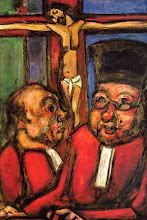
The infection is endemic: it is found among the populace, informed largely by advertising jingles, talking media heads, and pop music and rap songs. But it is also found in the marble halls of the Supreme Court, bouncing within the heads of some of the wizened or wizening--though not for all that wise or wisening--black robed justices. The infamous "sweet-mystery-of-life" language of Justice Kennedy is classic sophistry, and apparently there are some justices who view the Constitution as an instrument of a sophisticated stripe:
At the heart of liberty is the right to define one's own concept of existence, of meaning, of the universe, and the mystery of human life.
What? That squishy language is found in the case of Planned Parenthood v. Casey, written by Justice Kennedy. So the sweet liberty to define the "mystery of human life" allows us to define that mystery to exclude those in the human womb, or (later when the language was cited to in Lawrence v. State of Texas) to engage in intrinsically sterile homosexual sex? This is pure sophistry. To be sure, it is shallow, banal, clownish, sophomoric sophistry, but it is sophistry just the same. Did it ever occur to Justice Kennedy that liberty is given us not to define one's truth and one's good, but to discover the truth and good, and live in the truth and to do that good? Apparently not. Too much sophist lint; not enough philosophical brains; and certainly no Gospel salt there to keep the little Justice's brain there is from spoiling, regardless of its raw talent.

"Abuse of words," John Adams observed, "has been the great instrument of sophistry and chicanery, of party, faction, and division of society." The abuse of words comes back to haunt their abuser. They are like a fickle woman, a woman who spurns the man who once caressed her, for she enjoys the caressing, but not fidelity, not love. She leaves his mouth a lover, and returns a termagant. Sophistry, the poet tells us, is "nature's lay idiot."
Nature’s lay idiot, I taught thee to love,
And in that sophistry, oh, thou dost prove
Too subtle: Fool, thou didst not understand
The mystic language of the eye nor hand:
Nor couldst thou judge the difference of the air
Of sighs, and say, this lies, this sounds despair . . . .
John Donne, "Elegy VII"

Liberty, like love, is not the realm of sophistry; and it is a tragedy of liberty as it is of love not to understand the "mystic language of the eye nor hand." There is a huge and yawning difference between the hand of the law that--in the name of liberty--protects innocent life, and the hand of a law that--in the name of liberty--wields the murderous instruments of dilation and curetage. One protects innocent blood, the other allows it to be shed. These liberties are opposites: strangers, not kinsmen. Only one of them is loyal.

"I would define liberty," John Adams further said (are you listening Mr. Justice Kennedy?), "to be a power to do as we would be done by."** In John Adams's unsophisticated view, liberty is the ability to live the Golden Rule, which, of course would usually be interpreted to mean the power to live in accordance with the natural moral law. This further means that we should not slaughter innocents since we (being innocent) would not want to be slaughtered.

The problem of sophistry is, by and large, fueled by the academic world. Academia is the stronghold of the sophist. "[I]f the modern university is not theoretically Sophist, it is operationally Sophist, and the extremists hold the high ground." Budziszewski (2003), 169. Certainly, the philosophy of natural law has been replaced wholesale, and the academic world seems to teem with relativists, nihilists, consequentialists, utilitarians, feminists, and "ists" of every kin, kith, and kind. Budziszewski should know. He rubs shoulders with the Sophists, but, to his credit (and God's grace), he is also head and shoulders above them. He left the cave of sophistry into the light of day of the natural law. Let us make sure we follow.

______________________________________
*Budziszewski defines these terms: "Postmodernism is 'suspicion of metanarratives . . . A metanarrative is a Big Story that tries to make sense of how it really is. Suspicion of metanarratives, then, means thinking no one ever gets the Big Story right." "Epistemological relativism is the view that truth is relative to one's point of view. In other words, there is no Truth with a capital T, but only your truth . . . and my truth." "Antifoundationalism is the view that there are no first principles. Everything goes around in circles." Budziszewski (2003), 167. These all share the aspect of sophism that all is conventional or relative, and there is no absolute right and wrong or absolute truth falsehood.
**Letter to J. H.Tiffany (March31,1819), The Works of John Adams (Boston: Little & Brown,1856), Vol. 10, p. 377.

Saturday, September 4, 2010

Leo Strauss and Natural Right: Kingdoms and Robber Bands

IF THE NATION-STATE OR OTHER SOCIETY is conventional, then the common good, which is defined by the conventional boundaries of that nation-state or political society, is conventional. So, at least argue the conventionalists. "[T]he city would seem to be a conventional or fictitious [in the sense of a "legal fiction] unity." Strauss, 103. The border between the United States and Canada, or between Mexico and the United States: are not these things fixed by treaty, by convention? The boundaries of nation-state are seen to be unnatural in that they require for their maintenance vigilance, force, violence, compulsion. Things existing by nature do not require this sort of external imposition or governance. Similarly, the difference between illegitimate and legitimate children, the difference between natural born and naturalized citizens . . . these things are matters of convention. Why should a child born on the southern bank of the Rio Grande be a "Mexican," and one born on the northern bank of the Rio Grande be an "American"? Convention. Nothing but convention.

So it would seem that the entirety of law, which necessarily refers to this conventionally-defined civil society, must needs be conventional. Here, then, in a nutshell is the crux of the common good problem:
[T]he city is a multitude of human beings who are united not by nature but solely by convention. They have united or banded together in order to take care of their common interest--over against other human beings who are not by nature distinguished from them . . . Hence what claims to be the common good is, in fact, the interest of a party which claims to be a whole, or a part which forms a unity only by virtue of this claim, this pretense, this convention. If the city is conventional, the common good is conventional, and therewith it is proved that right or justice is conventional. . . . The nerve of the conventionalist argument, then, is this: right is conventional because right belongs essentially to the city and the city is conventional.
Strauss, 104-05, 107-08. The argument seems almost insurmountable, and its advocates, whether philosophical, vulgar, or sophistical have indeed their share of followers. But their persuasiveness is based ultimately upon a notion of good that is materialistic. The good is equated with the "pleasant." There is an underlying hedonism, a calculus of maximizing pleasure and minimizing pain, that underlies the conventionalist view. It is this that overcomes the taboo of ancestral prohibitions, and tags the desires that were frowned by such taboos as natural over and against the prohibitions of the ancestors or the gods and their priests. "Orientation by pleasure becomes the first substitute for the orientation by the ancestral." Strauss, 109.

Epicurus

Strauss looks at two forms of this materialistic hedonism that express the conventionalist theory of right: a philosophical form (advanced by the likes of Epicurus or Lucretius) and a vulgar form (advanced by the Sophists, best exemplified by the characters of Plato's dialogues Thrasymachus, Glaucon, and Adeimantus) which is a "corruption of philosophic conventionalism" traceable to the Sophists. Strauss, 115.

Epicureanism starts with materialistic presuppositions. Casting aside any good that may be defined by convention, the Epicurean finds good in the preconventional urge for pleasure, bodily pleasure. Since we do not feel other's bodily pleasures it follows for the Epicurean that good is highly individualistic. The Epicurean divides the world into the pleasurable, the useful, and the noble. It rejects the last as built upon convention. It emasculates the virtues, at least those other than justice (as justice is a conventional, not natural virtue in the Epicurean view), by making them means, and not ends. And it further corrupts the eunuch virtues by making them slaves to pleasure. For the Epicurean, to act in accordance with justice is to act in accord with convention. It is a pleasure that is conventionally defined. It requires the Other to be of any good:
The other virtues have a salutary effect regardless of whether or not other people know of one's being prudent, temperate, or courageous. But one's justice has a salutory effect only if one is thought to be just.
Strauss, 111.

The same is true looked upon it from the other pole. As a vice, injustice differs from the other vices, because it requires detection by the Other or it is meaningless. One cannot be unjust if the Other does not know:
The other vices are evils independently of whether they are detected or detectable by others or not. But injustice is an evil only with a view to the hardly avoidable danger of detection.
Strauss, 111. Justice it would seem depends only upon whether one is wearing the ring of Gyges. It is this sort of notion that underlies the materialistic ethos of the Roman disciple of Epicurus, Lucretius. Lucretius, distant atavus to Hobbes and Rousseau, saw justice as a construct of convention, a convention arising out of the life of the polis, foisted upon man by the strictures of religion and law. The philosopher, who lives in accordance to nature, must live on the "fringes of civil society," because a life that would be "devoted to civil society and to the service of others," partakes of the artificial, the conventional, and "is not the life according to nature." Strauss, 113.

The vulgar form of materialistic conventionalism is that vaunted by the Sophists. It is not the pursuit of philosophy on the fringes of society that is sought, but raw power: might versus right. The greatest good in the Thrasymachian world, the natural good, "is to have more than the others or to rule the others." Strauss, 114. The city's artificial and conventional laws seek to suppress the natural desire to lord it over others. But even so, the natural urge to dominance seeks to circumvent, or perhaps better, co-opt or exploit in an expedient spirit the conventional laws so as to obtain the power that is at the heart of all natural urges. Here is the germ of the ethos of the Machiavellian:
[L]ife according to nature [when within the political construct] consists in cleverly exploiting the opportunities created by convention or in taking advantage of the good-natured trust which the many put in convention. Such exploitation requires that one not be hampered by sincere respect for city and right.
Strauss, 114. Therefore, the "summit of happiness is the life of the tyrant, of the man who has successfully committed the greatest crime by subordinating the city as a whole to his private good and who can afford to drop the appearance of justice and legality." Strauss, 115.

There is an apparent problem with this view. If the basis of law is the common good, and the common good is defined by convention alone, then what is to distinguish the city-state from a gang of robbers? What essential difference is there between the rules by which a gang is governed and the rules by which a political society is governed? There must, it would seem, be something to distinguish these two forms of human gathering.

Strauss has here invoked that distinction between the "band of robbers" and kingdoms of St. Augustine's De Civitate Dei, one which insists that there is a difference between a gang of robbers and a kingdom, and that distinction is justice, a non-conventional concept:
Justice being taken away, then, what are kingdoms but great robberies? For what are robberies themselves, but little kingdoms?

Remota itaque iustitia quid sunt regna nisi magna latrocinia? quia et latrocinia quid sunt nisi parva regna?
St. Augustine, De civ. Dei, IV.4 (English, trans. Dods).

How, then, are we to escape the argument of the conventionalist, be they philosophical or be they vulgar?

Socrates

The way out was first intimated by the sharp brain of the pug-nosed Socrates.

Sunday, July 4, 2010

The Natural Law's Sophist Strawman

A FREQUENT ARGUMENT LEVIED AGAINST the existence of a natural law is that it cannot be empirically supported. Patently, among societies and among men, from ancient history to the present and through the foreseeable future, there have been, are, and will be myriad opinions as to what is right and what is wrong. And, so the argument goes, there would not be such variety of opinions among men as to what is right and wrong were there, in fact, a natural law. If right or wrong were determined by nature, then the wrongness of abortion or of contraception, to chose two simple examples, should be obvious. And their wrongness is not recognized among all men. Hence, there is no such thing as natural law. In short, the existence of a natural law requires unanimity among men regarding morals, and since none exists, it follows there is no natural law.

The Straw Man Argument of the Sophist: Natural Law = Unanimity in Conventional Morals

"The opposition to [the natural law theory] is as old as the theory." Yves Simon, The Tradition of Natural Law: A Philosopher's Reflections (New York: Fordham, 2000), 5. The Sophists were the first to raise this argument against the theory against the Greek advocates of it. But we find the same form of argument among moderns. Consider the following argument in Judge Richard A. Posner's The Problems of Jurisprudence:
The underlying problem of moral objectivity [i.e., the natural law, L.C.] is that there are neither facts to which moral principles correspond (as scientific principles, for example, appear to correspond to things in nature) nor a strong tendency for moral principles to converge. A tiny handful of moral principles--for example, the unrestricted killing of members of one's own society is bad--seem essential to social existence, but [note here the implicit conclusion from the lack of unanimity, L.C.] the rest are conventional and culture-bound to a far greater extent than scientific principles are.
Richard A. Posner, The Problems of Jurisprudence (Cambridge: Harvard University Press, 1993), 236.

We might expect the argument to be sophistry since it was advanced by the Sophists. And so it is. The argument is, in a word, a straw man. The theory of natural law does not imply unanimity among men as to right and wrong. No theory of natural law has required that there be such unanimity. The natural law has been advanced in the face of such lack of unanimity.

It is important to note that the theory of natural law is not an empirically-based theory. The theory of natural law did not emanate with some sort of social survey of all men and all cultures an an extrapolation or abstraction from those to the theory that all men share in one moral code. Natural law theory comes out of a different sort of thinking than empirical observation. Indeed, the theory of natural law was developed and held by men with full awareness of the great variety of convention among men, and the great disparity of opinion on what is considered evil or good. In other words, the natural law theory developed with an understanding that it was not empirically provable, because the conventions of men were (even frequently) against the natural law. And the theory was therefore not expected to be empirically provable based upon the diverse conventions of right and wrong. Thus science (in the narrow sense as used modernly) cannot prove or disprove the natural law. To the extent the theory is based upon reason, the theory of natural law is a philosophically-based or metaphysically-based understanding of reality. To the extent that it is based upon revelation, the theory would be theologically-based. In either event, whether through reason (natural faith) or through revelation (supernatural faith), belief in a natural law is not an empirically-based theory of morality. It is not subject to the experimental method, as if we were dealing with a law of physics. The natural moral law is not a law that relates to unthinking, unfree matter; it is a law that relates to the mind, to spirit, to a being with reason and free will. To a spiritual soul that is called to union with God.

That natural law exists does not mean that all men will recognize its existence; there are men that have denied, and there will always be men that will deny, its existence. That natural law is true does not mean that all men will recognize its truth. There are men that have denied, and there will always be men that will deny, its truth. That natural law exists does not mean that it is infallibly applied. There are men that have made, and there will always be men that will make, errors in applying the natural law. That the natural law binds all men does not mean that man will follow it inerrant. There are men that have not followed, and there will always be men that will not follow, the natural law. There are simply too many factors that run interference between the heart of man that contains the natural law, its voice in the human conscience, its application in human judgment; and then there is too much weakness of will to follow its precepts with full integrity. No advocate of the natural law has ever suggested that the existence of the natural law necessarily means that it will be followed or recognized everywhere.

Though it is not part of the onus of the advocate of a natural law theory, the fallacious argument against the natural law persists, probably because it is an easy argument for the Sophist to pull out of his quiver of ready arguments. As Yves Simon relates in his The Tradition of Natural Law:
The most common objection [to the theory of natural law], which is also psychologically the most powerful, can be summed up as follows: if there were a natural law, there would be more uniformity in ideas about the right and the wrong, and in the customs and institutions which embody these ideas.
Simon, 3-4. Displayed symbolically, the logic of this psychologically powerful argument is:


p = the existence of such a thing as the natural law.
q = uniformity in beliefs of right and wrong and in behavior concerning right and wrong
˜q = lack of uniformity in beliefs of right and wrong and in behavior concerning right and wrong
˜p = the non-existence of such a thing as the natural law

So the argument goes as follows: If there were such a thing as the natural law, then it would follow that there would be uniformity in moral beliefs and behavior. However, since it is our experience that there is no such uniformity in moral beliefs and behavior, we can infer that there is no such thing as a natural law.

The argument is, from a logical point of view, unassailable. But it is unassailable if, and only if, p implies q, if the existence of a natural law implies that all men will universally recognize it and universally act in accord with it once recognized. This is not, however, a tenet of any theory of natural law.

The natural law is a moral law, not an ineluctable law of nature, such as a law of physics. It is a law that woos, not a law that compels. It is a law that tugs, not a law that yanks. It is a law that persuades and compels with reason, not one that compels by chain or binds by rope. It is a law, not of determinism, but of freedom. It is a law not writ in mathematical equations, with the mathematical exactitude that Kant required of his moral laws. It is a law that may be suppressed, denied, rejected, unfelt. It is a law writ in one of the most unreliable and weak of media, and yet also one of the most noble in created nature: the human heart, the fallen human heart, subject to disordered passion, and to an entire panoply of impediments: vice, lack of virtue, inadequate education, physical and mental impediments, lack of wisdom or practical experience, bad customs, erroneous religious training, one's time in history, etc. The music comes through, but with a lot of static. If we focus on the static, we will not hear the tune.

That proponents of the natural law, even from the beginning, recognized that its existence did not imply agreement among men as to right and wrong may be shown by reference to Aristotle's Nichomachean Ethics:
Political Justice is of two kinds, one natural, the other conventional. A rule of justice is natural that has the same validity everywhere, and does not depend on our accepting it or not. A rule is conventional that in the first instance may be settled in one way or the other indifferently, though having once been settled it is not indifferent: for example, that the ransom for a prisoner shall be a mina, that a sacrifice shall consist of a goat and not of two sheep; and any regulations enacted for particular cases, for instance the sacrifice in honor of Brasidas, and ordinances in the nature of special decrees. Some people think that all rules of justice are merely conventional, because whereas a law of nature is immutable and has the same validity everywhere, as fire burns both here and in Persia, rules of justice are seen to vary. That rules of justice vary is not absolutely true, but only with qualifications. Among the gods indeed it is perhaps not true at all; but in our world, although there is such a thing as Natural Justice, all rules of justice are variable. But nevertheless there is such a thing as Natural Justice as well as justice not ordained by nature; and it is easy to see which rules of justice, though not absolute, are natural, and which are not natural but legal and conventional, both sorts alike being variable.
Arist., Nic. eth., 1134b. As Russell Hittinger observes in his introduction to Yves Simon's work quoted above:
It is sometimes asserted that if the natural law conviction were true we should expect all men everywhere to agree upon its content. Since we do not find this universal agreement there is no such thing as natural law or universal justice. Such critics point to the diversity of moral customs throughout the world as though this were a clinching argument. Such criticism is as old as the tradition itself and, though they are rarely identified by the same name, the Sophists are still with us . . . . Yet what clamors for explanation is not the diversity of moral custom throughout the world but the universal fact that men everywhere under very different circumstances impose some restrains on conduct and defend some customs as more appropriate than others. And it is certainly something more than subjective preference for out own standards of conduct that leads us to describe some moral customs as superior to others.
Simon, viii-ix.

Vacate et videte quoniam ego sum Deus. "Be still, and know that I am God." (Psalm 46:11). It follows that the same is true for the Eternal Law. Vacate et videte quoniam ego sum Lex Aeterna. Since the natural law is nothing other than the participation of man in the eternal law, we might expect that we have to be still, to vacate our minds of convention and predispositions, of the cacophony of voices other than the natural law that would mislead us, to hear the eternal law writ by the finger of God in our heart. Like God, the Deus absconditus, the hidden God, the natural law is lex abscondita, hidden law. It is hidden, not absent. The Sophist takes advantage of the natural law's hiddenness to argue that it is absent.