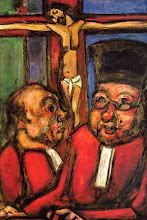
Angilbert (fl. ca. 840/50), On the Battle Which was Fought at Fontenoy

The Law of Christians is broken,
Blood by the hands of hell profusely shed like rain,
And the throat of Cerberus bellows songs of joy.

Angelbertus, Versus de Bella que fuit acta Fontaneto

Fracta est lex christianorum
Sanguinis proluvio, unde manus inferorum,
gaudet gula Cerberi.
Showing posts with label Natural Law and Catholic Church. Show all posts

Friday, January 31, 2014

The Foundation of the Christian Moral Order

AN INTERESTING DOCUMENT, from both a historical and doctrinal standpoint, is the schema "On the Christian Moral Order" drafted by the Preparatory Commission to the Second Vatican Council headed by Cardinal Ottaviani, the then-head of the Holy Office (which later became the Congregation of the Doctrine of the Faith). Some of these schemas have been translated from Latin into English by Fr. Joseph A. Komonchak of Marquette University. They were posted on the Unam Sanctam web page, accessible here.

The schema "On the Christian Moral Order" gives a remarkable synopsis of the Church's teaching on the natural moral law, on its objective nature, on its reality, on its reliance upon God, on its role in informing the conscience, on the Church's Magisterium's competence over the natural moral law, on its role in salvation, and on its universal nature, among other things.  It is a tightly-reasoned and balanced presentation of the natural law.

Much of the confusion in Catholic moral theology--which eventually led to Blessed John Paul II's promulgation of his encyclical on Christian morals and the natural moral law and moral theology, Veritatis splendor--could have been avoided had this sort of schema been adopted by the council fathers.  Alas, hindsight is 20/20.

Thursday, November 3, 2011

Freedom's Conscientious Limits: The Natural Law

IN OUR LAST POST WE QUOTED that part of the Compendium which stated that the proper exercise of personal freedom demands not only specific conditions of economic, social, political, and cultural order to be properly exercised, but that, moreover, these must be conformed to the natural law, since "[b]y deviating from the moral law man violates his own freedom, becomes imprisoned within himself, disrupts neighborly fellowship, and rebels against divine truth.'" (Compendium, No. 137) (quoting CCC, § 1740)

The natural law is therefore behind all of man's economic, social, political, and cultural life. It follows that the natural law is an essential part of the social doctrine of the Church. Indeed, the natural law is an essential part of man's freedom, for any action outside of the pale of the natural moral law is by definition a movement from the real, from what is, to the unreal, to what is not. As John Paul II vividly taught us in his Encyclical Veritatis splendor, there is an intrinsic connection between freedom and living in the truth. The negative is likewise true: there is an intrinsic connection between living in falsehood and slavery.

Freedom is not boundless. It must be exercised responsibly which means according to rule. Who can advocate an irresponsible freedom? As Solzhenitsyn pointed out in his famous Harvard Commencement Address (June 8, 1978), an "irresponsible freedom" granted "boundless space" is "destructive," and leads, moreover, society into "the abyss of human decadence."*

To avoid this fall into the "abyss of human decadence," therefore, we must exercise freedom responsibly. This means that freedom must conform itself to the judgment of conscience. Freedom is therefore restrained by conscience. Indeed, to place freedom under the judgment of conscience "leads to the acceptance of responsibility for the good accomplished and the evil committed." (Compendium, No. 139)

Conscience is therefore the lode star of freedom. Focus on the pole star of conscience keeps society from falling into the "abyss of human decadence," as Solzhenitsyn warned. But conscience serves a double purpose since it also keeps us out of the abyss of Hell. "Quidquid fit contra conscientiam, aedificat ad gehennam," the Fourth Lateran Council taught. That which goes against conscience, conduces one to Gehenna, a place where--one might to one's edification recall--both body and soul are destroyed. (Matt. 10:28)

If for both society and soul's sake freedom must be exercised responsibly, and this means in accordance with conscience, then what is to inform the conscience? Can conscience dispense with conscience? Surely not. Is conscience under no law? Surely not, for to judge means there is some law by which to judge. And if conscience is necessarily under some law, whose law, man's or God's?

If conscience is to be regarded as nothing more than vox hominis, the voice of man, then man is the measure of all things, and the law that governs conscience is nothing other than "self-law," a declaration of autonomy from external or objective rule. Conscience would then be nothing but the application of arbitrary rule. Conscience thought of in this way is, as Newman called it, in his famous Letter to the Duke of Norfolk, "counterfeit."** It is, in fact, rebellion.

Tower of Babel (Breughel)

Such a notion of conscience cannot support life in common. "Those who proclaim themselves to be the sole measure of realities and of truth cannot live peacefully in society with their fellow men and cooperate with them." (Compendium, No. 142) So there is an ominous harbinger of things to come when a Supreme Court Justice Anthony Kennedy can say, in what his much more sensible fellow Justice Scalia mocked as "the famed sweet-mystery-of-life passage," that "[a]t the heart of liberty is the right to define one's concept of existence, of the universe, and of the mystery of human life." (Planned Parenthood v. Casey)

No, Justice Kennedy. The "right to define one's concept of existence, of the universe, and of the mystery of human life," is not at the heart of liberty, it's at the heart of slavery.

Conscience, Justice Kennedy plainly forgot, is not the voice of man, it is vox Dei, the voice of God. And this suggests that God, and not man, is the measure of all things. There is then a measure or rule outside ourselves to which we must conform. And this outside measure or rule--which finds its source in God and his eternal law and as it applies to man-- is known as the natural law.

For this reason, the Compendium states that the "exercise of freedom implies a reference to a natural moral law, of a universal character, that precedes and units all rights and duties." As if bullet points, the Compendium insists on the following:
  • The natural law is "nothing other than the light of intellect infused within us by God."***
  • By the natural law we "know what must be done and what must be avoided."†
  • "This light or this law has been given by God to [man in] creation."††
  • The natural law consists in the participation of God's eternal law, "which is identified with God himself."
  • The natural law is called "natural" "because the reason that promulgates it is proper to human nature."
  • The natural law "is universal, it extends to all people insofar as it is established by reason."
  • The natural law, in "its principal precepts," is presented "in the Decalogue," that is, the Ten Commandments, "and indicates the primary and essential norms regulating moral life."
  • The natural law's "central focus is the act of aspiring and submitting to God, the source and judge of everything that is good."
  • The natural law's "central focus" also includes the "act of seeing others as equal to oneself."
  • The natural law "expresses the dignity of the person and laws the foundations of the person's fundamental duties" to both God, to himself, and to man."
(Compendium, No. 140)

The natural law is the law among all people, and it traverses all culture, all convention, all human law. It is the law under all laws, over all laws, and within all laws. It is "immutable," constant, a reliable lode star, even "under the flux of ideas and customs," though it is also flexible, and "its application may," where exceptionless or absolute norms are not at issue, "require adaptations to the many different conditions of life according to place, time, and circumstances."††† (Compendium, No. 141)

It is true that man can reject the natural law, and in the main our society seems to have rejected its guidance. But "[e]ven when it is rejected in its very principles," the Compendium states quoting the Catechism, "it cannot be destroyed or removed from the heart of man. It always rises again in the life of individuals and societies." (Compendium, No. 141) Indeed, the "natural law, which is the law of God, cannot be annulled by human sinfulness."

Not only is it true that man can reject the natural law, it is also true that we can simply be ignorant of the natural law. The voice of the natural law is sufficiently quiet that particular individuals or whole societies fail to hear it. "Be still and know that I am God," says the Psalter. (Psalm 46:10 [45:11]) The "stillness" rule applies to the natural law: "Be still and know the natural law." And most of us are not still enough to hear the natural law. Most of us listen to other, louder voices: selfish regard, the poisons and conventions of our culture, the stupid, trite, and shallow aphorism of the day, the rule of expediency. Additionally, our inner ear is muffled by the ease of torpid conscience, the inconvenience even sacrifice demanded by a life lived by principle, or by an all-too-frequent acedia in moral life.

Since most of us are not still enough, listen to other voices, or have a sort of lint in our heart's inner ear, the natural law's "precepts . . . are not clearly and immediately perceived by everyone." It is therefore the case that, as a matter of practical necessity in a world that has lapsed after the Fall, religious and moral truths can be known "with facility, with firm certainty, and without the admixture of error" only "with the help of Grace and Revelation."

As Matthew Arnold said in his poem, "Pis Aller":‡

Man is blind because of sin,
Revelation makes him sure;
Without that, who looks within,
Looks in vain, for all's obscure.

The natural law is not only the recipe for individual morality, it is the recipe for social life. The natural law is, in fact, the foundation upon which the Church's social doctrine is built, and is the foundation upon which every society bar none must be built.

The natural law "lays the indispensable moral foundation for building the human community and for establishing the civil law that draws its consequences of a concrete and contingent nature from the principles of the natural law." (Compendium, No. 142) Without the natural law, in vain do men build their societies, found their governments, and attempt constitutions devoted to life, liberty, or the pursuit of happiness.

"Unless the Lord builds the house, its builders labor in vain." (Psalm 127 (126):1) Build a society without reference to the natural law, build a society of relativism and moral pluralism without reference to God and his law, and you have built not on Mount Zion. Rather, you have built its ersatz, a fake substitute, a tower of Babel. And we all know what happened to that tower.

They who did labour Babels tower to'erect,
Might have considered, that for that effect,
All this whole solid Earth could not allow
Nor furnish forth Materials enow;
And that his Center, to raise such a place
Was far too little, to have been the Base;
No more affords this worlds, foundation
To erect true joy, were all the means in one.
But as the Heathen made them several gods,
Of all God's Benefits, and all his Rods,
(For as the Wine, and Corn, and Onions are
Gods unto them, so Agues be, and war)
And as by changing that whole precious Gold
To such small copper coins, they lost the old.

If we think like Justice Kennedy, we have traded precious Gold of the natural law, for the small copper coin of relativism, and with the loss of capital and the loss of coin, we have sold ourselves to slavery. And all this not even for a mess of pottage, but for such enormities such as contraception, abortion, homosexual marriage, and pornography.

________________________________
*"Harvard Commencement Address," by Alexander Solzhenitsyn in Lewis Copeland, et al, eds., The World's Great Speeches 4th ed. (Mineola: Dover Publications, 1999), 837.
**John Henry Newman, A Letter addressed to His Grace the Duke of Norfolk (New York: Catholic Publication Society, 1875), 75, 82.
***Quoting Saint Thomas Aquinas, In Duo Praecepta Caritatis et in Decem Legis Pracepta Expositio, c. 1. ("nihil aliud est nisi lumen intellectus insitum nobis a Deo")
†Id. ("per quod cognoscimus quid agendum et quid vitandum")
††Id. ("Hoc lumen et hanc legem dedit Deus homini in creatione")

†††As an example, the distinction between extraordinary medical care (which one is not required to render a person) and ordinary medical care (which one is) varies "according to place, time, and circumstances." Similarly, the right to a living wage and what that means varies "according to place, time, and circumstances." Some norms--like the prohibition against murder or adultery--are exceptionless and do not admit of change "according to place, time, and circumstances."
‡See The Need for Revelation: "Pis-Aller" by Matthew Arnold.

Sunday, August 21, 2011

Veritatis Splendor: Part 18--Created Conscience or Creative Conscience?

IT WOULD SEEM THAT THE "law of the heart," the heart's yearning for freedom, and what Pope John Paul II calls the "'heart of the person," his moral conscience through which the natural moral speaks to man, would have an intimate relationship. And so they do. Unfortunately, it is an intimate relationship that is modernly misunderstood.

In fact, one's understanding of conscience is at the heart of one's understanding of the relationship of freedom and law: and this would suggest that errors in understanding conscience either stem from misunderstandings on the relationship of freedom or law, or that errors in misunderstanding the relationship between freedom and law stem from misunderstandings of the role of conscience. So pivotal is conscience in the moral life.

Modernly, errors between freedom and law, specifically errors which exalt freedom "almost to the point of idolatry," result in man usurping the role of creator, thus leading to a "'creative' understanding of moral conscience," VS, 54, an understanding which "diverges from the teaching of the Church's tradition and her Magisterium," which is to say, it departs from the Words of Christ Jesus, the Word of God. Modern definitions of conscience ascribe to it a creative role to the point where it becomes not so much conscience, but an anti-conscience, something which bedevils conscience, a devil in the mind.

Based upon what seems to be a legion of justifications seemingly pastoral and humane, some modern theologians--unidentified in name by the Pope--enlarge the role of human conscience at the expense of law, of norms, of precepts. In general, these theologians tend to deprecate the role of law, norms, or precepts, and tend to ascribe to conscience a "creative" role, as if conscience ought to be considered the source of norms, precepts, or law, and not the faculty in man by which he recognizes the law, norms, or precepts as extra-consciential. Conscience is thus creative and free from God's law expressed in norms and precepts, and not created and submissive to those norms and precepts. Conscience is accordingly not seen as playing an adjudicatory role (applying pre-existing law to existing exigencies), but rather as a sort of legislative role (creative law to fit existing exigencies). Understanding conscience as the faculty of decision rather than the faculty of judgment, conscience becomes for these theologians the tool by which man in his autonomy crafts for himself laws of his own making rather than a faculty by which man can assess his prior acts or his prospective acts in conformity with those precepts, norms, or laws which may be found already given man either in his created nature, or in Divine revelation.

Clearly, such a notion of "creative conscience" suggests that conscience creates moral norms, and implies an autonomy of conscience from any law. In fact, some of these theologians suggest that only by making moral decisions "'autonomously' would man be able to attain moral maturity," as if venturing on one's own apart from God and his law were in fact acting in accordance with God's desire for mankind.

It follows that these theologians take a dim view of the Church's role in teaching applicable moral norms. They view the Church's teaching role as stifling this individual creative conscience, in limiting authentic autonomy, and in causing conflicts of conscience which ought not exist.

All manner of means are used by these theologians to "soften" the Magisterial role or pronouncements short of rejecting them wholesale. Commonly, these theologians ascribe to the Church's teaching sort of general guiding value, with at best a pastoral but not dogmatic or commanding role, and always subject always to the exceptions of an individual conscience. The situation envisioned by these theologians would be analogous to a situation whereby the legislature passed a law whereby the executory or judicial official enforcing the law retains the absolute discretion to enforce or not enforce the law. It is doubtful in such a case whether that law would be law at all, since it is not ultimately binding upon the official. Thus the Magisterial role in guiding conscience is essentially demoted to an irrelevancy. Conscience's rights are absolute over and against the voice of the teaching Church and, ultimately, given the role willed by God for the Church, over the law of God itself, indeed over God himself (for in God there is no distinction between Him and His Eternal Law). "No one can fail to realize," the Pope states, "that these approaches pose a challenge to the very identity of the moral conscience in relation to human freedom and God's law." VS, 56.

This description of conscience, as the creator of values, as the faculty or source of complete human autonomy, as an internal legislator rather than internal judge, despite the velvety words used by these theologians, is not conscience, but is more like the devil in one's mind.


These theologians, like Milton depicted Satan and his mind, see human conscience as:
. . . [H]e who now is Sovran [Sovereign] [and] can dispose and bind
What shall be right . . .
. . . .
The mind is its own place, and in itself
Can make a Heav’n of Hell, a Hell of Heav’n.
. . . .
Here we may reign secure, and in my choice
To reign is worth ambition though in Hell:
Better to reign in Hell, than serve in Heaven.*
This sort of false depiction of conscience tells God and His Church what Manfred said in Lord Byron's poem by that name:
Thou hast no power upon me, that I feel;
Thou never shalt possess me, that I know;
What I have done is done . . .
. . . .
The mind which is immortal makes itself
Requital for its good or evil thoughts,
Is its own origin of ill and end,
And its own place and time; its innate sense,
When stripp’d of this mortality, derives
No colour from the fleeting things without,
But is absorb’d in sufferance or in joy,
Born from the knowledge of its own desert.**
What is involved here is a re-definition of man, and a re-definition of God. In fact, it is a revolt. It is a replay of what occurred in the Garden of Eden, where man seeks, shrouded in words like "creative," "pastoral," "feeling," "psychological complexity" and so on, to shrug off the law of God as relevant to his day-to-day activities.

In fine, it is non-serviam redux.

_____________________________________
*John Milton, "Paradise Lost," Book 1.246, 254-55, 261-63.
**Byron, "Manfred," III.iv.146 ff.

Wednesday, July 27, 2011

Veritatis Splendor: Part 1-The Call to Transfiguration and the Primordial Question

THE FOURTH AND FIFTH centuries of the Church's history are marked by Christological and Trinitarian controversies. There was a remarkable focus during that time on the mystery of the Incarnation and the mystery of divine life in the Trinity. How was it that Jesus was both God and Man? How was it that God was both Three and One? In those lands formerly occupied by the pagan Roman empire and recently converted to Christianity, that was man's preoccupation, and it seems all--from the simple layman and parish priest to the Emperor and the Pope--were involved in those great issues of the day. Man spoke about whether there were two natures, one person in Christ or whether the Son of God was of the same substance as the Father or only a similar substance as the Father.* These often heated, always passionate discussions eventually led to the dogmas of the Incarnation and the Trinity to which we subscribe and to the creeds that--separated by centuries from our Christian predecessors-- we now recite at Mass almost passionlessly.

Modernly, we are engaged in controversies of our own, controversies which raise as much passion, have spilled as much ink, and have caused as much heat as those Christological and Trinitarian controversies in the past. Only the controversies deal with moral issues: What is human freedom? Is there a moral order? What is right and what is wrong? Can right and wrong can be known, and, if so, how? Are some things always wrong to do, i.e., are there moral absolutes or exceptionless norms? These, and like questions, are what occupy us, move us, cause us to enter into heated, often acrimonious disputes. Often, these questions lie behind our political disputes, our disputes about what freedom is, and what laws ought to govern us. Many believe that there are no certain answers to these questions, and so they are tempted, an indeed succumb, to moral despair, which is what moral relativism or moral nihilism is.

In a way, because of the questions that are being asked, the forum has widened. Unlike the Christological and Trinitarian controversies which dealt with faith, the moral controversies of today deal with morals, and any discussion about morals takes us out of the household of faith into the household of humanity. We are no longer discussing things with our Christian brother and sister, we are discussing things with our neighbor, with men of good will, whether they be Catholic, Protestant, Mormon, Jewish, Muslim, Buddhist, Hindu, Sikh, Agnostic, Atheist, or anything else. What should we believe about the Trinity? is a question that will not phase a Hindu unless he has an interest in conversion. What is right and good? is a question that interests us all. It is a question that each of us is compelled to ask.

It is within this context that we will be addressing in this next series of postings John Paul II's great encyclical Veritatis Splendor, The Splendor of Truth. The encyclical was issued on August 6, 1993, on the Feast of the Transfiguration.

We might begin by observing that there is some significance in the Pope's issuance of this encyclical on that feast. One might recall that in the Transfiguration,** three of the apostles of Jesus (representing all mankind) see Christ transfigured. Christ shows himself resplendent in the light of his Divinity, allowing it to shine through his humanity. Christ allows his divinity to shine past the veil of his humanity, but one must also remember that this shows that his humanity is therefore brought into his divinity. Christ is transfigured between Moses and Elijah, symbols of the Mosaic Law and Prophets, who recognize his preeminence. Christ is, after all, the end, the culmination of, the purpose-for-which of the Law and the Prophets.


Icon depicting the Transfiguration of Christ

Christ's Transfiguration is an invitation to us, an invitation in freedom to our own transfiguration. This transfiguration is made by our conformity to the truth, in particular by our conformity to the moral truth. This transfiguration is, as the encyclical states toward the end, most fully witnessed by the Christian martyrs and Christian saints by "their eloquent and attractive example of a life completely transfigured by the splendor of moral truth." By living their life so transfigured, the saints and martyrs "light up every period of history by reawakening its moral sense," like Christ lit up Mount Tabor, act as a "living reproof to those who transgress the law," like Moses the lawgiver to the Jews, and serve as an admonition to "'those who call evil good and good evil, who put darkness for light and light for darkness, who put bitter for sweet and sweet for bitter,'" like Elijah the prophet. VS, 93 (quoting Isaiah 5:20).

Pope John Paul II in effect, issued his encyclical Veritatis Splendor on the Feast of the Transfiguration with the hope that we may be transfigured and know how we may be transfigured, to be transformed. "And be not conformed to this world; but be reformed in the newness of your mind, that you may prove what is the good, and the acceptable, and the perfect will of God." (Romans 12:2) The proper use of our freedom is to use it to transfigure our life in the image of Christ, that is by He who lived in the most exemplary way the splendor of moral truth.

At the Transfiguration, God the Father declares: Behold, my Son, my beloved, Listen to him! Cf. Mark 9:7. Ultimately, this is where we are to find our answers: in God, and in his Christ who reveals the splendor of truth in a unique way, being fully man and fully God.
[T]he answer to the question, "What good must I do to have eternal life?" can only be found by turning one's mind and heart to the "One" who is good: "No one is good but God alone" (Mk 10:18; cf. Lk 18:19). Only God can answer the question about what is good, because he is the Good itself.
VS, 9.

But the splendor of truth shines in other places. It is, to be sure, found principally in God and in His Christ, but the Church, creation, and even man's internal witness participate in that truth. "The splendor of truth shines forth in all the works of the Creator, and, in a special way, in man, created in the image and likeness of God." VS, Intro.

Christ and his Church, Creation, Man: these are our three sources whence the light of the Lord's face shines upon us. This is where answers may be found.

Christ is the "true light that enlightens everyone," VS, 1 (citing John 1:9), and in Him there is no darkness. "The light of God's face shines in all its beauty on the countenance of Jesus Christ." VS, 2. "Jesus Christ," who is "the 'light of the nations' shines upon the face of his Church," which "offers to everyone the answer which comes from the truth about Jesus Christ and his Gospel." VS, 2.***

Man is not light in and of himself, but is participated light, and is "constantly tempted to turn his gaze away" from light's source, God, and walk in in the darkness of an idolatry which darkens his capacity to know the truth. "But no darkness of error or of sin can totally take away from man the light of God the creator," VS, 1, and so there remains in man "the splendor of the truth which shines forth deep within the human spirit." VS, 2.

But to find answers, we have first to ask questions. And the encyclical directs us to the fundamental moral question by reflecting upon the story of the rich young man in the Gospels.


The Rich Young Ruler asks Christ
What Everyman Must Do

One ought not to think that by directing us to this story the Pope is being parochial. He already stated that the Church's moral office is universal or cosmopolitan. The question that the rich young man asks in the Gospel, is a universal question. It is the everyman question. "It is an essential an unavoidable question for the life of every man." VS, 8. It is the question which is at the foundation of every one of his acts: "What good must I do?" Quid boni faciam? It is, in fact, a religious question because it necessarily involves a turn to God, the source of all good. "To ask about the good, in fact, ultimately means to turn towards God, the fullness of goodness." VS, 9. In the nameless rich young man, "we can recognize every person who, consciously or not, approaches Christ the Redeemer of man and questions him about morality." VS, 7. Asking the question, "what is good?" is impliedly already approaching God and his Christ.

Some things ought to be noted: The word "good" here is in the Latin encyclical is plural, boni. The question does not relate to one act: it includes each and every act of one's life. The question refers to the good of one's life, the good over the entirety, the moral order to which one ought to be conforming, the manner into which one ought to order one's life. In other words, the question asks for a rule, a standard. The question is asking under what law we ought to operate to do good. What is our law? Where is it to be found? How is to be known? The question is thus fundamental: it directs itself to the last end, the final end, the ultimate purpose for all our acts. But more than this, the question of rule, standard, law is more than a question "about rules to be followed," rather, it is a question "about the full meaning of life." VS, 7.

The question "what good should I do?" includes the question, "what is good?" Necessarily, that includes the question: What is evil? It is, then, the simplest question. It is both positive and negative. What good must I do, and what evil must I avoid? It is also the persistent question. It is a question that we ask here-and-now, so that we may asses our past (and acknowledge any guilt) and so that we may act in a consistent way in the future.

Note also that the question is personal: it is not a question of what we must do. That question arises later, after this first question is asked and answered. The first question to be asked is intimately singular. What must I do? The question precedes every act.

This is in fact the aspiration at the heart of every human decision and action, the quiet searching and interior prompting which sets freedom in motion. This question is ultimately an appeal to the absolute Good which attracts us and beckons us; it is the echo of a call from God who is the origin and goal of man's life.

VS, 7.

The other thing that should be noted is that the question presupposes that I am free, and it is in fact my freedom that allows me ask this question. If I was not free, I would have no need to ask this question. Freedom and good are inextricably intertwined. Freedom and evil are not. The rich young man does not ask: What evil must I do? The rich young man does not ask how he may abuse his freedom. He asks how he ought to use his freedom. To unhinge freedom from the question of the good, the true is an abuse of freedom. It is an error to detach "human freedom from its essential and constitutive relationship to truth." VS, 4. The rich young man does not detach good from truth.

Further, the rich young man does not ask this question to an institution, to a group. The question does not ask for what is the consensus. The question is not directed to the emperor, to the governor. Nor, however, does he ask this question to himself, though he asks it for himself. The rich young man realizes that though the question is for him, he is not the source of the answer to the question. There would be no need to ask the question, if he was the source of the answer. The source of the answer to the question is outside of him. The question is asked to a person, to a teacher, to a Rabbi, to a Rabbi who, as the Transfiguration showed us, was God, the end of the Law and the Prophets: Listen to him!

Finally, the rich young man realizes the import of his question. "What good must I do," asks the rich young man, "to have eternal life?" The doing of good is inextricably intertwined with eternal life. The fundamental moral question is thus hand in glove with man's yearning for immortality, for lasting, permanent meaning. It is what he must do for his life to have meaning, for anything done that is not good is done in vain. "The young man," like all of us, "senses that there is a connection about the moral good which must be done, and about eternal life." VS, 8.

The question has been asked. How does Christ answer?
___________________________
*In Greek terms, the theologians argued over whether the Son of God was the same substance (homoousios) or a similar substance (homoiousios) with the Father. Theologically, the difference between the two terms was huge, though facially the only difference was one letter--the letter "i" (in Greek, iota). Hence the expression "iota of a difference."
**The Transfiguration is described in Synoptic Gospels. See Matthew 17:1-9, Mark 9:2-8, Luke 9:28-36.
***The Church, of course, speaks to the Christian faithful, but her ministry in the realm of morals is much broader. Not only is the Church engaged in the ministry of spreading the Gospel, she as an "'expert of humanity' places herself at the service of every individual and of the whole world." VS, 3. The natural moral law is essential for salvation. It is the path upon which, preceded and accompanied by Grace, every man must walk if he is to gain salvation:
The Church knows that the issue of morality is one which deeply touches every person; it involves all people, even those who do not know Christ and his Gospel or God himself. She knows that it is precisely on the path of the moral life that the way of salvation is open to all.
VS, 3. It is, in fact, in the Scriptures and in the Church where we encounter Christ:
In order to make this "encounter" with Christ possible, God willed his Church. Indeed, the Church "wishes to serve this single end: that each person may be able to find Christ, in order that Christ may walk with each person the path of life."
VS, 7.

Wednesday, February 2, 2011

Freedom and Law: Pope Leo XIII's Libertas praestantissimum, Part 6

FREEDOM OF RELIGION, OF SPEECH AND THE PRESS, and of conscience are considered to be staples of modern political and civil organization in the Western and Western-style democracies. Though there is an authentic freedom of worship, of conscience, and of speech and the press, there is, in Pope Leo XIII's view, also an inauthentic or counterfeit freedom of religion, conscience, and speech, one based upon a misunderstanding of man. The misunderstanding stems from man's supposed autonomy from the natural law and the divine law. Some advocates of such extensive civil rights insist that these freedoms are beyond the reach of the natural or divine law: that these are temples where no man or even God can reach, or, what is the same thing, that such untrammeled freedom of religion, conscience, and speech are themselves mandated by the natural or divine law and so the natural law or divine law precludes any curb--individual or social--upon their exercise.

In his analysis of these liberties or freedom, Leo XIII does not begin with the liberty or freedom, but with its related virtue or good. Thus, with respect to the liberty of worship, he starts with the virtue of religion. LP, 19. With regard to the liberty of speech and and related liberties, he begins with truth. LP, 23. In approaching the rights of conscience, he begins with the duty of man to God. LP, 30. The only means of understanding these freedoms or these liberties is to understand their end. These freedoms are not without their end or purpose, and it is only in reference to their end that they, and any proper limits to them, can be understood. As Pope Leo XIII had earlier indicated, freedom does not consist in the liberty to do wrong, but freedom is the liberty to do right. The freedom of worship is the freedom to worship rightly. The freedom of speech is the freedom to speak truthfully. The freedom of conscience is the freedom conscientiously to determine and follow objective good. Another way of looking at it is to analyze the freedoms from the perspective of their analogous duty. The freedom of worship is tied to the duty to worship the one true God, and not idols of our own making. The freedom of speech is tied to the duty to speak the truth, and not to lie. The freedom of conscience is tied to the duty to form one's conscience in accordance, not with whim, not based upon subjective preference, but upon the foundation of an objective moral reality.

The liberty of worship that Leo XIII analyzes is a one that is based "on the principle that every man is free to profess as he may choose any religion or none." LP, 19 (emphasis added). In assessing this freedom, Leo XIII points to what is "without doubt" man's "chiefest and holiest" duty, officiis . . . sine dubitatione maximum ac sanctissimum, which is the duty "to worship God with devotion and piety." LP, 20. Moreover, the choice of worship is not up to individual whim: the natural law and reason both give guidance here, and impose an affirmative moral duty on man:
And if it be asked which of the many conflicting religions it is necessary to adopt, reason and the natural law unhesitatingly tell us to practice that one which God enjoins, and which men can easily recognize by certain exterior notes, whereby Divine Providence has willed that it should be distinguished, because, in a matter of such moment, the most terrible loss would be the consequence of error.
LP, 20. Consequently, a liberty of religion that is framed as a liberty where "every man is free to profess as he may choose any religion or none," is palpably false. The choice of religion is not an autonomous choice, a choice or exercise of will with no duty but to ourselves and to our whim. It is a choice with a duty, a duty imposed by reason and the natural law. The duty is to the true God. The suggestion that man has the liberty of religion defined as a liberty to manufacture an idol of his own hand, or, if he is more sophisticate, and idol of his own mind, is to suggest that "the power is given him to pervert or abandon with impunity the most sacred of duties, and to exchange the unchangeable good for evil." LP, 20. The sort of notion of religious liberty that Leo XIII condemned is the one espoused by Justice Anthony Kennedy in the "sweet-mystery-of-life" (so-sarcastically referred to by Justice Scalia) passage in the case of Planned Parenthood v. Casey, and which he has been justly ridiculed as "New Age jurisprudence" (Robert Bork), "open-ended validation of subjectivism" (William Bennett), "gaseously" written (George Will), or a "thing of almost infinite plasticity" (Michael Uhlman), or as the editors of First Things called it, the "notorious mystery passage":
At the heart of liberty is the right to define one's own concept of existence, of meaning, of the universe, and of the mystery of human life.
Justice Holmes, in his famous dissent in Lochner v. New York, stated that the "14th Amendment does not enact Mr. Spencer's Social Statics." Well neither, one should have thought, did the 14th Amendment enact Sartre's existentialism. I would call Justice Kennedy's "sweet-mystery-of-life" passage as--fittingly--nauseous, "nauseous words past mentioning or bearing." (Byron) For Leo XIII, these are the words of a man--probably through sheer philosophical ignorance or obtuseness or mindless acceptance of convention--which adopt Lucifer's "rebellious cry," and consequently substitutes "for true liberty what is sheer and most foolish license." LP, 14. One can virtually hear the voices of demons a-Maying, dancing as in a Mayfest around a phallic maypole, and chanting in dissipated glee and the rising of he coming mayhem:
La nausée reprend le pouvoir

Neo-Pagans celebrating the "Sweet-Mystery-of-Life"
before the Nausea sets in

The natural law obliges man to search for the truth in religious doctrine, to use all his tools at his disposal to seek for the truth, including both reason and prayer, and, if found, adopt and embrace the religion one believes to be true. That is the liberty protected by liberty of religion. There is no natural right to create our own religion, to create our own god, and to manufacture our own reality, as if religion is nothing other than ordering a Martini instead of a Bellini.

There is a concomitant duty upon the State equally to recognize God, to render homage to God, and to profess that religion which alone is true. Leo XIII labels as "manifestly false," the notions that "the State has no duties toward God, or that such duties, if they exist, can be abandoned with impunity." LP, 21.
[C]ivil society must acknowledge God as its Founder and Parent, and must obey and reverence His power and authority. Justice therefore forbids, and reason itself forbids, the State to be godless; or to adopt a line of action which would end in godlessness-namely, to treat the various religions (as they call them) alike, and to bestow upon them promiscuously equal rights and privileges.

Quamobrem Deum civilis societas, quia societas est, parentem et auctorem suum agnoscat necesse est, atque eius potesta tern dominatumque vereatur et colat. Vetat igitur iustitia, vetat ratio atheam esse, vel, quod in atheismum recideret, erga varias, ut loquuntur, religiones pari modo affectam civitatem, eademque singulis iura promiscue largiri.
LP, 21. There will be, Leo XIII warns, a loss of liberty that will be engendered by a false notion of liberty of worship which relativizes all religions, which acts indifferently toward them, which advances a notion that religious truth and cult is what we craft and not what we discover. Religion conduces to pure morals and pure morals to liberty. Praetermittimus quantum religio bonis moribus conducat, et quantum libertati mores boni. LP, 22. In fact, if Leo XIII is to be believed, our false notions of freedom of religion and the rejection of any strict obligation, both individual and communal, to God and to objective truth in religion will lead to our demise because it will corrupt morals: "Reason shows, and history confirms the fact, that the higher the morality of States; the greater are the liberty and wealth and power which they enjoy." LP, 22.

(continued)

Monday, January 24, 2011

Magisterial Invocation of Natural Law: Leo XIII and Diuturnum Illud, Part 3

COMPLETING OUR REVIEW of Pope Leo XIII's encyclical Diuturnum illud in this posting, we turn to Leo XIII's solutions. The rise of false theories of the State and revolutionary movements spawned by such false theories provide the State with serious threat, threats it has a certain extent the right to counter. But power alone will not remedy the problem giving rise to or stemming forth from such erroneous theories of the State. "[N]o power of punishment can be so great that it alone can preserve the State." DI, 24. Fear of punishment is simply too weak a reed upon which to build a civil society and upon which to found a governing organ. To base order on fear of punishment, in fact, tends to brew discontent and incite rebellion. "It is therefore necessary," says St. Leo:
to seek a higher and more reliable reason for obedience, and to say explicitly that legal severity cannot be efficacious unless men are led on by duty, and moved by the salutary fear of God.

obediendi altiorem et efficaciorem causam adhibere necesse est, atque omnino statuere, nec legum esse posse fructuosam severitatem, nisi homines impellantur officio, salutarique metu Dei permoveantur.
DI, 24. The desire for obedience must be internalized, and the only way to do this is through an understanding of the religious foundation of the State, as this "enters into the souls and bends the very wills of men causing then not only to render [external] obedience to their rulers, but also show their affection and good will." DI, 24. It would do good, therefore, for the State to "defend religion, and to consult the interest of their Lord to defend religion, and to consult the interest of their States by giving that liberty to the Church which cannot be taken away without injury and ruing to the commonwealth." DI, 25.


Portrait of Leo XIII

The State ought not see the Church as a competitor for civil power, for the "things that are of a civil nature," are "under the power and authority of the the ruler," and those areas which belong "both to the sacred and to the civil power," such as marriage and its civil emoluments, should be exercised in harmonious manner. "Never opposed to honest liberty, the Church has always detested a tyrant's rule," atque honestae libertati nuspiam inimica tyrannicum dominatum semper detestari consuevit. DI, 26.

Leo XIII then ends his encyclical Diuturnum illus with a short litany of duties that a properly-ordered State would have:
  1. Strive with all possible care to make men understand and show forth in their lives what the Catholic Church teaches on government and the duty of obedience;
  2. Let the people be frequently urged by the State's authority and teaching to fly from the forbidden sects, abhor all conspiracy, have nothing to do with sedition, and understand that they who for God's sake obey their rulers render a reasonable service and a generous obedience.
God is the source of authority and power, and supplies both the reasons for and limits on the exercise of its power by the State, and the reasons for and limits to obedience by the people. This belief thus ennobles, without divinizing, the authority of the State, and gives reason other than fear of punishment for obeying the State.
And as it is God "who gives safety to kings," [Ps. 152:11] and grants to the people "to rest in the beauty of peace and in the tabernacles of confidence and in wealthy repose," [Isa. 37:18] it is to Him that we must pray, beseeching Him to incline all minds to uprightness and truth, to calm angry passions, to restore the long-wished-for tranquility to the world.

Quoniam vero Deus est, qui dat salutem regibus, et concedit populis conquiescere in pulchritudine pacis et in tabernaculis fiduciae et in requie opulenta. Ipsum necesse est orare atque obsecrare, ut omnium mentes ad honestatem veritatemque flectat, iras compescat, optatam diu pacem tranquillitatemque orbi terrarum restituat.
DI, 27.

Our states have gone a different way than what Leo XIII prayed for, have turned him a deaf ear, and the secular rulers and secular state have turned less and less to religion and more and more to process and to the thin veneer of "human rights," which, without God, also have little foundation. In the West, the theory of the modern State is built on sand, on the sands of social contractism, on the sands of moral relativism, on the sands of the will of man as if the will of the majority, which is so easily manipulated, is the cure for all ills. It is a recipe for either revolution or tyranny, not for peace or tranquillitas ordinis.

Our prayer may now be:
Usquequo Deus inproperabit inimicus inritat adversarius nomen tuum in finem?

How long, O God, shall the enemy reproach: is the adversary to provoke thy name for ever?
(Ps. 73:10)

Saturday, January 22, 2011

Magisterial Invocation of Natural Law: Leo XIII and Diuturnum Illud, Part 2

CONTINUING ON OUR REVIEW of Pope Leo XIII's encyclical Diuturnum illud which addresses the origin of government, and rejects social contractism, we ended our last blog posting with the notion that civil power is given to the ruler by God for the public good and for the purpose of promoting the common good of those assigned to his care. The ruler has not right to use the power he has been given by God for private gain. Government is thus a res publica, a public thing. In fact, its abuse by the ruler will expose him, as it does all men, to the judgment of God: "they are warned in the oracles of the sacred Scriptures, that they will have themselves some day to render an account to the King of kings and Lord of lords; if they shall fail in their duty, that it will not be possible for them in any way to escape the severity of God." DI, 16.


Portrait of Leo XIII

The other side of the coin of the concept that power and authority come from God is that the people have a duty to obedience to the State. The citizen is not to be seen as some sort of pawn or slave of the state, but one who submits himself to the divine will, thus fully retaining his dignity "even in obedience" and submission to their rulers because the rulers in a certain way "bring before them the image of God, "who to serve is to reign," cui servire regnare est.

This principle remains true even if "the Christian form of civil government may not dwell in the minds of men." DI, 18. Historically, the Church taught the faithful that they were obliged to give due obedience even to the Pagan emperors, as St. Paul states it "to be subject to princes and to powers, to obey at a word." DI, 18 (quoting Titus 3:1). Indeed, more than obedience was the practice, as Christians were enjoined to pray for "kings and all that are in a high station." DI, 18 (quoting 1 Tim. 2:1-3). And the early Christian obedience to the Roman authority was exemplary, and it provided a singular argument that laws against them were unjust. Thus the Christian lawyer Tertullian could argue:
The Christian is the enemy of no one, much less of the emperor, whom he knows to be appointed by God, and whom he must, therefore, of necessity love, reverence and honor, and wish to be preserved together with the whole Roman Empire.

Christianus nullius est hostis, nedum imperatoris, quem sciens a Deo suo constitui, necesse est ut et ipsum diligat et reuereatur et honoret et saluum uelit, cum toto Romano imperio, quousque saeculum stabit: tamdiu enim stabit.*
Yet though history shows that the obedience and docility of the Christians was exemplary, to the point that they could be a foundation for a plea for toleration, it is equally true that the obedience only went so far. The duty to obey properly constituted authority, even if secular or pagan, only goes as far as that authority--which comes from God--is used in accordance with the law of God. That is to say, no State has the authority to order any man to do something that contradicts the natural moral law or that contradicts divine positive law. DI, 20.

When Christians became head of States, there was cooperation between the Church and State, and the ends of both overlapped, both recognizing the Divine source of any power and authority, and hence the limits to it. "And, indeed, tranquility and a sufficient prosperity lasted so long as there was friendly agreement between these two powers." DI, 22. But the writings of recent political philosophers have injected into the mix a poison. That poison arises from "an unwillingness to attribute the right of ruling to God, as its Author," ius imperandi nolle ad Deum referre auctorem. Instead of finding the source of authority and power from God, they place it at the feet of the people, a doctrine which assures abuse and rebellions and dissatisfaction:
And they who say that this power depends on the will of the people err in opinion first of all; then they place authority on too weak and unstable a foundation. For the popular passions, incited and goaded on by these opinions, will break out more insolently; and, with great harm to the common weal, descend headlong by an easy and smooth road to revolts and to open sedition.

Quod autem inquiunt ex arbitrio illam pendere multitudinis, primum opinione falluntur; deinde nimium levi ac flexibili fundamento statuunt principatum. His enim opinionibus quasi stimulis incitatae populares cupiditates sese efferent insolentius, magnaque cum pernicie reipublicae ad caecos motus, ad apertas seditiones proclivi cursu et facile delabentur.
DI, 23.

Leo XIII places the fount and origin of these erroneous notions of authority at the feet of the "so-called Reformation." The attack by the Protestant Reformers on the foundations of religious and civil authority, particularly Luther, invited the Peasant Rebellion which required repression by the German princes. So also did it invite "an outburst of civil war and with such slaughter that there was scarcely any place free from tumult and bloodshed," DI, 23, which appears to be a reference to the Wars of Religion. It was from the Protestant heresy that there arose a philosophy that sought to justify civil authority, and which postulated its origin in the people, taking it away from God:
From this [Protestant] heresy there arose in the last century a false philosophy--a new right as it is called, and a popular authority, together with an unbridled license which many regard as the only true liberty.

Ex illa haeresi ortum duxit sœculo superiore falsi nominis philosophia, et jus quod appellant novam, et imperium populare, et modum nesciens licentia, quam plurimi solam libertatem putant.
DI, 23.

Placing authority at the feet of the people is not only wrong, but it leads to social and political horrors. And like a bad apple or an insidious lentivirus, this philosophy has led to a virtual wax house of political philosophies, where all philosophies are false, made of wax by human hands, and not are real, based upon nature and nature's God:
Hence we have reached the limit of horrors, to wit, communism, socialism, nihilism, hideous deformities of the civil society of men and almost its ruin. And yet too many attempt to enlarge the scope of these evils, and under the pretext of helping the multitude, already have fanned no small flames of misery.

Ex his ad finitimas pestes ventum est, scilicet ad communismum, ad socialismum, ad nihilismum, civilis hominum societatis teterrima portenta ac pene funera. Atqui tamen tantorum malorum vim nimis multi dilatare conantur, ac per speciem iuvandae multitudinis non exigua jam miseriarum incendia excitaverunt.
DI, 23.

(continued)
_________________________________
*In the Encyclical, the cite is to Tertullian's Apologeticus, 35 (PL 1, 451), but I could not find this quotation in Tertullian's Apologeticus under this reference. Indeed, it is an apparent error, as the cite is to Tertullian's Ad Scapula, II.6.

Friday, January 21, 2011

Magisterial Invocation of Natural Law: Leo XIII and Diuturnum Illud, Part 1

THE RICHNESS OF THE NATURAL LAW shown forth in the thought of Pope Leo XIII, who "even more than Pius IX, based his teaching on the laws given by nature, meaning the Creator of nature." Fuchs, 5. Leo XIII's pontificate was a rich one indeed, and many things could be said of it. But with reference to the natural law, one has to focus on Leo XIII's contribution to Catholic social thought, in particular his groundbreaking encyclical on social questions, Rerum novarum, which fittingly means "On New Things." The world that Leo XIII confronted was saying new things, preaching new doctrines and new gods, based upon principles that were new, not perhaps in the sense that they were never known, for there is nothing new under the sun, and much of what was going under new thought was but paganism with a new sheen, but new in the sense that answers were being sought for new social and moral problems without reference to God or to the natural law. The number of Leonine encyclicals that address the applicability of the natural law and its principles to questions of government, slavery (In plurimis [On the Abolition of Slavery]) liberty and freedom (Libertas praestantissimum donum [On Liberty]), Christian democracy (Graves de Communi Re [On Christian Democracy], socialism (Quod Apostolici Muneris [On Socialism]), the relationship of Christianity to the State (Immortale Dei [On the Christian Constitution of the State], Sapientiae Christianae [On Christians as Citizens]), social justice [Rerum Novarum [On Capital and Labor]), marriage (Arcanum divinae sapientia [On Christian Marriage]), and so forth is remarkable.

Leo XIII, who was deeply influenced by the doctrines of St. Thomas Aquinas, and in fact promoted their importance in the life of the Church through his encyclical on St. Thomas Aeterni Patris,* applied these traditional Thomistic methods, including those relating to the natural law doctrine, to these new questions and arrived at remarkable refreshing answers to the social questions of the day. Alas, freemasons, socialists, communists, liberals, secularists, even "Americanists,"** all turned a deaf ear, and the world, or at least the West, continued to unravel.


Portrait of Pope Leo XIII

Confronting the extreme positions of political nihilists and anarchists, which were ultimately founded upon the false philosophical and political principles of Protestantism, the "so-called Reformation," and the Enlightenment, and spurred by the murder of the Russian emperor Alexander II (1818-1881) by the political group called Narodnaya Volya (Народная воля, the "People's Will"), a political terrorist organization, Leo XIII addressed the issue of civil power, its source, and the role of the civil power relative to the people and the common good in an encyclical entitled Diuturnum illud (On the Origin of Civil Power). The encyclical Diuturnum illud combines both the insights of Christian revelation as well as principles of natural law philosophy to arrive at the ultimate notion that all power comes from God. It rejects the notion that power is derived from the people and assigned, through some sort of social contract, to the ruler. In rejecting the political philosophy based upon social contract notions, it, however, does not reject the democratic process and the people's role in choosing a ruler if it accords with the customs, social, and political institutions of a people. Regardless of the procedural vehicles that relate to the selection of one's leader or leaders, however, the fundamental teaching of the natural law (as well as Revelation) is that all power--this includes priestly power, paternal power, and civil power--comes from God and is given to men for the purpose, not of private gain, but of promoting the public good. There is no power in the individual that he can convey to the ruler, for no man has the authority over any other man by virtue of their fundamental equality in nature.

The heart of the Encyclical would seem to be the principle, attested to both by Scripture and the natural law, that civil authority, though required as a result of man's natural disposition to live in common and so to that degree is natural, does not arise out from the people to be conveyed to the ruler. Rather, the only explanation for political power and the possible source of it is that it comes from God. If this principle is not fastly held, then there is no limit to what the civil authority can do in the name of the people, and there is, ultimately, no basis for power except raw power.
11. And, indeed, nature, or rather God who is the Author of nature, wills that man should live in a civil society; and this is clearly shown both by the faculty of language, the greatest medium of intercourse, and by numerous innate desires of the mind, and the many necessary things, and things of great importance, which men isolated cannot procure, but which they can procure when joined and associated with others. But now, a society can neither exist nor be conceived in which there is no one to govern the wills of individuals, in such a way as to make, as it were, one will out of many, and to impel them rightly and orderly to the common good; therefore, God has willed that in a civil society there should be some to rule the multitude. And this also is a powerful argument, that those by whose authority the State is administered must be able so to compel the citizens to obedience that it is clearly a sin in the latter not to obey. But no man has in himself or of himself the power of constraining the free will of others by fetters of authority of this kind. This power resides solely in God, the Creator and Legislator of all things; and it is necessary that those who exercise it should do it as having received it from God. "There is one lawgiver and judge, who is able to destroy and deliver." [James 4:12] And this is clearly seen in every kind of power. That that which resides in priests comes from God is so acknowledged that among all nations they are recognized as, and called, the ministers of God. In like manner, the authority of fathers of families preserves a certain impressed image and form of the authority which is in God, "of whom all paternity in heaven and earth is named." [Eph. 3:15] But in this way different kinds of authority have between them wonderful resemblances, since, whatever there is of government and authority, its origin is derived from one and the same Creator and Lord of the world, who is God.

Et sane homines in civili societate vivere natura jubet, seu verius auctor naturae Deus: quod perspicue demonstrant et maxima societatis conciliatrix loquendi facultas et innatae appetitiones animi perplures, et res nëcessariae multae ac magni momenti, quas solitarii assequi homines non possunt, juncti et consociati cum alteris assequuntur. Nunc vero, neque existere neque intelligi societas potest, in qua non aliquis temperet singulorum voluntates ut velut unum fiat ex pluribus, easque ad commune bonum recte atque ordine impellat: voluit igitur Deus ut in civili societate essent qui multitudini imperarent. — Atque illud etiam magnopere valet, quod ii, quorum auctoritate respublica administratur, debent cives ita posse cogere ad parendum, ut his plane peccatum sit non parere. Nemo autem hominum habet in se aul ex se, unde possit huiusmodi imperii vinculis liberam ceterorum voluntatem constringere. Unice rerum omnium procreatori et legislatori Deo ea potestas est: quam qui exercent, tanquam a Deo secum communicatam exerceant necesse est. Unus est legislator et judex, qui potest perdere et liberare. Quod perspicitur idem in omni genere potestatis. Eam, quae in sacerdotibus est proficisci a Deo tam est cognitum ut ii apud omnes populos ministri et habeantur et appellentur Dei. Similiter potestas patrumfamilias expressam retinet quamdam effigiem ac formam auctoritatis, quae est in Deo, ex quo omnis paternitas in cœlis et in terra nominatur. Isto autem modo diversa genera potestatis miras inter se habent similitudines, cum quidquid uspiam est imperii et auctoritatis, eius ab uno eodemque mundi opifice et domino, qui Deus est, origo ducatur.
The encyclical finds the first seeds of false doctrine in the ideas of the Protestant reformers which were amplified and carried through by the philosophes of the Enlightenment. It was from first the rift and misunderstanding of civil power and the power of the sword, and then the full rejection of the notion that civil power comes from God, that required some alternative theory of justification. Most common was the notion of social contractism, the Hobbesian/Rousseauian notion that power is conveyed to the ruler by the people, and finds its fount and origin, and therefore its limits, if any there be, in the people. God is thus removed from question of power, all power is secular, material, and ultimately without any limiting principle, and certainly no spiritual limiting principle.
12. Those who believe civil society to have risen from the free consent of men, looking for the origin of its authority from the same source, say that each individual has given up something of his right [an allusion to, among others Rousseau], and that voluntarily every person has put himself into the power of the one man in whose person the whole of those rights has been centered. But it is a great error not to see, what is manifest, that men, as they are not a nomad race, have been created, without their own free will, for a natural community of life. It is plain, moreover, that the pact which they allege is openly a falsehood and a fiction, and that it has no authority to confer on political power such great force, dignity, and firmness as the safety of the State and the common good of the citizens require. Then only will the government have all those ornaments and guarantees, when it is understood to emanate from God as its august and most sacred source.

Qui civilem societatem a libero hominum consensu natam volunt, ipsius imperii ortum ex eodem fonte petentes, de jure suo inquiunt aliquid unumquemque cessisse, et voluntate singulos in ejus se contulisse potestatem, ad quem summa illorum iurium pervenisset. Sed magnus est error non videre, id quod manifestum est, homines, cum non sint solivagum genus, citra liberam ipsorum voluntatem ad naturalem communitatem esse natos: ac praeterea pactum, quod praedicant, est aperte commentitium et fictum, neque ad impertiendum valet politicae potestati tantum virium, dignitatis, firmitudinis, quantum tutela reipublicae et communes civium utilitates requirunt. Ea autem decora et praesidia universa tunc solum est habiturus principatus, si a Deo augusto sanctissimoque fonte manare intelligatur.
The notion that rulers derive their power from God means that citizens have a duty to respect it and obey it. But with that dignity comes limitation. Since the power of the ruler comes from God, and his not his own, it comes with limits which may not be exceeded.
15. The one only reason which men have for not obeying is when anything is demanded of them which is openly repugnant to the natural or the divine law, for it is equally unlawful to command to do anything in which the law of nature or the will of God is violated. If, therefore, it should happen to any one to be compelled to prefer one or the other, viz., to disregard either the commands of God or those of rulers, he must obey Jesus Christ, who commands us to "give to Caesar the things that are Caesar's, and to God the things that are God's," [Matt. 22:21] and must reply courageously after the example of the Apostles: "We ought to obey God rather than men." [Acts 5:29] And yet there is no reason why those who so behave themselves should be accused of refusing obedience; for, if the will of rulers is opposed to the will and the laws of God, they themselves exceed the bounds of their own power and pervert justice; nor can their authority then be valid, which, when there is no justice, is null.

Una illa hominibus causa est non parendi, si quid ab iis postuletur quod cum naturali aut divino jure aperte repugnet: omnia enim, in quibus naturae lex vel Dei voluntas violatur, aeque nefas est imperare et facere. Si cui igitur usu veniat, ut alterutrum malle cogatur, scilicet aut Dei aut principum iussa negligere, Iesu Christo parendum est reddere jubenti quae sunt Caesaris Caesari, quae sunt Dei Deo, atque ad exemplum Apostolorum animose respondendum: Obedire oportet Deo magis quam hominibus . Neque tamen est, cur abiecisse obedientiam, qui ita se gerant, arguantur; etenim si principum voluntas cum Dei pugnat voluntate et legibus, ipsi potestatis suœ modum excdunt iustitiamque pervertunt: neque eorum tune valere potest auctoritas, quae, ubi iustitia non est, nulla est.
The power of the ruler is not only limited by the natural law, it is also limited by the fact that it is ordered to the common good, and, by its nature, it is not ordered to any private good. It is a res publica, a public thing, and not a res privata, a private thing. Accordingly, any capture of that power by private interests is by definition an abuse of that power:
16. But in order that justice may be retained in government it is of the highest importance that those who rule States should understand that political power was not created for the advantage of any private individual; and that the administration of the State must be carried on to the profit of those who have been committed to their care, not to the profit of those to whom it has been committed.

Ut autem justitia retineatur in imperio, illud magnopere interest, eos qui civitates administrant intelligere, non privati cujusquam commodo politicam potestatem esse natam: procurationemque reipublicae ad utilitatem eorum qui commissi sunt non ad eorum commissa est, geri oportere.
(continued)

______________________________________
*Leo XIII and his Aeterni Patris has been the subject of a prior post in Lex Christianorum. See The Disfigured Face: Pope Leo XIII to the Rescue.
**Americanism is a heresy that advocates, among other things, an extreme separation of Church and State, excessive notions of liberty and individualism, and particularism for the Church in America. Leo XIII addressed these issues in a letter in 1899 entitled Testem Benevolentiae.

Thursday, January 20, 2011

Magisterial Invocation of Natural Law: Pio Nono

PIO NONO, AS PIUS IX (1792-1878) is frequently referred even in English, was a remarkable figure who ruled as Pope during a time of social, political, and moral ferment. The successor to Pope Gregory XVI, who died in 1846, Pio Nono's confronted an age of revolution, and when elected to the papacy was considered relatively liberal. However, early during his reign, confronting revolutionary elements in his administration of the Papal States, and suffering the humiliation of being a "prisoner of the Vatican," and opposing himself to the Italian forces of unification and liberalism, he seemed to harden into conservative positions. Next to St. Peter himself, Pius IX enjoyed the longest reign of any Pope (more than 31 years), rivaled only by John Paul II (more than 26 years). A victim of rising Italian nationalism, the Risorgimento and its insistence on the unification of Italy, Pope Pius IX was the last Pope to rule the Papal States which, by 1870 had been wrested from the Holy See.


Pius IX--Pio Nono

But while he saw his temporal power taken from him, his spiritual realm appeared to rise in an inversely proportional manner. He is considered the first modern pope, and under his reign the influence of the papacy grew in terms of influence and centralization. He convened the First Vatican Council which define the dogma of papal infallibility. He defined as dogma the Immaculate Conception of Mary through his constitution Ineffabilis Deus on December 8, 1854. He is perhaps most excoriated by the liberals because of his promulgation of his Syllabus of Errors (Syllabus errorum) in conjunction with his encyclical Quanta cura, a virtual declaration of war against the excesses of liberalism and its errors. He re-established the Roman Catholic hierarchy in England changing its status from a missionary territory. Perhaps his most controversial act, and certainly one that cuts against the grain of modern standards, was the position he took in the case of Edgardo Mortara, a young Jewish boy who was baptized by a Christian servant girl and so who fell under a law that prohibited Christians to be raised by Jews, even if they were his own parents. Mortara was raised in the Papal household and eventually became a priest and Augustinian missionary. Pius IX was beatified by John Paul II on September 3, 2000. Evviva Pio nono!

It was the political fervent in Italy and in greater Europe that forced Pius IX to draw from the natural law foundation of Catholic and human morality which lay, as it were, below the surface to be drawn at need, to provide the authentic Catholic and human response to questions such as contraception, neo-Malthusianism, the foundations of civil law, the indissolubility of marriage, and other political, social, and legal questions. It seems as if everything was up for deconstruction.

For example, the following acts were taken by the the Holy Office on May 21, 1851, and approved by Pope Pius IX, in response to certain questions relating to coitus interruptus (also known as "Onanism") as a form of birth control.* The ruling makes it clear that Onanism is against the natural law. To the questions of whether it was "permissible for spouses to use marriage the way Onan did [eo modo quo usus est Onan], if their motives are worthy [ob rationes honestas]," or if it was probable that "such use of marriage is not forbidden by the natural law [prohibitum iure naturali]," the Holy Office called the first proposition "scandalous, erroneous, and contrary to the natural right of matrimony [iuri naturali matrimonii contraria]," and the second "scandalous, erroneous, and elsewhere implicitly condemned by Innocent XI."**

In the Syllabus of Errors, promulgated under his authority, Pius IX also invoked the natural law on the issue of the relationship between human, positive law and the natural law, and on the issue of marriage as an institution under the auspices of the natural law. The following propositions were condemned by the Syllabus:
The laws of morals by no means need divine sanction, and there is not the least need that human laws conform to the natural law [naturae ius], or receive the power of binding from God

By natural law [iurae naturae] the bond of matrimony is not indissoluble and on various grounds the civil authority may grant divorce.

Morum leges divina haud egent sanctione, minimeque opus est, ut humanae leges ad naturae ius conformentur aut obligandi vim a Deo accipiant.

Iure naturae matrimonii vinculum non est indissolubile, et in variis casibus divortium proprie dictum auctoritate civili sanciri potest
.
DS 2956; D 1756 (civil law); DS 2967; D 1767 (marriage). What the condemnation means, of course, is that civil laws must conform to the natural law, and that marriage is indissoluble by natural law, and not as a result of any positive law. Laws, therefore, that allow for dissolution of marriage are contrary to the natural law. Essentially, the marriage laws of every single Western country, by allowing for divorce and remarriage, are violative of the natural law in addition to divine law as found in the teachings of Jesus on the indissolubility of marriage. Is it any wonder society limps from intractable problems associated with shattered marriages and shattered families?

In his encyclical of August 10, 1863, Quanto conficiamur moerore, addresssing the issue of indifferentism, Pius IX spoke about the natural law and its role in salvation:
There are, of course, those who are struggling with invincible ignorance about our most holy religion. Sincerely observing the natural law and its precepts inscribed by God on all hearts and ready to obey God, they live honest lives and are able to attain eternal life by the efficacious virtue of divine light and grace. Because God knows, searches and clearly understands the minds, hearts, thoughts, and nature of all, his supreme kindness and clemency do not permit anyone at all who is not guilty of deliberate sin to suffer eternal punishments.

Notum Nobis vobisque est, eos, qui invincibili circa sanctissimam nostram religionem ignorantia laborant, quique naturalem legem eiusque praecepta in omnium cordibus a Deo insculpta sedulo servantes ac Deo oboedire parati, honestam rectamque vitam agunt, posse, divinae lucis et gratiae operante virtute, aeternam consequi vitam, cum Deus, qui omnium mentes, animos, cogitationes habitusque plane intuetur, scrutatur et noscit, pro summa sua bonitate et clementia minime patiatur, quempiam aeternis puniri suppliciis, qui voluntariae culpae reatum non habeat.
Pius IX, Quanto conficiamur moerore, No. 5 (DS 2866; D 1677). Here, the natural law inscribed in the heart of all men--clearly a reference to the Pauline teaching contained in the Epistle to the Romans--links the natural moral law universally to all men, and makes it part of our reasonable obligation to submit ourselves to the law of God which is also the law in us. It is the law that is intended to be part of the guide that leads us to eternal salvation. Following the natural law, it would seem, is essential for salvation, a sine qua non not only for the Christian, but for every Jew and every Gentile, that is every man, woman, and child. No one is excused from following the precepts of the natural law.

In addressing these variety of issues, it is clear that Pius IX began drawing from that well of doctrine of the natural law, a well-spring of doctrine and doctrinal principles that had been held, as it were, in reserve to be drawn upon, as the sick drew upon the Pool of Siloam, the more and more society got sicker and sicker, and the further and further it distanced itself from the divine law, the natural law, and the very voice of reason and of conscience. Pius IX's successors, especially Leo XIII, Pius XI, and Pius XII were to follow the example of this Blessed Pope.

______________________________
*Coitus interruptus (from Latin "interrupted coitus") is a method of birth control known as the withdrawal method in which the man withdraws from the woman during ejaculation so as to avoid pregnancy. The system is not particularly effective as a contraceptive method, and, in any event, it is regarded as immoral since it seeks to disengage the unitive from procreative components of the conjugal act. It is also called Onanism. Onan was the second son of Judah, and was the younger brother to Er, Judah's first son. After Er died, he was required to fulfill the Levirate law and engage in intercourse with his Er's widow, Tamar. However, Onan, who was not eager to provide heirs to his brother's line, withdrew from Tamar prior to climax, and, as the biblical text puts it, "spilled his seed on the ground." "And the thing which he did was evil in the sight of the LORD," and he was punished by God by death. (Genesis 38:8-10).
**The Holy Office referenced the teaching of Innocent XI we discussed in a prior posting. See Magisterial Invocation of Natural Law: Pius II and Innocent XI The source for these is Batzill Hartmann, O.S.B.,
Decisiones S. Sedis de Usu et Abusu Matrimonii (Torino: Marietti, 1944), 19-20 (May 21, 1851). The English translation of the Holy Office's texts may found at http://www.therealpresence.org/archives/Abortion_Euthanasia/Abortion_Euthanasia_004.htm. The Latin may also be found in DS 2791-93:
2791 Qu.: Qua nota digna sint tres propositiones sequentes: 1. Ob rationes honestas coniugibus uti licet matrimonio eo modo quo usus est Onan (Gn 38, 8ss). Resp.: Ad. 1 Scandalosa, erronea et iuri naturali matrimonii contraria.

2792 2. Probabile est istum matrimonii usum non esse prohibitum iure naturali. Resp.: Ad 2. Scandalosa, et alias implicite condemnata ab Innocentio XI propos. 49 (DS 2149).

2793 3. Nusquam expedit interrogare de hac materia utriusque sexus coniuges, etiamsi prudenter timeatur, ne coniuges, sive uxor sive uterque abutantur matrimonio. Resp.: Ad 3. Propositio ut iacet, est falsa, nimis laxa et in praxi periculosa.

Wednesday, January 19, 2011

Magisterial Invocation of Natural Law: Alexander VIII

THE SPIRIT BLOWS WHERE IT WILLS, and not as mankind wills. It is not easy to see where it is blowing, although sometimes, one's view in hindsight, is better than one' view in foresight. The spirit appears to have been blowing in the area of a blossoming of the doctrine of natural law in 19th and 20th centuries. Before that development, there were seeds planted. There was the Scriptural warrant for natural law in St. Paul's Epistle to the Romans, and there was a well-developed body of natural law that Platonic, Aristotelian, and Stoic philosophers had fashioned which was easily incorporated into the Church's life with only minor modifications. Though the notion ran deep in the writings of the Fathers, it only surfaced in the official organs of the Church, its bishops in synod or in council, and in the teaching of the Pope, bishop of Rome and pontiff of the universal church occasionally, in blips. We have seen three such blips arising in the acts of the Synod of Arles (ca. 475), the letter Cum sicut accepimus of Pius II (1459), and the acts of the Holy Office under the pontificate of Innocent XI (1679).

In this blog posting, we will review one last of these small eruptions in the Magisterium of the Church that invoke the natural law before the fruitful pontificate of Pio nono, Pius IX, who was Pope between 1846-1878, the longest-lasting pontificate in the history of the Church (outside of St. Peter's pontificate.)


Alexander VIII


Alexander VIII had cause to address the natural law in regard to the Church's battle against moral rigorism or tutiorism spurred by the Jansenist heresy. Rigorism or tutiorism is a moral theory that provides that, in an area where teaching as to whether a moral law covers a situation is not certain, and there is a conflict in between two opinions on that law, one interpretation construing the law as prohibiting something and the other construing the law in favor of liberty, then the opinion which would support the prohibition should take precedence over the interpretation of the law that would allow liberty, even if that latter interpretation is more probable or very probable relative to the stricter interpretation. The opinion favoring liberty would have to be certain before it could be adopted against an opinion that favored restriction. A certain John Baptist Sinnichius (1603-1666-), an Irish professor of Louvain, defended Rigorist moral doctrines. Rigorism received its death blow from Alexander VIII who, through a decree of his Holy Office, condemned the Rigorist doctrines as espoused by Sinnichius. One of the positions taken by Sinnichius which was condemned referred to the natural law [iuris naturae]:
Although there is such a thing as invincible ignorance of the law of nature [iuris naturae], this, in the state of fallen nature, does not excuse from formal sin anyone acting out of ignorance.

Tametsi detur ignorantia invincibilis iuris naturae, haec in statu naturae lapsae operantem ex ipsa non excusat a peccato formali.
D. 1292(2); DS 2302(2).

It was the invocation of the natural law in the Synod of Arles, and in the pontificates of Pius II, Innocent XI, and Alexander VIII which led Josef Fuchs to conclude "The use of natural perspectives," in such treatments of moral questions, is "quite evident," and this "either from the actual use of the term 'natural law or because an alternative was chose which expressed antithesis to the 'divine or ecclesiastical' positive law." Fuchs, 4.