Angilbert (fl. ca. 840/50), On the Battle Which was Fought at Fontenoy

The Law of Christians is broken,
Blood by the hands of hell profusely shed like rain,
And the throat of Cerberus bellows songs of joy.

Angelbertus, Versus de Bella que fuit acta Fontaneto

Fracta est lex christianorum
Sanguinis proluvio, unde manus inferorum,
gaudet gula Cerberi.
Showing posts with label Natural Law and the Family. Show all posts

Tuesday, November 22, 2011

The Family: The Economy of Love

THE WORD ECONOMY comes from the Greek word oikonomia, which literally means law of the house or law of the hearth. There is an oikonomia, a law of the hearth, a law of the family, and that law is a law of love. The means of exchange in the family economy is not one measured in specie, but one measured in communion.

In the oikonomia, the family "business," investments are made not in securities or manufacturing plants or in fixed assets, but in persons. "The family is present as a place where communion . . . is brought about. It is the place where an authentic community of persons develops and grows thanks to the dynamism of love . . . ." (Compendium, No. 221)

In the economy of the family, profit is of no motive, and there is not thing such as Pareto efficiency; rather, love is at the heart of it all. And love does not think in terms of efficiency or net margins. "To love means to give and to receive something which can neither be bought nor sold, but only given freely and mutually." (Compendium, No. 221) Indeed, love is profligate, wasteful, heedless of efficiency and gain.

In the family economy, men and women not exploited in self-interest, sharp practice, or fraud. No. The relationship is one as distant from mutual exploitation as can be possible, for the dignity of the other is what is at the heart of all labor and effort. It is in marriage and family that the person "is recognized, accepted, and respected in his dignity." The "only basis for value" in this family economy is the dignity of the other, and this results in "heartfelt acceptance, encounter, and dialogue, disinterested availability, generous service, and deep solidarity." (Compendium, No. 221) (quoting JP II, Familiaris consortio, 43) These are the goods that are traded.

What a contradiction is the economy of the family from the economy on Wall Street or even Main Street! Indeed, the "existence of families living this way exposes the failings and contradictions of society that is for the most part, even if not exclusively, based on efficiency and functionality." (Compendium, No. 221)


If the "Occupy Wall Street" folks want to challenge Wall Street greed, be more that adult street urchins, and see a stimulus that works, then the first thing they should do, after taking showers and finding jobs, is to found families. For it is by "constructing daily a network of interpersonal relationship, both internal and external," that the family becomes "the first and irreplaceable school of social life, and example and stimulus for the broader community relationships by respect, justice, dialogue, and love." (Compendium, No. 221) (quoting Familiaris consortio, 43)

The family thrives on this reversal of values, and that is why the law of the jungle that seems to govern businessmen will cast away those things that are most treasured in the law of the hearth: The young--who are treasured for their promise and their innocence, and the elderly--who are treasured for their prior contributions and their current wisdom. The usufruct of the old never declines. The elderly in particular have something to teach us, for "they show that there are aspects of life--human, cultural, moral, and social values--which cannot be judged in terms of economic efficiency . . . ." (Compendium, No. 222)

The elderly are therefore a source of capital never exhausted:

As the Sacred Scripture says: "They still bring forth fruit in old age" (Ps. 92:15). The elderly constitute an important school of life, [one] capable of transmitting values and traditions and of fostering the growth of younger generations, who thus learn to seek not only their own good but also that of others.

(Compendium, No. 222)

At the foundation of the family is a contract. But this is no ordinary contract, one based on the consideration or peppercorn. And it is a contract without any condition, without any escape clause. It is a contract more properly called a covenant, where force majeure based upon fickle feelings is unknown, and where the only "act of God" clause is this: "what therefore God has joined together, let no man put asunder." (Mark 10:9)
When it is manifested as the total gift of two persons in their complementarities, love cannot be reduced to emotions or feelings, much less to sexual expression. In a society that tends more and more to relativize and trivialize the very experience of love and sexuality, exalting its fleeting aspects and obscuring its fundamental values, it is more urgent than ever to proclaim and bear witness that the truth of conjugal love and sexuality exist where there is a full and total gift of persons, with the characteristics of unity and fidelity.
(Compendium, No. 223)

In the greater economy, at least modernly, the ideal seeks to erase distinctions between man and woman: equal work, equal pay. Women and men are to be judged solely on individual merit, without regard to sexual identity. Asexual beings is the preference.

In the economy of the family, this sort of reasoning is unknown:

[T]he Church does not tire of repeating her teaching: "Everyone, man and woman, should acknowledge and accept his sexual identity. Physical, moral, and spiritual difference and complementarities are oriented towards the goods of marriage and the flourishing of family life. The harmony of the couple and of society depends in part on the way in which the complementarities, needs, and mutual support between the sexes are lived out. According to this perspective, it is obligatory that positive law be conformed to the natural law, according to which sexual identity is indispensable, because it is the objective condition for forming a couple in marriage.*

(Compendium, No. 224)

In the world at large, unions are measured in terms of convenience, not of permanency. And while it may be acceptable for the consumer to shift loyalties from Kellogg's Frosted Flakes to General Mill's Cheerios, or from the Blackberry to the iPhone, and from Sprint to Vonage, such fickleness is not part of marriage and family life. In the family, loyalties outlast even death.
The nature of conjugal love requires the stability of the married relationship and its indissolubility. The absence of these characteristics compromises the relationship of exclusive and total love that is proper to the marriage bond, bringing great pain to the children and damaging repercussions also on the fabric of society.

The stability and indissolubility of the marriage union must not be entrusted solely to the intention and effort of the individual persons involved. The responsibility for protecting and promoting the family as a fundamental natural institution, precisely in consideration of its vital and essential aspects, falls to the whole of society. The need to confer an institutional character on marriage, basing this on a public act that is socially and legally recognized, arises from the basic requirements of social nature.

The introduction of divorce into civil legislation has fueled a relativistic vision of the marriage bond and is broadly manifested as it becomes "truly a plague on society."
(Compendium, No. 225) (quoting CCC § 2385)

Marriage is a natural institution between two persons, but it is also a social institution since it has "a social dimension that is unique . . . attending as it does to caring for and educating children," with the aim of having them both self-integrated and integrated into social life. That is one reason, among others, that the law ought not to legitimize forms of relationships that are nothing but ersatz marriages or relationships that ape--even mock--marriage.

De facto unions . . . are based on a false conception of an individual's freedom to choose and on a completely privatistic vision of marriage and family. . . . . Making "de facto unions"** legally equivalent to the family would discredit the model of the family, which cannot be brought about in a precarious relationship between persons but only in a permanent union originating in marriage, that is, in a covenant between one man and one woman, founded on the mutual and free choice that entails full communion oriented towards procreation.

The fact is that there will never be anything close to approaching a just society as long as our laws do not recognize the characteristic traits of marriage: a relationship between one man and one woman that is marked by unity, indissolubility and fidelity, and fruitfulness. It must reject other false models of marriage. Similarly, it must promote the unique oikonomia of the family.

Granted, where the social evil reigns as it does in our society, the law may have to tolerate evil. In the current state of Western society, it would impossible to enforce the natural law of marriage. Yet toleration is not promotion. Positively, the law ought not to "weaken the recognition of indissoluble monogamous marriage as the only authentic form of the family." Though it may cut against the grain of specious liberty, there is such a thing as the pedagogy of the law. The law must teach of the importance of marriage and family life as understood by the Church:
It is therefore necessary that public authorities "resist these tendencies which divide society and are harmful to the dignity, security, and welfare of the citizens as individuals, and they must try to ensure that public opinion is not led to undervalue the institutional importance of marriage and the family."
(Compendium, No. 229) (quoting JP II, Familiaris consortio, 81)

Clearly, positive law alone will not cure the social ills we suffer from false concepts of marriage and family. Positive law is a slim reed, and is a poor tool to hold social corruption in check. The cure for our social disease will require the concerted action of the entirety of civil society:

It is the task of the Christian community and of all who have the good of society at heart to reaffirm that "the family constitutes, much more than a mere juridical, social, and economic unity, a community of love and solidarity, which is uniquely suited to teach and transmit cultural, ethical, social, spiritual, and religious values essential for the development and well-being of its members and of society."

(Compendium, No. 229) (quoting Holy See, Charter of the Rights of the Family (24 November 1983), Preamble, E)

____________________________________________
*For those Catholics that are tone deaf as a result of listening to the loud music of modernity: this means no civil unions or same sex travesties of "marriage." Later, the Compendium tackles the issue head on when it refers to the demands of legal recognition of homosexual unions. Under the light of authentic anthropology, the incongruity of the demand to accord marital status to such unions is patent. (Compendium, No. 228) By nature, these unions are unopen to life, infertile per se. Moreover, the requisite complementarity is absent. And while homosexual persons (but not homosexual acts!) are to be given the respect due all persons, there is no justification for "the legitimization of behavior that is not consistent with moral law." "By putting homosexual unions on a legal plane analogous to that of marriage and the family, the State acts arbitrarily and in contradiction with its duties." What God has clearly sundered, let no man join.
**A pastoral way of saying what used to be called in the days of a moral theology less pastoral but more accurate: in peccato existens, living in sin. Legally, it was called concubinage.

Monday, November 21, 2011

Marriage, Natural Institution at the Foundation of the Family

IF SOCIETY IS VISUALIZED AS A BODY, then the family is its vital cell. It is the first natural society, the smallest indivisible unit of society, and is at the center of all social life. It is a marvelous society, one formed by the communion of two human persons in the bond of marriage. Marriage is a permanent union between a man and a woman, persons equal in dignity, yet each with a personhood distinct and complementary. Indeed, it is this complementarity that yields the great fruit of procreation, an office "which makes [the spouses] co-workers with the Creator." (Compendium, No. 209)

Though the family is a natural society, and though it is established through the "free choice of the spouses to unite themselves in marriage," the basic form of the family is not one that can be redefined by man. This is because marriage which is the family's foundation is an "institution that does not depend upon man but on God himself." (Compendium, No. 215) "For God himself is the author of marriage and has endowed it with various benefits and purposes." (Compendium, No.215) (quoting VII, Gaudium et spes, 48) What God has written, no man ought to unwrite or rewrite.

The institution of marriage might be defined as an "intimate partnership of life and love . . . established by the Creator and endowed with him with its own proper laws." (Compendium, No.215) (quoting VII, Gaudium et spes, 48) The institution of marriage, its form, and its laws, are therefore not something that is the result of "human conventions or legislative prescriptions." We therefore tamper with it at our peril. It is a gift given, not a gift we make for ourselves.

"Marriage is in fact endowed with its own proper, innate, and permanent characteristics." (Compendium, No. 216) While culture and societies may color marriage with different customs, at its center, marriage, which has a dignity of its own, remains unchanged. This intrinsic dignity of marriage must be respected and safeguarded. In fact, society is not at liberty "freely [to] legislate with regard to the marriage bond by which the two spouses promise each other fidelity,assistance, and acceptance of children." Rather, society is "authorized [only] to regulate its civil effects." (Compendium, No.216)


The characteristic traits of marriage are four: totality, unity, indissolubility and fidelity, and fruitfulness, but they are all interrelated.
  • totality: nothing is held back in the mutual spousal self-giving.
  • unity: the result of the spousal self-giving, which, in biblical language is expressed as the spouses become "one flesh." (Gen. 2:24)
  • indissolubility and fidelity: this characteristic comes from the total, permanent, and unique bond of marriage.
  • fruitfulness: the spouses are open to new life, as it is at the heart of their self-giving as expressed in the self-giving conjugal act. "In its 'objective' truth, marriage is ordered to the procreation and education of children." "Nonetheless, marriage was not instituted for the sole reason of procreation." It therefore retains its other characteristics even if "children, although greatly desired, do not arrive to complete conjugal life." (Compendium, No 218-19)
Any custom or law that does not respect these characteristics is unjust. Though we take them for granted, laws allowing for divorce and remarriage are therefore intrinsically unjust. They violate the dignity of marriage, its nature of indissolubility, and are a blemish and a scourge on the society which lives under them. A fortiori, laws that allow for polygamy or same-sex marriage or civil unions are even more execrable, as they make a mockery out of true marriage. Adultery is obviously a practice that is offensive to the characteristic of fidelity, and it represents a great act of injustice against the other spouse. Similarly, the use of artificial contraception violates the fundamental characteristic of marriage of fruitfulness.

Though of divine institution, marriage is something that is intimately human. Indeed, at its heart, marriage requires two reciprocal human acts. The spouses are the dispensers of their own marriage. Marriage arises "from the human act by which the partners mutually surrender themselves to each other," not for a time, but for all their lives.

This mutual giving of self-to-other self which is at the heart of conjugal love is what gives marriage its unchangeable nature. This mutual giving of self-to-other self is a "total and exclusive gift of a person to a person," a "definitive commitment expressed by mutual, irrevocable, and public consent." (Compendium, No. 215) It is not a commitment for a time, for a utilitarian purpose, for convenience. In this mutual giving self-to-other self, nothing is held back. Nothing is reserved. Because of this, marriage by its very nature has permanency.

Marriage is a natural right, a human right. For this reason, "[n]o power can abolish the natural right to marriage or modify its traits or purpose." (Compendium, No. 216)

Of course, the family, and the marital covenant which is at its heart, extends beyond procreation of children. It also includes the important function of the education of children. It is within the family, the "cradle of life and love" formed by a "communion of life and love," that children are "humanized." As children grow within the family, they are taught lessons of virtue, of wisdom, of truth and goodness, and of love as they "develop their potentialities, become aware of their dignity, and prepare to face their unique and individual destiny." (Compendium, No. 212)

The family is "the first natural society," one of divine institution. As the "first natural society" of divine institution, the family has "underived rights that are proper to it" given to it by God. (Compendium, No. 211) "The family possesses inviolable rights and finds its legitimization in human nature and not in being recognized by the State. The family, then, does not exist for society or the State, but society and the State exist for the family." (Compendium, No. 214)

In a country such as ours, where we nourish an unhealthy individualism, the family and hence society tend to suffer. There is a certain danger in this overemphasis on individualism. It is important to nourish health families because they constitute a bulwark against the danger of collectivism, of an overweening State. "A society built on a family scale is the best guarantee against drifting off course into individualism or collectivism, because within the family the person is always at the center of attention as an end and never a means." (Compendium, No. 213)

The conjugal bond and family life ought therefore to be protected and promoted by society and the State. "In their relationship to the family, society and the State are seriously obligated to observe the principle of subsidiarity." (Compendium, No. 214) Of course, this means that the society and the State must not impede, frustrate, or needlessly interfere with the conjugal bond or family life. Therefore, ways of life, customs, laws, and institutions that do not support the permanency of the conjugal bond or the health of family life are to be condemned.

Thursday, October 21, 2010

Jacques Maritain and Natural Law: Charter of Natural Rights

JACQUES MARITAIN PROVIDES us a summary, a charter, as it were, of fundamental natural rights in Section I of Chapter 4 of the book Natural Law: Reflections on Theory and Practice.

Enumerated, they are as follows:
  1. The right to existence and life.
  2. The right to personal freedom or to conduct one's own life as master of oneself and of one's acts, responsible for them before God and the law of the community.***
  3. The right to the pursuit of the perfection of moral and rational human life.
  4. The right to keep one's body whole (i.e., bodily integrity).
  5. The right to private ownership of material goods, which is a safeguard of the liberties of the individual.
  6. The right to marry according to one's choice and to raise a family which will be assured of the liberties due it.****
  7. The right of association.
  8. The respect for human dignity in each individual, whether or not he represents an economic value for society.*
"All these rights," Maritain insists, "are rooted in the vocation of the person," that is, the vocation proper to "a spiritual and free agent," a vocation which is ordered and rooted in "absolute values and to a destiny superior to time." Maritain, 78.

This enumeration of rights bear some similarity to the French Declaration of the Rights of Man and the rights contained in the American Declaration of Independence. Yet one must be aware of differences in rendition. The French Declaration of the Rights of Man** was rationalistic in origin. The American Declaration of Independence is somewhat more classical and Christian in character, though it to is marked or marred by the "influence of Locke and 'natural religion.'" Maritain, 78. The rationalism of the French version made the natural law "no longer an offspring of creative wisdom, but a revelation of reason unto itself," and thus changed natural law into "a code of absolute and universal justice inscribed in nature and deciphered by reason as an ensemble of geometric theorems or speculative data." Maritain, 78. Law and justice therefore became more like mathematics, geometry, and physics, and less like philosophy, music, or art. In Maritain's view, the blame is not to be placed entirely on the philosophes, but also on the leadership--civil and ecclesiastic--that supported the Ancien Régime, or, more precisely, refused to correct the corruption of Christian principles that had become ossified. The Christian bones of the French ruling bodies had become brittle, their hearts sclerotic, and their ears deaf to the plight of their neighbor. Maritain really believes the controversial proposition that the "consciousness of the rights of the person [in revolutionary France] really has its origin in the conception of man and of natural law established by centuries of Christian philosophy." Maritain, 79. I feel rather guarded about the accuracy of that statement.


__________________________
*Maritain does not put this in "right" form.
**For an English translation of the Declaration of the Rights of Man and the Citizen of 1789, click here. For the text in French, click here.
***Maritain elaborates with respect to religious freedom:
The first of these rights is that of the human person to make its way towards its eternal destiny along the path which its conscience has recognized as the path indicated by God. With respect to God and truth, one has not the right to choose according to his own whim any path whasoever, he must choose the true path, in so far as it is in his power to know it. But with respect to the State, to the temporal community and to the temporal power, he is free to choose his religious path at his own risk, his freedom of conscience is a natural inviolable right.
Maritain, 79.
****Maritain elaborates on the rights of the family:
Here [in the family] the person is no longer considered merely an individual person. It is by virtue of the fact that it is part of a group that special rights are accorded at the same time to it and to the group in question. The rights of the family, the rights of the human person as father or mother of the family, belong to natural law in the strictest sense of the word.
The same must be said of the rights and liberties of spiritual and religious families, which are at the same time the rights and liberties of the person in teh spiritual and religious order. These rights and liberties belong to natural law--not to mention the superior right which the Church invokes by reason of her divine foundation.
Maritain, 80.

Wednesday, October 20, 2010

Jacques Maritain and Natural Law: On the Limits of the State

CAESAR IS NOT DIVINE, nor is his modern analogue, the Leviathan State, Hobbes's "mortal God." That is why the State is the servant, and not the master, of the natural law, which is just one part of the "universe of truths--of science, of wisdom and of poetry--towards which intelligence tends by itself." Maritain, 75. "The power of the State of of social interest cannot impose itself upon this universe." Maritain, 75. Its power is meant only to "oppose, within the social body, the propagation of errors which might threaten the fundamental ethics of common life and the principles on which it is founded." Maritain, 75. The State has absolutely no competence in the matter of truth, speculative or moral. The diktats of its soulless, heartless, unintelligent, bureaucratic apparatchiki do not extend to the splendor of truth or to matters of the heart.

The secret of the heart and the free act as such, the universe of moral laws, the right of conscience to hearken unto God, and to make its way to Him--all these things, in the natural as in the supernatural order, cannot be tampered with by the State nor fall into its clutches.

Maritain, 76.

Get your hands out of the truth, State! Get your hands out of my heart!

Maritain, like any advocate of the natural law, is not by any means an anarchist. "Doubtless," he states, "law binds in conscience." Maritain, 75. But--and this is a big "but" which the Leviathan state with delusions of grandeur and pretensions toward divinity loathes to hear--but "this is because it is law only if just and promulgated by legitimate authority, not because the majority or the State can become the standard of conscience." Maritain, 76.

State! Government! Legislators! You are morality's servant!

At the service of morality, the State thus "has a moral and not merely material function." A hands-off, liberal State that recognizes no moral master is as loathsome as a State that pretends to be morality's master. The law itself has a pedagogical, "educational function and tends to develop moral virtues." The State may punish if, I follow a blind conscience "and commit an act in itself criminal or unlawful." Maritain, 76. The State, however, has no authority "to make me reform the judgment of my conscience." That is outside of its competence. It cannot plead ignorance.
The State knows this well. And that is why, whenever it goes beyond its natural limits, in the name of some totalitarian pretension, and inters into the sanctuary of conscience, it strives to violate this sanctuary by monstrous means of psychological poisoning, organized lies and terror.
Maritain, 76.

Moreover, the State cannot thrust itself into matters of "personal destiny." Every person has the right to make his own decision regarding these things. Accordingly, the State has no competence, no right to interfere in the "question of choosing one's work, of marrying the man or woman of one's choice or of pursuing a religious vocation."*

The State has the right to defend itself, and therefore, in cases of "extreme peril and for the safety of the community," the state can requisition its citizens' services and demand even that the citizens risk their lives in a just war. It can also "deprive criminals of certain of their rights (or rather sanction the fact that they themselves forfeited them)." But these self-protective rights are easily transgressed, and the State "becomes iniquitous and tyrannical if it claims to base the functioning of civil life on forced labour, or if it tries to violate the rights of the family order to become master of men's souls." Maritain, 77.

The institution of the family is under God, but the institution of the family is above the State.

For just as man is constituted a person, made for God and for a life superior to time, before being constituted a part of the political community, so too man is constituted a part of family society before being constituted a part of political society. The end for which the family exists is to produce and bring up human persons and prepare them to fulfill their total destiny.

Maritain, 77. This does not mean that the State has no role in family life, but its role is decidedly subservient, corroborative.
And if the State too has an educative function, if education is not outside its sphere, this function is to help the family fulfill its mission, and to complement this mission, not to efface in the child his vocation as a human person and replace it by that of a living tool and material for the State.
Maritain, 77.

________________________
*It goes without saying that the State can interfere and prohibit same-sex marriages, since these moral enormities run afoul of natural moral law and, regardless of what the positive law or anyone's misguided conscience says, are nothing less than criminal associations from a moral point of view. Nothing the positive law can do can wash these unions of their foulness. A sodomite is a sodomite is a sodomite. The law cannot "out out" the "damn spot" by denominating these relationships as civil unions or marriage or anything else. It cannot prevent them from crying to heaven with a vengeance (cf. Gen. 18:20; 19:13), however concerted the effort may be to muffle their cries and cover their shame with the heavy robes of positive law. Putting a velvet dress on a corpse doesn't keep it from rotting and smelling rotten.

Wednesday, August 11, 2010

Cardinal Mercier and the Natural Law, Part 18: Family Rights

THAT THE FAMILY HAS RIGHTS, natural rights at that, is forgotten in modern Western thought. The family has suffered assault from the existential, relativistic, liberal ethic, just like the individual. As the individual is said to be able to define himself without regard to his nature, so, analogously, is he able to define what he means by family. Man is answerable neither to God nor to his nature in respect to self or to family. This is the modern creed of liberalism, and it gives us such foul perversions and natural aberrations, indeed monsters, as homosexual "marriage." The intellectual dishonesty among its advocates is rank. Suggesting that homosexual "marriage" is constitutional is untenable under any reasonable theory of a written constitution, at least the U.S. Constitution. In no wise can it be said to have incorporated implicitly, much less explicitly, the right to homosexual activity, much less homosexual marriage. The suggestion is a legal enormity as much as it is a moral enormity.

The institution of marriage is a natural institution between a man and a woman formed by their mutual consent to join for life. The institution of the family derives from the institution of marriage and the procreation of children. Thus there are two societies or relationships: a conjugal "horizontal" one between spouses (which arises out of the marital covenant), and a "vertical" parental one between parents and children (arising out of consanguinity and procreation). In his discussion of right and duty, Mercier treats of the institution of marriage--its purpose, the perpetuity of the marital bond--and then family.

Mercier steps slightly outside of the typical presentation of marriage, at least at the time that he wrote his A Manual of Modern Scholastic Philosophy. In his discussion on the purpose of the institution of marriage, he designates the first end of the family as the good of the spouses. He describes the second end of the family as the procreation and education of children. In most classical treatments of marriage, the hierarchy of ends is reversed. What Mercier appears to be doing, however, is not contradicting the classical treatment, but presenting the ends in chronological order. First there is marriage and union of the spouses, and second there is procreation. The chronology in ends is thus distinguished from the hierarchical ordering of ends.

A man and a woman generally agree to unite themselves in marriage each with a view to his or her own well-being and the well-being of his or her partner. "This is the reason why they give themselves to one another, each being the complement, as it were, of the other by sharing in common the physical, intellectual, and moral resources of their individual natures." [316(99)] The couple seek happiness in their wedlock. There is thus conveniently joined in marriage the happiness sought by the couple with the means to assure the perpetuation of the human race and the allaying of the "importunities of passion."*

Couple and Child by Marc Chagall (1887-1985)

The second end of marriage and the family is the procreation and education of children. [317(100)] Human development is a lengthy process, and the marital relationship is accordingly naturally designed to be long-lasting, indeed permanent. Parents have the duty to form and educate their children.
To parents above all others falls the duty of being the protectors and educators of their child. This is not difficult to understand. Together they have been instrumental in bringing into being a human person like themselves, possessing the same imprescriptible right both to life and perfection and yet incapable of providing for himself. Tho whom should such a one turn to obtain the assistance to which he has a right unless to those who are the authors of his being? To their instrumentality his life is due; by bringing him into being they have taken upon themselves the duty of providing the means for his preservation and his full development. Such is what right order would require. . . . This is the dictate of logic, and is not the natural law the law of reason?
[317(100)] The natural disposition or natural inclination that parents have to their children is evidentiary of what reason would require of parents.

[In slightly different presentation, this is the Augustinian/Thomistic trilogy of the ends of marriage of marriage: offspring (procreatio), mutual help and aid (mutuum adiutorium or auxilium), and the legitimate expression for sexual desire (honestum remedium concupiscentiae). These are closely tied to the three goods (bona) of marriage: the good of children (bonum prolis), the good of fidelity (bonum fidei), and the good of a "natural" sacrament (bonum sacramenti).]

Mercier elaborates on what is meant by education of children. The education is holistic, and includes physical, intellectual and aesthetic, moral, and religious education. Physical education looks to the health of the body, and so includes providing a healthy physical environment, with opportunity of exercise. The physical development is important to the intellectual and moral life. Intellectual education helps develop those specific human faculties that have as their object the true and the beautiful. This requires the development of the senses, the memory, and intelligence. "The primary purpose of [intellectual] education is not to stock the mind with erudition, but to make it capable of thought." [319(101)] Although parents are preeminently the educators of their children, "public authority has here the right to interfere in the last resort in order to safeguard the right of the child [to education] against any remissness or selfishness on the part of the parent." [319(101)] The religious and moral faculties of the child must not be neglected.
As morality is meaningless if divorced from the idea of the Absolute--the proper object of religion--the moral upbringing of anyone must have religious education as its foundation. By the first he will be shown the law which must govern his conduct, he will be taught how to conform to it, and for this end his will-power will be strengthened against the allurements of the senses; by the second he will be shown the august origin of this law and the sovereign sanctions on which it rests. Parents owe to their children this moral and religious education . . . .
[320(101)] The duty that the parents have to their children suggests that the children have correlative duties, and they do:
The duty of parents towards their children implies as its counterpart the rights to obedience, respect and affection from the latter towards them.
[321(102)]

Viewed strictly from a natural law standpoint, and not from any religiously doctrinal point of view, marriage is, by nature, "an indissoluble contract." The reason for its indissolubility is that it s founded upon love, not sensual love, but "a love that is rational, which alone is worthy of the dignity of man." [321(103)] Thus, superficial, fleeting, passing qualities are not the substance of marriage. Marriage "has the grasp of a substance that is enduring." "Its very nature is that it should last." [321(103)]

The perpetuity of the marriage bond is made more manifest by the link it has to the procreation and education of children and their correlative duty to honor their parents. The education of children is a lengthy, laborious, and enduring one, which calls for a stable, long-lasting relationship between the parents. More, once the children become emancipated, they are still bound to their parents by the claims of gratitude which "may put upon them imperious obligations binding in strict justice." [321(103)] So the parental union would seem to endure by nature beyond the emancipation of the children. "The dissolution of the latter [marriage] would shake the very foundations of the economy of the former [obligations of gratitude, perhaps even care, that children should have to their parents]." [322(103)]

Mercier then handles the problem of divorce. He acknowledges that legislators have made exception to the perpetuity of the marital covenant and have permitted divorce. In discussing the issue of divorce, Mercier divides the issue into three separate parts: divorce by mutual consent, divorce for incompatibility of temper, and divorce for reasons of adultery, cruelty, or ill-treatment.
It is evident that divorce by mutual consent, or for mere incompatibility of temperament, notwithstanding the legal [civil] formalities that accompany it, is nothing short of a direct negation of the whole principle of the perpetuity of the marriage tie.
[322(103)] The entire edifice upon which such notion of divorce rests--the rescindability of the marital covenant--makes marriage as an institution less enduring.

Divorce on the account of adultery or some grave crime (violence against a spouse, for example) is a harder case. "For certainly the innocent party, condemned to live a solitary life under the hard law of continence, has a claim on our sympathy." But marriage is more than a contract for the convenience of two individuals; it also has a social role. And divorce, which is always an evil, may be viewed by some as the lesser of two evils. The Catholic Church has thought otherwise:
The Catholic Church has . . . absolutely prohibited divorce in the name of the higher interests of morality and social order. And the experience of centuries has clearly justified her action. We are well aware that when divorce is once sanctioned by law it slowly by surely becomes a practice in all classes of society. It works as a germ bringing social dissolution and death. In vain does legislation [or marital counseling, for that matter] attempt to restrain the growth of this evil. The time comes when the restrictions of thought to be capable of opposing further developments are swept away by the impulse of passion. . . . It was for this reason that the Founder of Christianity laid down the principle, 'what God hath joined together let no man put asunder.'
[323(104)]

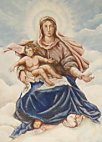
Holy Family by Bartolomé Esteban Murillo (1617-82)

Let any modern argue that no-fault divorce has raised the health and welfare of family life. Let any modern argue that the current marital regime has led to more stable, more fulfilling family life. It is an impossible burden. The very opposite seems manifestly the case. In the West, the family is in shambles. And divorce and contraception are, above all, the principal culprits. They are fundamentally opposed to marriage, deny its very nature. Is it any wonder that, accustomed to such marital evils, we have lost the sense of what marriage is, and now hear arguments seriously entertained that marriage is even possible between two members of the same sex? It is but a short step, however, from marriage made artificially unfruitful to marriage by its nature unfruitful. But marriage made unfruitful, either by nature or by artifice, is no longer marriage. It is a travesty of marriage.
[S]igns are not lacking of a disturbing degradation of some fundamental values [relating to marriage and the family]: a mistaken theoretical and practical concept of the independence of the spouses in relation to each other; serious misconceptions regarding the relationship of authority between parents and children; the concrete difficulties that the family itself experiences in the transmission of values; the growing number of divorces; the scourge of abortion; the ever more frequent recourse to sterilization; the appearance of a truly contraceptive mentality.
Familiaris consortio, No. 6.

Before Mercier takes leave of his discussion of marriage and family, he briefly discusses the relationship between marriage and family and the State. "[T]he institution of the family is not the result of legislation, nor are the rights and duties of its members created by it." [324(105)] It is the height of hubris, indeed, it is absolutely tyrannous, for the State to suggest that it has the power of defining marriage through positive law. While the State should have a supportive role in its citizens' marriages, and may address certain aspects of marriage life, such as formalities of marriage, and financial and other social or public aspects of it, marriage and family life remain fundamentally outside and independent of the State. Marriage is a natural institution established by God, and is governed by natural law and natural right, which are absolutely preeminent over the State, and to which the State must be subordinate. For the State to arrogate to itself the right to re-define marriage, whether under the mantle of "equal rights" or any other pennant or standard, is an arrogation of power it does not have. In a sense, it is a claim to divinity, of power over nature, over man, and over God. The advocates of homosexual marriage are doing nothing other than feeding the ravenous appetite of a tyrannous state that sees no natural limitations on its legislative powers. If it can define marriage, it can define man, and that means he can define who is man, and who is not (as indeed it has done in legislating or by judicial opinion holding that children in the womb are not "persons" subject to legal protection).


______________________________

*Cardinal Mercier emphasizes that the fact that marriage "allay[s] in some measure the importunities of passion," that is, acts as a honestum remedium concupiscentiae, a legitimate remedy for sexual concupiscence, "must not have a preponderating influence." "Sensual gratification," Mercier reminds us, "must always be subordinated to a higher motive, for if this is sought as an exclusive end, the worst excesses may result. The union of marriage is not that of merely material organisms but of persons with spiritual natures. To be of one flesh is but a means to a closer union of soul. This the dignity of human personality requires." [316-17(99)]