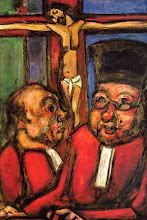
Angilbert (fl. ca. 840/50), On the Battle Which was Fought at Fontenoy

The Law of Christians is broken,
Blood by the hands of hell profusely shed like rain,
And the throat of Cerberus bellows songs of joy.

Angelbertus, Versus de Bella que fuit acta Fontaneto

Fracta est lex christianorum
Sanguinis proluvio, unde manus inferorum,
gaudet gula Cerberi.
Showing posts with label Natural Law and Work. Show all posts

Sunday, December 11, 2011

The Right to Work

THE CHURCH HONORS HUMAN WORK, and sees it as a fundamental good of man. She recognizes it as both a duty and a right. The reason work is both a duty and a right stems from the fact that work is necessary and that it affirms the human person.

Work is necessary for a variety of reasons. It is needed to form and support a family. It is a necessity to support one's right to property. It is needful because it contributes to the common good and to civil peace. The relationship between work and the common good is so intrinsic that the Church views unemployment as a "real social disaster." (Compendium, No. 287) (quoting John Paul II, Laborem exercens)

The Church therefore urges governments to aim, as part of a mandatory objective required by both justice and the common good, to the "full employment" of their citizens. Governments ought to avoid economic policies which frustrate this goal and which result in the denial of, or thwarting of, employment. (Compendium, No. 288)

Governments should also aim to assuring that there be adequate access to education and training. The role of education becomes even more important as the society becomes technologically mature. Also, with the "fluid economic context that is often unpredictable in the way that it evolves," retraining or on-going education is an essential requirement. (Compendium, No. 289, 290)

Finally, there ought to be special solicitude to those who have difficulty in obtaining employment and yet who have both the duty and the right to work: the young, women, less-specialized workers, those with disabilities, immigrants, ex-convicts, the illiterate. (Compendium, No. 289) Special concern should be women, whose "feminine genius is needed in all expressions in the life of society." (Compendium, No. 295). Also, there is frequent exploitation of foreign or immigrant workers to which the State ought to be vigilant to prevent. (Compendium, No. 298) Finally, the exploitation of children and child-labor is a blight that needs to be overcome. (Compendium, 296)


The Church therefore puts a large responsibility upon the shoulders of the State in the area of the employment of its citizens. But her social doctrine ought in no way to be interpreted in a manner suggestive of socialism or Soviet-style central planning. The Church is not advocating by any means politburo-employment. "The duty of the State does not consist so much in directly guaranteeing the right to work of every citizen, making the whole of economic life very rigid and restricting individual free initiative." (Compendium, No. 291)

Rather, the duty upon the State is one of sustaining "business activities by creating conditions which will ensure job opportunities, by stimulating those activities where they are lacking or by supporting them in times of crisis." The principle of subsidiarity is here of critical importance. (Compendium, No. 291) Employment is to be the result of "an open process" and not government dictates, a process essentially free yet responsible, which does not forget the solidarity among men. There is room here for private, for-profit initiative, and for non-profit, volunteer-type arrangements, the so-called "third sector" between private enterprise and public authority.

With the increased globalization of the world's economy, there is a role also to promote international cooperation among the several nation States "by means of treaties, agreements,and common plans of action that safeguard the right to work." International organizations and labor unions also "must strive first of all to create 'an ever more tightly knit fabric of juridical norms that protect the work of men, women, and youth, ensuring its proper remuneration." (Compendium, No. 292) Whether chronic unemployment is in Yuma, Arizona, or in Harare, Zimbabwe, or in Madrid, Spain, all of us are in some manner hurt.

There is an intrinsic connection between work and family life. Indeed, the Church sees that work is "a foundation for the formation of family life." (Compendium, No. 294) (quoting JP II, Laborem exercens) This is one reason why the Church is so concerned in assuring employment. Work allows marriage and family to flourish. It is needed to sustain the family and to allow for its principle end: the raising and education of children.

It is this intrinsic connection between work and family life, that ought to cause a re-appraisal of the relationship between employer and employee. The employment relationship cannot only be thought of in economic terms or in terms of a private contract, though it has those dimensions. But every employment decision has a familial dimension that ought not to be forgotten. So the Church asks everyone involved in the employment process, "businesses, professional organizations, labor unions, and the State," to "promote policies that, from an employment point of view, do not penalize but rather support the family nucleus." (Compendium, No. 294)

The Compendium also addresses the issue of agricultural labor, which requires a specialized or individualized treatment. In many countries, agricultural labor is particularly important to the national economy. In some countries, particularly in Latin America, land ownership is excessively centralized in what are known as latifundia or huge landed estates. The latifundia system is an inefficient, unproductive, unjust system, repeatedly condemned by the Church as immoral. It is closed to the free market, to wide-spread ownership of private property, to ready alienation of property. It requires attention and, in some countries, "a redistribution of land as part of sound policies of agrarian reform" is a moral imperative. (Compendium, No. 300)


Wednesday, November 30, 2011

Christ Working for Christ

THE INDUSTRIAL REVOLUTION WAS SOMETHING LIKE Pandora's box. With all the unquestionable increase in human economic development and the increase in wealth and efficiency in productivity and technical progress that the Industrial Revolution ushered in, came a variety of moral plagues and social evils, particularly for the factory worker, the miner, the child laborer, the family in overcrowded tenement, the disregarded poor, all of whom seemed to suffer from exploitation.

For many, these were hard times. The moneyed capitalist and the bourgeoisie who prospered from this Gospel of Wealth which dulled their appetite for the Eternal and their obligations to their fellow man seemed fat enough. But for the exploited class, it seemed like Hope remained bottled up, hidden somewhere.

Then, to make matters worse, all sorts of human devices were thought up as solutions for the moral and social problems: socialism, communism, anarchism. These seemed to pit class against class, brother against brother, and suggested injustice as an answer for injustice, two wrongs to make a right. These were Godless, materialistic recipes to counter a Godless, heartless capitalism. They were but salt in the wound of class warfare.

This Industrial Revolution and the "social question" it raised, presented the Church with a new challenge. When she saw the crowds, she had compassion on them, because they were distressed and troubled, wandering around like sheep without a shepherd. So she looked into her reservoir of knowledge to see what she could offer to alleviate the problem and counter the spurious solutions. Drawing forth from the natural law and evangelical principles, she brought forth the salve of her social doctrine.

The Church's first sally into this area was Pope Leo XIII's encyclical Rerum novarum, literally "Of New Things." This encyclical was, as, as the Compendium of the Social Doctrine of the Church describes it, "a heartfelt defense to the inalienable dignity of workers," but it also stressed the "importance of the right to property, the principle of cooperation among the social classes, the rights of the weak and the poor, the obligations of workers and employers, and the right to form associations." (Compendium, No. 268)

From Pope Leo XIII's encyclical Rerum novarum to Pope Benedict XVI's encyclical Caritas in veritate, "the Church has never stopped considering the problems of workers within the context of a social question which has progressively taken on worldwide dimensions."(Compendium, No. 269)

In addressing the social questions raised by the Industrial Revolution and the economic and social changes it brought forth, the Church has had cause to reflect on the meaning of work. Work that is the every-day fact of life for man. Work from which man can derive dignity, but which may in some cases also be impersonal, tainted by injustice, the loss of freedom, and the cause of heavy toil and inhuman suffering.


The Church brings a unique personalistic vision of work, one that finds in it great dignity and great value. For the Church, work is always understood within the context of the human person. The human is never viewed as a commodity, but always as a person, one endowed with body and soul, and one called to an eternal destiny. It is from this personal vantage point that the Church understands work and its dignity.

The Church therefore sees human work from three dimensions: the objective, the subjective,and the social. The first looks first at the work and not necessarily the person doing the work. The second looks at the person doing the work and not necessarily the work done. The third looks at the social aspect of work: how it affects others.

The Church recognizes that work has an objective component. It can be seen as the "sum of activities, resources, instruments, and technologies used by men and women to produce things." The precise boundaries of works therefore changes with the times and with place.

But the Church also sees the more important subjective component of work. In this subjective sense, work is the "actus personae," an act of a person. She recognizes that "work is the activity of the human person as a dynamic being," one made in the image of God and enjoying all the dignity of that image. (Compendium, No. 270) It is this personal, subjective side of work which gives it its dignity, and "which does not allow that it be considered a simple commodity or an impersonal element of the apparatus for productivity." "The subjective dimension of work must take precedence over the objective dimension." (Compendium, No. 271)

From the subjective, personal vantage point, any materialism is excluded. "Any form of materialism or economic tenet that tries to reduce the worker to being a mere instrument of production, a simple labor force with an exclusively material value, would end up hopelessly distorting the essence of work and stripping it of its most noble and basic human finality." (Compendium, No. 271).

Human work, therefore, must recognize "human finality." It must have as its final goal, not work itself or its product, but must have its "final goal in the human person." The "end of work any work whatsoever, always remains man." "Work is for man, and not man for work." (Compendium, No. 272)

There is therefore always a personal, a spiritual part of man involved in work, and for this reason "whatever work it is that is done by man--even if the common scale of values rates it as the meanest 'service,' as the most monotonous, even the most alienating work" retains its subjective value.

Work is never not tied to others. There are invariably social aspects, social connections and interdependency tied to work. One always works with others and for others, and not only for oneself. "Work, therefore, cannot be properly evaluated if its social nature is not taken into account." (Compendium, No. 273)

Work is not an option for man. Work is "an obligation, that is to say, a duty on the part of man." (Compendium, No. 274) (quoting John Paul II, Laborem exercens, 16) In a sense, work may be seen as part of that commandment of loving one's self and loving one's neighbor as one's self. The "Creator has commanded" that man work. That command is not arbitrary, as it recognizes that work is required for a man "in order to respond to the need to maintain and develop his own humanity." Finally, work is a moral obligation "with respect to one's neighbor, which in the first place is one's family," but which may also be seen to including "the society to which one belongs, the nation of which one is son or daughter," and even "the entire human family of which one is a member." Indeed, the duty of work extends beyond our own time, since we are "heirs of the work of generations and at the same time shapers of the future of all who will live after us." (Compendium, No.274)

In trying to understand the Church's personalistic vision of work, we might invoke here the picture of the last judgment presented by Jesus in the Gospel of Matthew (25:31-46).

At the end of time, the Lord will separate employers and employees.

And to the employers who understand the dignity of work, the Lord will say, "Come, for you provided me work." And they will respond, "Lord when did we give you work?" And the Lord will respond, "Truly I tell you, whatever you did for the least of these brothers and sisters of mine, you did for me."

And to the employees who understand the dignity of work, the Lord will say, "Come, for you worked for me." And these will respond, "Lord when did we work for you?" And the Lord will respond, "Truly I tell you, whatever work you did for the least of these brothers and sisters of mine, you did for me."

Think of how the world would differ if the employment relationships were seen as Christ employing Christ and Christ working for Christ.

I'll bet Adam Smith, James Mill, the Comte Saint-Simon, Karl Marx, and Pierre Joseph Proudhon never thought of that.

What a new thing that would be.

Sunday, November 27, 2011

The Word of God Worked: The Biblical Foundations of Work

“WORK IS NO DISGRACE; it is idleness which is a disgrace," writes the Greek poet Hesiod in his poem, "Works and Days."* Even this noble pagan sentiment fails to capture the Scriptural notion of the nobility of work and our duty to engage in it and sanctify it. Indeed, in the Scriptural view, work is a sort of imitation of God, the entire creation being seen as a workweek in which God brings forth the world out of nothing and gifts it to man so that he may exercise dominion over it and cultivate and care for it. (Gen. 1:28; 2:15; cf. Ps. 8:5-7) In Christ, work is even more ennobled, as we see God in his human nature working in the silent, hidden obscurity of Nazareth, setting for us an example of how work, even the most menial, can be the source of sanctification. In Christ, "human work becomes a service raised to the grandeur of God." (Compendium, No. 262)

The Compendium of the Social Doctrine of the Church begins its section on work with a reflection of the Biblical view of work and man's relationship to work. The message that one may take from the Compendium's understanding of the Biblical view of work is that it is a great, but relative good. "Work is part of the original state of man and precedes his fall; it is therefore not a punishment or curse." Work becomes toilsome only after the sin of Adam and Eve, after the fall. (Gen. 3:6-8; 17-19) The soil begrudges its gifts: it "becomes miserly, unrewarding, sordidly hostile." Only "by the sweat of one's brow" will man "get bread to eat." (Gen. 3:19)


The Childhood of Christ by Gerrit van Honthorst

When Christ teaches us to pray, "Give us this day, our daily bread," he is not teaching us to ask for some sort of divine welfare, a life of leisure while bread comes down from heaven as if it were manna. He is enjoining up us also the duty of work as a predicate for the gift of its fruit. "Through work," John Paul II said in his encyclical on human labor, "man must earn his daily bread." The post lapsarian suffering and toil, frustration and burden do not change our essential duty to exercise dominion over, to "cultivate and care for" creation.

Work was part of paradise. Work is part of the world which is no longer a paradise.

Work has a place of honor because it is a source of wealth, a necessary key to flourishing, to fulfillment, to happiness. It is the key to the conditions of a decent life. It is a tool against poverty and hunger. In this world--unless one lives off of the labor of another or off one's inherited or saved capital--work is what will keep body and soul together. "If any man will not work, neither let him eat." (2 Thess. 3:10)

For all its value, however, work and the wealth and money it may bring are not to be idolized. There is such a thing as idols of work, of the marketplace, and of wealth: idola laboris, idola fori, idola pecuniae. The Compendium warns us that one "must not succumb to the temptation of making an idol of work, for the ultimate and definitive meaning of life is not to be found in work." "Work is essential," it recognizes, "but it is God--and not work--who is the origin of life and the final goal of man." (Compendium, No. 257) The work week culminates in the Sabbath rest. "The memory and the experience of the Sabbath constitute a barrier against becoming slaves to work, whether voluntarily or by force, and against every kind of exploitation, hidden or evident." (Compendium, No. 258)

Indeed, the wealth that work may yield--while unquestionably a great good--may also be inordinately loved. "Man," our Lord says, "does not live by bread alone." (Matt. 4:4; Luke 4:4) There are things greater than wealth--justice, righteousness, and charity among them. "Better is a little with the fear of the Lord," Proverbs 15:16 says, "than great treasure and trouble with it." The same message is repeated: "Better is a little with righteousness than great revenues with injustice." (Prov. 16:8) We are therefore not to be anxious for earthly goods, like the Pagans. (Matt. 6:25, 31, 34) "But seek first the kingdom (of God) and his righteousness, and all these things will be given you besides." (Matt. 6:33)

There are few things more dangerous than wealth. We know what God has in store for the hoarder who had only his riches in mind, even if these riches were legally and justly acquired: "You fool! This very night your life will be demanded from you." (Luke 12:20) In the parable of Lazarus and Dives, the rich man Dives lands in Hades. (Luke 16:19-31) "I tell you the truth," Christ says, "it is hard for a rich man to enter the kingdom of heaven." He follows it up with an image which is harrowing to a man of means: "it is easier for a camel to go through the eye of a needle than for a rich man to enter the kingdom of God." (Matt. 19:23-24; Mark 10:24-25; Luke 18:24-25)

The Christian must therefore always subject himself to an examen of conscience, and he may have no better guide than Job:
Had I put my trust in gold or called fine gold my security;
Or had I rejoiced that my wealth was great,
Or that my hand had acquired abundance
. . .
This too would be a crime for condemnation,
For I should have denied God above.
(Job 31: 24-25, 28)

In his life, Jesus gives us an example of Christian work. One must remember than in all Christ's "hidden years," Jesus labored in obscurity. In fact, Jesus "'devoted most of the years of his life on earth in manual work at the carpenter's bench' in the workshop of Joseph." (Compendium, No. 259) (quoting JP II, Laborem exercens, 6) Nothing Jesus did was in vain. Nor must we think these almost thirty years of obscure labor meant nothing to Jesus or to humankind.

In his book Orthodoxy, G. K. Chesterton said that there was one thing too great for God to show us when He walked upon earth, and that he "sometimes fancied that it was His mirth."

In truth there was something other than Jesus' mirth that was not shown us: the almost thirty years of obscure labor in Nazareth: God in humility, poverty, and silence--in hiding--doing "the work of human hands," the opera manuum hominum, of a poor carpenter. It was this mysterious "non-revelation" that so inspired Blessed Charles de Foucald himself to live this "hidden life" outside of Tamanrasset, among the Berber Touareg tribe, in the hostile southern Sahara.

He [Jesus] came to Nazareth, the place of the hidden life, of ordinary life, of family life, of prayer, of work, of obscurity, of silent virtues practiced with no witness other than God, his family, and his neighbors, of this holy life, humble, kindly, obscure, that place where the greater part of humans lead their lives, and where he set the example for thirty years.**

The value that Jesus ascribes to work is apparent in his parables and in his words. Useless servants are chastised for hiding talents. (Matt. 24:46) Hired laborers in the vineyard should accept their agreed wage. (Matt. 20:1-6) The laborer deserves his wages. (Luke 10:7) Servants that are faithful to their masters are held in high esteem. (Matt. 24:46) He views his entire mission as work: "My Father is working still, and I am working." (John 5:17)

"Work," reflected upon in the revelation of Jesus Christ, "represents a fundamental dimension of human existence as participation not only in the act of creation but also in that of redemption." (Compendium, No. 263) The difficulties of work can be part of that cross which, as disciples of our Lord, we are called to carry in imitation of our Lord. Our work, not through any merits of its own, but as a result of the grace of Christ, becomes "an expression of man's full humanity, in his historical condition and his eschatological orientation." (Compendium, No. 118)

_______________________________________
*ll. 309 (ἔργον δ᾽ οὐδὲν ὄνειδος, ἀεργίη δέ τ᾽ ὄνειδος)
**Il vint à Nazareth, le lieu de la vie cachée, de la vie ordinaire, de la vie de famille, de prière, de travail, d’obscurité, de vertus silencieuses, pratiquées sans autre témoin que Dieu, ses proches, des voisins, de cette vie sainte, humble, bienfaisante, obscure, qu’est celle de la plupart des humains, et dont il donna l’exemple pendant trente ans. Charles de Foucauld, "Voyageur dans la nuit, notes de spiritualité 1888-1916", note quotidienne du 20 juin 1916, éditions Nouvelle Cité, page 208.