Angilbert (fl. ca. 840/50), On the Battle Which was Fought at Fontenoy

The Law of Christians is broken,
Blood by the hands of hell profusely shed like rain,
And the throat of Cerberus bellows songs of joy.

Angelbertus, Versus de Bella que fuit acta Fontaneto

Fracta est lex christianorum
Sanguinis proluvio, unde manus inferorum,
gaudet gula Cerberi.
Showing posts with label Veritatis Splendor. Show all posts

Sunday, September 11, 2011

Veritatis Splendor: Part 38--Mary and Morals

TOTUS TUUS, "ALL YOURS," was John Paul II's papal motto. And, true to this motto, the Pope in his encyclical on the fundamentals of morality "entrusts . . . the moral life of believers and people of good will, and the research of moralists, to Mary, Mother of God and Mother of Mercy." VS, 118. The final sections of his encyclical are devoted to the role that Mary, the Mother of Mercy, Mater misericordiae, plays in the moral life of Christians.

The Pope focuses on three reasons of why Mary is important in the Christian moral life: two ontological (relating to her position as fully human mediatrix to the one and only divine Mediator between God and man, Christ Jesus) and one exemplary.

Mary is the Mother of Mercy "because her son, Jesus Christ, was sent by the Father as the revelation of God's mercy" through her. VS, 118. Mary is also the Mother of Mercy "because it is to her that Jesus entrusts his Church and all humanity." VS, 120. Finally, Mary, the Mother of Mercy, is also fulgidum est ac pulcherrimum vitae moralis exemplum, "the radiant sign and inviting model of the moral life," perhaps better translated as the most refulgent and beautiful exemplar of the moral life. VS, 120. Mary, Advocata, Auxiliatrix, Adiutrix, et Mediatrix nostrae, therefore, ushers in Mercy into human history--fiat mihi secundum verbum tuum. Mary continues to be the custodian, by God's design--ἴδε ἡ μήτηρ σου! Ecce mater tua! Behold your mother!*--of God's mercy in Jesus. And Mary remains for us the epitome, the paradigm of Christian discipleship, a perfect example of following Christ, even being by him while he hung on the Cross--Stabat mater dolorosa iuxta Crucem lacrimosa, dum pendebat Filius.

During his exposition of Mary's role in bring us God's mercy in Christ, the Pope delivers an important truth: "No human since can erase the mercy of God, or prevent him from unleashing all his triumphant power, if only we call upon him." VS, 118. To suggest that any particular sin can overcome God's infinite mercy is, in a real way, to claim that our sin is more powerful than God. The thought is blasphemous, if not also foolish. There is no sin too large for God's mercy. To suggest that we can sin in a manner that overcomes God's infinite mercy is, at bottom, a claim that we are more omnipotent than God! What a foolish falsehood and false folly is behind the notion of a sin that is unforgivable. The only unforgivable sin is believing that one's sin is unforgiveable!

O felix culpa quae talem et tantum meruit habere redemptorem. "O happy fault that merited such and so great a Redeemer," we sing in the grand Exsultet during the Easter liturgy, overjoyed at Christ's victory over sin and death. It is this spirit--the same spirit that the Patriarch Joseph invoked when he told is brothers that they had plotted evil against him, but that God had used their evil as an occasion of good (Gen. 50:20)--that drives the Pope to say that even sin cannot defeat God: "Indeed, sin itself makes even more radiant the love of the Father who, in order to ransom a slave, sacrificed his Son: his mercy toward us in Redemption." VS, 118. Indeed, the Pope himself invokes the Exsultet when he cites to those beautiful words that are also part of it:
O inaestimabilis dilectio caritatis: ut servum redimeres, Filium tradidisti!

O inestimable affection of love: that Thou mightest redeem a slave, Thou didst deliver up Thy Son!

God's mercy is infinite, almost offensively prodigious and ostentatious. Why would God give up his son for us slaves! What sort of God is this! "Rarely will anyone die for a righteous person, though perhaps for a good person someone might actually dare to die," says St. Paul. Rom. 5:7. But to die for slaves, to those enslaved in sin? For Uncontingent Being to assume contingent being so that he can redeem contingent beings? This is too impossible a thought. And yet this is precisely what is at the nut of the Gospel. Though never forced on anyone, the least movement even implicitly towards the Divine Mercy that became incarnate in Jesus wins its favor,** and, ultimately draws us toward and leads us to the fullness of Mercy, which is found "in the gift of the Spirit who bestows new life and demands that it be lived." VS, 118.

No matter how many and great the obstacles put in his way by human frailty and sin, the Spirit, who renews the face of the earth (cf.Ps 104:30), makes possible the miracle of the perfect accomplishment of the good. This renewal, which gives the ability to do what is good, noble, beautiful, pleasing to God and in conformity with his will, is in some way the flowering of the gift of mercy, which offers liberation from the slavery of evil and gives the strength to sin no more. Through the gift of new life, Jesus makes us sharers in his love and leads us to the Father in the Spirit.

VS, 118. Where sin abounds, grace abounds all the more. Cf. Rom. 5:20-21. This is a spiritual law in a theology where God is mercy.

Christian morality, at its root, which is to say most radically, is extraordinarily simple. This is the great beauty of the Christian Gospel. While in the concrete all life can seem hopelessly complex, difficult, or burdensome, at the heart of Christian morality is an utterly simple concept: "Christian morality consists, in the simplicity of the Gospel, in following Jesus Christ, in abandoning oneself to him, in letting oneself be transformed by his grace and renewed by his mercy, gifts which come to us in the living communion of his Church." VS, 119. The heart of the Christian life is readily available and comprehensible to everyone. Follow Jesus, or, as St. Francis de Sales was wont to put it in his French, Vive Jesus! Vive Jesus! Live Jesus! Live Jesus!


The motto of St. Francis de Sales, Vive Jesus! Vive Jesus!
encapsulates Christian morality

Again, though the heart of the Christian moral enterprise is extraordinarily simple, this does not mean that the Christian moral life is simplistic.
[T]his evangelical simplicity does not exempt one from facing reality in its complexity; rather it can lead to a more genuine understanding of reality, inasmuch as following Christ will gradually bring out the distinctive character of authentic Christian morality, while providing the vital energy needed to carry it out. It is the task of the Church's Magisterium to see that the dynamic process of following Christ develops in an organic manner, without the falsification or obscuring of its moral demands, with all their consequences. The one who loves Christ keeps his commandments (cf. Jn 14:15).
VS, 119. Since responding to Christ's merciful invitation is so much at the heart of Christian morality, it follows that Mary is also at the heart of it. Not only is she a model of humble response to God's invitation--fiat mihi secundum Verbum tuum, be it done to me according to your Word--she is herself, as a result of her great fiat, the Mother of Mercy, the mother of the Jesus who tells each of us, "Follow me!" Mary's "yes" is ensconced between God pre-incarnate and God incarnate. Mary's "yes" is the conjunction, the copula between the Son of God as only true God and the Son of God as true God and true man. Mary is the Mother of the one whom we need to follow as we follow Christ. She is the one who has made the Lord seen, who gave him his human nature, who gave him the body that he offered up for us on the Cross, and so, in a real albeit mystical way, Mary is the mother of all the faithful.

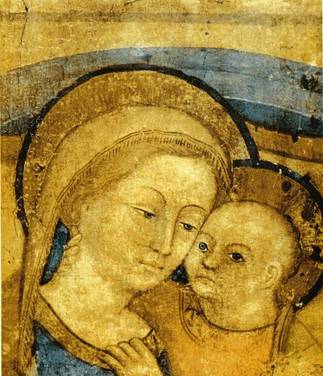
Virgin of Ostrobramska also called
Mater Misericordiae, Mother of Mercy


Mary is the exemplar of a Christian response to the invitation of Christ to "follow me," an invitation she accepted fully, even from the time--through a singular grace of God--of her Immaculate Conception. By a singular act of grace, she was following the Lord, even at the moment of conception.

Mary is the radiant sign and inviting model of the moral life. As Saint Ambrose put it, "The life of this one person can serve as a model for everyone," and while speaking specifically to virgins but within a context open to all, he affirmed: "The first stimulus to learning is the nobility of the teacher. Who can be more noble than the Mother of God? Who can be more glorious than the one chosen by Glory Itself?" Mary lived and exercised her freedom precisely by giving herself to God and accepting God's gift within herself. Until the time of his birth, she sheltered in her womb the Son of God who became man; she raised him and enabled him to grow, and she accompanied him in that supreme act of freedom which is the complete sacrifice of his own life. By the gift of herself, Mary entered fully into the plan of God who gives himself to the world. By accepting and pondering in her heart events which she did not always understand (cf. Lk 2:19), she became the model of all those who hear the word of God and keep it (cf. Lk 11:28), and merited the title of "Seat of Wisdom". This Wisdom is Jesus Christ himself, the Eternal Word of God, who perfectly reveals and accomplishes the will of the Father (cf.Heb 10:5-10). Mary invites everyone to accept this Wisdom. To us too she addresses the command she gave to the servants at Cana in Galilee during the marriage feast: "Do whatever he tells you" (Jn 2:5).

VS, 120.***

Mary's Scriptural role is intended to continue in history and outside of history, and so the Pope concludes, before closing his encyclical to a prayer to Mary, with a summary of her solicitude toward men as they strive to follow her Son, the Lord's invitation to come and follow him:
Mary shares our human condition, but in complete openness to the grace of God. Not having known sin, she is able to have compassion on every kind of weakness. She understands sinful man and loves him with a Mother's love. Precisely for this reason she is on the side of truth and shares the Church's burden in recalling always and to everyone the demands of morality. Nor does she permit sinful man to be deceived by those who claim to love him by justifying his sin, for she knows that the sacrifice of Christ her Son would thus be emptied of its power. No absolution offered by beguiling doctrines, even in the areas of philosophy and theology, can make man truly happy: only the Cross and the glory of the Risen Christ can grant peace to his conscience and salvation to his life.
VS, 120.

So let us end this series of reflections on Veritatis splendor with the Pope's own prayer, so full of Scriptural reference:
O Maria,
Mater Misericordiae,
omnibus nobis prospice,
ne inanis reddatur crux Christi,
ne deerret homo a via bonitatis,
neque peccati conscientiam amittat,
sed spem sibi augeat in Deo,
qui dives est in misericordia,
libere exsequatur opera bona ab Eo praeparata
et sic fiat totam per vitam
in laudem gloriae eius.

O Mary,
Mother of Mercy,
watch over all people,
that the Cross of Christ
may not be emptied of its power,
that man may not stray
from the path of the good
or become blind to sin,
but may put his hope ever more fully in God
who is rich in mercy.
May he carry out the good works prepared
by God beforehand
and so live completely
for the praise of his glory.
Amen.
_______________________________________
*John 19:27.
**This notion, of course, is what was behind Pope Benedict XVI's much misunderstood statement in his book
Light of the World, regarding a male prostitute with AIDS who decides to use a condom so as to protect others. It is not that this action is right, but that it might, under some envisionable circumstances, represent the first tentative step, the first leaning back towards a life of moral norms in human sexuality where the pleasure principle is for the first time eschewed or limited: the use of such prophylaxis in such speculative and specific circumstance being "a first step toward moralization, that is, becoming moral. In such a case, condom use might be their first act of responsibility to redevelop their consciousness of the fact that not everything is permitted and that one cannot do everything one wants." One would think that when a heart begins to turn, that the grace of God will be there drawing it still further into Himself, so that step-by-step, from this most tentative of beginnings, the Lord may eventually draw this soul into communion with Himself, which is where He desires all mankind to be. For Christ came into the world not to condemn the world, but to save it. Cf. John 3:17.
***The Pope quotes from St. Ambrose,
De Virginibus, II.2.15: PL 16, 222.

Saturday, September 10, 2011

Veritatis Splendor: Part 37--The Witness of Bishops

MODERN MAN SEEMS TO BE AVERSE TO AUTHORITY, thinking erroneously that recognizing authority and being obedient to it is ipso facto a curb on his freedom. But this is a serious mistake because this attitude will blind us to a part of the Gospel: "All authority in heaven and on earth has been given to me. Therefore go and make disciples of all nations, baptizing them in the name of the Father and of the Son and of the Holy Spirit and teach them to obey everything I have commanded you." Matt.28:18-20. Christ is the repository of all authentic authority, and if view authority as incompatible with freedom we cannot know Jesus, who is the source of true freedom.

This commission to preach the Gospel and teach all nations has, in a way, been given to the entire Church. And yet it resides in a particular, central, and unique and irreplaceable way in the body of bishops.

Among the principal tasks of Bishops the preaching of the Gospel is pre-eminent. For the Bishops are the heralds of the faith who bring new disciples to Christ. They are authentic teachers, that is, teachers endowed with the authority of Christ, who preach to the people entrusted to them the faith to be believed and put into practice; they illustrate this faith in the light of the Holy Spirit, drawing out of the treasury of Revelation things old and new (cf. Mt 13:52); they make it bear fruit and they vigilantly ward off errors that are threatening their flock (cf. 2 Tim 4:1-4).

VS, 114 (quoting Dogmatic Constitution on the Church Lumen Gentium, 25).

Here, the Pope comes full circle, returning back to the meditation on the rich young ruler with which he began his encyclical. The Bishops are to be like Christ and are to reply honestly and fully to the question which is on the lips, and, if not on the lips, in the heart of every man: "What good must I do to have eternal life?:
In the heart of every Christian, in the inmost depths of each person, there is always an echo of the question which the young man in the Gospel once asked Jesus: "Teacher, what good must I do to have eternal life?" (Mt 19:16).
VS, 117.

The rich young ruler, when he asked this question, turned to Christ:
Replying to the question: "What good must I do to have eternal life?" Jesus referred the young man to God, the Lord of creation and of the Covenant. He reminded him of the moral commandments already revealed in the Old Testament and he indicated their spirit and deepest meaning by inviting the young man to follow him in poverty, humility and love: "Come, follow me!" The truth of this teaching was sealed on the Cross in the Blood of Christ: in the Holy Spirit, it has become the new law of the Church and of every Christian [nova Ecclesiae omniumque Christifidelium lex est facta].

This "answer" to the question about morality has been entrusted by Jesus Christ in a particular way to us, the Pastors of the Church; we have been called to make it the object of our preaching, in the fulfillment of our munus propheticum [prophetic office]. At the same time, our responsibility as Pastors with regard to Christian moral teaching must also be exercised as part of the munus sacerdotale [priestly office]: this happens when we dispense to the faithful the gifts of grace and sanctification as an effective means for obeying God's holy law, and when with our constant and confident prayers we support believers in their efforts to be faithful to the demands of the faith and to live in accordance with the Gospel (cf. Col 1:9-12). Especially today, Christian moral teaching must be one of the chief areas in which we exercise our pastoral vigilance, in carrying out our munus regale [kingly office].
VS, 114.

Therefore, when modern man asks this question, where is the voice of Christ to be found?

When people ask the Church the questions raised by their consciences, when the faithful in the Church turn to their Bishops and Pastors, the Church's reply contains the voice of Jesus Christ, the voice of the truth about good and evil. In the words spoken by the Church there resounds, in people's inmost being, the voice of God who "alone is good" (cf. Mt 19:17), who alone "is love" (1 Jn 4:8, 16).

VS, 117.

The novelty of what confronts Christianity is highlighted by the circumstances which brought forth the Pope's encyclical Veritatis splendor. Other encyclicals have handled the issue of morals, but in the history of the Church, there has been no felt need to have an encyclical which handled the fundamental aspects, the foundation of the Church's moral teaching. It is remarkable that the Church confronts a situation where man's moral makeup is being denied, not only by the occasional libertine, or by those outside her communion, but even by a large cadre of her own theologians. And so the Church, acting through her head, the Pope, finds it necessary to take a step that is novel, unprecedented. "This is the first time, in fact," the Pope tells us, "that the Magisterium of the Church has set forth in detail the fundamental elements of this teaching, and presented the principles for the pastoral discernment necessary in practical and cultural situations which are complex and even crucial." VS, 115.

What has brought upon the felt need for the encyclical that sought to affirm the basic characteristics of freedom, of its intimate link with moral truth, the natural law, and grace as components of our adoption into Christ? The Pope felt the need to affirm that there are such things as moral absolutes. "Each of us can see the seriousness of what is involved, not only for individuals but also for the whole of society, with the reaffirmation of the universality and immutability of the moral commandments, particularly those which prohibit always and without exception intrinsically evil acts." VS, 115. Acceptance of absolute norms is sort of a litmus test of whether our understanding of moral reasoning is right. Once we abandon the notion of absolute norms we have abandoned the Gospel, at least in its important moral component.

Those who reject the notion of exceptionless norms injure themselves and condemn themselves to a moral regime which is not authentically human. More, they incapacitate themselves to hearing the entire fulness of the Gospel, hamstringing their ability to live, in a manner fully and free, the Gospel, at whose heart is the promise of authentic freedom in truth:

In acknowledging these commandments [including the exceptionless norms, those that prohibit always and without exception], Christian hearts and our pastoral charity listen to the call of the One who "first loved us" (1Jn 4:19). God asks us to be holy as he is holy (cf. Lev 19:2), to be — in Christ — perfect as he is perfect (cf. Mt 5:48). The unwavering demands of that commandment are based upon God's infinitely merciful love (cf. Lk 6:36), and the purpose of that commandment is to lead us, by the grace of Christ, on the path of that fullness of life proper to the children of God.

VS, 115.

The notion that there are exceptionless norms, moral absolutes is not popular. But popular or not, it is part of the Gospel, and it is therefore a duty of the Bishops to see that this truth is preached, faithfully and in its fullness and proper context. This moral truth--that there are certain boundaries of behavior which cannot be breached without violating the truth of what man is and what he is mean to be--is not a message of law for law's sake: it is a message of law for God and for man's sake, for in the area of moral truth, the interests of both God and man align. What God wills is good for man.


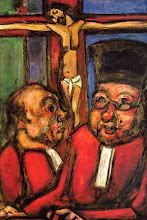
Beware of wolves in sheep's clothing!
'Catholic' theologians and institutions in masquerade!

The theologians play a vital supportive component of this episcopal duty; they are vital resource to the bishop. And yet, the theologians do not have, as it were, an office independent of the bishop. In the exercise of their discipline, the moral theologians are not some sort of Übermensch, a man above faith, above rules. Quite the contrary, the theologians, like the most humble layman, remain under the guiding authority of the bishop:
In carrying out this task we [bishops] are all assisted by theologians; even so, theological opinions constitute neither the rule nor the norm of our teaching. Its authority is derived, by the assistance of the Holy Spirit and in communion cum Petro et sub Petro with Peter and under Peter], from our fidelity to the Catholic faith which comes from the Apostles. As Bishops, we have the grave obligation to be personally vigilant that the "sound doctrine" (1 Tim 1:10) of faith and morals is taught in our Dioceses.
VS,116.

What is true of the individual theologian is true of Catholic institutions:

A particular responsibility is incumbent upon Bishops with regard to Catholic institutions. Whether these are agencies for the pastoral care of the family or for social work, or institutions dedicated to teaching or health care, Bishops can canonically erect and recognize these structures and delegate certain responsibilities to them. Nevertheless, Bishops are never relieved of their own personal obligations. It falls to them, in communion with the Holy See, both to grant the title "Catholic" to Church-related schools, universities, health-care facilities and counseling services, and, in cases of a serious failure to live up to that title, to take it away.

VS, 116. The bishops of the Church, then, are to make sure that there are no theologians or Catholic institutions who, like wolves in sheep's clothing, do not hide under the mantle "Catholic" when they reject fundamental aspects of "Catholic" teaching.

The episcopal task is onerous. The three-fold office of the bishop is difficult when confronting a world that has denied moral absolutes. But the Pope asks his bishops to have confidence in the dignity of their office, and in the importance of their task. It is a task for which they have been anointed:
Through the anointing of the Spirit this gentle but challenging word becomes light and life for man. Again the Apostle Paul invites us to have confidence, because "our competence is from God, who has made us competent to be ministers of a new covenant, not in a written code but in the Spirit... The Lord is the Spirit, and where the Spirit of the Lord is, there is freedom. And all of us, with unveiled faces, reflecting the glory of the Lord, are being changed into his likeness from one degree of glory to another; for this comes from the Lord, the Spirit" (2 Cor 3:5-6, 17-18).
VS, 117.

The moral life leads to Christ, the "follow me" is the invitation of Christ, and our following him is what leads us to virtue, to happiness, to union with God. One human being followed Christ in a supereminent way, and it is to this person, Mary, to whom the Pope turns in closing his encyclical Veritatis splendor. We will review this Marian coda of the encyclical in our last and final installment of this series on this encyclical.

Friday, September 9, 2011

Veritatis Splendor: Part 36-Theologus Moralis, Quo Vadis?

THERE IS NO ONE IN THE BODY of Christ, the Church, that is absolved or exempted from keeping the Gospel by the witness of his life, and in this way, all of the Church's members share in the munus propheticum, the prophetic office of Christ, and partake of the one Baptism into Christ which makes them fellow sharers of the Holy Spirit. The Church as a whole, confirmed in truth by the Spirit of Truth, is preserved from error. "It displays this particular quality through a supernatural sense of the faith in the whole people when, 'from the Bishops to the last of the lay faithful,' it expresses the consensus of all in matters of faith and morals." VS, 109 (quoting Lumen Gentium, 12).

Despite the infallibility of the whole Church in faith and morals, it would be wrong to limit that infallibility to the whole alone, and ignore the hierarchical organs in the Church, the bishops in communion with the Pope, which are part of the Lord's constitution of the Church. Similarly, it would also be wrong to forget St. Paul's understanding that there are many members to that body, and the members have special roles. 1 Cor.12:4-31. St. Paul's image is quite vivid:
As a body is one though it has many parts, and all the parts of the body, though many, are one body, so also Christ. [13] For in one Spirit we were all baptized into one body, whether Jews or Greeks, slaves or free persons, and we were all given to drink of one Spirit. [14] Now the body is not a single part, but many. [15] If a foot should say, “Because I am not a hand I do not belong to the body,” it does not for this reason belong any less to the body. [16] Or if an ear should say, “Because I am not an eye I do not belong to the body,” it does not for this reason belong any less to the body. [17] If the whole body were an eye, where would the hearing be? If the whole body were hearing, where would the sense of smell be? [18] But as it is, God placed the parts, each one of them, in the body as he intended. [19] If they were all one part, where would the body be? [20] But as it is, there are many parts, yet one body. [21] The eye cannot say to the hand, “I do not need you,” nor again the head to the feet, “I do not need you.” [22] Indeed, the parts of the body that seem to be weaker are all the more necessary, [23] and those parts of the body that we consider less honorable we surround with greater honor, and our less presentable parts are treated with greater propriety, [24] our more presentable parts do not need this. But God has so constructed the body as to give greater honor to a part that is without it, [25] so that there may be no division in the body, but that the parts may have the same concern for one another.
One of these parts of the body is the theologian, and, in the case of morals, the moral theologian. What is the specific contribution of the moral theologian to the life of the Church? Here, we must recall the role of reason and faith, of, in Augustinian and Anselmian terms, faith seeking understanding, or in Petrine terms the desire to give an accounting for their hope to those who ask for it (1 Pet. 3:15)

[R]evealed truth beckons reason — God's gift fashioned for the assimilation of truth — to enter into its light and thereby come to understand in a certain measure what it has believed. Theological science responds to the invitation of truth as it seeks to understand the faith. It thereby aids the People of God in fulfilling the Apostle's command (cf. 1 Pet 3:15) to give an accounting for their hope to those who ask it.

VS, 109.* "The 'vocation' of the theologian in the Church," says Pope John Paul II, "is specifically at the service of this 'believing effort to understand the faith." VS, 109. More precisely, the theologian's role "is to pursue in a particular way an ever deeper understanding of the word of God found in the inspired Scriptures and handed on by the living Tradition of the Church." The theologian does this, however, not as some sort of lone ranger, some sort of theological wildcatter, exploring for moral truths in a spirit of wild independence. The theologian performs his role "in communion with the Magisterium, which has been charged with the responsibility of preserving the deposit of faith." VS, 109.* In carrying out his important mission, a mission which the Church has no desire to begrudge him, the theologian, irrespective of whether faith or morals is involved, will recognize his "profound and vital connection with the Church, her mystery, her life and her mission." VS, 109.

Germain Grisez: An example of a faithful moral theologian

The moral theologian falls under these same principles. The moral theologian seeks to reflect and better understand "the Gospel as the gift and commandment of new life," a "life which 'professes the truth in love' (cf. Eph 4:15)," and "the Church's life of holiness, in which there shines forth the truth about the good brought to its perfection." VS, 110. The moral theologian will not forget the competency of the Magisterium in this area, as the "Church's Magisterium intervenes not only in the sphere of faith, but also, and inseparably so, in the sphere of morals." VS, 110. The Magisterium has a particular role in preserving the deposit of faith as it relates to morals:
It has the task of "discerning, by means of judgments normative for the consciences of believers, those acts which in themselves conform to the demands of faith and foster their expression in life and those which, on the contrary, because intrinsically evil, are incompatible with such demands." In proclaiming the commandments of God and the charity of Christ, the Church's Magisterium also teaches the faithful specific particular precepts and requires that they consider them in conscience as morally binding. In addition, the Magisterium carries out an important work of vigilance, warning the faithful of the presence of possible errors, even merely implicit ones, when their consciences fail to acknowledge the correctness and the truth of the moral norms which the Magisterium teaches.
VS, 110.*

The Magisterium's normative guidance is not limited to generalities, but also includes particulars. This is a guidance the moral theologian will not spurn; rather, he will seek to understand it, to internalize it, to give it "loyal assent, both internal and external." VS, 110. The moral theologian will, like Mary, in a spirit of faith and humility, treasure these things and ponder them in hearts. Cf. Luke 2:19. The moral theologian is not given a license to be unfaithful.

To be sure, moral theologians are not merely mouthpieces for the hierarchy. They are not the shock troops or lackeys of bishops. But neither are they the "loyal opposition." The relation is much more cooperative, symbiotic. Not everyone is called to be a moral theologian, but "[m]oral theologians, who have accepted the charge of teaching the Church's doctrine, thus have a grave duty to train the faithful to make this moral discernment, to be committed to the true good and to have confident recourse to God's grace." VS, 113.

While recognizing the possible limitations of the human arguments employed by the Magisterium, moral theologians are called to develop a deeper understanding of the reasons underlying its teachings and to expound the validity and obligatory nature of the precepts it proposes, demonstrating their connection with one another and their relation with man's ultimate end. Moral theologians are to set forth the Church's teaching and to give, in the exercise of their ministry, the example of a loyal assent, both internal and external, to the Magisterium's teaching in the areas of both dogma and morality. Working together in cooperation with the hierarchical Magisterium, theologians will be deeply concerned to clarify ever more fully the biblical foundations, the ethical significance and the anthropological concerns which underlie the moral doctrine and the vision of man set forth by the Church.

VS, 110.

Charlie Curran: An example of a unfaithful moral theologian

It is distressing that dissent among her moral theologians is so prevalent in the contemporary Church, as the Church confronts a situation where their role is of utmost importance, "not only for the Church's life and mission, but also for human society and culture." VS, 111. Those moral theologians who dissent from the Church's teaching damage not only the Church, but insult all mankind. Like some sort of vicious, mean, and sadistic father, they give us stones when we ask for bread. They feed us scorpions, when we clamor for eggs. They give us snakes, when we hunger for fish. Luke 11:11-12. Woe to those who cause the little ones to stumble. It would be better if they had been thrown in the sea with a millstone around their neck. Matt. 18:6; Mark 9:42; Luke 17:2. The dissenters blithely seem to disregard these evangelical warnings.
While exchanges and conflicts of opinion may constitute normal expressions of public life in a representative democracy, moral teaching certainly cannot depend simply upon respect for a process: indeed, it is in no way established by following the rules and deliberative procedures typical of a democracy. Dissent, in the form of carefully orchestrated protests and polemics carried on in the media, is opposed to ecclesial communion and to a correct understanding of the hierarchical constitution of the People of God. Opposition to the teaching of the Church's Pastors cannot be seen as a legitimate expression either of Christian freedom or of the diversity of the Spirit's gifts. When this happens, the Church's Pastors have the duty to act in conformity with their apostolic mission, insisting that the right of the faithful to receive Catholic doctrine in its purity and integrity must always be respected. "Never forgetting that he too is a member of the People of God, the theologian must be respectful of them, and be committed to offering them a teaching which in no way does harm to the doctrine of the faith."
VS, 113.*

Which takes us to the office of bishops, a matter we will handle in the next post.
______________________________________________
*In these sections, VS is quoting Congregation for the Doctrine of the Faith, Instruction on the Ecclesial Vocation of the Theologian Donum Veritatis (May 24,1990). AAS 82 (1990), 1552.

Thursday, September 8, 2011

Veritatis Splendor: Part 35--Evangelical Morality

“GO INTO ALL THE WORLD, and preach the Gospel to the whole creation." (Mark 16:15). These words of Jesus issue "the most powerful and stirring challenge which the Church has been called to face from her very beginning." VS, 106. This is one of the fundamental reasons for the Church's existence. Christ founded his Church to evangelize--that is to bring the good news about God and man to the world, sometimes to a world that is not eager to hear the message. Christ came in the fullness of time, but the Gospel may have to be preached in and out of season, when it may not be the fullness of time, but when time may be quite empty.

Every time and place involves different challenges to the fulfillment of this weighty charge that the Lord has placed upon us, and the modern challenge calls for an evangelization which is "new it is ardor, methods, and expression." It is called the "new evangelization," but that word may not be a perfect moniker, because the Gospel being preached is not new. It's not a new good news. Nor yet is is old good news. It is good news that is ever ancient, ever new. So what we have here is the Gospel being preached in ways that accommodate themselves to the historical situation that confronts the Church without a compromise in the message. The Church confronts a situation--not where life has to Christianized when it never was--but where life has to be re-Christianized. Preaching the Gospel to a dechristianized world is different from preaching the Gospel to a world that had never been Christian at all. The Church confronts a world that is weary, even weary of Christianity, a world that lives off memories of it and wanders and trudges listlessly, purposelessly, with money in one pocket and a gun in the other, and with lust in its heart, finding things to squander its money on, things to kill, and things to copulate with for no other reason than it has money and a gun and an itching crotch. Christianity is a waning memory in the dechristianized West. In his life, modern man has as much meaning as the life of the character Leopold Bloom in James Joyce's novel Ulysses :
The memory throws up high and dry
A crowd of twisted things;
A twisted branch upon the beach
Eaten smooth, and polished
As if the world gave up
The secret of its skeleton,
Stiff and white.
A broken spring in a factory yard,
Rust that clings to the form that the strength has left
Hard and curled and ready to snap.
T. S. Eliot,"Rhapsody on a Windy Night."

Our Lady of Good Counsel (15th Century)
Fresco from the Church of Genazzano, Italy


In the Pope's words, the malaise of the modern world weighs heavy upon it:

Dechristianization, which weighs heavily upon entire peoples and communities once rich in faith and Christian life, involves not only the loss of faith or in any event its becoming irrelevant for everyday life, but also, and of necessity, a decline or obscuring of the moral sense. This comes about both as a result of a loss of awareness of the originality of Gospel morality and as a result of an eclipse of fundamental principles and ethical values themselves. Today's widespread tendencies towards subjectivism, utilitarianism and relativism appear not merely as pragmatic attitudes or patterns of behavior, but rather as approaches having a basis in theory and claiming full cultural and social legitimacy.

VS, 106. It is not that we have never had faith or morals, it is that we had them once, and, having had them once, became apostates to the faith and dissipated in morals. It is hard to evangelize a rich, drunk atheist, a man on technical crack and steroids, a cynical man full of ennui and anomie, which is what society has become.

The loss of the moral sense presents a particular difficulty in the proclamation of the Gospel, inasmuch as it requires us to combat notions of moral subjectivism, utilitarianism, and relativism that are now deeply entrenched conventions. "Evangelization — and therefore the "new evangelization" — also involves the proclamation and presentation of morality." "[I]n presenting the foundations and content of Christian morality," the Pope says, "the new evangelization will show its authenticity and unleash all its missionary force when it is carried out through the gift not only of the word proclaimed but also of the word lived." VS, 107. We have to preach not only about what to believe, but about what to do.

Our Lady of Good Counsel (19th century)
by Pasquale Sarullo

What this calls for, then, is a re-commitment on the part of Christians to the moral demands of the Gospel. We must strive to live our lives differently--to exhibit "the word lived"--so as to effectively transmit the Gospel to others. Essentially, to "the word lived" means "the life of holiness," a "life in accordance with God's commandments and the Beatitudes of the Gospel."
In particular, the life of holiness which is resplendent in so many members of the People of God, humble and often unseen, constitutes the simplest and most attractive way to perceive at once the beauty of truth, the liberating force of God's love, and the value of unconditional fidelity to all the demands of the Lord's law, even in the most difficult situations.
VS, 107. From the martyrs, examples of fidelity to moral truth unto death, to the saints, examples of fidelity to moral truth in life. It is the example of the saints, in particular the Virgin Mother of God, whom the Church considers "full of grace" and "all-holy," wherein we find "the model" of "the word lived," "the strength" to live "the word lived," and "the joy" in having "the word lived." VS, 107. The life of holiness "brings to full expression and effectiveness the threefold and unitary munus propheticum, sacerdotale et regale [prophetic office, priestly office, and kingly office] which every Christian receives as a gift by being born again 'of water and the Spirit' (Jn 3:5) in Baptism." VS, 107. Conformity to the morality of the Gospel may thus be seen as an act of spiritual worship: a Christian's "moral life has the value of a 'spiritual worship'," one which flows from and is nourished and fed by a deep sacramental life. It will therefore be Eucharistic. The moral life of the Christian will also be Trinitarian. It will be intimately tied to the Spirit of Christ, of which it will be an expression, and it will be open to the activity of the Holy Spirit.

Here, the Pope quotes from Novation's orthodox work on the Trinity, an implicit recognition that the moral life must be Trinitarian which necessarily means open to the activity of the Holy Spirit:

[It is the Holy Spirit] who confirmed the hearts and minds of the disciples, who revealed the mysteries of the Gospel, who shed upon them the light of things divine. Strengthened by his gift, they did not fear either prisons or chains for the name of the Lord; indeed they even trampled upon the powers and torments of the world, armed and strengthened by him, having in themselves the gifts which this same Spirit bestows and directs like jewels to the Church, the Bride of Christ. It is in fact he who raises up prophets in the Church, instructs teachers, guides tongues, works wonders and healings, accomplishes miracles, grants the discernment of spirits, assigns governance, inspires counsels, distributes and harmonizes every other charismatic gift. In this way he completes and perfects the Lord's Church everywhere and in all things.

[Est enim Spiritus Sanctus] qui ipsorum animos mentesque firmavit, qui evangelica sacramenta distinxit, qui in ipsis illuminator rerum divinarum fuit, quo confirmati pro nomine Domini, nec carceres nec vincula timuerunt, quin immo ipsas saeculi potestates et tormenta calcaverunt, armati iam scilicet per ipsum atque firmati, habentes in se dona quae hic idem Spiritus Ecclesiae Christi sponsae quasi quaedam ornamenta distribuit et dirigit. Hic est enim qui prophetas in Ecclesia constituit, magistros erudit, linguas dirigit, virtutes et sanitates facit, opera mirabilia gerit, discretiones spirituum porrigit, gubernationes contribuit, consilia suggerit, quaeque alia sunt charismatum dona componit et digerit, et ideo Ecclesiam Domini undique et in omnibus perfectam et consummatam facit.

VS, 108.*

The burden upon all members of the Church, then, is to assure that their lives reflect "the word lived," that the word which they proclaim are not empty words, but that the Word that they proclaim bears fruit within their very lives, so that their very lives become witness to the Gospel. Their life is a living word of the Living Word.

We might here invoke the prayer to Our Lady of Good Counsel written by Pope Pius XII and published on January 23, 1953, as it brings together the theme of sanctity--and the Marian role in it--and the notion of moral truth:
Holy Virgin, moved by the painful uncertainty we experience in seeking and acquiring the true and the good, we cast ourselves at thy feet and invoke thee under the sweet title of Mother of Good Counsel. We beseech thee: come to our aid at this moment in our worldly sojourn when the twin darknesses or error and of evil that plots our ruin by leading minds and hearts astray.

Seat of Wisdom and Star of the Sea, enlighten the victims of doubt and of error so that they may not be seduced by evil masquerading as good; strengthen them against the hostile and corrupting forces of passion and of sin.

Mother of Good Counsel, obtain for us from thy Divine Son the love of virtue and the strength to choose, in doubtful and difficult situations, the course agreeable to our salvation. Supported by thy hand we shall thus journey without harm along the paths taught us by the word and example of Jesus our Savior, following the Sun of Truth and Justice in freedom and safety across the battlefield of life under the guidance of thy maternal Star, until we come at length to the harbor of salvation to enjoy with thee unalloyed and everlasting peace.

In making this "journey without harm along the paths taught us by the word and example of Jesus our Savior" a reality, the Bishops, in their teaching and pastoral offices, have an important, preeminent role. The moral theologians also play a role, a role which is at service of the teaching and pastoral office of the bishops. And it is to those two, the bishops and moral theologians, their interaction and their respective roles, to which the Pope next turns.
__________________________________________
*Quoting from Novation, De Trinitate, XXIX, 9-10;CCL 4, 70.

Wednesday, September 7, 2011

Veritatis Splendor: Part 34-Lex ipsa gratia vivificata est

THE MORAL LAW MAY BE DIFFICULT TO KEEP, particularly in certain circumstances. There are both external and internal circumstances that affect man's ability to exercise his freedom in a manner that conforms to the precepts of morality. But "[e]ven in the most difficult situations man must respect the norm of morality so that he can be obedient to God's holy commandment and consistent with his own dignity as a person." VS, 102.

A rose garden we have not been promised.

Certainly, maintaining a harmony between freedom and truth occasionally demands uncommon sacrifices, and must be won at a high price: it can even involve martyrdom. But, as universal and daily experience demonstrates, man is tempted to break that harmony: "I do not do what I want, but I do the very thing I hate... I do not do the good I want, but the evil I do not want" (Rom 7:15, 19).

VS, 102.

Man is thus "divided," and this "inner division" in man, of which any introspective person will be aware, is evidentiary or testamentary of a prior failure to acknowledge "the Lord as his Creator," and a wish "to be the one who determines, with complete independence, what is good and what is evil." VS, 102. Every man, then, bears the vestiges of a prior rebellion, the vestiges which easily attract temptations to ignore or trespass against God's commandments. There is in us an unfortunate disorder, a disorder which affects the entire man, his emotions, his physical desires, his will, and his intellect. Although revelation describes this as a "fall," revelation is not required to know that something is wrong. Observation and plain common sense tells us something is wrong, though reason alone may not give us the reason why this is case. That obvious fact is what led G. K. Chesterton in his book Orthodoxy to observe that original sin "is the only part of Christian theology which can really be proved."

The moral law, however, can be kept. God does not legislate the impossible, and it follows that the temptations that haunt man do not compel an act against the moral law. The temptations do not rob us of our free will:
But temptations can be overcome, sins can be avoided, because together with the commandments the Lord gives us the possibility of keeping them: "His eyes are on those who fear him, and he knows every deed of man. He has not commanded any one to be ungodly, and he has not given any one permission to sin" (Sir 15:19-20). Keeping God's law in particular situations can be difficult, extremely difficult, but it is never impossible. This is the constant teaching of the Church's tradition, and was expressed by the Council of Trent: "But no one, however much justified, ought to consider himself exempt from the observance of the commandments, nor should he employ that rash statement, forbidden by the Fathers under anathema, that the commandments of God are impossible of observance by one who is justified. For God does not command the impossible, but in commanding he admonishes you to do what you can and to pray for what you cannot, and he gives his aid to enable you. His commandments are not burdensome (cf. 1 Jn 5:3); his yoke is easy and his burden light (cf. Mt 11:30)."
VS, 102.

The law, however, cannot be kept without divine grace, and man sees "before him the spiritual horizon of hope," a hope that founded upon the confidence of the "help of divine grace," which cooperates with, and in fact buttresses, his freedom. Semper conceditur homini spiritalis via ad spem, divina gratia adiuvante atque humana libertate operam navante. VS, 103. Lex ipsa gratia vivificata est. The law itself is enlivened, is given life, by grace. Cf. VS, 103. In the moral life of man, law is its skeleton, and grace is its flesh.

God, of course, is the author of this grace, and he distributes it as he will. And yet he has provided in the Christian dispensation for some ordinary channels of this grace, channels which only the foolhardy, the ignorant, or the evil would forego:

It is in the saving Cross of Jesus, in the gift of the Holy Spirit, in the Sacraments which flow forth from the pierced side of the Redeemer (cf. Jn 19:34), that believers find the grace and the strength always to keep God's holy law, even amid the gravest of hardships. As Saint Andrew of Crete observes, the law itself "was enlivened by grace and made to serve it in a harmonious and fruitful combination. Each element preserved its characteristics without change or confusion. In a divine manner, he turned what could be burdensome and tyrannical into what is easy to bear and a source of freedom."*

VS, 103.

St. Andrew of Crete

The central act of God's grace is found in Christ, in his Redemption of all mankind. For this reason, the Pope insists that "[o]nly in the mystery of Christ's Redemption do we discover the 'concrete' possibilities of man." VS, 103. What John Paul II means by that is that the natural moral law should not be considered some ethereal, transcendent ideal way beyond man here-and-now. The ability to keep the moral law in all its fullness is not pie in the sky. The keeping of the moral law is achievable in the here-and-now, in the concrete circumstances, in the "categorical." The moral law is not some ideal which must be dumbed down, "adapted, proportioned, graduated to the so-called concrete possibilities of man."

But in speaking of the "concrete possibilities of man," and of the ability to keep the moral law, we must distinguish between what "man" we mean. "And of which man are we speaking? Of man dominated by lust or by man redeemed by Christ? VS, 103. This is the question rarely asked by both advocates and opponents of the natural law: when we talk about man's nature, what man are we referring to?

The man dominated by lust cannot keep the law, and it is not this man whose nature we appeal to. On the other hand, the man redeemed by Christ can keep the law, and it is this man whose nature is normative. And so the law's ideal, when applied to the "concrete possibilities of man," will force us to the recognition of a reality: "the reality of Christ's redemption. Christ has redeemed us!" VS, 103.

And what does this mean? The Redemption of man by Christ and the promise of forgiveness, provides man with the opportunity, one built on grace and powered by the Holy Spirit, of being free, free of the heavy hand of past wrongs, free of concupiscence, free to live a life awash in the splendor of moral truth.

[The Redemption of man by Christ] means that he has given us the possibility of realizing the entire truth of our being; he has set our freedom free from the domination of concupiscence. And if redeemed man still sins, this is not due to an imperfection of Christ's redemptive act, but to man's will not to avail himself of the grace which flows from that act. God's command is of course proportioned to man's capabilities; but to the capabilities of the man to whom the Holy Spirit has been given . . . .

VS, 103.

Even man's failure to enjoy these new-found possibilities given to him by Christus Redemmptor is governed by that Redemption. That perfection of Christ's redemption, if not seized by man in the first instance, may be seized by him in a second, since "though he has fallen into sin," the fallen "can always obtain pardon and enjoy [anew] the presence of the Holy Spirit" in all its fullness. VS, 103.

Christ's Redemption is perfect, but man remains imperfect. Part of that imperfection arises from man's weakness. Man, even the man of good will, even the man who lives in grace, remains weak. And so "appropriate allowance" must be made "both for God's mercy towards the sinner who converts and for the understanding of human weakness." VS, 104.

And yet this "appropriate allowance" is something worlds apart from compromise:
Such understanding never means compromising and falsifying the standard of good and evil in order to adapt it to particular circumstances. It is quite human for the sinner to acknowledge his weakness and to ask mercy for his failings; what is unacceptable is the attitude of one who makes his own weakness the criterion of the truth about the good, so that he can feel self-justified, without even the need to have recourse to God and his mercy. An attitude of this sort corrupts the morality of society as a whole, since it encourages doubt about the objectivity of the moral law in general and a rejection of the absoluteness of moral prohibitions regarding specific human acts, and it ends up by confusing all judgments about values.
VS, 104.

There is, in fact, a need to resist succumbing to the temptation of a reductio of the moral law to accommodate our weakness, our failures, or our sins. The moral law always tugs per aspera ad astra, from difficulties to the stars. It does not tug the other direction: per aspera de astris, by adversities down from the stars. The stars don't come down to man; rather, man must reach for the stars, in particular one star, the "star of Jacob," stella ex Iacob, the "bright morning star," the stella matutina that is Christ. Cf. Numbers 24:17-19; Rev. 22:16.

The biblical example of this appropriate attitude is the parable of the Pharisee and the tax collector (Luke 18:9-14). Had the tax collector, the publican been so disposed, he might have justified his sins through all manner of moral casuistry. He may have adopted the posture of the modern libertine. He may have adopted the stance of the modern proportionalist. He may have adopted the attitude of the Pharisee who felt "self-justified, finding some excuse for each of his failings" to the point that he was blind to them. But had our humble publican done so, in his self-justification would have remained in his sins, and he would have missed the opportunity for forgiveness and his opportunity at becoming free. "But his prayer does not dwell on such justifications," Pope John Paul II observes, "but rather on his own unworthiness before God's infinite holiness: 'God, be merciful to me a sinner!'" VS, 104.

Deus, propitius esto mihi peccatori! This is the attitude of a man about to be set free.

Here we encounter two different attitudes of the moral conscience of man in every age. The tax collector represents a 'repentant' conscience, fully aware of the frailty of its own nature and seeing in its own failings, whatever their subjective justifications, a confirmation of its need for redemption. The Pharisee represents a 'self-satisfied' conscience, under the illusion that it is able to observe the law without the help of grace and convinced that it does not need mercy.
VS, 104.

We must stand watch against becoming Pharisee. The sin of the Pharisee is not in maintaining the integrity of the law. The sin of the Pharisee is in self-justification, in adapting the law to his ability, in making the law come down to him, and so never seeing himself as a sinner in need of redemption, of forgiveness, of God's mercy.

All people must take great care not to allow themselves to be tainted by the attitude of the Pharisee, which would seek to eliminate awareness of one's own limits and of one's own sin. In our own day this attitude is expressed particularly in the attempt to adapt the moral norm to one's own capacities and personal interests, and even in the rejection of the very idea of a norm. Accepting, on the other hand, the "disproportion" between the law and human ability (that is, the capacity of the moral forces of man left to himself) kindles the desire for grace and prepares one to receive it. "Who will deliver me from this body of death?" asks the Apostle Paul. And in an outburst of joy and gratitude he replies: "Thanks be to God through Jesus Christ our Lord!" (Rom 7:24-25)

VS, 105.

St. Ambrose of Milan

Pope John Paul II ends this part of his encyclical with a prayer of Saint Ambrose which typifies and enshrines the attitude of the tax collector in its simple and total lack of self-justification before the Thrice Holy God:
What then is man, if you do not visit him? Remember, Lord, that you have made me as one who is weak, that you formed me from dust. How can I stand, if you do not constantly look upon me, to strengthen this clay, so that my strength may proceed from your face? When you hide your face, all grows weak (Ps 104:29): if you turn to look at me, woe is me! You have nothing to see in me but the stain of my crimes; there is no gain either in being abandoned or in being seen, because when we are seen, we offend you. Still, we can imagine that God does not reject those he sees, because he purifies those upon whom he gazes. Before him burns a fire capable of consuming our guilt (cf. Joel 2:3)

Quid est enim homo nisi quia visitas eum? Non ergo obliviscaris infirmum, memento quia pulverem me finxisti. Quomodo stare potero, nisi solidaturus hoc lutum semper intendas, ut de vultu tuo soliditas mea prodeat? “Cum averteris faciem, turbabuntur omnia” (Ps. 104 (103), 29): si intendas, vae mihi. Non habes quod in me aspicias nisi contagia delictorum: nec deseri utile nec videri est, quia dum videmur offendimus. Possumus tamen aestimare quia non repellit quas videt, quia emundat quos aspicit. Ignis ante eum ardet, qui crimen exurat (Cfr. Ioe. 2, 3)
VS, 105.**

The "Jesus Prayer," so beloved by the Orthodox, presents to us in a concise and precise way the attitude of a man who will be freed as he confronts the personal God, the only uncontingent and absolutely free Being, whose only limits are the Good which is the same as His Being:
Κύριε Ἰησοῦ Χριστέ, Υἱὲ τοῦ Θεοῦ, ἐλέησόν με τὸν ἁμαρτωλόν!
Domine Iesu Christe, Filius Dei, miserere me peaccatorem!
أيها الرب يسوع المسيح ابن الله, إرحمني أنا الخاطئ
(Ayyuha-r-Rabbu Yasū` al-Masīħ, Ibnu-l-Lāh, irħamnī ana-l-khāti’)
Տէր Յիսուս Քրիստոս Որդի Աստուծոյ ողորմեա ինձ մեղաւորիս!
Госпадзе Ісусе Хрысьце, Сыне Божы, памілуй мяне, грэшнага!
Pane Ježíši Kriste, Syne Boží, smiluj se nade mnou hříšným!
Herra Jeesus Kristus, Jumalan Poika, armahda minua syntistä.
Heer Jezus Christus, Zoon van God, ontferm U over mij, zondaar!
უფალო იესუ ქრისტე, ძეო ღმრთისაო, შემიწყალე მე ცოდვილი!
Herr Jesus Christus, Sohn Gottes, erbarme dich meiner, eines Sünders!
Viešpatie Jėzau Kristau, Dievo Sūnau, pasigailėk manęs nusidėjelio!
Mulej Ġesù Kristu, Iben ta’ Alla l-ħaj, ikollok ħniena minni, midneb!
Herre Jesus Kristus, forbarm deg over meg!
Panie Jezu Chryste, Synu Boga, zmiłuj się nade mną, grzesznikiem!
Господи Иисусе Христе, Сыне Божий, помилуй мя грешнаго!
Señor Jesucristo, Hijo de Dios, ten piedad de mi, que soy un pecador!
主耶穌基督,上帝之子,憐憫我罪人!
Seigneur, Jésus Christ, Fils de Dieu, aie pitié de moi, pécheur!
Ē ka Haku ‘o Iesu Kristo, Keiki kāne a ke Akua: e aloha mai ia‘u, ka mea hewa!
Uram Jézus Krisztus, Isten Fia, könyörülj rajtam, bűnösön!
Signore Gesù Cristo, Figlio di Dio, abbi misericordia di me peccatore!
主イイスス・ハリストス、神の子よ、我、罪人を憐れみ給え!
하느님의 아들 주 예수 그리스도님, 죄 많은 저를 불쌍히 여기소서
Wahai Isa-al-Masih, Putra Allah, kasihanilah aku, sesungguhnya aku ini berdosa!
Senhor Jesus Cristo, Filho de Deus, tende piedade de mim pecador!
Lord Jesus Christ, Son of God, have mercy on me, a sinner!

In all languages or one, the sentiment is the same, and humanity would be far better off if all men prayed the prayer in common.
_________________________________________
*The quotation is from St. Andrew of Crete's Oratio I, found in PG 95,805-06.
**Citation to St. Ambrose,
De interpellatione David, VI.6.22. [CSEL 32/2, 238-84]

Tuesday, September 6, 2011

Veritatis Splendor: Part 33--Human Equality and Natural Law

MAN DISPLAYS A GREAT DIVERSITY in his cultures and traditions, not to mention the tremendous diversity of natural, physical, intellectual, and psychological gifts in each individual man, woman, or child. Each man, woman, and child is different, and therefore incommensurable, uncomparable. And yet, for all their uniqueness and incommensurability, they are equal. Not only do they share a common human nature, they are equal when it comes to the moral law. Here is an unalterable, absolute, unchanging truth:

When it is a matter of the moral norms prohibiting intrinsic evil, there are no privileges or exceptions for anyone. It makes no difference whether one is the master of the world or the "poorest of the poor" on the face of the earth. Before the demands of morality we are all absolutely equal.

VS, 96.

The natural law, then, is a great equalizer. It cuts across the entirety of society, through all hierarchies, all socio-economic strata, all castes, all religions, all ideologies to govern all men in all societies, bar none:
In this way, moral norms, and primarily the negative ones, those prohibiting evil, manifest their meaning and force, both personal and social. By protecting the inviolable personal dignity of every human being they help to preserve the human social fabric and its proper and fruitful development. The commandments of the second table of the Decalogue in particular — those which Jesus quoted to the young man of the Gospel (cf. Mt 19:19) — constitute the indispensable rules of all social life.
VS, 97. By being the great equalizer, the natural moral law--and the human rights that flow from it--is a bulwark against totalitarianism of every kind--whether ideological or as a result of moral relativism. VS, 99.

There is no part of man's life--private or public--that would be outside the pale of the natural moral law. All his activities, from the most mundane to the most transcendent, are governed by moral considerations. "Thus, in every sphere of personal, family, social and political life, morality — founded upon truth and open in truth to authentic freedom — renders a primordial, indispensable and immensely valuable service not only for the individual person and his growth in the good, but also for society and its genuine development." VS, 101.

Democracy is not insulated from totalitarianism. It is an error to think that the democratic process is sufficient to preserve the freedoms and rights of its citizenry. Democracy coupled with moral relativism is a recipe for totalitarianism of a different kind. As the Pope, who haled from Poland and saw first-hand the evils of Marxist communism, warns:
[T]here is no less grave a danger that the fundamental rights of the human person will be denied and that the religious yearnings which arise in the heart of every human being will be absorbed once again into politics. This is the risk of an alliance between democracy and ethical relativism, which would remove any sure moral reference point from political and social life, and on a deeper level make the acknowledgement of truth impossible. Indeed, "if there is no ultimate truth to guide and direct political activity, then ideas and convictions can easily be manipulated for reasons of power. As history demonstrates, a democracy without values easily turns into open or thinly disguised totalitarianism."
VS, 101 (quoting Centesimus annus, 46).

The Ten Commandments, both in their general terms and through their more specific demands, are binding upon all men:

These commandments are formulated in general terms. But the very fact that "the origin, the subject and the purpose of all social institutions is and should be the human person" allows for them to be specified and made more explicit in a detailed code of behavior. The fundamental moral rules of social life thus entail specific demands to which both public authorities and citizens are required to pay heed. Even though intentions may sometimes be good, and circumstances frequently difficult, civil authorities and particular individuals never have authority to violate the fundamental and inalienable rights of the human person. In the end, only a morality which acknowledges certain norms as valid always and for everyone, with no exception, can guarantee the ethical foundation of social coexistence, both on the national and international levels.

VS, 97.

Manifestly, the world's "principalities and powers," its princes, ministers, and presidents, its multinational corporations, face and often cause "serious forms of social and economic injustice and political corruption," and these are often the result of violation of fundamental moral norms, particularly involving the violation of fundamental human rights which find their bases in those exceptionless norms of the natural law. Any reform, any "radical personal and social renewal capable of ensuring justice, solidarity, honesty, and openness," must not only be rooted in a "moral sense," but must also be "rooted and fulfilled in the religious sense." VS, 98.

This, of course, means that God must be at the center of all efforts at rectifying social and economic injustice among men.

Only God, the Supreme Good, constitutes the unshakable foundation and essential condition of morality, and thus of the commandments, particularly those negative commandments which always and in every case prohibit behaviour and actions incompatible with the personal dignity of every man. The Supreme Good and the moral good meet in truth: the truth of God, the Creator and Redeemer, and the truth of man, created and redeemed by him. Only upon this truth is it possible to construct a renewed society and to solve the complex and weighty problems affecting it, above all the problem of overcoming the various forms of totalitarianism, so as to make way for the authentic freedom of the person.

VS, 99.

The natural moral law, of which God is the author as he is the author of our nature, will therefore necessarily govern economic and political questions, as these are nothing other than personal questions of morality writ large.

The economic sphere, if governed within the natural moral law, will exhibit certain features:


  • There will be a certain temperance, a moderation of attachment to the goods of the world.

  • There will be an attachment to the virtue of justice, a desire to give to our neighbor his due.

  • There will be a sense of solidarity among the members of the system, which means that the Golden Rule will be followed and kept, and that there will be a sense of shared duty, of the acceptance of burdens, of helping those who are weakest or poorest.

  • Some behavior will not be tolerated:


    • Theft, deliberate retention of goods lent or objects lost.

    • Business fraud.

    • Unjust wages.

    • Forcing up prices by trading on the ignorance or hardship of the other.

    • Misappropriation and private use of corporate property of an enterprise.

    • Work badly done.

    • Tax fraud.

    • Forgery of checks and/or invoices.

    • Excessive expenses.

    • Waste of resources.

    • Any enslavement of human beings, or any system that shows disregard for their personal dignity such as chattel slavery.
Similarly, the political sphere will be influenced by the natural moral law and will exhibit certain features:

  • The governing authorities will recognize an obligation to tell the truth to those being governed.

  • There will be an openness in public administration.

  • There will be impartiality in the service of the body politic.

  • There will be respect for the rights of political adversaries.

  • There will be safeguards which assure fair trials and which prevent summary trials and convictions.

  • Public funds will be justly and honestly used.

  • Equivocal or illicit means to gain, preserve, or increase power at any cost will be rejected.

Monday, September 5, 2011

Veritatis Splendor: Part 32--The Witness of Martyrs

CHRISTIAN MARTYRS HAVE ALWAYS been venerated by the Christian Church. Indeed, so central was martyrdom to the early Christians that it is well-nigh impossible to understand them without also recognizing martyrdom's role. The blood of martyrs is the seed of the Church, sanguis martyrum semen christianorum, a commonplace phrase attributed to Tertullian.* What jihad was (and is) for the Muslim, martyrdom--a radically different concept than the martyrdom of jihad--was for the Church.**

It is clear that the Pope wishes us to focus on Christian martyrdom and its significance to the Christian who confronts a world that is as equally hostile towards him as the pagan Roman Empire, with its cult of emperor and cult of State. We perhaps have not become yet "enemies of State," but in the eyes of the world's liberal democracies we have become what John Paul II characterized in the encyclical Centesimus annus as unreliable citizens.*** Worse yet than confronting a hostile secular West, though unmentioned by the Pope in this encyclical, is the rising threat of radical and intolerant Islam whose problem is not a morally relativistic tyranny, but rather a morally positivistic tyranny. One is tyranny in the name of man, the other tyranny in the name of Allah. In either event, the Christian witness of martyrdom is paramount.

In the light of the prevalent and prevailing consequentialist or utilitarian morality in the West, and in light of the compromise to it by certain Catholic theologians in proportionalist ethical theories, Christian martyrdom may help clean out the cobwebs in our thinking, and may shake us from our complacency.

The unacceptability of "teleological", "consequentialist" and "proportionalist" ethical theories, which deny the existence of negative moral norms regarding specific kinds of behavior, norms which are valid without exception, is confirmed in a particularly eloquent way by Christian martyrdom, which has always accompanied and continues to accompany the life of the Church even today.

VS, 90.

The root of martyrdom runs deep in the Christian ethos, the Christian consciousness. It is part of radical Christianity in the sense of radix, root, since it is part of its foundational roots. The tree of the Church will die if the root of martyrdom is severed. One sees even in the Old Testament the example of brave men and women, for whom fidelity to God is preeminent to any worldly accommodation. The Pope points to the story of Susanna as an example where fidelity to truth, to moral truth, exceeds any compromise even if it means the loss of her life.

Susanna and the Lecherous Elders, by Annibale Carraci (1560-1609)

Susanna, one may recall, was a fair and comely Hebrew wife. Two lecherous elders quietly approached her as she was bathing in her garden. Voyeurs both, they looked at her nakedness and then, eaten by the lust that grew in their leering, followed her into her house and accosted her. They threatened that, unless she yielded to their demands, they would accuse her of an adulterous union with some young man. She knew that if she did not give in, that she would be tried, likely found guilty by the practically unimpeachable testimony of the influential elders, and would suffer death.
I am hemmed in on every side. For if I do this thing, it is death for me; and if I do not, I shall not escape your hands. I choose not to do it and to fall into your hands, rather than to sin in the sight of the Lord!
Dan 13:22-23. Susanna prefers to be "handed over" to the authorities than trespass that exceptionless norm that prohibits adultery. She would not trespass into evil, even if it meant to suffer an unjust death. Susanna is a witness to an exceptionless norm.

John the Baptist is that watershed prophet, the last of the Old Testament and the first of the New. Straddling the two dispensations, St. John the Baptist fearlessly witnessed to the true teaching regarding marriage. In his zeal for God, St. John the Baptist was "unable to refrain from speaking the law of the Lord," and he rejected "any compromise with evil," despite the knowledge that it would offend the ruling, albeit decadent, powers. For this reason, John Paul II points to him as an exemplar of the Christian fidelity to moral norms in the face of hostile authority.

Salome with the Head of St. John the Baptist, by Caravaggio (1557-1610)

The situation confronting the historical St. John, in particular the family situation of the Herodian family, is hopelessly complicated, not unlike some of the modern blended families that neglect and trespass the "law of the Lord" on marriage and family life.*** Herodias had married Herod II, the son of Herod the Great and his third wife Mariamne II. Herodias herself was a granddaughter of Herod the Great, as she was the daughter of Aristobulus IV and Herod's second wife, Mariamne I. After Herod II fell from grace, Herodias divorced him, and, following the path of power, married Herod Antipas, another son of Herod the Great though from his fourth wife, Malthace. Herod Antipas had himself divorced his prior wife Phasaelis. It was from her former marriage with Herod II that Herodias had her famous daughter Salome, a daughter who apparently had the eye of Herod Antipas.

John the Baptist, of course, found the entire intermarriage and divorce and remarriage among the established powers as unsavory and immoral. And he publicly preached against it. Power does not excuse from morality, just like celebrity does not excuse from morality. Herodias could not countenance being reminded of her decadent behavior, and she arranged, through her and her daughter's feminine wiles, for John the Baptist to be arrested. She then finagled his martyrdom by decapitation, the result of a rash promise made by her the King to her seductive daughter. Quoting one of the Venerable Bede's homilies, Pope John Paul II observes:
The one who came to bear witness to the light and who deserved to be called by that same light, which is Christ, a burning and shining lamp, was cast into the darkness of prison. . . . The one to whom it was granted to baptize the Redeemer of the world was thus baptized in his own blood.
VS, 91.

Icon depicting martyrdom of the Deacon Stephen,
proto-martyr of the Christian Church

The Lord, of course, was a constant model of fidelity to God, the filial love for the Father drove him to accept his passion, the carrying of the cross, and his brutal, if redemptive, death. And his followers soon found themselves on similar paths, dying first at the hands of Jewish and Roman authorities, and later by authorities of all kinds, Islamic, Asian, African, American Indian, Nazi, Communist, and on and on. Thousands of these may be seen on the Catholic altars and depicted on icons. There are millions more whose names will never be known. It is they who are calling us to be more like them.

The list of martyrs begins with the first martyr, the proto-martyr, St. Stephen, deacon of the Church, and St. James the Great, the first apostle who would suffer martyrdom and in whose coat tails all but the Apostle John, captive in the Island of Patmos, would follow.

Martyrdom of St. James the Great
by Giovanni David (1743–1790) after Andrea Mantegna

[These] died as martyrs in order to profess their faith and their love for Christ, unwilling to deny him. In this they followed the Lord Jesus who "made the good confession" (1 Tim 6:13) before Caiaphas and Pilate, confirming the truth of his message at the cost of his life. Countless other martyrs accepted persecution and death rather than perform the idolatrous act of burning incense before the statue of the Emperor (cf.Rev 13:7-10). They even refused to feign such worship, thereby giving an example of the duty to refrain from performing even a single concrete act contrary to God's love and the witness of faith. Like Christ himself, they obediently trusted and handed over their lives to the Father, the one who could free them from death (cf. Heb 5:7).
VS, 91.

The Church glorifies the names of these martyrs, and she "proposes the examples of numerous Saints who bore witness to and defended moral truth even to the point of enduring martyrdom, or who preferred death to a single mortal sin." VS, 91. The Church "has canonized their witness and declared the truth of their judgment, according to which the love of God entails the obligation to respect his commandments, even in the most dire of circumstances, and the refusal to betray those commandments, even for the sake of saving one's life." VS, 91.

But martyrdom is not a celebration of death for death's sake. Martyrdom is a celebration of death because there are some things more important than life, as precious as life is. Some things--truth, moral integrity, justice, fidelity, love, obedience to God--are more important than life because they are what life is for.††† Life, at least in its authentic form, is life according to truth, to moral integrity, where justice, fidelity, love, and obedience to God are reflected as we fulfill our purpose to live with God, in whom we move, and breath, and have our being.

How important is the witness of the martyrs! Against all those who would compromise the Gospel truth, the truth that is found in kernel in the natural moral law, the Church's martyrs witness to three unalterable truths.

First, they witness to the "inviolability of the moral order," which is a witness "both to the holiness of God's law and to the inviolability of the personal dignity of man." VS, 92. These, God's holy law and man's dignity, have been conjoined in Christ, who was both God and man, and they are part and parcel of man's moral life, from which God and man can no more be separated, having been hypostatically united in the person of the Son of God.

Second, martyrs witness to the falseness and illusory aspect found in "whatever 'human meaning' one might claim to attribute, even in 'exceptional' conditions, to an act morally evil in itself." They witness against answers that "seem right," but in fact are not. How many times are the exceptionless norms called harsh, mean, inhumane, inefficient, unreasonable, or otherwise insupportable? It is these excuses that men use to justify divorce, birth control, homosexuality, euthanasia, and a multitude of evils.

The martyr is then a witness to the truth found in Proverbs 16:25: "There is a way that seemeth to a man right: and the ends thereof lead to death." Martyrdom "unmasks the true face" of such acts, and uncovers them for what they are, and not what they seem, a "violation of man's 'humanity', in the one perpetrating it even before the one enduring it." VS, 92.

I recently was chastised as inhumane because I insisted in an argument that a victim of rape had no moral choice but to carry the child to term. This is a seeming reason, a false reason, in the sense that John Paul II speaks of. The victim of rape who bears the unwanted child instead of perpetrating an abortion, is more human, not less for her endurance. She has her models in such modern martyrs such as St. Maria Goretti who preferred to die than succumb to the rape of her neighbor, Alexander. She has as her models a man such as Franz Jägerstätter. This recent saint endured an unjust death because he refused conscription into the Nazi army, and this action was more human than that action of a man who perpetrated evil by materially participating in Hitler's plans. "Dieser Zug fährt in die Hölle!" "This train," Franz Jägerstätter recognized through his dream where National Socialism was going, "is being driven to Hell." Jump out," he says to us today when we are riding a secular, relativistic train, "before the train reaches its destination, even if it costs you your life." "Springet aus, ehe dieser Zug in deine Endstation einfährt, wenn es dabei auch das Leben kostet!"

Lastly, the Pope suggests that martyrdom "is an outstanding sign of the holiness of the Church."
Fidelity to God's holy law, witnessed to by death, is a solemn proclamation and missionary commitment usque ad sanguinem [even unto the shedding of blood], so that the splendor of moral truth may be undimmed in the behavior and thinking of individuals and society. This witness makes an extraordinarily valuable contribution to warding off, in civil society and within the ecclesial communities themselves, a headlong plunge into the most dangerous crisis which can afflict man: the confusion between good and evil, which makes it impossible to build up and to preserve the moral order of individuals and communities. By their eloquent and attractive example of a life completely transfigured by the splendor of moral truth, the martyrs and, in general, all the Church's Saints, light up every period of history by reawakening its moral sense. By witnessing fully to the good, they are a living reproof to those who transgress the law (cf. Wis 2:12), and they make the words of the Prophet echo ever afresh: "Woe to those who call evil good and good evil, who put darkness for light and light for darkness, who put bitter for sweet and sweet for bitter!" (Is 5:20).
VS, 93.

The martyrdom of "red martyrs" feeds the day-to-day life of the ordinary Christian disciple. They are the "high point of the witness to moral truth." But while there is a high point, there are also all the other times and places below, in which a consistent witness is required by Christians, if not by death, then often "at the cost of suffering and grave sacrifice," sometimes even a "heroic commitment." The red martyrdom of martyrs feeds the "white martyrdom" of daily Christian living in "fidelity to the moral order" in a society where the moral order is denied. VS, 93. Fortitude is the virtue the Christian must have under these trying circumstances, and, as St. Gregory the Great teaches in his Moralia in Job (VII.21), when the world is topsy turvy this requires one to "love the difficulties of this world for the sake of eternal rewards," huius mundi aspera pro aeternis praemiis amare, which might be translated as "tough up against this world in your love of the eternal prize." VS, 93.
_____________________________________
*Tertullian actually said: "Plures efficimur, quoties metumur a vobis; semen est sanguis Christianorum." (We multiply whenever we are mown down by you; the blood of Christians is seed). Tertullian, Apol., c.50. In one of his epistles, St. Jerome said "est sanguis martyrum seminarium Ecclesiarum." ("The blood of martyrs are the seeds of the Church"). St. Jerome, Ep., 27.2. St. Augustine said regarding martyers in his De civitate Dei (22:6): "Ligabantur, includebantur, caedebantur, torquebantur, urebantur, laniabantur, trudidabantur et--multiplicanbantur."(They [the martyrs] were bound, imprisoned, beaten, tortured, burned, torn in pieces, massacred, and yet they multiplied.")
**One must not forget that Islam rejects the crucifixion of Christ, both historically and theologically. The notion of the Cross is offensive to them. It is outside the framework of their reference to suggest that one ought to love his fellow man to the point of giving up his life for him, as a lamb to slaughter. The Cross to them is a failure, and God could not have allowed one of his authentic prophets to undergo such indignity, such infamy, such ignominy. The notion of
jihad does encompass sacrifice of self, but not for one's fellow man; rather, it is always for the extension of the rule of Allah and his claimed prophet Muhammad. One suffers violence; the other is violent. One allows itself to be handed over to the power of the sword; the other wields power of the sword.
***"Nowadays there is a tendency to claim that agnosticism and skeptical relativism are the philosophy and the basic attitude which correspond to democratic forms of political life. Those who are convinced that they know the truth and firmly adhere to it are considered unreliable from a democratic point of view, since they do not accept that truth is determined by the majority, or that it is subject to variation according to different political trends. It must be observed in this regard that if there is no ultimate truth to guide and direct political activity, then ideas and convictions can easily be manipulated for reasons of power. As history demonstrates, a democracy without values easily turns into open or thinly disguised totalitarianism."
Centesimus annus, 46.
Lex Christianorum has reflected on the meaning of Susanna within the context of natural law and devotion to truth and justice. See The Natural Law Between Two Trees: Susanna's Devotion to Natural Law.
For one effort at putting together the strands of this intricate familial web, see double click on the following chart to expand it for viewing:
†††This is not only a Christian concept. It is human concept. "In this witness to the absoluteness of the moral good Christians are not alone: they are supported by the moral sense present in peoples and by the great religious and sapiential traditions of East and West, from which the interior and mysterious workings of God's Spirit are not absent. The words of the Latin poet Juvenal apply to all: "Consider it the greatest of crimes to prefer survival to honor and, out of love of physical life, to lose the very reason for living". The voice of conscience has always clearly recalled that there are truths and moral values for which one must be prepared to give up one's life. In an individual's words and above all in the sacrifice of his life for a moral value, the Church sees a single testimony to that truth which, already present in creation, shines forth in its fullness on the face of Christ. As Saint Justin put it, "the Stoics, at least in their teachings on ethics, demonstrated wisdom, thanks to the seed of the Word present in all peoples, and we know that those who followed their doctrines met with hatred and were killed." VS,94.The quotations are from Juvenal's Satires, VIII, 83-84, and from St. Justin's Apologia II, 8: PG 6, 457-458.