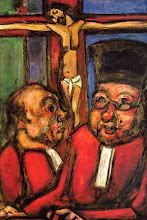
Angilbert (fl. ca. 840/50), On the Battle Which was Fought at Fontenoy

The Law of Christians is broken,
Blood by the hands of hell profusely shed like rain,
And the throat of Cerberus bellows songs of joy.

Angelbertus, Versus de Bella que fuit acta Fontaneto

Fracta est lex christianorum
Sanguinis proluvio, unde manus inferorum,
gaudet gula Cerberi.
Showing posts with label Rights and Duties. Show all posts

Thursday, February 2, 2012

The Political Community and Inalienable Rights and Duties

THE POLITICAL COMMUNITY is directed to the promotion of the common good. Intimately tied to the common good in a manner that the two cannot be separated are fundamental and inalienable human rights. It follows that the political community has as one of its principal purposes the defense and promotion of these fundamental and inalienable human rights. Here the American Declaration and Catholic social doctrine are in perfect agreement and accord:
We hold these truths to be self-evident, that all men . . . are endowed by their Creator with certain unalienable Rights, that among these are Life, Liberty and the pursuit of Happiness. That to secure these rights, Governments are instituted among Men . . . .

Considering the human person as the foundation and purpose of the political community means in the first place working to recognize and respect human dignity through defending and promoting fundamental and inalienable human rights: "In our time the common good is chiefly guaranteed when personal rights and duties are maintained."

(Compendium, No. 388) (quoting John XXIII, Pacem in terris, 273)


Draft of the Declaration of Independence

Though both the Enlightenment thinkers and the Church agree that inalienable or unalienable rights pre-exist the State and relate to the common good,* the Church's social doctrine is broader as it includes not only inalienable "rights," but also the other side of the rights equation: inalienable "duties."

The rights and duties of the person contain a concise summary of the principal moral and juridical requirements that must preside over the construction of the political community. These requirements constitute an objective norm on which positive law is based and which cannot be ignored by the political community, because both in existential being and in final purpose the human person precedes the political community. Positive law must guarantee that fundamental human needs are met.

The political community pursues the common good when it seeks to create a human environment** that offers citizens the possibility of truly exercising their human rights and of fulfilling completely their corresponding duties.

(Compendium, No. 388, 389)

The political community is not a "necessary evil," but it is a positive good and required both as part of the nature of man, who is a political animal. This notion of the political community is as old as Aristotle who taught in his Politics "that the city belongs among the things that exist by nature (τῶν φύσει ἡ πόλις ἐστί), and that man is by nature a political animal (ὁ ἄνθρωπος φύσει πολιτικὸν ζῷον)." (1253a1-3) The political community civilizes man, makes him a man, for a man without a city would in reality either be a beast or a sort of god, and certainly not man. "He who is without a city through nature (ὁ ἄπολις διὰ φύσιν) rather than chance is either a mean sort [beast] or superior to man [god] (ἤτοι φαῦλός ἐστιν, ἢ κρείττων ἢ ἄνθρωπος)." (1253a4-5)

Not only is the political community something that is natural to man, it is, as a matter of experience, something practically required to prevent might--political, economic, or social--from gaining the upper hand over right:
Experience has taught us that, unless these [political] authorities take suitable action with regard to economic, political, and cultural matters, inequalities between citizens tend to become more and more widespread, especially in the modern world, and as a result human rights are rendered totally ineffective and the fulfillment of duties is compromised.

(Compendium, No. 389) (quoting Pope John XXIII, Pacem in terris, 274)

The relationship of the political community to these fundamental human rights and duties is two-fold if it is to accord with the common good.

First, it must defend and promote these inalienable rights and respect the inalienable human duties an equal manner so that one group is not given preeminence over another with respect to these fundamental rights. "It should not happen that certain individual or social groups derive special advantage from the fact that their rights have received preferential protection." (Compendium, No. 390) The political community and its organs are not a res privata, a private thing, but they are a res publica, a public thing.

Second, in exercising its fundamental function--to protect the political community and its organs of government should not interfere with, or inhibit the full expression of these inalienable rights and duties. Indeed, it ought not disrupt the moral ecology of a people. The State must not become a sort of officious and high-handed intermeddler so that "in seeking to protect these [inalienable human] rights," it becomes an obstacle "to their full expression and free use." (Compendium, No. 389)


___________________________________________
*On inalienable or unalienable in the Declaration of Independence see http://www.ushistory.org/declaration/unalienable.htm. Obviously, unalienable rights are placed in opposition to alienable rights. The distinction between alienable and unalienable rights appears to have come from the moral philosopher Francis Hutcheson. In his Inquiry into the Original of Our Ideas of Beauty and Virtue first published in 1725, Hutcheson clearly anticipates the language eventually selected in the Declaration of Independence: "For wherever any Invasion is made upon unalienable Rights, there must arise either a perfect, or external Right to Resistance. . . . Unalienable Rights are essential Limitations in all Governments." Though unmentioned in the Declaration of Independence, but stressed in the Compendium, Hutcheson also linked these unalienable rights with the common good, stating in the same book, that "there can be no Right, or Limitation of Right, inconsistent with, or opposite to the greatest publick Good." Francis Hutcheson, An Inquiry into the Original of Our Ideas of Beauty and Virtue in Two Treatises (Indianapolis: Liberty Fund Press 2004), 192, 193.
**In other words, governments are instituted to protect the "moral ecology" or the "social ecology" of a people. We might borrow from Robert Bellah who defined "moral ecology" or "social ecology" as "[t]he web of moral understandings and commitments that tie people together in community." Robert N. Bellah, et al., Habits of the Heart: Individualism and Commitment in American Life (Berkeley: University of California Press, 1985), 335. Allen D. Hertzke defines "moral ecology" as the "philosophical, empirical, and practice construct" that forms the moral environment in which people live their civil or social lives. Allen D. Hertzke, "The Concept of Moral Ecology," Review of Politics, Vol. 60, No. 4 (Autumn 1998), 629.

Wednesday, April 6, 2011

Natural Law's Modern Cousin Germain: Excursus on Right

IT IS APPARENT THAT THE CONCEPT OF RIGHTS is nothing other that the flip side of obligation or duty, although that aspect seems to have been forgotten. The "grammar of rights is a multi-faceted instrument for reporting and asserting the requirements or other implications of relationship of justice." And yet it is a sort of skewed presentation, almost argumentative or adversarial, as it presents justice "from the point of view of the person(s) who benefit(s) from" the alleged requirements of justice. NLNR, 205. This one-sided view of right is something acquired along the way of the development of Western jurisprudence, as it appears not to have been part and parcel of the original concept of right (ius). The original concept of right (ius) included both modern notions of right (as something of a benefit) as well as notions of duty (burdens or limits).* Right or ius was understood within the greater confines or boundaries of what was justice between persons. But there was a shift --sort of like the great vowel shift in English--in the use of the term right (ius) that occurred between St. Thomas and Suarez that gave the term this subjective connotation, one that it did not originally have. The term ius, naturally, is Roman in origin, and it was in its Roman sense that St. Thomas understood it. For St. Thomas Aquinas, the term right (ius) was "the just thing itself" (Ita etiam hoc nomen ius primo impositum est ad significandum ipsam rem iustam.** Thus, St. Thomas's central case of rights (ius) he understood to be the just acts, objects, and states of affairs between men. The principal notion of rights is therefore intricately tied to a just state of affairs, and right (ius) may mean "the fair," "the what's fair," or even that which is "aright." "[I]f one could use the adverb 'aright' as a noun, one could say that [St. Thomas's] primary account is of 'arights' (rather than of rights)." NLNR, 206. Secondarily, St. Thomas also defines right (ius) as:
  • the art by which one knows or determines what is just (artem qua cognoscitur quid sit iustum)

  • the place in which what is just is awarded (locum in quo ius redditur)

  • the award (even if unjust) of the judge, whose role it is to do "justice" (ad cuius officium pertinet iustitiam facere, licet etiam id quod decernit sit iniquum)**
The notion of ius principally as a state of affairs that is just is significantly modified by the time one gets to Francisco Suarez. "If you like, it is Aquinas's primary meaning of 'jus', but transformed by relating it exclusively to the beneficiary of the just relationship, above all to his doings and havings." NLNR, 207. Thus, in his De Legibus (written ca. 1610), Suarez's notion of ius or right has a much more modern ring to it. Suarez defines right (ius) as "a kind of moral power [facultas] which every man has, either over his own property or with respect to that which is due to him."*** "Somewhere between the two men [Aquinas and Suarez] we have crossed the watershed." NLNR, 207. To study the evolution of the term ius between St. Thomas and Suarez would itself be an interesting venture, but Finnis does not explain it.****


We Need Janus-Faced Rights Rights Ought to Look Backward to Duty

The watershed has been crossed by the time Hugo Grotius comes on the scene. Although Grotius maintains the original notion of right (ius), he clearly has adopted as another of the meanings of right (ius) the personalist, subjective notion of right that was seen in Suarez. Grotius defines right (ius) as "a moral quality of the person enabling [competens] him to have or to do something justly," a "moral quality" he describes as a faculty if it is perfect, or an aptitude if it is imperfect.† Grotius elaborates that a faculty is what was referred to as one's suum, one's own, and so included notions of power (over onself, in which case it was called a liberty (libertas), or over others, in which case it was a power (potestas)), dominion or ownership (dominium), and credit or debt (debitum). What is clear, in any event, is that "Grotius is still on the same side of the watershed as Suarez: jus is essentially something someone has, and above all (or at least paradigmatically) a power or liberty. The notion of right (ius) continues its development until the point that it takes leave of the notion of law (moral or positive) and becomes seemingly independent from it. By the time we get to Hobbes, this notion of right is placed in opposition to law:

jus and lex, right and law . . . ought to be distinguished; because RIGHT, consisteth in liberty to do, or to forbear; whereas LAW determineth and bindeth to one of them: so that law, and right differ as much, as obligation, and liberty; which in one and the same matter are inconsistent.

Leviathan, ch. xiv (quoted in NLNR, 208). Right, then, becomes as it were an enemy to Law. Now a tension between Law (which aims at the common good) and Right (which, as defined post-Suarez as a personal faculty) might not be a bad thing. There is always a tension between the rights of the community and the rights of the individual which ought to be balanced. The problem, however, is that the notion of rights was torn out of any mooring in any norm. At least in Hobbes, it is clear that his notion of rights was shed of "virtually all its normative significance." NLNR, 208. So much so that, in state of nature, rights become a virtual free for all, to the point where one might say that one has rights to do anything with oneself and with regard to another so that rights are near absolute and without limit. The other side of the coin, however, is that everyone else's rights are similarly absolute, so that in point in fact, the absolute nature of everyone's rights nullify everyone else's to the point where no one has any rights. NLNR, 208. While Hobbe's extreme views may not have been adopted by the majority of jurists after him, the notion of right as liberty from law survived, and so we find right (ius) understood by, for example, Locke or Pufendorf as a liberty.†† In any event, the notion of rights prevalent today seems clearly to be one that is in opposition to law, and one that is not based upon the same moral norms or notions of the common good that one finds in law. Rights are no longer a benefit that arises from law (a chose in law), but a choice independent from and even apart from law (a liberty from law). Torn from their mooring in law, however, rights so fashioned bring in their wake significant problems. First of all, of course, they can be advocated against the common good. Secondly, they can be advocated as something more fundamental than the moral law. Thirdly, they have a significant problem justifying their moral existence, shorn as they are from any foundation in law.
There should be no question of wanting to put the clock back. The modern idiom of rights is more supple and, by being more specific in its standpoint or perspective, is capable of being used with more differentiation and precision that the pre-modern us of the 'the right' (jus). But it is salutary to bear in mind that the modern emphasis on the powers of the right-holder, and the consequent systematic bifurcation between 'right' (including 'liberty') and 'duty', is something that sophisticated lawyers were able to do without . . . . In Roman legal thought, 'ius' frequently signifies the assignment made as between parties of justice according to law; and one party's 'part' in such an assignment might be a burden, not a benefit--let alone a power or liberty of choice.
NLNR, 209. While Finnis appears to adopt, then, the modern vocabulary of rights, he tries to put brakes upon it. He seeks to re-incorporate the notion of rights into the greater construct of justice and the common good (which, of course, would link it with law, which also serves justice and the common good).

[W]hen we come to explain the requirements of justice, which we do by referring to the needs of the common good at its various levels, then we find that there is a reason for treating the concept of duty, obligation, or rquirement as having a more strategic explanatory role than the concept of rights. The concept of rights is not on that account of less importance or dignity: for the common good is precisely the good of the individuals whose benefit, from fulfilment of duty by others, is their right because required of those others in justice.
NLNR, 210.
___________________________________
*The use of the same word to express both right and duty is not limited to the original use of the Roman term ius, but seems to be quite common in other societies. Finnis gives the example of African tribal regimes where the same word is used for both concepts and comes from a large sense of ought. In Barotse the word swanelo and in Tswana the word tshwanelo are used to refer to what is "due," but in a manner that "looks both ways along a juridical relationship, both to what one is due to do, and to what is due to one." NLNR, 209. The notion of ius, of swanelo, of tshwanelo then is a notion that, like the Roman god Janus looked both ways. **S.T. Iª-IIae q. 57 a. 1, ad 1. ***De Legibus, I, ii.4. (. . . illa ergo actio, seu moralis facultas, quam unusquisque habet ad rem suam, vel ad rem ad se aliquo modo pertinentum, vocutar ius . . . .) ****In his notes he suggests that it may have its source in a nominalistic philosophy, since it appears that Ockham may have expanded the notion of ius from its traditional meaning to the meaning of ius utendi which he defined as "a lawful power of using an external object, a power which one ought not to be deprived of against one's will except for fault or other reasonable cause; a power such that, if one is deprived of it, one can institute legal proceedings against the person so depriving one." (jus iutendi est potestas licita, utendi re extrinseca, qua quis sine culpa sua et absque causa rationabili privari non debet invitus, et si privatus fuerit, privantem poterit in judicio convenire.) This already sounds like a modern conception of right. †Ab hac iuris significatione diversa est altera, sed ab hac veniens, quae ad personam refertur; quo sensu ius est Qualitas moralis personae competens ad aliquid iuste habendum vel agendum. Personae competit hoc ius, etiam si rem interdum sequatur, ut servitutes praediorum quae iura realia dicuntur comparatione facta ad alia mere personalia: non quia non ipsa quoque personae competant, sed quia non alii competunt quam qui rem certam habeat. Qualitas autem moralis perfecta, Facultas nobis dicitur; minus perfecta, Aptitudo . . . ." IBP 1, 1, 4. ††Locke, Essays on the Law of Nature: jus enim eo positum est quod alicujus rei liberum habemus usum. "For right is predicated on this, that we have the free use of a thing."

Tuesday, April 5, 2011

Natural Law's Modern Cousin Germain: Rights Talk

HUMAN RIGHTS OR NATURAL RIGHTS ARE here to stay, and so we must become accustomed the "grammar of rights" though it does not fit perfectly into the natural law without some accommodation. The accommodation, however, needs to be from the end of right, not from the end of law. Morality ought not change so as to accommodate rights. Rights ought to accommodate to the good. (And for Finnis human rights are nothing less than moral in origin.) Rights talk ought to accept a "grammar of morality," the grammar of the natural moral law. Else rights cannot find a sound basis, and without basis seem to be the favored tool of the unscrupulous, the powerful, the clever, or those with their hands on propaganda machines who use the vehicle of rights to advance agendas that are nothing less that vice writ large, and advance an immorality institutionalized and writ into law.

With that caveat, however, it remains true that the principles of natural law can be framed in the language of rights, and that "the modern grammar of rights," at least according to Finnis, "provides a way of expressing virtually all the requirements of practical reasonableness." NLNR, 199. There is, however, something lost by expressing moral realities in rights language rather than in law language or duty language. The insight that one obtains from framing issues in terms of duty or in terms of law must not allow these classical formulations to be treated as unwanted cousins. In other words, we ought to be comfortable speaking of duty and law at the same time we speak of right.


Wesley Newcomb Hohfeld

Not only do we forget duties when we sound off on rights. We are sloppy in our rights talk. So the first thing that Finnis does in his treatment of rights is to focus on the subtle language that is involved in rights. He does so by adopting (and adapting) the language of the short-lived American scholar, Wesley Newcomb Hohfeld (1879-1918). The effort of Hohfeld to disambiguate the term "rights" is a remarkable achievement.

Finnis encapsulates the Hohfeldian effort by distinguishing four basic "Hohfeldian rights":
  1. a "claim-right" (which Hohfeld calls a "right stricto sensu," a right in the strict sense);
  2. a "liberty" (which Hohfeld calls a "privilege");
  3. a "power"; and
  4. an "immunity".
Distinguishing rights into these four general categories, Hohfeld then suggested that rights need to be understood within a "three-term relation between one person, on act-description, and one other person." NLNR, 199. Applying the triadic schema with the four-fold division of rights, we get the following expansion of rights:*
  1. A has a claim-right that B should φ, if and only if B has a duty to A to φ.
  2. B gas a liberty (relative to A) to φ, if and only if A has no claim-right ("a no-right") that B should not φ.
  3. B has a liberty (relative to A) not to φ, if and only if A has no claim-right ("a no-right") that B should φ.
  4. A has a power (relative to B) to φ, if and only if B has a liability to have his legal position changed by A's φ-ing.**
  5. B has an immunity (relative to A's φ-ing), if and only if A has no power (i.e., a disability) to change B's legal position by φ-ing.**
NLNR, 199. All of a sudden "rights" become saddled with a matrix of more intricate language, and we speak of claim rights, of no-rights, of a liberties, of duties, liabilities, immunities, and disabilities. In the area of rights as we commonly discuss them, however, the notion of "claim-right" and "liberty" appear to be most important.

If A has a claim-right, then B has a correlative duty. If A's claim-right positive, then A can require something of B (to be given something, to be assisted in exercising the claim-right to φ). If A's claim-right is negative, he has a right not to be interfered with or dealt with or treated in a certain way by B. A has a liberty to φ (or not to φ) if he is free of any duty to B in the matter, which means that B has no claim-right over A that A not φ (or φ).

If A's claim-right or liberty involves more than B (i.e., also involves C, D, etc.), then that claim-right or liberty is multital.

A claim-right and a liberty are distinct, but are not mutually exclusive. Accordingly, A may have both a claim-right and a liberty to φ.

Hohfeld's rights analysis seems to suffer from one weakness, and that is that commonly people do not talk about a three-fold relationship when it comes to rights (A, B and φ). Usually, people talk in a two-term manner: A has a right to a subject matter, to a thing. Unfortunately, speaking of rights in a two-term manner disguises how rights for one person may be an obligation (and, therefore, a loss of rights or liberty for another). When a homosexual claims his "right" to marriage, does he ever think about how and who his "right" may effect? What sort of obligations he will impose on others? NLNR, 201.***

The relationship between claim-right and duty appears to present a problem when rules or rights are translated into the Hohfeldian schema. If B has a duty, when is A said to have a claim-right? There are two possible answers which a person who wants to translate a rule or a right into the Hohfeldian schema must choose:
  1. A has a claim-right that correlates to B's duty if and only if there is a person A for whose benefit that duty has been imposed on B, which is to say that A is to be the recipient of B's performance consonant with his duty.
  2. A has a claim-right that correlates to B's duty if and only if there is a person A who has the power to remedy B's disregard of that duty by judicial remedy.
NLNR, 202-03.

But, pulling away from the technical Hohfeldian analysis, Finnis sees the problem as a little more basic, more fundamental than merely translating rights into more precise Hohfeldian formulations and choosing what stipulation one wants in adjoining claim-rights to duties:

[T]here is a philosophical problem not to be solved by stipulation. This is the question: What, if any, is the underlying principle, unifying the various types of relationships that are reasonably said to concern 'rights'? Or, more crudely: Is there some general explanation of what it is to have a right?

NLNR, 203. At heart, the difference in which stipulation one should use is the difference between one's vision of rights. Are rights to be considered as benefits or interests (so that A's claim-right involves "benefits" or "advantages")? Or are rights to be considered as vehicles which respect choice? The first stipulation views rights as benefits or interests, whereas the second stipulation would emphasize the importance of choice or will.

But for Finnis, the decision is not required:
[I]t is not necessary here to settle the dispute between the 'benefit' and the 'choice' theories . . . It suffices that . . . we may safely speak of rights wherever a basic principle or requirement of practical reasonableness, or a rule derived therefrom, gives to A . . . the benefit of (i) a positive or negative requirement (obligation) imposed upon B (including, inter alia, any requirement not to interfere with A's activity or with A's enjoyment of some other form of good) or of (ii) the ability to bring it about that B is subject to such requirement, or of (iii) the immunity from being himself subjected by B to any such requirement.
NLNR, 205.

This was all rather tedious. Let's see where Finnis goes with it.

____________________________
*A and B signify persons, but they need not be individuals, they can be natural persons or corporate persons (e.g., the State or business entities). The symbol φ represents an act-description.
**In 4 and 5, the act φ has juridical connotations. In other words, it involves a juridical act or a legally-cognizable act such as buying, selling, leasing, granting, conveying, marrying, paying, adjudicating, enacting, etc. NLNR, 200. In 1, 2, and 3, the act φ can be either juridical in nature or natural (with or without juridical import),
e.g., walking, hitting, traveling by plane, defaming.
***All this seems laboriously technical, but Finnis explains that the "persistence of 'two-term' 'thing-oriented' rights talk" in conjunction with the "'three-term' 'act-oriented' schema of rights" becomes important when certain natural rights (e.g., the right to life) are discussed.

Wednesday, November 3, 2010

Contra Consequentialismum: Moral Duties, Justice, and Law

RIGHT IS ONE SIDE OF THE MORAL COIN. The other side is duty. In our last blog posting on moral right, we observed that it is apparent that our claim to right as against others in our pursuit of happiness, that is, the pursuit of the good, brings with it its reciprocal: duty or obligation. As Oderberg states it:

Every right imposes a duty on every other person to respect it. Without duties correlative to rights, morality would again be self-contradictory, for it would permit what it prohibited--interference by others with the legitimate pursuit of the good on the part of an individual. Duties correlative with rights are simply the logical mirror of those rights--they reflect those rights into the eyes of other people.

Oderberg, 60.

And yet duty is not exactly the mirror image of right. "[T]here is more to duty than rights." Oderberg, 60. What has happened since "The fundamental principle governing the relationship of human law (or simply "law") and morality is as follows: it is morality that determines what is and what is not a just law, hence law always follows morality."
--David S. Oderberg
the Enlightenment is that the scope of rights has become hyper-inflated, over-exaggerated, and therefore rights thinking has become unbalanced. "If you believe that the whole of morality is founded upon rights, you will naturally conclude that there can be no duty that does not correspond to some right." Oderberg, 60. This "correspondence theory" of rights and duty, where rights and duty correspond and perfectly match up, is just plain wrong. And it's easy to show why.

Good is the most fundamental aspect of morality. But no one is duty-bound, no one is obligated in conscience, to perform every possible good act. To impose such an Atlas-like burden on an individual would cripple him, would be to give him an impossible, Herculean task. Even Blessed Mother Theresa of Calcutta, who heroically did good to the poor, failed, and failed miserably, if this was the moral imperative. There was some good that she left undone, unattended, by the mere fact that she chose to do some good.


Additionally, duty is not coextensive with right. For example, all men have a duty to be generous to others in need, to provide alms to the poor out of their surplus. However, unless there is another source of duty (e.g., familial or contractual), our general duty to be generous with our surplus does not extend to the poor a moral right to our surplus. So if one walks by a beggar on the street with extra change in one's pocket, one may have violated a duty to be generous, but one has not violated the beggar's rights or been unjust to him.*

Rights and justice are intimately tied together; this is because justice is a virtue, a virtue "by which a person is inclined to accord another his rights." Oderberg, 61.** There is also a link between moral rights and the virtue of justice, on the one hand, and moral law on the other.
In its broadest sense, a law is a binding rational principle governing behavior, whether it be the behavior of molecules or of people. The moral law is that subset of principles which direct human beings toard their ultimate end of happiness. Rights and duties, then, originate in the moral law and governing human beings in their pursuit of happiness in all its particulars. . . . The fundamental principle governing the relationship of human law (or simply "law") and morality is as follows: it is morality that determines what is and what is not a just law, hence law always follows morality.
Oderberg, 62.***
_________________________________
*The obligations of charity, or even natural sacrificial love, may exceed those of strict justice and natural duty. But this is a whole other area altogether, and is outside the natural law. When charity is involved we move from a jurisdiction sub lege to a jurisdiction sub gratia, from law to grace.
**Justice is a virtue, but, by analogy the term is used to refer to a state of affairs (e.g., just society) or a condition (e.g., just war, just wage). The State is subject to the demands of justice, in which case the state is regarded as a "moral person" akin to an individual. Justice is traditionally divided into three kinds: commutative justice, distributive justice, and what Oderberg calls civic justice. Oderberg defines them thus:
Commutative justice concerns relations between individuals, and is the virtue which inclines them to accord one another their rights. Distributive justice concerns the relationship of the state to the individual, in particular its obligations to respect the individual's rights. Civic justice is the converse of this, being concerned with the individual's obligations to the state--specifically, to contribute to the common good.
Oderberg, 61.
***From this principle it follows:
It is the duty of the legislator to frame laws that reflect morality and therefore provide the citizen with the state-authorized powers to do what morality already allows him to do, the state-authorized duties to do what morality already obliges him to do in conscience, and the state-authorized sanctions against those who would already be morally at fault for interfering with another person's pursuit of the good. . . .[A]lthough the legislator may, as a matter of fact, enact an unjust law, his duty, the requirement of morality, is that the law he enacts conform to it.
Oderberg, 62.