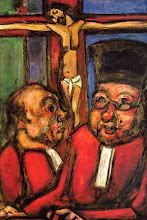
Angilbert (fl. ca. 840/50), On the Battle Which was Fought at Fontenoy

The Law of Christians is broken,
Blood by the hands of hell profusely shed like rain,
And the throat of Cerberus bellows songs of joy.

Angelbertus, Versus de Bella que fuit acta Fontaneto

Fracta est lex christianorum
Sanguinis proluvio, unde manus inferorum,
gaudet gula Cerberi.
Showing posts with label Self Evident Principles. Show all posts

Friday, June 10, 2011

Ignorance of the Wrong-Levels of Knowledge

IN OUR EARLIER POSTING WE EXPLORED the issue of the ontological division of precepts with a focus on the relationship of the precept to the ultimate end. In this posting, we shall explore the epistemological division of precepts. The former looked at the precepts in se; the latter will look at the precepts quoad nos, as we know (or are ignorant of) them. Knowledge of the precepts is obviously important for if the precepts are to guide us in our reasonable quest for happiness and our ultimate good, then we must have knowledge of the precepts when choosing among the various particular goods that confront us in determining whether the particular goods are, in fact, leading us to happiness or our ultimate good.

The practical reason in man, not less than the speculative, is discursive; it draws conclusions from general principles which are, so to speak, their causes. As principles are better known than conclusions, it becomes evident that some precepts of the natural moral law will be better known than others. There will be a hierarchy of order according to the cognoscibility.

Bertke, 37. Knowledge of principles is affected by a variety of factors, but we may categorize them into two general areas: (i) the precepts' generality versus their particularity, and (ii) their closeness to our natural inclinations. These two areas are important in distinguishing what affects our knowledge of moral principles.

The general principles of the natural law may be self-evident inclinations or principles or may be direct conclusions from self-evident principles. On the other hand, they may be determinations much further down the discursive chain of reasoning. The injunction, "do not kill the innocent," is much more readily understood (and known) than the application of that principle in the issue of ordinary care and extraordinary care, and when extraordinary medical means may be refused, or when palliative care, which indirectly may hasten death, may be used to alleviate the suffering of a patient. It is apparent at once that the more common or general principle is more readily known than the more particularized application of it.
[I]t becomes evident that the practical intellect will be apt to know precepts which deal with human action in general before it becomes aware of those norms which guide particular actions, and the deeper we descend into the real of particular action surrounded by various circumstances, the more difficulty is encountered by the intellect in determining the correct norm to follow."
Bertke, 40.

Generality of a principle ought not to be confused with self-evidency, as there may be self-evident principles that are general and those that are particularized and require specialized knowledge. Self-evident principles are those in which the predicate is contained within the subject, so that if one knows the subject, one will necessarily know the predicate. St. Thomas divides the propositions into those which are self-evident considered in themselves (secundum se or per se notae quoad se) and those which are self-evident in relation to the knowing subject (quoad nos).* Since knowledge of self-evidency requires that we know the subject and the predicate (so as to recognize that the predicate is contained within the subject), it follows that ignorance of the subject or predicate will result in our failing to comprehend a self-evident proposition or principle.

Since our knowledge is derived from the senses, it follows that those principles that are more closely tied to the senses are more readily known. Similarly, those principles which are strongly tied to natural inclinations are generally better known. "[F]acility in the acceptance of a precept guiding an inclination will be in proportion to the strength of the inclination." Bertke, 39. Inclinations tend to be stronger the more further removed they are from man's conscious intellectual activity. The intellectual feltness found in man's basic inclinations are, in a manner of speaking, guttural and "these inclinations will be stronger in those regions farthest removed from the conscious life."** The principles behind the basic inclinations which incline and direct the will strongly will be more readily grasped than those to which the will is indifferent. There thus arises a certain curious paradox:

It is paradoxical that the intellect will more easily assent to precepts guiding to the attainment of those goods which are farthest removed from conscious life as such, while the easiest assent of all will be to that precept which guides us to the good which is possible only because of the nature of intellectual apprehension. The reason lies in the strength of the inclination. . . . [M]an must seek the total human good, or perfect happiness; this is man's strongest inclination, and a precept finding its wellspring therein will most easily find acceptance in the intellect.

Bertke, 40. There are, moreover, distinctions within the inclinations arising from whether these relate to being generally, animality, or rationality. There is, therefore a "threefold category of inclinations which man possesses by reason of his complex nature." Bertke, 42. "[E]ach distinct class of being has an inclination to the good which is in conformity with its nature. We find similar inclinations of all these types in man by reason of his complexity." Bertke, 41-42.

Following St. Thomas, Bertke therefore distinguishes the overriding first principle of moral life and "a series of precepts which, though less universal and therefore less easily known than the first principle, are nevertheless self-evident to all and therefore constitute with it the first class of precepts." They are as follows:
  • good must be done; evil must be avoided (the first principle).
  • being must be conserved.
  • the species must be conserved.
  • act in accordance with rational nature.
  • do unto others as you would have them do unto you.
  • give everyone his due.
As we descend from these self-evident general principles, we encounter a "second group of precepts," easily deduced from the first class, "and which have to do with determined actions or means to the realization of the general goods proposed to man's reason by the various inclinations." Bertke, 43. By and large, this second group of precepts is well-summarized in the Ten Commandments or Decalogue. Though the Ten Commandments are revealed precepts, they are coterminous with precepts of the natural law that are easily deduced from the fundamental principle of the natural moral law and the self-evident principles identified above.***


To St. Thomas the Ten Commandments are a sort of moral plexus which implicitly contain the fundamental precepts of the natural law and, further, implicitly contain the entirety of all further conclusions and determinations. "The first precepts are to be found in the Decalogue as principles are contained in conclusions drawn from them, while the remote precepts are contained in the Decalogue as conclusions in principles." Bertke, 43.†

From the first level and second level precepts we may mover further down the deductive chain of reasoning. At this point we enter more and more remote conclusions or determinations. As we go further down this often times sinuous mental road, matters become more concrete, particularized, contingent, conditional and therefore more mentally tenuous. Commonly, the precepts of this third level are not self-evident or readily obtained by the ordinary man. The ordinary man needs help, either by reliance upon the judgment of a wise and virtuous person or upon positive law (either divine or human) to determine the correct norm of action. It is evident that a huge part of our lives plays out in this third level of precepts. Accordingly, it follows that a large part of our lives must be governed by the judgment of wise men or positive law.††

Error and ignorance of the natural moral law is not "the normal fruit of the mind," and yet, in the state of man as we find him, fallen and with a loss of integral nature, it is the case that error and ignorance are common, and in fact more frequent than truth and knowledge. Mental or moral abnormality is unfortunately common, and we have modern institutions in competition with the Church for man's soul that encourage, promote, and relish in propagandizing error.††† But before we can assess what is abnormal, we need to know what is normal and what may detract from normalcy.

_________________________________________________
*S.T., IaIIae, q. 94, art. 2, c.
**As we have discussed before, it is not that these inclinations are irrational; rather, they are very rational even though their rationality is not such that result from the conscious or propositional rationality. Maritain and others have called this rational (but not conscious) knowledge by inclination or by connaturality, and we have used the concept of "intellectual feltness" to encompass both the rational aspect of it and the inclinatory, connatural, congenial aspect of it. See Jacques Maritain and Natural Law: Inclination and Law, Part 1. Yves Simon uses an interesting analogy to distinguish matters known by inclination versus matters known consciously through discursive knowledge. Knowledge known by inclination is, as it were, "smelled." Knowledge known discursively or consciously is, at it were, "touched," or "seen." See notes to Virtue Defined.
***Excepted would be the requirement to keep the Sabbath holy. Though the worship of God would be preceptive under the natural law, it would not necessarily translate into the separating apart of a particular day of the week to God.
†See S. T. IaIIae, q. 100, art. 3, c.
††Some of these wise men wear habits or soutanes. In the case of a person who has faith in Christ, he would have the further assured help of the Magisterium of the Catholic Church, which provides guidance, under some circumstances infallible guidance, of the content of the natural moral law even in this third level. It would seem, however, that even a person without faith in Christ and his Church would pay attention to the Church as an institution that has amassed tremendous wisdom of both matters divine and human. Even as a matter of natural faith, the Church ought to be recognized as a voice crying out in the moral wilderness. Far better to listen to the Church, than to the drone of the media and the opinions of their proffered pundits and talking heads, the psycho-babble of many psychiatrists and psychologists, the foolishness of "Dear Ann" columns or articles in Cosmopolitan, the inanities of the celebrities of Hollywood, or the slogans of self-serving politicians.
†††The names of these competing institutions are Legion (Cf. Mark 5:9; Luke 8:30). We might include such names as PP, ACLU, MSNBC, MTV, NAMBLA, KKK, ANP. Some of these demons of Gadarenes are decidedly less liberal or progressive, e.g., Al-Qaida.

Saturday, March 19, 2011

Natural Law's Modern Cousin Germain: To Know is Good

THE TERM "BASIC VALUE" IS A FUNDAMENTAL term in the Finnisian construct of natural law. For Finnis, basic values are: (i) self-evident and unquestionable without lapsing into unreason; (ii) pre-moral; and (iii) the basis of all moral judgments. In his book Natural Law and Natural Rights, Finnis begins his sally into this concept by choosing one such basic value--knowledge--from the larger set of basic values he identifies later on in his work: life, knowledge, play, aesthetic experience, sociability (friendship), practical reasonableness, and "religion" (scare quotes are Finnis's).

The "knowledge" that Finnis has in mind as basic good is speculative knowledge, that is "knowledge as sought for its own sake from knowledge as sought only instrumentally," knowledge that "is of truth," and not because it is useful. NLNR, 59. It is that thirst for knowledge that arises "out of curiosity, the pure desire to know, to find out the truth about [something] simply out of an interest in or concern for truth and a desire to avoid ignorance or error as such." NLNR, 60. It is, in fact, the knowledge that is spurred by what Aristotle identifies as wonder, θαυμάζω (thaumazō).*

Knowledge is the satisfaction of the "inclination or felt want that we have when, just for the sake of knowing, we want to find out about something." NLNR, 60. Knowledge justifies its own self, as it is not an instrumental good. It is simply good to gain knowledge. Good simpliciter. It is simply bad not to have it and remain in ignorance of the truth. While some knowledge may be more worth knowing than other knowledge (whether the philosophy of natural law is true is more important that the sexual habits of a snail darter), and while some value knowledge differently than others (the PhD will view things differently from the man waiting for food in the soup kitchen line), and while the pursuit of knowledge may sometimes have to be put off (man does not live by knowledge alone), and while it cannot be "pursued by everybody, at all times, in all circumstances," and while it is not "the only general form of good, or [even] the supreme form of good," it remains undeniably true:

[T]o say that knowledge is a value** is simply to say that reference to the pursuit of knowledge makes intelligible (though not necessarily reasonable-all-things-considered) any particular instance of the human activity [of seeking knowledge] and commitment involved in such pursuit.

NLNR, 62. Ultimately, we can say that "knowledge" is a basic value or good, which is the same thing as saying it is an aspect of human flourishing, because the opposite is insupportable rationally. Who can intelligibly support the general statement that knowledge is evil?*** Who can say we are better off, generally speaking, being ignorant? It is a basic good because it satisfies itself; it pulls itself up by its own bootstraps, as it were. "To avoid it [the self-evident nature of the proposition that knowledge is good and that knowledge ought to be pursued], I have to be arbitrary." NLNR, 72. By definition, being arbitrary is being unreasonable. When we justify a particular act (say reading a biography on Cardinal Newman, or going to college and taking a course on African Studies, or googling the term "synapses") by saying that we want simply to know, the statement is intelligible and final. Generally, nobody can answer, at least not unless other circumstances warrant, "That's unreasonable!" The self-evident good of knowledge is a final answer, a legitimate end, a stopping point, a one-need-not-go-any-further to the question why are you doing the act? Knowledge is therefore a bonum honestum as distinguished from a bonum utile or a bonum delectabile, a for-its-own-sake good, as distinguished from a merely useful good or merely pleasurable one.

Is it not the case that knowledge is really a good, an aspect of authentic human flourishing, and that the principle which expresses its value formulates a real (intelligent) reason for action? It seems clear that such is indeed the case, and there are not sufficient reasons for doubting it to be so. The good of basic knowledge is self-evident, obvious. It cannot be demonstrated, but equally it needs no demonstration.

Finnis, 64-65. One must not confuse the question of whether knowledge is a basic good with different questions, such as what are the physical, biological, or psychological aspects (the causes, pre-conditions, and/or concomitants) of that question. Whether knowledge is a basic good or value is not determined by whether the quest for knowledge is spurred by some psychological need, or stymied by some physical handicap, or part of some biological protective mechanism. Even more so, one ought to confuse the question of whether knowledge is a basic good with the question of whether one has any feelings of certitude with respect to that proposition. These are different questions. "The soundness of an answer to a particular question is never established or disconfirmed by the answer to [an] entirely different question."† NLNR, 65.


To say knowledge is not a good
is like saying this is not a picture of a pipe

The basic value or good of knowledge is not founded on "fact," but on self-evidency, which is not to say that it does not have its "factual" components and support. (That something may be self-evident does not mean that it has no factual reality. By being self-evident it does not become a non-fact and anti-fact.) But the value or good of knowledge ought not to be predicated upon such facts, for that would be a lapse into "is" which does not support an "ought."†† So even such observations of fact that "all men desire to know" or that "the human is wired to know" or that man has a "psychological need to know" or "the most exemplary men desired to know" are not the bases for the basic value of knowledge, though they may be a reflection of it as a basic value. Such facts are evidentiary of the basic value, but are not the source of its foundation.

Since knowledge is a basic value or basic good, it follows that it can be the basis for a practical principle: since knowledge is a basic good, knowledge is something good to have, and that good ought to be pursued and ignorance avoided. There is therefore a translation of the self-evident principle "knowledge is a basic good" to the self-evident principle "knowledge, as a basic good, ought to be pursued." Basic practical principles are not rules, but rather provide a form of orientation to one's practical reasoning which can be "instantiated (rather than applied [as rules]) in indefinitely man, more specific, practical principles and premisses."††† NLNR, 63.

"The principle that truth is worth knowing and that ignorance is to be avoided is not itself a moral principle." It is a pre-moral principle, one that is foundational to the making of moral judgments.

In closing his chapter on knowledge as a basic good, Finnis shows how knowledge is unique relative to the other basic goods in that one can show that denying its self-evidency is self-defeating. Any argument that knowledge is not self-evidently good is bound to fail, is self-contradictory, and ends in an intellectual cul-de-sac, a sack's end.

In addressing this issue, Finnis identifies three kinds of propositions: (1) intrinsically self-defeating propositions; (2) pragmatic self-defeating propositions; and (3) operationally self-refuting propositions.

Intrinsically self-defeating propositions are internally inconsistent because they contain their own contradiction. The examples given by Finnis are: "I know that I know nothing." "It can be proved that nothing can be proved." "All propositions are false." These are like saying A = not A.


Pragmatically self-defeating statement

Those propositions that are pragmatically self-defeating which are defeated by the circumstances in which they are stated. Finnis gives the example of a person singing "I am not singing" as such a proposition. The statement could be true if, for example, it is said or if it is written. He also calls it a "performative inconsistency," which he defines as an "inconsistency between what is asserted by a statement of facts that are given in and by the making of the statement." An example of this may be René Magritte's La trahison des images (The Treason of Images), with its famous depiction of a pipe with the statement "Ceci n'est pas une pipe" ("This is not a pipe"). Or perhaps even more accurately, the statement "Nothing is written in stone" inscribed on stone.

The final group of propositions, operationally self-defeating propositions, are not logically incoherent, but are "inevitably falsified by an assertion of them." NLNR, 74. They are a form of performative inconsistent statements (see above) but but are inconsistent with the fact arising from their very assertion (and not from a fact extrinsic to them). Examples of these are: "I do not exist," which is immediately falsified in its mere assertion. As another example, Finnis gives the proposition: "No one can put words (or other symbols) together to form a sentence."
Operationally self-refuting propositions have a quite definite reference and so can be (and inevitably are) false. They have a type of performative inconsistency; that is, they are inconsistent with the facts that are given in and by any assertion of them. An operationally self-refuting proposition cannot be coherently asserted, for it contradicts either the proposition that someone is asserting it or some proposition entialed by the proposition taht someone is asserting it.
NLNR, 74.

To state that knowledge is not a good is operationally self-defeating. If one asserts "knowledge is not good," then presumably one believes that the knowledge that "knowledge is not good" is good to know. So how can knowledge be both not good to know and yet good to know? Thus the skeptic to the proposition "knowledge is good" finds himself in an operationally self-defeating situation. Unless one relishes in living a life of absurdity, which itself is unreasonable, self-defeating positions ought to be abandoned.

In summary, Finnis states that the proposition that knowledge is a basic good and ought to be pursued is self-evident. Its contrary, that knowledge is not a basic good and ought not to be pursued is operationally self-defeating. The self-evident nature of the proposition that knowledge is good and ought to be pursued, then, has the tags or indicia of objective truth. It is pre-moral in the sense that it is a "given" that exists before the moral decision which must use practical reason to make moral decisions regarding the entire ensemble of basic goods, including, but not limited to knowledge.

______________________________
*Aristotle, Metaphysics, 982a.
**Finnis uses the term "good" in both a particular sense (as a reference to "some particular objective or goal" a "particular object of a particular person's desire,choice, or action") as wells as in its broad general sense (good in general). He reserves the term "value" as the "general form of good that can be participated in or realized in indefinitely many ways on indefinitely many occasions." NLNR, 61. He admittedly strays from St. Thomas: "Aquinas's exposition of his ethics particularly suffers for want of a term reserved for signifying [value as a general form of good, the aspect or description under which particular objects are (or are regarded as) good]." Why the word "value" is needed and good is not sufficient is not really explained.

***Knowledge is not an absolute good without regard to circumstances. It may be inappropriately pursued as, for example, when it contradicts charity or a more important or immediate duty. Thus, a husband who studies his philosophy while his wife is choking on a piece of meat next to him is pursing the good of knowledge in an improper way. There are other forms of knowledge that may not be properly pursued, and thus give rise to the vice of curiositas, NLNR, 76, which is a corruption of knowledge or false knowledge. There is knowledge that may be called Promethean or Faustian or Sadian: the best means of torturing one's captive, for example, or knowledge regarding perverse sexual techniques. Was the Marquis de Sade's knowledge good? See generally Roger Shattuck's Forbidden Knowledge: From Prometheus to Pornography (New York: St. Martin's Press, 1996).
†This principle becomes particularly important with respect to the basic good of life. Whether life is a basic good is an entirely different question than the biological, psychological, and/or physical pre-conditions or concomitants of that question. "Value" is something different from St. Thomas's bonum commune, bonum generale, bonum universale, or even just plain bonum.
I ask myself the question: does self-evidency take us out of the land of "is" into the land of "ought"? Cannot self-evidency relate to descriptive matters (something cannot both be and not be at the same time and same way seems to be a reality that is descriptive, not prescriptive. "Knowledge is a basic good," seems likewise to be a descriptive, not prescriptive statement. There are, true, some self-evident statements that are "oughts," for example, "good ought to be pursued, and evil avoided." But "knowledge is good" is not such a statement. What Finnis does is to reformulate the self-evident proposition "knowledge is a basic good or value" into another self-evident proposition that "knowledge is a basic good or value that ought to be pursued." The latter formulation is an "ought." (Another way of saying this is that Finnis changes a speculative principle into a practical principle.) Yet what is the difference between translating self-evident descriptive propositions to self-evident prescriptive propositions and a classical natural law proponent translating descriptive propositions (e.g., the sexual organs' functions are ordered to procreation) to prescriptive propositions (the sexual organs ought to be used in conformity with that order)? How does Finnis move from a pre-moral principle (knowledge is good) to a moral principle (knowledge ought to be pursued)? Why is Finnis allowed the translation from is to ought but not the traditionalist? Why is Finnis allowed to argue: "It is equally irrelevant for the sceptic [read Hume] to argue that values cannot be derived from facts. For my contention is that, while awareness of certain 'factual' possibilities is a necessary condition for the reasonable judgment that truth is a value, still that judgment itself is derived from no other judgment whatsoever." NLNR, 73.
†††The word "instantiate" is not a word in common use, but is an important concept. It is the particularization, one "instance," of a larger, general, abstract concept, idea, value, or transcendental such as being, good, beauty. Thus, Michelangelo's "Pietà" at the Basilica of St. Peter at the Vatican City may be said to be an artistic, sculptural instantiation of the maternal sorrow that Mary had for her son Jesus (cf. Luke 2:35), just as Luis de Morales's "Pietà" housed at the Real Academia de Bellas Artes de San Fernando, Madrid, Spain, is an artistic, painted instantiation of the same maternal lament and grief. Similarly, Mike's decision to study philosophy by picking up St. Thomas Aquinas's Summa Theologiae is an instantiation of the practical pursuit of the basic good or value of knowledge. Cindy's decision to study the difference between pinnately compound leaves and palmately compound leaves by picking up and perusing Loudon's An Encyclopedia of Plants is another (different and unique) instantiation of the same practical pursuit of the basic good or value of knowledge. Both Cindy's decision and Mike's decision participate in the same more general practical pursuit of the basic good or value of knowledge. They are therefore both "good" pursuits in their unique, particular ways. This decision to participate in a basic good Finnis calls "commitment." Commitment is "that sort of participation-in-a-value which is never finished and done with (except by abandonment of the commitment) and which takes shape in a potentially inexhaustible variety of particular projects and actions, each with its particularized first premiss of practical reasoning." So both Mike and Cindy are "committed" to the pursuit of the same basic good of knowledge. While they share in same premise: to pursue knowledge and eradicate ignorance is good, and so participate in, and are committed to, the same good, it is reflected in two particular ways--picking up the Summa and picking up Loudon's Encyclopedia--of a "potentially inexhaustible variety of particular projects and actions."

Saturday, November 27, 2010

Being and Natural Law: Moral Obligation

AS WE DISCUSSED IN OUR PRIOR POST, man is determined, is under an intrinsic compulsion, to seek the universal good, but has freedom in choosing particular goods. In looking about him, man, who is but one analogate of the analogon of being and the analogon of the good, is himself but a particular good among particular goods. He observes, however, that there are some particular goods, some analogates of being, namely himself and his fellow men and women, that participate in being, and hence in the good, in a more remarkable way. In humans "being has a voice," and good is sought in freedom. In these analogates of being, being and good is capable of being intellected, appreciated, held inside, and shown outside, and communicated with in a more particular way. Being and good is intellectually present in one's self and in one's fellow men in a manner in which no other particular goods--animal, vegetable, or mineral, or other tangible or intangible good--participates. This awareness--that we ourselves and our fellow man with us are "intellectors of good," what Dr. Knasas referred to as the phenomenon of seeing men as "epiphanies of being"*--immediately imposes a sense of obligation, a constraint or felt necessity, that these particular goods ought to be treated in a manner differently than those particular goods that are not "intellectors of good," but merely participate passively, as it were, in the good.

Because being as the good is intellectually present in a human, a human is a special analogate of being as the good. In the human, being as the good burns more brightly than it does in analogates like animals, plants, and miners. . . . Does it not make a world of difference in our estimation of the human? Does not the fact of the heightened intellectual presence of being as the good in our fellows issue to our freedom a command of respect and solicitude? . . . . This command is the initial appearance of obligation, moral necessity.

The awareness that as "intellectors of being as good" we carry in ourselves this light of being in a special way is what imposes, then, the obligations to cherish ourselves, and the equal obligation to cherish the other. Love your neighbor as yourself becomes the fundamental norm. Love your fellow "intellector of being" as you love yourself inasmuch as you also are an "intellector of being." To strike at oneself--to commit suicide, engage in self-mutilation, abuse oneself--is immediately enjoined. To strike at others, to murder them or to assault them, to abuse them is likewise an apparent injunction. For any assault on the special presence of being in these particular goods we call humans is unseemly. This is the "grand fact" that is the source of moral "oughtness," that men are intellectors of being as the good, and that they deserve a greater solicitude and respect, that is a moral response, than those who do not participate in being and good in the same intimate way.

So to summarize: we have advanced, from the real, to the intellection of the real, to analogical thinking, to an awareness of being and the good--the ratio entis and the ratio boni--to the awareness of their equivalency, to an understanding of an intrinsic compulsory thirst for being and the good which manifests itself in an awareness that we have freedom to chose those particular goods about us, and in the exercise of that freedom we come to see that certain particular goods, namely ourselves and our fellow human beings, share in being as good, in the ratio entis and the ratio boni, in an especial way, and that this demands from us an obligatory response of respect, of solicitude, of care. From reality itself we have thus walked step by step to the threshold of moral obligation. From "is" we have come to "ought" via being and its equivalency with good through a path that Hume never sought to travel as he wallowed in his skepticism. The cause for oughtness is to be found then in reality itself, in the ratio entis and the ratio boni and the ratio veri, which is at the heart of all that is, all that is good, and all that is true, and in the fact that we as men participate in being, the good, and the true in a special way from the rest of the analogates of being.

With this background, Dr. Knasas delved into article 94, q. 2 of the IaIIae of St. Thomas's Summa Theologiae. In the moral quest, like in the intellectual quest, we have to begin from somewhere. There is not infinite regress in the journey: there has to be a place from where we take leave. These are the self-evident principles, the principia per se nota. As St. Thomas explains something is self-evident in two ways or modes. First, it may be self evident in itself (secundum se), or it may be self-evident in a subjective sense (quoad nos). In other words, a proposition may in fact be self-evident without someone knowing it or recognizing it. A man may not see the self-evident because he is unlearned (or badly educated).

The reason for this is that a self-evident principle exists when the predicate is contained in the notion of the subject, so that when I say X=Y is a self-evident principle, the Y is already contained in the X in some manner (without being merely tautological). We have, therefore, to know the definition of the subject, of X, before we can see the self-evident nature of the proposition. If we do not know the definition of the subject, of X, or if we do not know the meaning of Y, we will fail to see the self-evident nature of the proposition.

Some principles are so obvious that they are self-evident to all. These are propositiones quarum termini sunt omnibus noti, propositions whose terms everyone recognizes as self-evident. There are, of course, a handful of such self-evident propositions which are often restatements or necessary corollaries of others, including the principle of being or existence ("being is"), the principle of identity ("whatever is, is"), the principle of excluded middle ("something either is or is not, but not both," or "there is no middle ground between being and non-being"), the principle of non-contradiction ("nothing can be both true and false at the same time and in the same respect," or "being as necessarily contradictory to non-being"), the principle of difference ("that which is is not that which is not, and that which is not cannot be identified with that which is"), the principle of sufficient reason ("everything which is possesses a sufficient reason for its existence"), the principle of causality ("non-being cannot cause being" or "nothing comes from nothing"), the principle efficient causality ("every effect must have a cause"), the principle of finality ("every agent acts for an end"), and so forth. As examples of these universally-held self-evident principles, St. Thomas cites two of Euclid's five principles or common notions ("things equal to one another and the same are equal to one another") and ("every whole is greater than its part").

There is a certain order in which we grasp these universally self-evident principles, as if one foot goes before the other. We first apprehend being, that transcendental--the analogon whose analogates includes all things. And from this we take the second step that being is not equivalent to non-being, and from here all other of the universally self-evident principles of the speculative or theoretical intellect are based. From here we start walking syllogistically.

What occurs with the speculative or theoretical intellect--which seeks being as truth--occurs in an analogous fashion in the practical intellect--which seeks being as the good and is directed to action. With the practical intellect we first apprehend that transcendental the good, and this leads to that second step which is that good is that which all things seek after. And from this comes the first precept of law: good is to be done and pursued, and evil is to be avoided (bonum est faciendum et prosequendum, et malum vitandum). This principle, that good is to be done and pursued and evil is to be avoided, is the foundation upon which the natural law rests. In contrast with the first principle of speculative reason, the first principle of practical reason is a command, an imperative: good ought to be done, should be done, must be done. From here, analogous to the speculative intellect, we begin our syllogistic journey into the realm of morality and ethics.

The need for such self-evident principles of speculative reason and of practical reason are obvious:

[T]o avoid debilitating infinite regress [in thought], we come to the realization that we know some reasons not because they are themselves demonstrated but because they are just obviously true.

The self-evident principles, however, are not given us a priori. The self-evident principles themselves are built upon reality, a reality which impresses itself upon our mind through the senses. These principles are obtained by man a posteriori, though they exist in reality which is a priori to us. These principles are objectively outside of us in the real, and through the senses and our process of intellection and apprehension of being we grasp them as being part of the real. This is fundamental to the realist view, and it is what distinguishes the self-evident principles in Thomistic realism from the self-evident principles arising out of the positivism of someone like A. J. Ayer**:
[I]n back of self-evident propositions as a basis for reasoning lies the previously noted*** capacity of the intellect to apprehend commonalities in the real things provided by sensation. . . . For [A. J.] Ayer, self-evident propositions do not express the way reality is. They express only how we want our words to be used. In other words, behind a self-evident proposition, Ayer does not see an intellectual insight into the real, but [rather he sees] a human decision that is basically arbitrary.
Dr. Knasas explored the link between the first principle of speculative reason and the first principle of practical reason. The first principles have an intimate relationship to their respective analagons. The first principle of speculative reason is based upon the "steadfastness" nature of being. That "steadfastness" is communicated to each analogate of the analogon of being. Our perception of this leads to the first principle of speculative reason: being is being, and excludes non-being: a thing cannot both be and not be at the same time and in the same respect.

There is a similar intimate relationship between the first principle of practical reason and its respective analogon, the good (bonum). Instead of "steadfastness," which is the central feature of being, we have "desirability" as the central aspect of the good. This "desirability" is what fees the first principle of practical reason: good ought to be done, and its opposite avoided. There is thus an intimate relationship between the characteristic feature of the analogon and the respective first principle.

As an aside, St. Thomas does not equate being with the good in article 94 of the IaIIae of the Summa Theologiae. But the equivalency is found elsewhere in the Summa, specifically in Ia, q. 5, arts. 1-3. St. Thomas is forthright: Every being, as being, is good (ens, inquantum est ens, est bonum) (Iª q. 5 a. 3 co.)

The issue is not so neat, however. For a principle to be self-evident, the predicate must in some manner exist in the subject. If the first principle of practical reason is that good ought to be done and its opposite avoided, how is it that the "oughtness" is contained in the notion of the "good"? Oughtness is not compulsion. Oughtness is not untrammeled freedom. Oughtness is obligation within freedom.

If "the good" in the first principle of practical reason is understood as the transcendental good, then it does not seem to lead to moral obligation. The reason for this is that one is not free to reject the transcendental good. The will, as we mentioned earlier in this posting, is captured in "automatic rush of appetite," an "initial eruption of the will," an "engendered volitional dynamism," as so compelled to seek the good. "There is no moral necessity here because there is no freedom." There is no moral necessity because there is necessity pure and simple. "The will acts automatically." Obviously this cannot be the source of the first principle of practical reason: there cannot be any "oughtness" if one is compelled and there is no freedom.

On the other hand, if "the good" in the first principle of practical reason is understood as particular goods--that is the analogates of the analogon "the good" as instantiated all its diversity and particularity--then there is similarly no moral obligation, although for exactly the opposite reason. Here, there is nothing to distinguish between one particular good and another. There is nothing but absolute freedom, and no oughtness that might impinge upon our arbitrary freedom. We are, as it were, in a Baskin Robbins free to choose whatever we will, and de gustibus non est disputandum. We are outside the realm of ought.

So where is it between "necessary volition" (a curious oxymoron) and "raw freedom" that we find oughtness? Here we have to go back to Thomistic epistemology. We have to go back to things. The question we must ask is: "In what things do we perceive the good so that the obligation arises?" It is in those things that are "intellectors and willers of the good."

Among all the analogates of the good, intellectors and willers have the analogon in an especially intense manner. Before such instances we are free undoubtedly, but we are also morally constrained. In humans, the ratio boni burns more brightly that it does in other instances . . . Can that fact leave us unconstrained?

Man stands midway between "the good" simpliciter, transcendentally, and "the good" in its most diverse particularity. Man shares in the particular, but man also touches, incarnates in a manner of speaking the universal good in a unique way. There is a spark of "the good" in him that is found in no other particular good, and so, like the man whom we confront who straddles the universal and the particular, we straddle between absolute freedom and absolute determinism. Right smack dab in the middle is the compulsion in freedom, the oughtness in liberty, that is the very definition of morality. So when we say that good ought to be done and evil avoided, the "good" in that first principle "is the ratio boni as specifically in the human instance."

All this discussion seems esoteric, hardly the type of thinking that the typical man-on-the-street engages in. But what we have described is a process that is virtually automatic and natural in us, so naturally do we engage in it that it is virtually "hidden in the human psyche," though it produces "conscious effects." The reality of the process that is dissected by the philosopher is evidenced by shadowy notions of our dignity, by the fellow-feeling we have for our fellow man, by our ability to visualize ourselves apart from the world and yet realize that somehow "human relations run by special rules," special rules that are part of reality, a reality of which we are part, which we have not made, but which we discover.

The source of these "half-conscious realization about special rules and human relations" is what St. Thomas Aquinas calls "synderesis." For Aquinas, synderesis is the habitual possession of the first principles of practical reason. But this habitual possession is not something a priori, but like all Thomistic thought it is based upon his a posteriori epistemology. The ratio entis as well as the ratio boni result from abstraction derived from sensible things, from our contact with reality. The natural law, the moral law, is something that is in some way external to us, outside of us, and beyond us, which impresses upon us through the senses, and which, through our habitual possession of by synderesis, becomes most internalized so that it also becomes our law. There is a fit between the law outside and the law inside, and the law outside, which is real, informs the law inside us, which is an accurate and correct reflection or copy as it were of what is outside us. The natural moral law is unquestionably real. To reject the natural moral law is to fall into the abyss of the unreal.

_________________________________________
*There is an interesting overlap between this concept of seeing men as "epiphanies of being" and W. H. Auden's "epiphany" that he described in his poem "Law Like Love" and "A Summer Night." See "Law Like Love" The Timid Analogy. What W. H. Auden described poetically, Dr. Knasas has sought to explain philosophically.
**Alfred Jules Ayer (1910-1989), a British philosopher associated with the British humanist movement, who advanced logical positivism in such books as Language, Truth, and Logic (1936) and The Problem of Knowledge (1956).
***Dr. Knasas adverts to the epistemological or metaphysical basis of our knowledge, which we discussed in our postings on his lectures entitled Being and Natural Law: Tarantulas and other Nightmares, Being and Natural Law: The Bent Twig and Epistemology, and Being and Natural law: On Vilnius and Kaunas and Koufax and Mays.