
GRATIAN IS ONE OF THOSE CHARACTERS whose biography is wholly out of whack with his contribution to history. The fact is that we know precious little of the monk Gratian, Gratianus Monachus, or Master Gratian, Gratianus Magister. With a little more than speculation, based largely on tradition and no real contemporary evidence, we suppose that he haled from the village of Carraria, near Orvieto, that he was a Camaldolese monk of the monastery of Sts. Felix and Nabor in Bologna, and that he was a teacher at the famous law school in that city. He died sometime around 1160 A.D. His most famous work, the Concordia discordantium canonum (Concordance of discordant canons), also know as the Decretum, was published around 1140 A.D. plus or minus some years either way. His tomb has not been found; it is not among those tombs of many eminent jurists buried in Bologna where it might have been expected. As Katherine Christensen states in the introduction to the translation of part of the Decretum (the "Treatise on Laws" or DD. 1-20) published by the Catholic University of America: "Gratian's real monument is, and always has been, his 'harmony of discordant canons,' the Decretum." (xi)
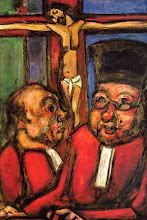
 Portrait of Gratianus Monachus
Gratian has another honor. He has the distinction of being honored by Dante, who, in his Paradiso, places him in the Circle (Paradiso, Canto X), along with others who have contributed to the natural law and who we have discussed in this blog: St. Thomas Aquinas, St. Albert the Great, and St. Isidore of Seville.
 Gratian and others in Dante's First Circle of Wisdom
The Decretum was a private effort by a private man. Gratian had no official ecclesiastical sanction or charge or warrant when he poured over the numerous and splintered sources of law (Scripture, the Fathers, papal decrees, laws of synods, provincial councils and ecumenical councils, etc.) written or promulgated over the course of 11 centuries, many of the laws contradictory or seemingly so, and tried to make some sense out of them by harmonizing them, with greater or lesser success, in one convenient text for the good of his fellows. The Decretum was therefore, for canon law and canon lawyers, a gratia gratis data. But though a private effort, its effect on officialdom was massive:
 Gratian and others in Dante's First Circle of Wisdom
Illustration by Giovanni de Paolo
Quell’ altro fiammeggiare esce del risoThat smile of Gratian, which assisted the courts ecclesiastical and the courts civil so much so that it pleased Paradise and landed him among the Wise in Heaven, is his Decretum.
di Grazïan, che l’uno e l’altro foro
aiutò sì che piace in paradiso.
That next effulgence issues from the smile
Of Gratian, who assisted both the courts
In such wise that it pleased in Paradise.
The Decretum was a private effort by a private man. Gratian had no official ecclesiastical sanction or charge or warrant when he poured over the numerous and splintered sources of law (Scripture, the Fathers, papal decrees, laws of synods, provincial councils and ecumenical councils, etc.) written or promulgated over the course of 11 centuries, many of the laws contradictory or seemingly so, and tried to make some sense out of them by harmonizing them, with greater or lesser success, in one convenient text for the good of his fellows. The Decretum was therefore, for canon law and canon lawyers, a gratia gratis data. But though a private effort, its effect on officialdom was massive:
From the time of its publication, and despite the fact that it was never officially recognized by the Church or enjoyed any juridical status greater than that of a private collection of canons, the Decretum Gratiani dominated the canon law of the Middle Ages and after . . .Crowe, 73. Relying heavily on St. Isidore's Etymologies, which we explored in our last blog posting (see St. Isidore of Seville: A Natural Law Encyclopedist), Gratian's definition of natural law was to have significant influence upon the centuries that followed, and as a consequence, so were St. Isidore of Seville's definitions upon which Gratian so heavily borrowed.
Die Definition des jus naturale in den Etymologien des Isidor ist von Gratian übernommen und dadurch auch Gemeingut der Scholastik geworden.M. Grabmann, "Das Naturrecht der Scholastik von Gratian bis Thomas from Aquin" in Mittlealterliches Gesitesleben, I, p. 69 (quoted in Crowe, 74, n. 7) (trans: The definition of ius naturale [natural law] in the Etymologies of Isidore was taken over by Gratian and through him also became common property of the Scholastics.)
 Title Page from Gratian's Decretum
Gratian supplied not one, but two definitions of natural law. The first he expressly and verbatim obtained from St. Isidore's Etymologies. The second (which equates the natural law with the Law and the Gospel) appears to have been "Gratian's personal contribution to the subject." Scholars dispute its source. Some say Gratian relied generally upon the Augustinian tradition in fashioning it. Others (e.g., Rudolf Weigland) say it is a borrowing from Pope Urban II's (1088-99 A.D.) Epistolae et Privilegia n. 278 (151 PL 535) or at least the thought behind it. Others (e.g., Lottin) see its source in the teaching of the school of Anselm of Laon (see St. Anselm of Laon: Natural Law as Locus Spatiosus, a "Large Place" and St. Anselm of Laon: Glossing the Natural Law) and Hugh of St. Victor (see Hugh of St. Victor: Sacraments of the Natural Law). Crowe, 74, 79-81. Crowe explains this process:
Crowe criticizes Gratian, suggesting that the confusion already engendered by St. Isidore was only further exacerbated by Gratian. According to Crowe, in the area of the natural law, Gratian created more disharmony, not less. St. Isidore had already injected a confusion between natural law and divine law, and Gratian's equating of the natural law with "what is in the Law and Gospel," quod in lege et evangelio continetur, was simply a further confusion of the two concepts. We shall address this issue at greater depth in our next blog posting. But here we shall end by quoting the definitions of the natural law in the Decretum Gratiani:
The natural law is also defined by Gratian in Canon 7 of Distinction I.
Is the natural law what is contained in the Law and the Gospels? Is the natural law the Commandments and the Golden Rule (in its negative and positive formulations)? Or is that which is common to all nations because it exists everywhere through natural instinct, not because of any enactment? Or is it, in the harmonizing spirit of Gratian himself, both?
That will be our focus in our next blog posting.
(English translations of Gratian's Decretum from Augustine Thompson, O.P., trans., Gratian: The Treatise on Laws (Washington, D.C.: Catholic University of America, 1993).
What these theologians, the school of Anselm [of Laon] and Hugh of St. Victor, did was to take a commonplace of Patristic theology--the idea of the natural law as primitive law given to man and reiterated after the fall because of man's inability to obey or even to discovery it--and to add the New Law (represented by the phrase of Matthew 7:12) to the Old Law or the Decalogue. The Fathers normally gave the summary of the law of the New Testament from Matthew 22:39--the precept of loving God and loving one's neighbour, in which "is contained the Law and the prophets." The theologians [Anselm and Hugh] prefer the Golden Rule of Matthew 7:12 (together with its negative formulation in Tobit4:15). This appeal to different texts hardly constitutes an essential difference between the medieval theologians and the Fathers in the question of the natural law. In following the theologians Gratian touched on a long tradition.Crowe, 81.
Crowe criticizes Gratian, suggesting that the confusion already engendered by St. Isidore was only further exacerbated by Gratian. According to Crowe, in the area of the natural law, Gratian created more disharmony, not less. St. Isidore had already injected a confusion between natural law and divine law, and Gratian's equating of the natural law with "what is in the Law and Gospel," quod in lege et evangelio continetur, was simply a further confusion of the two concepts. We shall address this issue at greater depth in our next blog posting. But here we shall end by quoting the definitions of the natural law in the Decretum Gratiani:
The human race is ruled by two things, namely, natural law and usages. Natural law is what is contained in the Law and Gospel. By it, each person is commanded to do to others what he wants done to himself and prohibited from inflicting on others what he does not want done to himself. So Christ said int he Gospel: 'Whatever you want men to do to you, do so to them. This indeed is the law and the Prophets."D.1, P. 1, C. 1.
Thus Isidore says in Etymologies, V, ii:
C.1. Divine ordinances are established by nature, human ordinances by usages.
§1. All ordinances are either divine or human. Divine ordinances are determined by nature, human ordinances by usages; and thus the latter vary since different things please different people.
§2. Morality is divine ordinance. Law is human ordinance.
§3. To pass through another's field is moral, but it is not legal.
From the text of this authority one can understand clearly how divine and human ordinances differ, since whatever is moral is included in the term "divine or natural ordinances," while by the term "human ordinances" we understand the usages drawn up in writing and passed on as law. Law is a general term containing many species.
Humanum genus duobus regitur, naturali videlicet iure et moribus. Ius naturae est, quod in lege et evangelio continetur,quo quisque iubetur alii facere, quod sibi vult fieri, et prohibetur alii inferre, quod sibi nolit fieri. Unde Christus in evangelio:
"Omnia quecunque vultis ut faciant vobis homines, et vos eadem facite illis. Haec est enim lex et prophetae." Hinc Ysidorus in V. libro Ethimologiarum [c. 2.] ait:
C. I. Divinae leges natura, humanae moribus constant.
§1. Omnes leges aut divinae sunt, aut humanae. Divinae natura, humanae moribus constant, ideoque he discrepant, quoniam aliae aliis gentibus placent.
§2. Fas lex divina est: ius lex humana.
§3. Transire per agrum alienum, fas est, ius non est.
Ex verbis huius auctoritatis evidenter datur intelligi, in quo differant inter se lex divina et humana, cum omne quod fas est, nomine divinae vel naturalis legis accipiatur, nomine vero legis humanae mores iure conscripti et traditi intelligantur.
The natural law is also defined by Gratian in Canon 7 of Distinction I.
C. 6. What the species of law are.D.I, P. 2, CC. 6-7.
§1. Law is either natural, civil, or that of nations.
C. 7. What natural law is.
§2. Natural law is common to all nations because it exists everywhere through natural instinct, not because of any enactment.
§3. For example: the union of men and women, the succession and rearing of children, the common possession of all things, the identical liberty of all, or the acquisition of things that are taken from the heavens, earth, or sea, as well as the return of a thing deposited or of money entrusted to one, and the repelling of violence by force. This, and anything similar, is never regarded as unjust but is held to be natural and equitable.
C. VI. Que sint species iuris.
[Isidor. eod. c. 4.]
Ius aut naturale est, aut ciuile, aut gentium.
C. VII. Quid sit ius naturale.
[Isidor. eod. c. 4.]
§1. Ius naturale est commune omnium nationum, eo quod ubique instinctu naturae, non constitutione aliqua habetur.
§2. Ut viri et feminae coniunctio, liberorum successio et educatio, communis omnium possessio et omnium una libertas, acquisitio eorum, quae celo, terra marique capiuntur; item depositae rei vel commendatae pecuniae restitutio, violentiae per vim repulsio. Nam hoc, aut si quid huic simile est, numquam iniustum, sed naturale equumque habetur.
Is the natural law what is contained in the Law and the Gospels? Is the natural law the Commandments and the Golden Rule (in its negative and positive formulations)? Or is that which is common to all nations because it exists everywhere through natural instinct, not because of any enactment? Or is it, in the harmonizing spirit of Gratian himself, both?
That will be our focus in our next blog posting.
(English translations of Gratian's Decretum from Augustine Thompson, O.P., trans., Gratian: The Treatise on Laws (Washington, D.C.: Catholic University of America, 1993).