
. . An important application of this relation between nature and grace is recognized in the moral theology of St. Thomas Aquinas, which is very timely. At the center of his teaching in this field, he puts the new law, which is the law of the Holy Spirit. With a profoundly evangelical focus, he insists on the fact that this law is the grace of the Holy Spirit given to all those who believe in Christ. To such grace is joined the written and oral teaching of the doctrinal and moral truths, transmitted by the Church. Stressing the fundamental role in moral life of the Holy Spirit's action, of grace, from which the theological and moral virtues flow, St. Thomas makes one understand that every Christian can attain the lofty prospects of the "Sermon on the Mount" if he lives an authentic relationship of faith in Christ, if he opens himself to the action of his Holy Spirit. However -- Aquinas adds -- "even if grace is more effective than nature, still nature is more essential for man" (Summa Theologiae, Ia, q, 29, a. 3), due to which, in the Christian moral perspective, there is a place for reason, which is capable of discerning the natural moral law. Reason can recognize [this law] considering what is good to do and what is good to avoid to obtain that happiness which is in each one's heart, and which also imposes a responsibility toward others and, hence, the search for the common good. In other words, the virtues of man, theological and moral, are rooted in human nature. Divine grace supports, sustains and drives the ethical commitment but, on their own, according to St. Thomas, all men, believers and non-believers, are called to recognize the exigencies of human nature expressed in natural law and to be inspired in it in the formulation of positive laws, that is, those issuing from the civil and political authorities to regulate human coexistence.
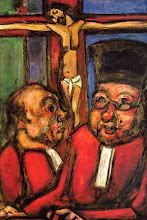
St. Thomas Aquinas Before a Crucifix
When the natural law and the responsibility it implies are denied, the way is opened dramatically to ethical relativism on the individual plane and to the totalitarianism of the state on the political plane. The defense of man's universal rights and the affirmation of the absolute value of the dignity of the person postulate a foundation. Is not the natural law precisely this foundation, with the non-negotiable values that it indicates? The Venerable John Paul II wrote in his encyclical "Evangelium Vitae" words that remain very timely: "It is therefore urgently necessary, for the future of society and the development of a sound democracy, to rediscover those essential and innate human and moral values which flow from the very truth of the human being and express and safeguard the dignity of the person: values which no individual, no majority and no State can ever create, modify or destroy, but must only acknowledge, respect and promote" (No. 71).Pope Benedict XVI
In conclusion, Thomas proposes to us a broad and trustworthy concept of human reason: broad because it is not limited to the spaces of the so-called empirical-scientific reason, but open to the whole being and hence also to the fundamental and inalienable questions of human living; and trustworthy because human reason, above all if it accepts the inspirations of the Christian faith, is a promoter of a civilization that recognizes the dignity of the person, the intangibility of his rights and the strength of his duties. It is not surprising that the doctrine about the dignity of the person, fundamental for the recognition of the inviolability of man's rights, matured in realms of thought that took up the legacy of St. Thomas Aquinas, who had a very lofty concept of the human creature. He defined it, with his rigorously philosophical language, as "that which is most perfect found in the whole of nature, that is a subsistent subject in a rational nature" (Summa Theologiae, Ia, q. 29, a. 3).
The profundity of St. Thomas Aquinas' thought stems -- let us never forget it -- from his lively faith and his fervent piety, which he expressed in inspired prayers, such as this one in which he asks God: "Grant me, I pray, a will that seeks you, a wisdom that finds you, a life that pleases you, a perseverance that waits for you with trust and a trust that in the end succeeds in possessing you."




1 year ago