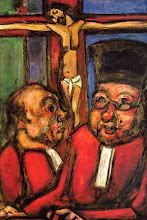
Angilbert (fl. ca. 840/50), On the Battle Which was Fought at Fontenoy

The Law of Christians is broken,
Blood by the hands of hell profusely shed like rain,
And the throat of Cerberus bellows songs of joy.

Angelbertus, Versus de Bella que fuit acta Fontaneto

Fracta est lex christianorum
Sanguinis proluvio, unde manus inferorum,
gaudet gula Cerberi.
Showing posts with label Leo XIII on Slavery. Show all posts

Thursday, January 27, 2011

Leo XIII's In Plurimis: Natural Law and Slavery, Part 3

WE CONCLUDE THIS THREE-PART SERIES on Pope Leo XIII's encyclical In plurimis. From a practical standpoint, the Church made some significant effort to provide practical remedies against slavery: she imposed canonical penalties, even excommunication; she allowed slaves sanctuary; those slaves that came into the possession of her bishops and religious, "according to times and places," she required bishops to divest themselves of after the slaves showed themselves capable of self-government; she put pressure on civil authorities to ameliorate, if not banish slavery. Through her efforts, the only institution of any size siding with the slaves, the slavery was "nearly blotted out from among Christian nations."

Unfortunately, the Church was to confront the Old World slavery's atavism in the New World and in the colonization--in America, Africa, and Asia--that followed, and she found herself at the forefront of confronting the effort revive the plague. Rome "took the greatest care that the evil germs of such depravity should nowhere revive." IP, 15. Pius II (r. 1458-64), Leo X (r. 1513-21), Paul III (r. 1534-49), Urban VIII (r. 1623-44), Benedict XIV (r. 1740-58), and Pius VII (r. 1800-23), Gregory XVI (1831-46) all showed themselves in one way or other concerned with slavery and the slave trade, condemning one or both for their part. Unfortunately, the cries and warnings of the Popes went unheeded, and slavery's ugly mien rose again and reigned for centuries. But, eventually, the Church's "long-continued and most just complaints of nature and religion," were to obtain remedy, at least in the Christian countries. IP, 17.

Not so the rest of the world, especially that part of the world governed by Islam, "it having been perversely laid down by the Mohammedans that Ethiopians and men of similar nations are very little superior to brute beasts." The African natives are likewise brutally treated by Muslims and by colonialists.
We open Our arms to them, how ardently We desire to be able to afford them every alleviation and support, with the hope, that, having cast off the slavery of superstition as well as the slavery of man, they may at length serve the one true God under the gentle yoke of Christ, partakers with Us of the divine inheritance. Would that all who hold high positions in authority and power, or who desire the rights of nations and of humanity to be held sacred, or who earnestly devote themselves to the interests of the Catholic religion, would all, everywhere acting on Our exhortations and wishes, strive together to repress, forbid, and put an end to that kind of traffic, than which nothing is more base and wicked.
IP, 19.


Bronze Statue of St. Peter Claver, Cartegena, Colombia

In another encyclical, Libertas praestantissimum, Pope Leo XIII summarized the Church's role in the slavery question thus:
It is sufficient to recall the fact that slavery, that old reproach of the heathen nations, was mainly abolished by the beneficent efforts of the Church. The impartiality of law and the true brotherhood of man were first asserted by Jesus Christ; and His apostles re-echoed His voice when they declared that in future there was to be neither Jew, nor Gentile, nor barbarian, nor Scythian, but all were brothers in Christ. So powerful, so conspicuous, in this respect is the influence of the Church that experience abundantly testifies how savage customs are no longer possible in any land where she has once set her foot; but that gentleness speedily takes the place of cruelty, and the light of truth quickly dispels the darkness of barbarism.
LP, 12.

The model that is required to overcome this evil was the Jesuit St. Peter Claver, patron saint of slaves:
Let them look at him who for fully forty years gave himself up to minister with the greatest constancy in his labors, to a most miserable assembly of Moorish slaves; truly he ought to be called the apostle of those whose constant servant he professed himself and gave himself up to be. If they endeavor to take to themselves and reflect the charity and patience of such a man, they will shine indeed as worthy ministers of salvation, authors of consolation, messengers of peace, who, by God's help, may turn solicitude, desolation, and fierceness into the most joyful fertility of religion and civilization.
IP, 20.

The extirpation of slavery de jure must also be accomplished de facto, but in removing slavery and its badges and remnants "let all be done lawfully, temperately, and in a Christian manner."
It is, however, chiefly to be wished that this may be prosperously accomplished, which all desire, that slavery may be banished and blotted out without any injury to divine or human rights, with no political agitation, and so with the solid benefit of the slaves themselves, for whose sake it is undertaken.
IP, 21.

Finally, Pope Leo XIII turns to the newly-freed slave, and renders this advice, which is the advice that ought to be given and received by any true free man:
Let them, then, endeavor piously and constantly to retain grateful memory and feeling towards those by whose council and exertion they were set at liberty. Let them never show themselves unworthy of so great a gift nor ever confound liberty with licence; but let them use it as becomes well ordered citizens for the industry of an active life, for the benefit and advantage both of their family and of the State. To respect and increase the dignity of their princes, to obey the magistrates, to be obedient to the laws, these and similar duties let them diligently fulfill, under the influence, not so much of fear as of religion; let them also restrain and keep in subjection envy of another's wealth or position, which unfortunately daily distresses so many of those in inferior positions, and present so many incitements of rebellion against security of order and peace. Content with their state and lot, let them think nothing dearer, let them desire nothing more ardently than the good things of the heavenly kingdom by whose grace they have been brought to the light and redeemed by Christ; let them feel piously towards God who is their Lord and Liberator; let them love Him, with all their power; let them keep His commandments with all their might; let them rejoice in being sons of His spouse, the Holy Church; let them labor to be as good as possible, and as much as they can let them carefully return His love.

Ergo illi memoriam et voluntatem gratam pie ad eos servare diligenterque profiteri studeant, quorum consilio quam prasbeant indignos, nec umquam libertatem cum licentia cupidilatum permisceant; ea vero utantur quo modo cives decet bene moratos, ad industriam vitae actuosas, et commoda et ornamenta quum familias tum civitatis. Vereri et colere majestatem principum, parere magistratibus, legibus obtemperare haec officia et similia, non tam metu adducti quam religione assidue exsequantur: etiam cohibeant arceantque alienae copiae et prestantiae invidiam, quae dolendum quam multos ex tenuioribus quotidie torqueat et quam multa ministret nequitiae plena instrumenta adversus ordinum securitatem et pacem. Re sua et statu contenti, nihil carius cogitent, nihil appetant cupidius quam bona regni caelestis, quorum gratia in lucem editi sunt et a Christo redempti: de Deo eodemque Domino ac Liberatore suo cum pietate sentiant, eum totis viribus diligant, ejus mandata omni cura custodiant. Sponsae ejus Ecclesiae sanctae, se filios esse gaudeant, esse optimos laborent, et quam possint amoris vicem sedulo reddant.
IP, 22.

Tuesday, January 25, 2011

Leo XIII's In Plurimis: Natural Law and Slavery, Part 2

THERE MAY HAVE BEEN NO LEGAL OR SOCIAL INSTITUTION more affected by the Incarnation and Redemptive death of Christ and the proclamation of the Christian Gospel of these two mysteries than slavery, and yet one stubbornly resistant to that proclamation. Slavery is, and remains, a stubborn blot on mankind, and one so prevalent that pagans, including "the Philosopher" Aristotle, confused it as being a natural institution. But its universality has been checked and its prevalence diminished in large part because of the leaven of the Christian Gospel. When the Son of God became man and dwelt among men in Palestine, "[t]he greater part of humanity were toiling in this abyss of misery" which slavery was, a result, we may not doubt of the fact that man was "sunk in the darkness of superstition." IP, 6. The Redemption of Mankind by our divine Redeemer, however, was calculated to lift men out of the "slough and the distress of slavery," illi erecti sunt et caeno et aerumna servitutis, free them of their bondage to sin, and recall them to their high dignity as sons of God. IP, 6. There was something marvelously revolutionary, and yet not revolutionary but restorative, in the notion of St. Paul, which of course was not his but was a central kernel of the Gospel message:
There is neither Jew, nor Greek; there is neither bond, nor free; there is neither male nor female. For you were all one in Christ Jesus.

Non est Iudaeus, neque Graecus: non est servus, neque liber: non est masculus, neque femina. Omnes enim vos unum estis in Christo Iesu.
Gal. 3:28 (see also Col. 3:11; 1 Cor. 12:13; cf. IP, 6). So St. Paul to the Galatians. These, and like words by St. Paul in writings to the Colossians and to the Corinthians, and words announced, we may be sure, from Jesus to apostle, from apostle to disciple, from bishop or priest to layman, from catechist to catechumen, from from Christian slave to Christian master, and Christian master to Christian slave were "golden, honest, most noble" words that were surely intended to dissolve the bonds of slavery that prevented man from being brother to man:
Golden words, indeed, noble and wholesome lessons, whereby its old dignity is given back and with increase to the human race, and men of whatever land or tongue of class are bound together and joined in the strong bonds of brotherly kinship.

Aurea sane, honestissima, saluberrima documenta, quorum efficacitate non modo hominum generi decus redditur suum atque augetur, sed etiam, cujuscumque ipsi sunt loci vel linguae vel gradus, inter se consociantur et vinculis fraternae necessitudinis arctissime conlinentur.
IP, 6.

It is impossible for slavery's darkness to persist in the light of the Gospel: if God, who is absolute master over all men and all things, became man and thus linked himself "to be the brother of us all," and thereby "so ennobled men that they might become participators in the divine nature," how is it that men, who accepted this prodigy of the God who is Love, and the commandment that we ought to love our fellow men as this God loved us, could then be masters over other men? It was but a matter of time for this leaven to do its work on the dough of pagan thought:
Through this Christian charity the various races of men were drawn together under the divine guidance in such a wonderful way that they blossomed into a new state of hope and public happiness; as with the progress of time and events and the constant labor of the Church the various nations were able to gather together, Christian and free, organized anew after the manner of a family.

Ea ipsa non secus fuere ac divinitus insertae propagines, quae mirum in modum provenientes effloruerunt ad spem felicitatemque, publicam; quum, decursu rerum et temporum, perseverante opera Ecclesiae, societas civitatum ad similitudinem familiae renovata coaluerit, Christiana et libera.
IP, 6. The universal and common origin in faith and salvation--Christ--made man see, as if scales fell from his eyes, his common origin in nature. As all men were made, by grace, adopted children of God through Christ, they recognized likewise that they were, by nature, brothers through Adam.
And now through the new Adam, who is Christ, there is established a brotherly union between man and man, and people and people; just as in the order of nature they all have a common origin, so in the order which is above nature they all have one and the same origin in salvation and faith . . . .

Jam nunc per Adamum novum, qui est Christus communionem fraternam et hominis cum homine et gentis cum gente intercedere: ipsis, sicut unam eamdemque, intra naturae fines, originem, sic, supra naturam, originem unam eamdemque esse salutis et fidei . . . .
IP, 7. The incipient, infant Church, however, did not have the power to overturn this institution which plagued, and may always plague, mankind like a cancer. Instead, it sought first to ameliorate it. "[T]the Church, like a tender mother, went on to try to find some alleviation for the sorrows and the disgrace of the life of the slave; with this end in view she clearly defined and strongly enforced the rights and mutual duties of masters and slaves as they are laid down in the letters of the Apostles."* IP,8. Indeed, the seeds of reversal were manifestly present: the evil of the institution was implicitly abrogated, de facto if not de jure:
For he that is called in the Lord, being a bondman, is the freeman of the Lord. Likewise he that is called, being free, is the bondman of Christ.

ὁ γὰρ ἐν κυρίῳ κληθεὶς δοῦλος ἀπελεύθερος κυρίου ἐστίν· ὁμοίως ὁ ἐλεύθερος κληθεὶς δοῦλός ἐστιν Χριστοῦ.

Qui enim in Domino vocatus est servus libertus est Domini similiter qui liber vocatus est servus est Christi.
1 Cor. 7:22. What else does it mean that the slave, the doulos, the servus, is to become free in Christ, and the freeman, the eleutheros, the man in liberty, is to become a slave in Christ? We have here an absolute reversal of values.

There is, therefore, in the scriptural record a clear indication of change in the relationship between slave and master:
Whoever compare the pagan and the Christian attitude toward slavery will easily come to the conclusion that the one was marked by great cruelty and wickedness, and the other by great gentleness and humanity, nor will it be possible to deprive the Church of the credit due to her as the instrument of this happy change.

Utramqueagendi rationem in servos, ethnicam etchristianam, qui conferre velit, facile dabit, fuisse alteram inclementem et flagitiosam, alteram mitissimam plenamque honestatis, neque erit commissurus, ut Ecclesiam, tantae indulgentiae ministram, merita laude fraudare videatur.
PI, 9.

To be sure, the mustard seed was planted, and slavery would--if and when the Gospel took root, and if the cares of the world or the thinness of the soil did not prevent the Gospel's growth--become supplanted. Eventually, the shade of the Gospel was to crowd out and deprive slavery of all its light. Yet the Church recognized that outright preaching that slaves could consider themselves free of their chains, visible or invisible, that tied them to their masters would have "entailed tumults and wrought injury, as well to the slaves themselves as to the commonwealth." IP, 9. She therefore counseled patience and opposed herself to violence and sedition. The slaveowner and the slave, indeed the entirety of civil society, was burdened by this institution, so the slave could not oppose himself to the institution alone, without regard to its link to others. But while she counseled moderation, she also imposed limits. There were prudential reasons to counsel moderation with regard to the institution as a whole, to tolerate it while she worked silently to overcome it without injury to master or to the common good. But there were clear limits to her counsel to the slave to be obedient, and these were already radical. They were as much a challenge to the institution of slavery as they were to the power of the State. There were limits to which a master, like the State, could not go, there was submission that a Christian slave would refuse, like there were commands of the Emperor that would be rejected. So we have examples of slaves who refuse the commands of their masters that would have required the slave to trespass the natural law or the law of God. The pages of the Church historian Eusebius and other hagiographies are seasoned with such instances of which Pope Leo XIII picks one: The beautiful St. Potamiana († ca. 205 A.D.), who preferred being put in a cauldron of pitch than acceding to the lustful demands of her heathen master.**
Many other admirable examples abound of slaves, who, for their souls' sake and to keep their faith with God, have resisted their masters to the death. History has no case to show of Christian slaves for any other cause setting themselves in opposition to their masters of joining in conspiracies against the State.

Similia admirari licet servorum exempla, qui, dominis libertatem sibi animorum, fìdemque Deo obligatam oppugnantibus, firmissime ad necem repugnaverunt: qui vero, christiani servi, aliis de causis restiterint dominis, vel conjurationes turbasve civitatibus exitiosas concitarint, historia prodidit nullos.
IP, 10.

We find similar radical doctrine, yet also similar circumspection and prudence, among the Church Fathers: Saints Chrysostom, Ambrose, Lactantius. It is apparent that the institution of slavery within the embrace of the Church has become insipid, dissolved, almost practically non-existent. Witness Lactantius:
Should any one say: Are there not among you some poor, some rich, some slaves, some who are masters; is there no difference between different persons? I answer: There is none, nor is there any other cause why we call each other by the name of brother than that we consider ourselves to be equals; first, when we measure all human things, not by the body but by the spirit, although their corporal condition may be different from ours, yet in spirit they are not slaves to us, but we esteem and call them brethren, fellow workers in religion.

Nonne sunt apud vos alii pauperes, alii divites, alii servi, alii domini? Nonne aliquid inter singulos interest? Nihil: пес alia causa est cur nobis invicem fratum nomen impertiamur, nisi quia pares esse nos credimus; nam quum omnia humana, non corpore sed spiritu metiamur, tametsi corporum sit diversa conditio, nobis tamen servi non sunt, sed eos et habemus et dicimus spiritu fratres, religione conservos.
Div. Inst. I.V.6; IP, 11.

The leaven of the Gospel ultimately had its effect, and as it took root in pagan society the manumission of slaves becomes frequent and encouraged. Indeed, there were instances where Christians voluntarily became slaves by an exchange of persons so as to liberate some who were in bondage.*** Laws were slowly put in place and enforced that took the bite out of slavery, that eventually made it illegal.


Trinitarians Exchanging Captives

The Popes were no less solicitous in overcoming the plague of slavery and the related plague of captives and in advancing the foundational truth that all men are free by nature, and none are by nature slaves. For example, we have the medieval Pope Alexander III (1100/1105-1181) writing to Lupus, the moorish king of Valencia: "since nature created all free, no one by the condition of nature has become subject to servitude," cum autem omnes liberos natura creasset, nullus conditione naturae fuit subditus servituti.**** The teaching is absolute, and absolutely held. Aristotle's view is decisively rejected as false.

It took centuries to overcome this plague,***** and toward the end of the fifteenth century, the "stain of slavery" was "blotted out from among Christian nations."
Finally, monuments, laws, institutions, through a continuous series of ages, teach and splendidly demonstrate the great love of the Church toward slaves, whose miserable condition she never left destitute of protection, and always to the best of her power alleviated. Therefore, sufficient praise or thanks can never be returned to the Catholic Church, the banisher of slavery and causer of true liberty, fraternity, and equality among men, since she has merited it by the prosperity of nations, through the very great beneficence of Christ our Redeemer.

Monumenta denique leges, instituta, continuo aetatum ordine, docent et declarant magnifice summam Ecclesiae caritatem in servos, quorum conditionem afflictam nullo tempore vacuam tutela reliquit, omni semper ope allevavit. Itaque Ecclesiae catholicae, amplissimo Christi Redemptoris beneficio, expultrici servitutis, veraeque inter homines libertatis, fraternitatis, aequalitatis effectrici, satis nunquam, proinde ac de prosperitate gentium merita est, haberi potest vel laudis vel gratiae.
IP, 14.

But the plague was not so easily extirpated. And during the age of discovery, spurned by the greed that is ever prevalent among men, the institution was to arise again and become part and parcel of the New World, and the Popes set themselves against this institution, which though prevalent, is unnatural and against the law of God.

(continued)
__________________________________
*Pope Leo XIII cites to 1 Pet. 2:18, Eph. 6:5-8, 1 Tim. 6:1-2, and Titus 2:9-10 as scriptural examples advocating slaves or servants to be diligent in serving their masters. For scriptural examples that impose obligations on masters, he cites Eph. 6:9, 1 Cor. 7:22, and Philemon 12, 18.
**Book VI, Ch. 6
***Compare the interesting history of the Trinitarians or members of the Order of the Holy Trinity founded by St. John de Matha, an order dedicated to the ransom of Christian captives during the Crusades. See also the parallel history of the Mercederians.
****Quoted by George Bancroft, History of the United States of America (London: George Routledge, 1854), Vol. I, 124 & 124 n. 1. (citing Historiae Anglicanae Scriptores, (London: 1652), i. 580). He also observes: "But the slave-trade had never relented among the Mahometans."
*****It also took centuries to overcome the pagan plagues of contraception, abortion and infanticide, pederasty and homosexuality, divorce and remarriage, and concubinage.

Leo XIII's In Plurimis: Natural Law and Slavery, Part 1

LEO XIII ADDRESSED THE ISSUE OF chattel slavery in his encyclical In plurimis dated May 5, 1888. The occasion for the encyclical was the abolition of slavery by Brazil. Brazil was the last nation in the Western World to abolish slavery, an act which was accomplished by the passage of the Lei Áurea (Portuguese for "Golden Law"), adopted on May 13, 1888.* The Lei Áurea is remarkable for its simplicity, as it had only two articles:
Article 1: From this date, slavery is declared abolished in Brazil.
Article 2: All dispositions to the contrary are revoked.
The Lei Áurea was sponsored by the Brazilian Senator Rodrigo A. da Silva. It passed both houses of the National Assembly (Assembléia Geral), and received official sanction by the Princess Imperial of Brazil, Isabel (1846–1921), acting as regent for her father, Emperor Dom Pedro II, who was then in Europe. Ironically, the uproar the law caused among Brazilian slave owners and upper classes to rebel against the monarchy, resulting in a military coup in 1889, the toppling of the monarchy, and the eventual establishing of a republic.

The Lei Áurea

Pope Leo XIII was clearly elated by the Brazilian emancipation of slaves, as he saw the institution of chattel slavery as one that arose as a result of sin, was against the law of God and the natural law, and was against the original intent of God:
In the presence of so much suffering, the condition of slavery, in which a considerable part of the great human family has been sunk in squalor and affliction now for many centuries, is deeply to be deplored; for the system is one which is wholly opposed to that which was originally ordained by God and by nature. The Supreme Author of all things so decreed that man should exercise a sort of royal dominion over beasts and cattle and fish and fowl, but never that men should exercise a like dominion over their fellow men

Jamvero tot inter miserias, graviter deplorandum videtur de servitute, cui pars non exigua humanae familiae abhinc multis saeculis est obnoxia, in squalore jacens est sordibus, idque omnino contra quam a Deo et natura erat primitus institutum. Sic enim ille rerum conditor summus decreverat, ut homo in bestiis et agrestibus et natantibus et volucribus regium quemdam dominatum teneret, non item ut in similes sui homines dominaretur.
IP, 3.

The human inheritance of slavery is the result of sin, a sin that blinded man to the fundamental equality among men, an equality arising from their common nature, their common dignity, and the common image of God in which they share. It is a tendency that is altogether prevalent, but for all that not less to be deplored, where some men believe that other men exist for others.
From the first sin came all evils, and specially this perversity that there were men who, forgetful of the original brotherhood of the race, instead of seeking, as they should naturally have done, to promote mutual kindness and mutual respect, following their evil desires began to think of other men as their inferiors, and to hold them as cattle born for the yoke. In this way, through an absolute forgetfulness of our common nature, and of human dignity, and the likeness of God stamped upon us all, it came to pass that in the contentions and wars which then broke out, those who were the stronger reduced the conquered into slavery; so that mankind, though of the same race, became divided into two sections, the conquered slaves and their victorious masters. The history of the ancient world presents us with this miserable spectacle down to the time of the coming of our Lord, when the calamity of slavery had fallen heavily upon all the peoples, and the number of freemen had become so reduced that the poet was able to put this atrocious phrase into the mouth of Caesar: "The human race exists for the sake of a few."**

Ex primi contagione peccati et cetera mala omnia et ista erupit monstruosa perversitas, ut homines fuerint, qui memoria fraternae ab origine conjunctionis rejecta, non jam duce natura mutuam inter se benevolentiam mutuamque observantiam colerent, sed cupiditatibus obedientes suis, homines alios infra se putare coeperint, et perinde habere ac nata jugo jumenta. Hoc modo, nulla ratione habita neque communis naturae, neque dignitatis humanae, neque divinae expressae similitudinis, consecutum est ut, per certationes et bella quae deinde exarserunt, qui vi existerent superiores, ii victos sibi subjicerent, atque ita multitudo ejusdem generis individua sensim in duasabscesserit partes, sub victoribus dominis vieta mancipia. Cujus rei luctuosum quasi theatrum memoria priscorum temporum explicat, ad tempora usque Domini servatoris, quum calamitas servitutis populos omnes late pervaserat, rariorque erat numerus ingenuorum, ut Caesarem poeta ille atrociter dicentem induxerit: «Humanum paucis vivit genus».
IP, 4.

The institution of slavery persisted not only among the primitive peoples, but it flourished even among the civilized Greeks and Romans, where slaves were regarded "as so many chattels--not as persons, but as things," quam bona, non personae sed res." IP, 5. Carved to be outside the pale of the law by a perverse positive law, blinding philosophers and jurists alike, the abuse that infected slavery went far beyond the evil of the institution itself, which was evil enough. The institution itself engendered moral confusion, moral perturbation, which allowed "men to sell their slaves, to give them in exchange, to dispose of them by will, to beat them, to kill them, to abuse them by forcing them to serve for the gratification of evil passions and cruel superstitions; these things could be done, legally, with impunity, and in the light of heaven." IP, 5. And the justifications raised to justify this moral enormity--that slavery was a natural institution because of its prevalence, that slaves were naturally inferior to their owners, that they were things without reason, etc.--were abhorrent. The institution is dehumanizing to both the slave and the master:
Such inhuman and wicked doctrines are to be specially detested; for, when once they are accepted, there is no form of oppression so wicked but that it will defend itself beneath some color of legality and justice.

Ejusmodi delestanda maxime tum inhumanitas tum iniquitas; qua semel accepta, nulla jam sit oppressio hominum barbara et nefanda, quae non sese in legis quadam jurisve specie impudentissime tueatur.
IP, 5.

(continued)

____________________________________
*The entire text (in Portuguese) is as follows:
Declara extinta a escravidão no Brasil:
A Princesa Imperial Regente, em nome de Sua Majestade o Imperador, o Senhor D. Pedro II, faz saber a todos os súditos do Império que a Assembleia Geral decretou e ela sancionou a lei seguinte:

Art. 1.º: É declarada extinta desde a data desta lei a escravidão no Brasil.
Art. 2.º: Revogam-se as disposições em contrário.

Manda, portanto, a todas as autoridades, a quem o conhecimento e execução da referida Lei pertencer, que a cumpram, e façam cumprir e guardar tão inteiramente como nela se contém.

O secretário de Estado dos Negócios da Agricultura, Comércio e Obras Públicas e interino dos Negócios Estrangeiros, Bacharel Rodrigo Augusto da Silva, do Conselho de Sua Majestade o Imperador, o faça imprimir, publicar e correr.
Dada no Palácio do Rio de Janeiro, em 13 de maio de 1888, 67.º da Independência e do Império.

Princesa Imperial Regente.
Rodrigo Augusto da Silva

Carta de lei, pela qual Vossa Alteza Imperial manda executar o Decreto da Assembleia Geral, que houve por bem sancionar, declarando extinta a escravidão no Brasil, como nela se declara. Para Vossa Alteza Imperial ver. Chancelaria-mor do Império - Antônio Ferreira Viana.

Transitou em 13 de maio de 1888.- José Júlio de Albuquerque.

**The quotation--humanum paucis vivit genus--is to Lucan's
Pharsalia V.343 (also known as the De bello civili (On the Civil War)). It is a Roman epic poem by the Roman poet Lucan about the civil war between Julius Caesar and Pompey the Great and the Battle of Pharsalus.