Angilbert (fl. ca. 840/50), On the Battle Which was Fought at Fontenoy

The Law of Christians is broken,
Blood by the hands of hell profusely shed like rain,
And the throat of Cerberus bellows songs of joy.

Angelbertus, Versus de Bella que fuit acta Fontaneto

Fracta est lex christianorum
Sanguinis proluvio, unde manus inferorum,
gaudet gula Cerberi.
Showing posts with label St. Irenaeus and the Natural Law. Show all posts

Thursday, March 4, 2010

St. Irenaeus of Lyons: The Natural Law in Adversus Haereses, Part II

FOR ST. IRENAEUS, THE CREATION OF ADAM, INDEED ALL MANKIND, WAS NOTHING but divine munificence. "In the beginning . . . did God form Adam, not as if He stood in need of man, but that He might have [someone] upon whom to confer His benefits." iv.14[1] All God's relationship with man, therefore, even the demand for obedience and service, must be seen as an effort of God's beneficence, his merciful giving. God's giving is needless; that is, God has no intrinsic need or lack that he assuages or meets by creating us, forming us, and demanding our obedience. He is self-sufficient, and so His act of creation is entirely for creation's benefit. It is creation, it is man, that is entirely in need of God.

This lack of need on the part of God is also true with respect to the divine law and the natural law. "For as much as God is in want of nothing, so much does man stand in need of fellowship with God." iv.14[1] And this is the purpose of God's law, to assure fellowship with God, and to govern us and lead us to our good and final end. God has no need of our obedience to his law; rather, it is we who are in need to be obedient to it.

Stained Glass Window Depicting St. Irenaeus


After man had fallen, in his divine plan of salvation, God called patriarchs, then prophets, then Moses, who led the Jews out of Egypt and into the desert up until the threshold of the promised land, where from a life of nomads they entered into a settled life, with all its accouterments, including a complex Temple cult and priesthood. In each of these phases, God acting through his agents, the patriarchs and prophets, promulgated law "adapted and applicable to every class." Thus, when they roamed the desert, God "promulgated a law very suitable [to their condition]." iv.14[2] When the settled in Israel, he promulgated "legal monitions, and all the other service of the law," that included such things as the election of Levites, and the prescriptions associated with the tabernacle, and with sacrifice. iv.14[3] "They (the Jews) had therefore a law, a course of discipline, and a prophecy of future things." iv.15[1] This law was manifestly positive, in that it was legislated or posited by God outside of, in addition to, or in confirmation of a law that was with man from the very beginning of his formation. This law was therefore circumstantial, that is, defined by, and conditional upon, circumstances.

The divine laws that God gave to the Jews were not only well-suited to their circumstances, but they were pedagogical. They were supplementary or complimentary to the natural law that prohibited the worship of idols:
He instructed the people who were prone to turn to idols, instructing them by repeated appeals to persevere and to serve God, calling them to the things of primary importance by means of those which were secondary: that is, to things that are real, by means of those that are typical; and by things temporal, to eternal; and by the carnal to the spiritual; and by the earthly, to the heavenly . . . .
iv.14[3] Departing his attention from these myriad positive laws, St. Irenaeus turns his attention to the central keystone of the Jewish law, the Decalogue. The Decalogue was given by God to the Jew, but it merely confirmed the "natural precepts, which from the beginning He had implanted in mankind." iv.15[1] The Ten Commandments, then, are nothing but, and demanded nothing more from the Jew than, the natural law, which "if any one does not observe, he has no salvation." iv.15[1] As we shall see, St. Ireneaus shall return to the Decalogue in greater depth in his analysis of the Mosaic law and the natural law in the context of salvation history.

Some of the Mosaic laws, St. Irenaeus acknowledges, were concessional, and "were enacted for [the Jews] by Moses, on account of their hardness [of heart]," one instance being divorce. There are instances even in the Apostolic writings of concessions to "human infirmity." iv.15[2] The concessions, however, are in some manner collateral. Such concessions were never made to the Decalogue. The Decalogue, whose principal purpose was to confirm the "natural precepts, which from the beginning [God] had implanted in mankind," was also intended to steer the Jews away from idolatry. The Decalogue was given to the Jew to obey, so that in the Jew's obedience, he should be restrained, and in such restraint, "not revert to idolatry, nor apostatize from God, but learn to love Him with the whole heart." iv.15[2] Manifestly, if the purpose of the Decalogue was to prevent the Jew from falling into idolatry, there could be no concessions made with regard to it.

Icon of St. Irenaeus with Miter, Crozier, and Pallium

St. Irenaeus views the Decalogue as being markedly distinct from the myriad circumstantial, pedagogical, and concessional laws of the Jew. The Decalogue is also substantially different from those laws of God that are assignatory or typical, such as circumcision initiated by Abraham and the legal and judicial requirements associated with the Sabbath under the Mosaic law. The latter have symbolic, assignatory, or typical value, they point to, are signs of, or are types of a deeper underlying reality. They are thus secondary, not primary. Circumcision and the Sabbath are both "signs." iv.15[1]. Thus Abraham, Lot, Noah, Enoch were all saved without either circumcision or the Sabbath. iv.15[2].
All the rest of the multitude of those righteous men who lived before Abraham and of those patriarchs who preceded Moses, were justified independently of [circumcision and Sabbath observations] and without the law of Moses.
iv.16[2] Then St. Irenaeus pulls out, as it were, the Decalogue from the circumstantial, pedagogical, concessional, and assignatory or typical laws contained in the Old Testament. He finds that the Decalogue is distinct, not only in degree, but in kind. The Decalogue is not only essential, it is confirmatory or declaratory of a law already written in the hearts and souls of all men.
Those righteous men that predeceased Moses, indeed Abraham, had the Decalogue written in their very nature: But the righteous fathers [before Moses, before Abraham] had the meaning of the Decalogue written in their hearts and souls, that is, they loved the God who made them, and did no injury to their neighbor. There was therefore no occasion that they should be cautioned by prohibitory mandates, because they had the righteousness of the law in themselves.
iv.16[3] The Decalogue was an effort by God to feed the souls of the Jew, who had forgotten these natural precepts, not unlike the giving to them of manna. The Decalogue, like the natural precepts written in man's nature, enjoined the same things. But for the manner of their promulgation, they cover the same ground:
[I]t enjoined love to God, and taught just dealing towards our neighbor, that we should neither be unjust nor unworthy of God, who prepares man for his friendship through the medium of the Decalogue, and likewise for agreement with his neighbor,--matters which did certainly profit man himself; God, however, standing in no need of anything from man.
iv.16[3] The Decalogue, which was binding without exception among the Jew, retains every bit as much its validity among the Christians operating under the new covenant. Indeed, the Decalogue's pale has been extended, increased by Christ's exhortation to internalize them.
Preparing man for this life, the Lord Himself did speak in His own person to all alike the words of the Decalogue; and therefore, in like manner, do they remain permanently with us, receiving by means of his advent in the flesh, extension and increase, but not abrogation.
iv16[3] The Decalogue, a law confirmatory or declaratory of the natural law in the hearts and souls of men, has been thus continued in the new covenant. This is not so with the "laws of bondage" that were "promulgated to the people by Moses," specific to the Jew, of circumstantial, pedagogical, concessional, or assignatory or typical value, and not of universal application. These "laws of bondage" were replaced by the "new covenant of liberty." iv.16[5]
But He has increased and widened those laws which are natural, and noble, and common to all, granting to men largely and without grudging, by means of adoption, to know God the Father, and to love Him with the whole heart, and to follow His word unswervingly, while they abstain not only from evil deeds, but even from the desire after them.
iv.16[5] The covenant of liberty ought not to be viewed as a release from law into licentiousness. No. Rather, the covenant of liberty ought to be viewed as a covenant that elicits from us the even greater response of obedient love and loving obedience to the Lord. It, in fact, imposes a greater responsibility of us than mere external obedience to laws, and thus is a test whether he will not only fear and serve, but believe and love the Lord. There is not the least suggestion in St. Irenaeus that the Law of Grace, which affords us re-entry into the supernatural life of the "likeness of God" or similitudo Dei, and the Natural Law, which governs the life of the image of God, the imago Dei, are inconsistent. Christ was not a moral anarchist who released us from all law. Nay, as St. Irenaeus puts it beautifully in a fragment from one of his lost works that has come down to us: Jesus Christ, who was "born of a virgin, and suffered on the cross," and who was "raised also fom the dead, and taken up to heaven," that self-same is also the "Founder of the universe," the "Maker of man," "with Moses . . . Legislator," "the Man among men," and the "Law in the laws." [Frag. LIV]. Christ, "the Law in the laws," is our Law.
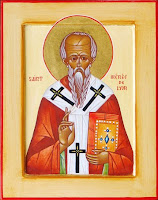
Icon of St. Irenaeus in Posture of Blessing

Tuesday, March 2, 2010

St. Irenaeus of Lyons: The Natural Law in Adversus Haereses, Part I

SAINT IRENAEUS, CHRISTIAN BISHOP OF LUGDUNUM (LYONS) who flourished in the late second century A.D., is considered an Apostolic Father and perhaps the first controversialist of the Church. He was a disciple of the martyr Polycarp, who, in turn, was a disciple of St. John, "the disciple whom Jesus loved." (John 13:23, 19:26, 20:2, 21:7, 21:20) Best known for his book Adversus Haereses or Against Heresies which was written around the year 180, St. Irenaeus is a valuable witness to the early Christian Church's conception of the natural moral law. It is manifest from his writings that the he saw the institutional Church as willed by Christ, and so emphasized obedience to episcopal authority and participation in the Sacramental life of the Church, particularly the Eucharist. From the foundation of the Church and the promulgation of the Gospel, the natural law was part of received Apostolic teaching. He also rejected the Gnostic tendency to claim secret traditions and hidden doctrinal knowledge. He is also a witness, along with Sts. Ignatius and Clement, to early recognition of papal supremacy, that is the supremacy of the Roman Church, with which communion had to be maintained. His theory of the natural law, thus, is within the mainline thinking of the early Christian Church.

Stained Glass Window Depicting St. Irenaeus

St. Irenaeus may have been born in Smyrna between 115 and 125 A.D. He lived through the persecution of the Roman Emperor Marcus Aurelius, had a hand in fighting against the Montanist heresy that so bewitched Tertullian, and succeeded St. Pothinus, the second bishop of Lugdunum (modernly, Lyons) when the latter was martyred. Originally probably written in Greek, his best-known work, On the Detection and Overthrow of the So-Called Gnosis (ἔλεγχος και άνατροπή της ψευδωνύμου γνώσεως) is commonly known by a shorter title, Against Heresies or Adversus haereses (Greek=κατὰ αἱρέσεων). Only fragments of the original Greek text exist, although an early Latin translation of that work exists. Unfortunately, the Latin text suffers from clarity in some areas. It is to that great text of St. Irenaeus that we turn to for his understanding of the natural moral law from the perspective of the early Christian Church. In regard to St. Irenaeus, we might consider the short summary of Michael Crowe before we turn to the work of Irenaeus himself:

Irenaeus treats of the natural law at length in his Adversus Haereses. His perspective is theological; for him human nature is created nature and the law of human nature is the law of God the lawgiver and is given to man to help out the Mosaic Law, itself completed in the Gospel. But despite the theological preoccupations Irenaeus, who after all was writing a polemic against heretics, insists upon the naturalness of the moral law. Phrases like naturalia praecepta and naturalia legis flow easily from his pen. On one occasion he says, apropos of the unity of the old and the new law as coming from the same legislator, God, that the first and greatest precept, namely love the [L]ord with your whole heart and the second like it, love your neighbour as yourself, is found in lege et Evangelio. The phrase, in the context, is innocuous. But is intriguing to think that the same phrase was to be the keynote of one of the most influential--and misleading--definitions of the natural law in the Middle Ages, Gratian's assertion that natural law is what is contained in the law and the gospel.

(Crowe, 59-60). In reviewing St. Irenaeus's concept of natural law, it is important to stress that it is fashioned within the context of salvation history. The focus is thus on its role within the divine economy of salvation. Pace the thesis of the Protestant theologian Felix Flückiger that the Apostolic Fathers had no concept of a metaphysical natural law, no conception of a "timeless person," St. Irenaeus's concepts of the natural moral law, while principally drawn from the context of salvation history, do not necessarily contradict metaphysical concepts of the natural law based upon reason. St. Irenaeus's concept of natural law is not derived from an abstract "timeless person," but is derived from concrete man in time. Recollect that in St. Irenaeus we are dealing with a bishop communicating with those who speak the language of Faith and who have a hold on the events of salvation history and Christian revelation, even if, like the Gnostics, they have misunderstood them and have slid into heresy. We are not dealing with a philosopher talking to his students among the columns of the Stoa, and it would be incongruous to expect our shepherd of souls to either talk or think like one. Given the substantial familiarity with, and borrowing of, Stoic concepts of metaphysical natural law by the Christian intellectuals from the very beginning, it is highly dubious, in my mind, that a metaphysical natural law was not part of the presuppositions of the Apostolic Fathers, including St. Irenaeus. Indeed, incorporating a metaphysical concept of natural law within salvation history gave the metaphysical concept a depth that it had not enjoyed when advanced by the Stoics without any concreteness. The "timeless person," was no longer orphaned, but became a "person in time," in the time that mattered, salvation history. (Cf. Fuchs, Guevin) More accurate than Flückiger's view is the synthetic view espoused by Crowe and Osborn. "Natural law has its place," in St. Irenaeus's concept of the good, "and natural man has been justified by natural law and faith." "In his blend of love and truth, Ireneaus joined Paul and Plato. In his blend of love and natural law, he united Paul and the Stoics." Eric Osborn, Ireneaus of Lyons (Cambridge: Cambridge University Press, 2001), 11.2.2, p. 239.

Another concept that is important in St. Irenaeus is the distinction between image and likeness. Paradisaical man had both the image and likeness of God. Fallen man lost God's likeness, but retained the image of God. Christ was the perfect, the plenary image of humanity, being also the perfect image and likeness of God, indeed bound to the very person of God the Son himself: His humanity was both the image and likeness of God, the paradigmatic human. Through Faith in Christ, the benefits of Christ's redemptive death served to allow man, with the grace of God, to repair God's image in as so to re-establish God's likeness. Man receives back the likeness he lost. It is within this context of re-establishment, of receiving back what was one lost, that Guevin argues one must understand St. Irenaeus's discussion on the natural law. (Guevin, 222-23)

And now, to Irenaeus . . .

Irenaeus's treatment of the natural law is found in Book IV of his Adversus Haereses. Man, for St. Irenaeus, must be understood within the various stages of salvation history. "Now man is a mixed organization of soul and flesh, who was formed after the likeness of God, and molded by His hands, that is by the Son and the Holy Spirit to whom also He said, 'Let Us make man.'" adv. haer., iv.pref.[4]. St. Irenaeus rejects outright any notion that would posit a strict dualism between flesh and spirit, and assign the creation of the flesh to someone other than God, some Demiurge that is less than, or separate from, God. Likewise, he rejects any notion that would begrudge to Jesus, at any moment of his post-incarnate existence, real fleshly existence. Importantly, St. Irenaeus resists any notion of duality in the Old Testament and the Gospels. We are dealing with the same, unchanging and unchanged God in both the Old and New Testaments, and with the same foundational law. "But as man as feared God, and were anxious about His law, these ran to Christ, and were all saved." iv.2[7]. Since, then the law originated with Moses, it terminated with John as a necessary consequence. Christ had come to fulfill it: wherefore 'the law and the prophets were' with them 'until John.'" iv.4[2]. The law, like the temple in Jerusalem, "fulfilling it own times, must have an end of legislation when the new covenant was revealed." iv.4[2]. The coming of the new covenant, and the end or fulfillment of the Mosaic law in Christ, does not bespeak a change in God. Rather, like the seasonal changes in the harvesting of wheat, it bespeaks of a change, a maturation or fruition, in man.
For He who makes the chaff and He who makes the wheat are not different persons, but one and the same, who judges them, that is separates them. But the wheat and the chaff, being inanimate and irrational, have been made such by nature. But man, being endowed with reason, and in this respect like to God, having been made free in his will, and with power over himself, is himself the cause to himself, that sometimes he becomes wheat, and sometimes chaff. Wherefore also he shall be justly condemned, because, having been created a rational being he lost the true rationality, and living irrationally, opposed the righteousness of God, giving himself over to every earthly spirit, and serving all lusts . . . .
iv.4[3]. God has revealed himself to man "by means of the creation itself, . . . by means of the world, . . . by means of the formation of man . . . and by the Son . . . . and these things do indeed address all men in the same manner, but all do not in the same way believe them." iv.6[6] It is "fitting that the truth should receive testimony from all" these revelations, "and should become [a means of] judgment for the salvation indeed of those who believe, but for the condemnation of those who believe not." iv.6[7]. Indeed, there is but one author and end to both covenants. "All things therefore are of one and the same substance, that is from the one and same God . . . who delivers a law suited both for slaves and those who are as yet undisciplined; and gives fitting precepts to those that are free, and have been justified by faith . . ." iv.9[1] "[O]ne and the same householder produced both covenants, the Word of God, our Lord Jesus Christ, who spake with both Abraham and Moses, and who has restored us anew to liberty, and has multiplied that grace which is from Himself." iv.9[1] "Greater," however, "is that legislation which has been given in order to liberty than that given in order to bondage; and therefore it has also been diffused, not throughout one nation [only], but over the whole world." iv.9[2] Within this notion of two covenants, revealed by the same God, a distinction must be made between the "tradition of the elders," and the "law given by Moses." iv.12[1]. The former is "a spurious law," "Pharisaical law," "and one contrary to the [true] law." iv.12[1]. The true "law of God . . . prepares them [the Jews] for the coming of Christ." iv.12[1]. The "commandment of the law," the true law, "is the love of God . . . and . . . neighbor." iv.12[1]-[2]. What Jesus taught is taught by Paul: "Love is the fulfilling of the law." Rom. 13:10; adv. haer., iv.12[2].


Icon of St. Irenaeus with Miter, Crozier, and Pallium

As in the law, therefore, and in the Gospel [likewise], the first and greatest commandment is, to love the Lord God with the whole heart, and then there follows a commandment like to it, to love one's neighbor as one's self; the author of the law and the Gospel is shown to be one and the same. For the precepts of an absolutely perfect life, since they are the same in each Testament, have pointed out [to us] the same God, who certainly has promulgated particular laws adapted for each; but the more prominent and the greatest [commandments], without which salvation cannot [be attained], He has exhorted [us to observe] the same in both.
iv.12[3]. St. Irenaeus sees Christ, like the apostle Paul did, as the "end of the law for righteousness to every one that believeth." Rom.10:3, 4; adv. haer. iv.12.4. "And how is Christ the end of the law," as St. Paul teaches, "if he is not also the final cause of it?" iv.12[4] And if the end and final cause, also the beginning, "[f]or He who has brought in the end has Himself also wrought the beginning." iv.12[4]. The "law did beforehand teach mankind the necessity of following Christ," so does Christ teach. And Christ enjoined his followers to love "God the Father . . . who was proclaimed by the law from the beginning." iv.12[5] Jesus "taught that they should obey the commandments which God enjoined from the beginning . . . and follow after Christ." Thus, for St. Irenaeus, Christ's teaching, while not contrary to the law of Moses, is an appeal to the law, to the commandments "from the beginning." The "Lord did not abrogate the natural [precepts] of the law, by which man is justified, which also those who were justified by faith, and who pleased God, did observe previous to the giving of the [Mosaic] law, but that He extended and fulfilled them . . . ." iv.13[1] This is clear from Christ's insistence that one go beyond the letter of the commandments, beyond the mere prohibition of adultery, of murder, of false oaths, to banish the more basic underlying lust, anger, and deceit and guile in words. Jesus' teachings in this regard "do not contain or imply an opposition to and an overturning of the [precepts] of the past . . . ." iv.13[1]. In his teaching with respect to the Decalogue, Christ has done two things. "In the first place, [we must] believe not only in the Father, but also in the Son now revealed . . . . In the next place, [we must] not only say, but we must do . . . and [we must] not only abstain from evil deeds, but even from the desires after them." iv.13[1].
Now He did not teach us these things as being opposed to the law, but as fulfilling the law, and implanting in us the varied righteousness of the law. That would have been contrary to the law, if He had commanded His disciples to do anything which the law had prohibited. But this which He did command--namely, not only to abstain from things forbidden by the law, but even from longing after them--is not contrary to [the law], as I have remarked, neither is it the utterance of one destroying the law, but of one fulfilling, extending, and affording greater scope to it.
iv.13[1]. With respect to the Mosaic law, then, Christ sought to free the Jew whose relationship to the Father was in the form of slavery or bondage, to a relationship of freedom or adoption into sonship:
For the law, since it was laid down for those in bondage, used to instruct the soul by means of those corporeal objects which were of an external nature, drawing it, as by a bond, to obey its commandments, that man might learn to served God. But the Word set free the soul, and taught that through the body should be willingly purified. Which having been accomplished, it followed as of course, that the bonds of slavery should be removed, to which man had now become accustomed, and that he should follow God without fetters: moreover, that the laws of liberty should be extended, and subjection to the king increased, so that no one who is converted should appear unworthy to Him who set him free, but that the piety and obedience due to the Master of the household should be equally rendered both by servants and children; while the children possess greater confidence [than the servants], inasmuch as the working of liberty is greater and more glorious than that obedience which render in [a state of] slavery.
iv.13[2]. Therefore, both the natural law and the Mosaic law "have received growth and completion" in the followers of Christ.
Inasmuch, then, as all natural precepts are common to us and to them (the Jews), they had in them indeed the beginning and origin; but in us they have received growth and completion. For to yield assent to God, and to follow His Word, and to love Him above all, and one's neighbor as one's self (now man is neighbor to man), and to abstain from every evil deed, and all other things of a like nature which are common to both [covenants? (per trans.) or rather to both Jew and Gentile?], do reveal one and the same God.
iv.13[4] Jesus revealed himself, then, to be the God who "certainly drew slaves to God," that is the Jews whom he appointed "that bondage with respect to God through the law," as well as the God who certainly drew friends, such as Abraham, who followed the Lord "voluntarily and under no compulsion, because of the noble nature of his faith." iv.13[4] This distinction between the patriarch Abraham and the lawgiver Moses leads St. Ireneaus to pay more attention to the historical relationship of God with mankind, beginning with Adam. And from Adam, he turns his attention to the new Adam, Christ. But these matters will be reserved for the next blog posting.

Icon of St. Irenaeus in Posture of Blessing

*Reference to Guevin is to Benedict Guevin, O.S.B., "The Natural Law in Irenaeus of Lyon's Adversus Haereses: A Metaphysical or Soteriological Reality?, XXXVI Studia Patristica (Leuven: Peters 2001), 222-25, and Fuchs is to Joseph Fuchs, S.J., Natural Law: A Theological Approach.