
REASON IS A FOUNDATIONAL BULWARK of any theory of natural law, and it is self-evident that the life of reason is a basic value which ought to be promoted, and in which no way should be disdained. Who could argue that man ought to be unreasonable in governing his actions? It is absurd as saying that man ought not be man, that man ought to fight against his very nature. An unreasonable man is (though we see it often enough) living an oxymoronic existence, not a moral, flourishing existence. It is a man who dulls his edge, who foolishly cuts with the broad end of the knife, who takes what is sharp, acidic, acute (ὀξύς)--his reason--, and abuses it or ignores it and thus makes himself dull (μωρός), blunt, a moron. A man who argues thus is a man who cannot be argued against, as he has made himself into a fool.
But might there nevertheless be an explanation for the obligation to be reasonable, to practice practical reasonableness, albeit that the obligation to do so is self-evident? Can we find some other reason that one ought to be reasonable because it just is so and it cannot not be so? It is impossible for man to be satisfied with such an answer, and so man has sought to go beyond: to the reason behind self-evidency.
Some have predicated the obligation to be reasonable upon some form of voluntarism, using the express will of God in some sort of foundational anchor or base. But such answers suffer from some fundamental problems, most significantly they suffer from the unknowability of God's will through reason. Invariably, the arguments fail or they must ultimately grasp (even if unacknowledged) at some sort of revelation or assumption about God. The existence of God as the Uncaused Cause can be established by the use of reason, but beyond that reason cannot seem to go:
As St. Thomas Aquinas states, "the will of God cannot be investigated by reasoning, except for those items that it is absolutely necessary for God to will. Now, as we have said before, such items do not include what God wills in regard to creatures." S.T. Ia, q. 46, art. 2, c. God's will is naked, or perhaps better, invisible to reason. It becomes visible only if it is clothed with revelation. Thus, those who build an argument that we ought to be reasonable because it is God's will ultimately are saying (though they may not admit it) that we ought to be reasonable because it is revealed (or presupposed or assumed):
So if neither reason (i.e., the existence of an Uncaused Cause) nor voluntarism (God's will) yields a ready answer as an explanation of the foundation of morality, what then? Where else do we go? Must we have recourse to positive revelation, a raw naked fideism?
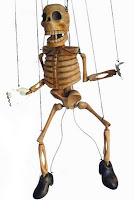
Man a Marionette?
Then Who's the Puppeteer?
Ultimately, it seems, we have to go to faith, but not to naked fideism. For reason has one last precursory, mythic role.** Before it decreases, it must increase in a last bloom of speculation, hope, anticipation even if it goes beyond itself in doing so. Reason prepares the way, as St. John prepared the way for Christ, by a reasoned speculation, a reasoned hope, a reasoned desire that the Uncaused Cause may be more than just Uncaused Cause. Perhaps--reason might speculate, hope, desire--perhaps this Uncaused Cause is personal, intentional in its acts and reasonable, perhaps it is desirous of communicating with us, perhaps it is a person that is concerned with our good and, ultimately, ought to be loved because the Uncaused Cause is lovable. It is this speculation that proposes the plausible explanation of the "why" of all things: of why we ought to be reasonable, of why one friend ought to yield to another, of why it is reasonable for a man to sacrifice himself for his family or his country (against the inclination toward self-preservation), of why there is a point of living at all (since our lives are clearly so limited as, in the long run, to be patently in vain).
This reasonable speculation, hope, anticipation or yearning, if confirmed to be true by some revelation, would likewise yield deeper answers to the reason why the basic human values ought to be promoted and never attacked beyond their self-evidency. It is, as we have noted in earlier postings,*** self-evident that life, knowledge, aesthetic appreciation, play, friendship, practical reasonableness, religion. But if our reasonable speculation, hope, or anticipation of the Uncaused Cause is one who personal, reasonable, lovable is true, then we have attained a reason behind the self-evidency. If true, the reasoned speculation, the reasoned myth, would go beyond the self-evident nature of the basic values. And because this reasoned myth--if true--offers a better explanation of these things than if it were not true, it is reasonable to accept it. Reason hands us off in one elegant gesture to Faith, very much like Virgil handed Dante off to Beatrice in the poet's journey in the Divine Comedy.
Plato, indeed, went through such an exercise in his last work, the Laws in what Finnis characterizes as "one of the foundation texts in the tradition of theorizing about natural law." NLNR, 408. The characters are talking about law, and the Athenian speculates, through a parable or myth, through imaginings, that man may be modeled to be a sort of puppet, a plaything of the gods, or perhaps not a plaything, but something with a more serious purpose. Man is pulled by opposite chords, chords of pleasure (ἡδονή) and chords of pain (λύπη). These antagonistic chords when cognizant of the future feed states based upon their anticipation, fear (φόβος) or confidence or courage (θάρρος). There is, however, beyond these two antagonistic chords, a faculty of reckoning or judgment (λογισμός) which distinguishes which, under any circumstance, is better or worse. When this judgment (λογισμός) is predicated not of man and his psyche, but of the city as a whole, as a public decree (δόγμα) it is known as law (νόμος).
In addition to the chord of pleasure/confidence and pain/fear, man in his psyche has yet a third chord, a subtle, soft, and golden chord, a chord of practical reasonableness (λογισμός χρύσεος). In the life of the city, this golden chord of reason is known as the common law (κοινός νόμος). Plato, Laws, I, 645a. There is, then, an analogue between the moral life of man, the golden chord of reason, and the common life of man, the golden chord of reasoned law. The reason this is so is because man is a puppet, perhaps a puppet-plaything-of-the-gods, but perhaps, perhaps a puppet-with-a-serious-purpose, a puppet-beloved-of-God?
_______________________________
*And while these beliefs may be true, they are beliefs, not reasons. They are ultimately based upon a view of God that is more-than-philosophical. They are based upon a view of God which is either assumed or a view of God that is strangely alike that of the God of revelation, namely the God as revealed in the Christian revelation.
**We use myth in the manner that C. S. Lewis used the term, as a sort of precursor or weak prophet of revelation, a reasonable though speculative longing that is put into story, and which, ultimately became fact in the reality of God-becoming-Man. Christ is therefore the speculative longing of every man, every culture, every society confirmed as real and made Flesh: "If ever a myth had become a fact, had been incarnated, it would be just like this. And nothing else in all literature was just like this [Christ presented in the Gospels]. Myths were like it in one way. Histories were like it in another. But nothing was simply like it . . . Here and here only in all time the myth must have become fact; the Word, flesh; God, man. This is not "a religion," nor "a philosophy." It is the summing up and actuality of them all." C. S. Lewis, Surprised by Joy. We might also borrow the definition of Carol Hamilton, who defines myths, as "unformed forecasts of God's ultimate plan." Carol J. Hamilton, "Christian Myth and Modern Man," 29 Encounter 251 Summer (1968).
***See, e.g., Natural Law's Modern Cousin Germain: The Seven Basic Values.
But might there nevertheless be an explanation for the obligation to be reasonable, to practice practical reasonableness, albeit that the obligation to do so is self-evident? Can we find some other reason that one ought to be reasonable because it just is so and it cannot not be so? It is impossible for man to be satisfied with such an answer, and so man has sought to go beyond: to the reason behind self-evidency.
Some have predicated the obligation to be reasonable upon some form of voluntarism, using the express will of God in some sort of foundational anchor or base. But such answers suffer from some fundamental problems, most significantly they suffer from the unknowability of God's will through reason. Invariably, the arguments fail or they must ultimately grasp (even if unacknowledged) at some sort of revelation or assumption about God. The existence of God as the Uncaused Cause can be established by the use of reason, but beyond that reason cannot seem to go:
[T]hose who [philosophically] claim to know what God [as the Uncaused Cause] wills in some human context, and that that will should be obeyed are . . . going beyond what can be affirmed about [God as Uncaused Cause] on the basis of philosophical argumentation.NLNR, 404.
As St. Thomas Aquinas states, "the will of God cannot be investigated by reasoning, except for those items that it is absolutely necessary for God to will. Now, as we have said before, such items do not include what God wills in regard to creatures." S.T. Ia, q. 46, art. 2, c. God's will is naked, or perhaps better, invisible to reason. It becomes visible only if it is clothed with revelation. Thus, those who build an argument that we ought to be reasonable because it is God's will ultimately are saying (though they may not admit it) that we ought to be reasonable because it is revealed (or presupposed or assumed):
They are claiming . . . relying . . . upon some definite revelation . . . that God positively favours both the basic goods and human adherence to the principles and requirements of practical reasonableness in pursuit of those goods; that the evils and disorders of this world are not favoured so, but are merely tolerated by God for the sake of some positive good (what, and how attained, we do not know); and that friendship with God, some sharing in God's life and knowledge and love-of-goods, is available to those who positively favour what God positively favours.NLNR, 405. It is these beliefs* that are the ground for any argument that it is God's will we follow reason and the good toward which it points, and the evil that it commands we shun. But then the explanation presupposes these beliefs in order to make sense, so it is no longer reason that answers, but belief. In terms of reason, it is an answer that is no answer.
So if neither reason (i.e., the existence of an Uncaused Cause) nor voluntarism (God's will) yields a ready answer as an explanation of the foundation of morality, what then? Where else do we go? Must we have recourse to positive revelation, a raw naked fideism?

Man a Marionette?
Then Who's the Puppeteer?
Ultimately, it seems, we have to go to faith, but not to naked fideism. For reason has one last precursory, mythic role.** Before it decreases, it must increase in a last bloom of speculation, hope, anticipation even if it goes beyond itself in doing so. Reason prepares the way, as St. John prepared the way for Christ, by a reasoned speculation, a reasoned hope, a reasoned desire that the Uncaused Cause may be more than just Uncaused Cause. Perhaps--reason might speculate, hope, desire--perhaps this Uncaused Cause is personal, intentional in its acts and reasonable, perhaps it is desirous of communicating with us, perhaps it is a person that is concerned with our good and, ultimately, ought to be loved because the Uncaused Cause is lovable. It is this speculation that proposes the plausible explanation of the "why" of all things: of why we ought to be reasonable, of why one friend ought to yield to another, of why it is reasonable for a man to sacrifice himself for his family or his country (against the inclination toward self-preservation), of why there is a point of living at all (since our lives are clearly so limited as, in the long run, to be patently in vain).
[I]f these speculations and hopes [of reason] were confirmed [by some sort of revelation], a more basic account of obligation would become possible. For if the uncaused cause were revealed to favour the well-being of everyman, for no other reason than [God's] own goodness . . . the common good could be pursued by us for a new reason, viz. out of love or friendship for the personal being ('God') who not only makes possible whatever well-being of persons there can be and actually is, but also positively favours (though in ways often unintelligible to us) that common good. . . . And this would not only explain, in principle, how self-sacrifice in friendship can make sense; it also would account for our obligation to the common good. . . . So if God could be recognized to be our friend . . . and to be one who favours the common good of human persons, we would have a new and pertinent reason for loving that common good . . . .NLNR, 406-07.
This reasonable speculation, hope, anticipation or yearning, if confirmed to be true by some revelation, would likewise yield deeper answers to the reason why the basic human values ought to be promoted and never attacked beyond their self-evidency. It is, as we have noted in earlier postings,*** self-evident that life, knowledge, aesthetic appreciation, play, friendship, practical reasonableness, religion. But if our reasonable speculation, hope, or anticipation of the Uncaused Cause is one who personal, reasonable, lovable is true, then we have attained a reason behind the self-evidency. If true, the reasoned speculation, the reasoned myth, would go beyond the self-evident nature of the basic values. And because this reasoned myth--if true--offers a better explanation of these things than if it were not true, it is reasonable to accept it. Reason hands us off in one elegant gesture to Faith, very much like Virgil handed Dante off to Beatrice in the poet's journey in the Divine Comedy.
Plato, indeed, went through such an exercise in his last work, the Laws in what Finnis characterizes as "one of the foundation texts in the tradition of theorizing about natural law." NLNR, 408. The characters are talking about law, and the Athenian speculates, through a parable or myth, through imaginings, that man may be modeled to be a sort of puppet, a plaything of the gods, or perhaps not a plaything, but something with a more serious purpose. Man is pulled by opposite chords, chords of pleasure (ἡδονή) and chords of pain (λύπη). These antagonistic chords when cognizant of the future feed states based upon their anticipation, fear (φόβος) or confidence or courage (θάρρος). There is, however, beyond these two antagonistic chords, a faculty of reckoning or judgment (λογισμός) which distinguishes which, under any circumstance, is better or worse. When this judgment (λογισμός) is predicated not of man and his psyche, but of the city as a whole, as a public decree (δόγμα) it is known as law (νόμος).
Let us conceive of the matter in this way. Let us suppose that each of us living creatures is an ingenious puppet of the gods, whether contrived by way of a toy of theirs or for some serious purpose—for as to that we know nothing; [644e] but this we do know, that these inward affections of ours, like sinews or cords, drag us along and, being opposed to each other, pull one against the other to opposite actions; and herein lies the dividing line between goodness and badness.Plato, Laws, I, 644d-e.
In addition to the chord of pleasure/confidence and pain/fear, man in his psyche has yet a third chord, a subtle, soft, and golden chord, a chord of practical reasonableness (λογισμός χρύσεος). In the life of the city, this golden chord of reason is known as the common law (κοινός νόμος). Plato, Laws, I, 645a. There is, then, an analogue between the moral life of man, the golden chord of reason, and the common life of man, the golden chord of reasoned law. The reason this is so is because man is a puppet, perhaps a puppet-plaything-of-the-gods, but perhaps, perhaps a puppet-with-a-serious-purpose, a puppet-beloved-of-God?
_______________________________
*And while these beliefs may be true, they are beliefs, not reasons. They are ultimately based upon a view of God that is more-than-philosophical. They are based upon a view of God which is either assumed or a view of God that is strangely alike that of the God of revelation, namely the God as revealed in the Christian revelation.
**We use myth in the manner that C. S. Lewis used the term, as a sort of precursor or weak prophet of revelation, a reasonable though speculative longing that is put into story, and which, ultimately became fact in the reality of God-becoming-Man. Christ is therefore the speculative longing of every man, every culture, every society confirmed as real and made Flesh: "If ever a myth had become a fact, had been incarnated, it would be just like this. And nothing else in all literature was just like this [Christ presented in the Gospels]. Myths were like it in one way. Histories were like it in another. But nothing was simply like it . . . Here and here only in all time the myth must have become fact; the Word, flesh; God, man. This is not "a religion," nor "a philosophy." It is the summing up and actuality of them all." C. S. Lewis, Surprised by Joy. We might also borrow the definition of Carol Hamilton, who defines myths, as "unformed forecasts of God's ultimate plan." Carol J. Hamilton, "Christian Myth and Modern Man," 29 Encounter 251 Summer (1968).
***See, e.g., Natural Law's Modern Cousin Germain: The Seven Basic Values.