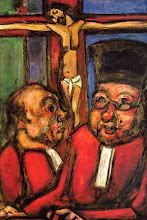
A Law is such a just and regular tuning of Actions, as that by virtue of this they may conspire into a moral music, and become very pleasant and harmonious. Thus Plato speaks much of that Εὐρυθμία&συμφωνία [melody and harmony] that is in Law, and in his second book De Leg.7 he does altogether discourse of harmony, and does infinitely prefer mental and intellectual music, those powerful and practical strains of goodness, that spring from a well-composed spirit, before those delicious blandishments, those soft, transient touches that comply with sense, and salute it in a more flattering manner; and he tells you of a spiritual dancing that is answerable to so sweet a music, to these τὰθείοτατααὐλήματα [most divine flutings]. While the Laws play in consort, there is a Chorus of well ordered affections that are raised and elevated by them.
And thus as Aristotle well observes, some Laws were wont to be put in verse, and to be sung like so many pleasant odes, that might even charm the people into obedience.
’Tis true, that learned Philosopher gives this reason of it, they were put into verse, ὅπωςμὴἐπιλάθωνται, that they might remember them the better: but why may not this reason also share with it, that they might come with a greater grace and allurement, that they might hear them as pleasantly as they would do the voice of a Vial or an Harp, that has Rhetoric enough to still and quiet the evil spirit?
Friday, June 5, 2009
The Melody and Harmony that is Law
Wednesday, June 3, 2009
St. Thomas Aquinas: Definition of Law, The Common Good
THE LAW IS A PUBLIC THING, NOT A PRIVATE TOY. This is essentially St. Thomas Aquinas's teaching in the second article to question 90 in the "Treatise on Law." St. Thomas quotes the early encylopedist, St. Isidore of Seville, for the proposition that laws are not enacted for private benefit, but for the public good. Etymologies, v.21 (nullo privato commodo, sed pro communi civium utilitate conscripta). St. Thomas observes that although reason is what directs the law, there must be something upon which reason is focused, the ultimate end or purpose (what is called the "final cause"). With respect to law, that focus must be the common good. The common good is based upon happiness; this happiness is "the principle in respect of all the rest." ST IaIIae, Q.90, art. 2, resp. From a natural perspective, this happiness is Aristotle's eudaemonia, what St. Thomas calls felicitas, felicity. From a supernatural perspective, this happiness is what is referred to as beatitude or eternal joy, what St. Thomas calls beatitudo.
The happiness that the law is concerned with is not any individual's happiness, but the happiness of the entire body politic, that is, the universal happiness, or happiness of the community (felicitatem communem). The law, therefore, must not have any particular individual's happiness as its end, but, rather, the happiness of the entire body politic. Quoting Aristotle, St. Thomas states that the only just law is that law which is adapted to produce and preserve happiness for the the body politic. See Aristotle, Ethics, v. 1. The law, can address individual things, and it may result in one particular individual's or one group's happiness. In itself, that is not defective so long as the law was ordained to the good of the community. It is only when the law is not it is ordered to the common good, but toward the good of a group or an individual, that it is "devoid of the nature of law" (non habeat rationem legis). ST IaIIae, Q. 90, art. 2, resp.; see also id. resps.1, 2. Thomas thus strikes a balance between individualism and collectivism.
Nathanael Culverwell describes what occurs when the law is ordered toward the common good
Law-givers should send out laws with Olive-branches in their mouths, they should be fruitful and peaceable; they should drop sweetness and fatness upon a land. Let not then Brambles make laws for Trees, lest they scratch them and tear them, and write their laws in blood. But Law-givers are to send out laws, as the Sun shoots forth his beams, with healing under their wings: and thus that elegant Moralist Plutarch speaks, God (says he) is angry with them that counterfeit his thunder and lightning, οὐσκηπτρον, οὐκεραυνὸν, οὐτρίαιναν; his Scepter, and his Thunderbolt, and his Trident, he will not let them meddle with these. He does not love they should imitate him in his absolute dominion and sovereignty; but loves to see them darting out those warm, and amiable, and cherishing ἀκτινοβολίαι, those beamings out of Justice, and goodness, and clemency. And as for Laws, they should be like so many green and pleasant pastures, into which these ποιμένεςλαων [shepherds of nations] are to lead their flocks, where they may feed sweetly and securely by those refreshing streams of justice, that run down like water, and righteousness like a mighty torrent. And this consideration would sweep down many cobweb-laws, that argue only the venom and subtilty of them that spin them; this would sweep down many an Achitophel's web and many an Haman's web, many an Herod's web; every spider's web that spreads laws only for the catching and entangling of weaker ones; such Law-givers are fit to be Domitian's play-fellows, that made it his Royal sport and pastime to catch flies, and insult over them when he had done. Whereas a Law should be a staff for a Commonwealth to lean on, and not a Reed to pierce it through. Laws should be cords of love, not nets and snares. Hence it is that those laws are most radical and fundamental, that principally tend to the conservation of the vitals and essentials of a Kingdom; and those come nearest the Law of God himself, and are participations of that eternal Law, which is the spring and original of all inferior and derivative laws. του ἀρίστου ἕνεκα πάντα τὰ νόμιμα [all laws exist for the sake of the good], as Plato speaks; and there is no such public benefit, as that which comes by laws; for all have an equal interest in them, and privilege by them. And therefore as Aristotle speaks most excellently, Νόμος ἐστὶ νους ἄνευὀρέξεως. A Law is a pure intellect, not only without a sensitive appetite, but without a will. ’Tis pure judgment without affections, a Law is impartial and makes no factions; and a Law cannot be bribed though a Judge may.
(from An Elegant and Learned Discourse of the Light of Nature, ed. Robert A. Greene and Hugh MacCallum, (Indianapolis: Liberty Fund, 2001) (spelling modernized).)
Saturday, May 23, 2009
Ouranios Nomos-An Orphic Hymn to Law
of ancient Greek religious and mythical beliefs and practices, and are clearly pagan in inspiration. They enjoyed a resurgence in the early Renaissance. For example, Marsilio Ficino of Florence (1433-99), tutor to Lorenzo de’ Medici and a leading Neoplatonic philosopher of that day, was credited with reviving the singing of these ancient songs by means of the Orphic lyre. Ficino's friend and fellow humanist Pico della Mirandola wrote encomia regarding the magic quality of these poems and music. In addition to songs of praise to the multiple gods in the Greek pantheon, there are four poems of praise to deities directly related to justice and law. Though there is no english equivalent for the Greek concepts of Nomos, Dike, Dikaiosyne, and Themis, one can approximate these as a Law (Nomos), Equity (Dike), Justice (Dikaiosyne), and Custom (Themis). The hymns document that felt notion that law and justice bear some relationship to divinity. This relationship is so vivid that, to the polytheist, these components are personified as gods that may be invoked, appeased, and worshiped. The important message that remains for us today is that Law and Justice are more than just human words or human concepts based on mere will and power, but they have a transcendent or mysterious character which ultimately means they reference God, and bear some analogy to and reliance upon Him. The English translation is from Thomas Taylor, the Latin text and Greek lower-case text come from Gottfried Hermann's Orphica.TO LAW (Nomos)
THE holy king of Gods and men I call,
Celestial Law, the righteous seal of all;
The seal which stamps whate'er the earth contains,
Nature's firm basis, and the liquid plains:
Stable, and starry, of harmonious frame,
Preserving laws eternally the same:
Thy all-composing pow'r in heaven appears,
Connects its frame, and props the starry spheres;
And shakes weak Envy with tremendous sound,
Toss'd by thy arm in giddy whirls around.
'Tis thine, the life of mortals to defend,
And crown existence with a blessed end;
For thy command and alone, of all that lives
Order and rule to ev'ry dwelling gives:
Ever observant of the upright mind,
And of just actions the companion kind;
Foe to the lawless, with avenging ire,
Their steps involving in destruction dire.
Come, bless, abundant pow'r, whom all revere,
By all desir'd, with favr'ing mind draw near;
Give me thro' life, on thee to fix my fight,
And ne'er forsake the equal paths of right.
("To Law," Orphic Hymn LXIII, Thomas Taylor, trans., The Hymns of Orpheus (London: 1792); see http://www.sacred-texts.com/cla/hoo/hoo00.htm)
LEGIS CARMEN
Coeligenum atque hominum genium te Diva voco Lex
Coelestem astrificem, rerum commune sigillum,
Terrai aequorei salis, naturaeque statumen.
Concors et constans servans bene legibus aptum,
Quis tu is componens coeli immortalia iura
Et quatis sublestam invidiam vortiginis ritu,
Qui bona das vitae mortalibus munia obire.
Sola etenim moderare animantum cuncta guberna,
Consiliis cernens observantissima rectis
Casca experta comes, iustis innoxia semper
Iniustosque labefaciens ingentibus noxis.
Sed veneranda opulentifer omnium amoena voluptas,
Fac to nos memores aspirans nomen amicum.
Gottfried Hermann Orphica (1805) 589.
From: The Book of Orphic Hymns (1827)