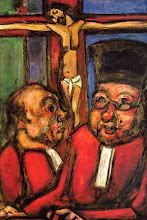
Angilbert (fl. ca. 840/50), On the Battle Which was Fought at Fontenoy

The Law of Christians is broken,
Blood by the hands of hell profusely shed like rain,
And the throat of Cerberus bellows songs of joy.

Angelbertus, Versus de Bella que fuit acta Fontaneto

Fracta est lex christianorum
Sanguinis proluvio, unde manus inferorum,
gaudet gula Cerberi.
Showing posts with label Theodrama. Show all posts

Monday, June 11, 2012

God's Glory Appears: Second Triad

THE SECOND TRIAD THAT VON BALTHASAR identifies in the dramatic form is one of presentation, horizon, and audience. These three aspects are part of the "dramatic realization."  These are features which distinguish the dramatic form from other forms of communication.  Presentation refers to the fact that dramas are performed for someone or some group.  Audience refers to the fact that dramas are observed by individuals, and that this observance is not simply passive observance, but some sort of expectative, active, participative observance.  Finally, horizon refers to the fact that there is a larger "horizon" or picture that ties together all the characters of the plot and in which the audience itself participates.

The theodrama of the Christ-event may be viewed under these three aspects: presentation, horizon, and audience.

The dramatic form is something that is fundamentally human.  Man has had a penchant for acting things out, and so the dramatic form seems to be a response to, or an expression of a fundamental human need.  What is this need? Why this form? 

Man has a need that is satisfied by the dramatic form, and so we find the dramatic form everywhere man has flourished.  Most fundamentally, the dramatic form seems to provide men and women with a means to communicate truths about human existence.  For this to happen, there has to be a participation between the audience and the play.  There must be a blurring between the play and audience so that the audience in some way internalizes the play and is able to recognize the events being acted out as "patterns of possibility" in its own life.  There is therefore a communication, a shared participation, in some sort of truth of human existence.  It takes the audience out of its mundane life and introduces it into the life of the play.


Presentation is of course the "address" of the play to the audience.  In the theodrama of the Christ event, this is the divine address.  Philosophy has no such divine address, and so it is unable to accomplish what drama is able to accomplish.  "God's dealing with the world provides, in dramatic form, the ultimate horizon for judging values and goods, and ultimately ourselves as moral agents." Steck, 57. 

The Christ-drama also draws us into itself.  We are able to enter into the Christ-drama because we recognize our own individual drama, our own life, in the life of Christ.  He is, after all, human, and it is this common bond which allows us to recognize and to relate to it.  The "divine play invites us to see our play in its light."  But it also adds an element of hope, as it suggests to us that we are not heirs to a "pitiless destiny," to some fatalistic, deterministic fate.  Rather, we are furnished with the hope that the world--both the world of Christ and our world--is governed by grace, by forgiveness, and, ultimately, with meaning.

"Through Christ and in him, the Christian is given a 'stage' on which to act and a story to give that acting a coherent form."  Steck, 57.  God's narrative--the story, the drama of Christ--becomes our narrative.  This not only in the manner that we can identify similarities between our narrative and Christ's (suffering injustice, pain, tribulation, etc.) but also in a manner that we can supersede or perhaps better correct our own (repentance, forgiveness, etc.).  The imitatio Christi becomes a means by which our narrative may be better fitted into the divine Narrative. This is the horizon of the dramatic event of Christ. 

The response called for by the Christ-drama is, of course, unique to this theodrama.  It calls for a response in faith.  "The faith that it awakens leads [the spectator] out of his spectator seat in the ardent hope that this narrative can be his own, that his identity can be one of it."  Steck, 58. 

The Holy Spirit is a participant in this.  "The voices and responses of human creatures can be included in God's life," and in his drama, "because that life," or that drama, "is already a communion of voices absolutely united in the Spirit."  The Holy Spirit takes the weak human word and amplifies it, as it were, so that it may in some way work it into the divine drama.  The Spirit does this by incorporating us into Christ, the person who is the "divine-human interchange."

Friday, June 8, 2012

God's Glory Appears: From First Triad to Trinity to the Moral Life

THE MOST FRUITFUL WAY to understand the Revelation of God to man in Von Balthasar's eyes is to understand it as a sort of dramatic event, a particular, one-of-a-kind dramatic event, a "theodrama." Understood through the lens of this "dramatic form" allows us to gain the full Trinitarian aspect of God's revelation in Christ.

Von Balthasar identifies two "triads" that are intrinsic to the dramatic form and so may be found to exist in the theodrama.  The first triad is author, director, and actor.  The second triad is presentation, horizon, and audience.

Just like plays have an author, a director, and actors, so does the theodrama have this triad.  For von Balthasar, this is a "perfect metaphor for the economic Trinity in the theodrama."  (Steck, 55, quoting TDI 3.352)  In other words, what we have here is a pattern or analogy for understanding the Triune God, not in His transcendency (ad intra), but in his expression to the created world (ad extra). 

God the Father is the "author who shapes the drama and makes sure than it has its intended effect on the audience."  Steck, 55.  While he does this, he also must rely upon and grants a certain freedom and spontaneity to the director and actors in performing the work.  While the actor in one perspective "stands above" the director and the actor, he also must "cherish their autonomy."  Steck, 55 (quoting TD 1.280)

The Son of God is "the actor who makes real the author's dramatic idea."  Steck, 55.  While he is bound in a manner to the author's script, he is also designedly free to apply it in a non-mechanistic or non-manneristic way, as the author, God the Father, has necessarily left room for freedom of expression within his work.

The Holy Spirit is for von Balthasar the director, who takes the author's text, interprets, and allows it to speak "in a living and spiritual manner," by "prompting, inspiring, and organizing the actors as they bring their talents and energies to their respective roles."  Steck, 55.

 Trinity by Lucas Cranach the Elder

So, to put it all together, "God the author brings the dram 'into being as a unity'; God the actor conceives and executes his role 'on the basis of a single, unified vision.'; and God the director comes up 'with a unified vision embracing both the drama (with the author's entire creative contribution) and the art of the actors (with their very different creative abilities).'"  Steck, 56 (quoting TD 1.268, 284, 298)

To view Jesus as the divine "actor" in this theodrama allows us to view him further as an actor in a form of tragedy.  He is, as it were, a personification of the Greek tragic figure "who now does what Greek tragedy could never do: tie the contingent to the absolute in a universal way that stamps every existent with its pattern."  Steck, 56.  Jesus overcomes the limitations of philosophy (its universal, non-concrete quality) and the limitations of Greek tragedy or myth (its contingency, its lack of basis in reality).  Jesus is the "concrete universal."  Steck, 56.  (Jesus as the "concrete universal" is another way of stating the historical, ontological, and religious "scandal of particularity" we find in Jesus.)

The reason Jesus is the "concrete universal" is that he "opens for the finite, historical creature a stage in which his finitude is granted eternal (absolute) meaning."  The infinite absolute and universal become man in a contingent, particular, concrete existence in the Incarnation.  This bound together into one divine person both the universal and concrete, both God and man, the Uncreated Absolute and the created particularity.  It thus allows man to overcome his contingent existence and through this "concrete universal" himself become part of the absolute.

As we stated in our last posting, von Balthasar's view of the Christ-event as a sort of theodrama, and this triadic division of the theodrama into author-actor-director is wed to his Christian ethics.  "Whatever form of divine command ethics appears in von Balthasar, it must be interpreted in light of a God who 'authors' our play and give us our (christological) roles but who also makes room for our contribution as we are prompted by the Spirit."  Steck, 56.  Succinctly, the moral life is participation in the theodrama.


Thursday, June 7, 2012

God's Glory Appears: The Theodrama

IN PRIOR POSTS WE HAVE SEEN how beauty in nature, particularly in persons, requires not only an openness on the part of the recipient, but a receptiveness to the form of the beautiful object, and a giving of self to the other, all within the envelope of freedom, therefore resulting in a sort of dialogue, a loving exchange, that leads to communion between one person and the other. It is more akin to a mutual self-giving. "[T]he beauty of this form reflects the aesthetic rightness of the mutual exchange of gift given and gratefully received. The epiphany of goodness, we can suggest, is a theophany in earthly form of the triune life." Steck, 50.

So there is for von Balthasar implicit in every authentic human response to beauty a trinitarian aspect.  But though this may be a sort of theophany, it is not, strictly speaking, Revelation.  Our reaction to beauty, however, provides us an analogy for our reaction to the divine beauty, i.e., God's glory.  It provides us therefore a fitting model of how humans ought to response to Revelation.

Revelation--which is a manifestation of the divine beauty or glory of the Lord--is encountered when we have a manifestation of the divine love, specifically "the triune nature of God's love."  Revelation also must contain and effect "God's covenantal intent to include the individual human existence in God's triune love."  Steck, 51.  There is always the possibility of human static in "seeing" God's glory revealed, in choosing another good, or as a result of a disordered soul which hides in its shell of egoism.

To overcome the static, the disordered egoism in our soul which makes us incapable of proper response to God's glory revealed, God must enter history in a "dramatic form," specifically, the form of tragedy.  It is tragedy that is the dramatic form by which God reveals his glory, and so it is tragedy that is "the great, valid cypher of the Christ event." Steck, 51 (GL4.101)

This dramatic form is something more than philosophy, and certainly something entirely other than myth.  Philosophy deals in universals, not particularities.  While myth has the advantage of being open to revelation from above and a sort of particularity, in its Greek form it reached a dead end.  There was "darkness" and "absence" in and ultimate impersonal.  The Greek gods are "above" us and never "with us."  That is why philosophy replaced myth in Greece.  However, philosophical truths do not result in a one-on-one encounter, and do not lead to a communion of giver, gift, and receiver of the gift.  So something other than philosophy and something more real than myth is required for the true God to reveal his glory.  The dramatic form allows for an interpersonal encounter, which is real, and so exceeds the general, impersonal encounter with philosophical truths and the unreal encounter with myth.

 The Oberamagau Passion Play

The dramatic form, however, does borrow the "encounter from above" that is found in myth, but in Revelation the unreal aspect of the myths of men is exchanged for the real aspect of God's glory being revealed.  Ultimately, this is done through tragedy. 

In drama, human action is interpreted in light of some overarching meaning that bestows a final and authoritative judgment on the agent's free historical choices of limited values and goods. The capacity of the dramatic form to interpret concrete existence makes it a particularly appropriate tool of a theological aesthetics. The dramatic story of Christ--what von Balthasar calls the "theodrama"--is the horizon in which the Christian interprets his concrete story. Like the beautiful form, the theodrama awakens a particular response on the part of the person by inviting him to interpret his life in terms of the absolute horizon of covenantal love.

Steck, 53. When Christ reveals himself in the theodrama of the Christ-event, we do not abandon the "'aesthetic lens, but rather move from an 'iconic' aesthetics to a 'dramatic' one."  Steck, 43.  From stasis to dynamis.  The theodrama of the Christ-event is dynamic in the fullest sense of the word since it is dynamic in terms of He who reveals his glory and he who receives the glory of the One revealing.  "God has brought into drama of triune life the drama of fallen human existence, so that 'our play 'plays' in his play."  Steck, 54.   So it is that God enters into our world.

That is why the Christ-event must not be seen only as a Christological event (Christ-in-man), but also as a Trinitarian event (God-in-Three-Persons).  The Trinitarian eternal "play" plays in our temporal "play."  It is a remarkable event wherein God as judge suffers the humiliation of allowing Himself to be judged.  God judges the God-man, and so "something akin to drama is played out between the sovereignty of [God's] judgment and the humiliation whereby he allows himself to be judged," and the voices of the judge and the judged, "are both united and kept distinct by a third, ineffable voice."  Thus Father, Son, and Holy Spirit.
In Christ . . . [w]e see in this life a God who allows the distance between Father and Son to become the distance of sinful alienation in order that it be overcome through the ever greater unity of divine love.

Steck, 55.

In a sense, there are two "dramas" in the Christ event: the "economic drama," which is the salvific activity of God to man, but there is also the "triune drama" where God reveals his internal life.  There are therefore two separate "triads" associated with a play and likewise with the theodrama.  The first such triad is author, director, and actor.  The second triad is presentation, horizon, and audience.  To grasp these two triads as occurring in the Christ-event is important, because von Balthasar uses the triads as metaphors to help us understand the "economic Trinity," as well as "the manner in which God accomplishes his reconciliation with humanity, without compromising divine transcendence or human freedom."  Steck, 55.  They are also important points of reference in understanding our response to the Christ-event and therefore in understanding the moral life. 

We shall explore these triads a little further in our next posting.