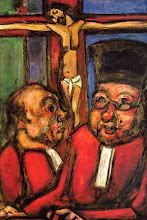
Angilbert (fl. ca. 840/50), On the Battle Which was Fought at Fontenoy

The Law of Christians is broken,
Blood by the hands of hell profusely shed like rain,
And the throat of Cerberus bellows songs of joy.

Angelbertus, Versus de Bella que fuit acta Fontaneto

Fracta est lex christianorum
Sanguinis proluvio, unde manus inferorum,
gaudet gula Cerberi.
Showing posts with label Temperance. Show all posts

Wednesday, September 12, 2012

Cicero: The Cardinal Virtues and their Subparts

CICERO HAS NEVER BEEN regarded as a philosophical innovator; rather, he was a philosophical conservative: a traditionalist who handed down, we may assume quite faithfully, the teachings of the Stoics which he regarded as important, especially in his early works, which is where we should place his De inventione.

We might expect Cicero then faithfully to hand down the Stoic teaching of the four cardinal virtues, and he does not disappoint.  He also appends to the four cardinal virtues, the Chryppian sub-parts that were ordered underneath these four cardinal virtues of prudence, justice, fortitude, and temperance.  The entire virtue taxonomy of Cicero is of course under the umbrella of living in agreement with the law of nature, a law which is ultimately founded upon a cosmic reason.

Cicero defines prudence using the characteristic Stoic categories of the morally good, the morally evil, and the morally indifferent.  "Prudence is knowledge of things that are good or bad or neither.  Its parts are memory, understanding, and foresight."  Prudentia est rerum bonarum et malarum neutrarumque scientia.  Partes eius: memoria, itnelligentia, providentia.  De inv., 2.160.

Justice for Cicero is "the habit of mind (habitus animi) that preserves the common utility while also giving to each what is his due."  Jusititia est habitus animi communi utilitate conservata suam cuique tribuens dignitatem.     De inv., 2.160.  Justice, of course, is the most extrinsic of the virtues since it is concerned with those other than the subject: the common good or the private good of another person.  Yet even here , in the most extrinsic of the virtues, we find the characteristic Stoic interiorization of virtue.  While concerned with externals, the focus is on the interior disposition, the habitus animi, of the virtuous person.  "In this way, the traditional Platonic and Aristotelian matter of Cicero's definition--concern for the common good and the private good of others--is given a Stoic form."  Houser, 27.

Cicero further explores justice and finds species or sub-parts of justice.  However, he divides these into to general categories depending upon whether the "law of nature" (ius naturae) or the "law of custom" (consuetudine ius) is involved.

Under the rubric of the law of nature, Cicero finds six sub-parts or species of justice: religion (religio), piety (pietas), consideration (gratias), retribution (vindicatione), honor (observantia), and truth (veritas). These sub-parts will be adopted and developed by St. Thomas Aquinas.

Under the rubric of the law of custom, Cicero finds three sub-parts: agreements (pactum), equity (par), and written judgments (iudicatum).  The notion of equity will be used by St. Thomas Aquinas, but the other two sub-parts--agreements and written judgments--are too legally-focused for St. Thomas Aquinas to be concerned with.

Houdon's Cicero inveighing against Cataline. 1803. Louvre Museum

Courage or fortitude is next.  Courage is defined as the "considered undertaking of dangers and endurance of hardships."  Fortitudo est considerata periculorum susceptio et laborum perpersio.  De inv., 2.163.  To some extent, the Ciceronian notion of fortitude is broader than the Aristotelian notion of fortitude.  The latter saw it as resolve in the face of death.  The sub-parts of fortitude or courage are identified by Cicero as magnificence (magnanimitas), confidence (fidentia), patience (patientia), and perserverance (constantia).*

Temperance Cicero defines as the "domination of reason over desire and over other incorrect inclinations of the mind, domination that is firm and attains the mean."  Temperantia est rationis in libidinem atque in alios non rectos impetus animi firma et moderata dominatio.  De inv., 2.164.  Here is the characteristic Stoic ratio or logos.  An interesting feature of the definition is that we have here not the "political" rule of Plato of reason over the passion, but more of a "tyrannical" rule of reason over passion.  Reason dominates over desire and passion in the Stoic view of things.**  Another interesting feature is the broadening of this virtue relative to the Aristotelian notion.  While Aristotle limited temperance to sex and nutrition, Cicero clearly extends it to cover any potentially improper inclination (libido).  Cicero does, however, adopt the Aristotelian notion of "mean."

Three subordinate virtues are identified by Cicero as being ordered under temperance: continence (continentia), clemency (clementia), and modesty (modestia).  Clemency is defined as "sympathy of the higher ranks for the lower," and "it seems a peculiarly Roman virtue and original with Cicero."  Houser, 29.  On the other hand, the other two notions, continence and modesty, are clearly Stoic in origin.  We find these for example, in Stobaeus, Plutarch, and Diogenes Laertius.

For Cicero, continence is defined as "that by which cupidity is ruled by the governance of good counsel."  Continentia est per quam cupiditas consili guvernatione regitur. De inv., 2.164.  The extent of continence is, of course, directly tied to the understanding of what cupidity comprehends.  If cupidity is understood to be limited to nutritional or sexual desires (as was largely understood to be the case by the medieval schoolmen, then continence will likewise be limited by this understanding).  It appears that Cicero had a broader notion of continence than was later to be the case with the scholastic understanding of the term, which limited it to nutritional and sexual desires.

Cicero was again not an original thinker.  "Cicero himself tended toward syncretism."  Houser,30.  But he was the link or bridge as it were between the original Greek Stoic thinkers and the later medieval thinkers.  "The main challenge for the scholastic masters was to try to bring a millenium-old Stoick skeleton present in lists of virtues they found in old books like Cicero's."  Houser, 30.
________________________________
*Houser observes: "Cicero's definition of magnificence shows he actaully had magnanimity in mind, and with this emendation the list of virtues subordinate to courage is thoroughly Stoic, and all four will be adopted by Philip [the Chancellor], Albert [the Great], and Aquinas."  Houser, 28.
**The Stoic conception of the passions and desires as being slave to reason is, of course, totally the opposite of Hume's famous formulation that reason is the slave to the passions.

Wednesday, August 22, 2012

Plato: Temperance, Courage, Wisdom Yield Justice

PLATO'S VIEWS ON VIRTUE APPEAR to have evolved. Initially, he seems to have adopted Socrates's view that virtue was knowledge.  So it appears in the following dialogues: Laches, Charmides, Euthyphro, Euthydemus, and the Protagoras.  But the Socratic reductionist formula (virtue=knowledge) appears to have been abandoned by Plato and replaced with a four-fold formula which would yield the classic cardinal virtues of wisdom, fortitude, temperance and justice (sophia, andreia, sophrosyne, and dikaiosyne, respectively) 22. We find the virtues treated thus in Plato's Republic, specifically in sections 427d through 445e.

Plato's synthesis is gained by his reflection on the topography of the soul, a soul which is the city writ small.  So the city (polis) reflects the soul (psyche) as the soul reflects the city.  They are analogues in Platonic thought as expressed in the Republic.

Each city--and consequently each soul--must have three classes effectively to function as a community: craftsmen (those who produce services or goods).  In the soul, the analogue of city's craftsmen is the virtue of temperance.  There is a subordination or discipline of self for the purpose of producing the goods or delivering the services to the city.  A similar subordination or restraint of the passions, of the appetites is found in the virtue of temperance.  But temperance suffers from a certain timidity.  More is required than mere businessmen, craftsmen, tradesmen for a city effectively to function.  Similarly, a soul requires more than temperance.

Hence the need for the next class: the warriors.  The warriors in a city assume the disciplinary or enforcing occupations--the police, the military.  They order or supervise the city, have a rugged strong frame.  These are the analogue to the virtue of courage.  While warriors do no lack temperance (just like craftsmen have courage), their predominant virtue is courage.

The warriors, on the other hand, have no governing virtue.  They are merely auxiliaries.  Their irascibility must be tempered by some extrinsic measure, and hence the need for some class that is able to establish the form of order, the end of the citizenry.  What are the goals in war?  What are the arrangements for peace.  The warrior class is not fit for these sorts of questions.  There must, therefore, be a guardian class.  These guardians in the city are the analogue for the virtue of wisdom.  When the temperance of the craftsmen and the courage of the warrior are well-ordered by the guardians of the city, one arrives at a complete and full justice.

The soul has has thee parts: reason (logistikon), emotion (thymos), and desire (epithymia) with three corresponding virtues, being, respectively, wisdom, courage, and temperance.

Wisdom is found wherever reason knows and chooses the good; courage is found wherever the emotions overcome obstacles to the good; and temperance is found wherever desire for pleasure is so controlled as to lead to the good rather than away from it.

Houser, 10-11.

Where does justice fit in?  Justice is "ontologically homeless."  It is the "harmony produced when each of the three parts functions well," and in unison.

To accommodate his theory, Plato had to expand upon and in fact amend the Socratic reduction.
Plato emended Socrates' thesis that wisdom is a necessary and sufficient condition for virtue, by substituting the combination of wisdom, courage, and temperance for Socrates' single virtue of wisdom. Taken together, these three virtues are the necessary and sufficient condition for justice. Taken together, these three virtues are the necessary and sufficient condition for justice: 'That which preserves and fosters this inner harmony is called a just and find action' ((W·C·T) ⊃ J); and 'an action which destroys this harmony is unjust' (˜(W·C·T) ⊃ ˜J).
Houser, 11 (quoting, Republic 445c).

Justice is therefor a reduction of the three other virtues of temperance, courage, and wisdom.  Plato's contribution was to show that interconnectedness of virtue.  By expanding the Socratic formula of wisdom = virtue to the formula that justice is a harmonization arising from well-ordered virtues of courage, temperance, and wisdom, Plato developed the idea of virtue, of arete.

Plato

Corresponding to virtue was its opposite: vice. Though there is but one kind of virtue--that which yields justice--the imbalance that can occur as a result of disorder--whether in the soul or in the polis--is literally infinite.  There are "unlimited forms of vice," but only four are worthy of being mentioned, says Plato.  Republic 445c.

The justice of the aristocrat can yield to honor, and so the aristocrat--that man governed by excellence--may corrupt into a timocrat--that man governed by honor.  A timocrat "loves the honor that accompanies good action more than the goodness that such action produces." Houser, 11.  The wrong focus is bound to create disharmony, and though the virtues remain, they are disordered and lose their inner life, their inner harmony.

A similar corruption occur with the oligarch.  Here, courage is foregone or deprecated, while temperance runs amok.  Wealth is this man's preoccupation, and as a result, the virtues of courage, of wisdom, and hence justice suffer.

When temperance yields to an overabundant sense of freedom and equality, one has the democrat.  Here justice seems to be the desire, and yet a justice without courage, without temperance, without wisdom.  Impossibly, the democrat's justice is "but a pale imitation of true justice, for its claim to the name of virtue is that some genuine goods, notably equality and freedom, are still prized, though they are attained in more and more unjust ways."  Houser, 12.

The last devolution or corruption is the tyrant.  Here, the mind is enslaved to power without order, to arbitrary impulse, and so all vestiges, all pretense to the virtues--to courage, temperance, wisdom and their harmonious product of justice--are gone.  (Republic 543a-592b).

Plato's theory of the four virtues is one of harmony, proportion, balance.  Perfection is achieved in the aristocratic soul, where courage, temperance, wisdom harmoniously interplay and produce their desirable fruit: justice.  "This harmony is produced through functional unity, not as Socrates thought, through ontological unity."  Houser, 13.

Plato's doctrine can be summed up as follows: following Socrates, Plato held that whoever truly has one virtue has all the virtues, and whoever lacks on virtue lacks all true virtue. But he departed from his teacher in recognizing four virtues, not just one. Because thee virtues exist on their own, they can be gained and lost one by one. Until all virtues are present together in the soul of the truly just person, however, they are only images of true virtues and therefore really are vices.
Houser, 13.

Tuesday, January 11, 2011

Preliminary to a Definition of Virtue: Fortitude and Temperance

IN AND EFFORT TO UNDERSTAND the concept of virtue we have looked at two of four classical cardinal virtues, prudence and justice. As we pointed out, prudence is sort of a virtue sui generis in that it straddles both intellectual and moral realms. Justice is a virtue specifically emphasizing the will. The remaining two cardinal virtues, fortitude and temperance, may be distinguished from the other two by being specifically related to the appetites of the senses.


Fortitudo by Giotto (Scrovegni Chapel, Padua)

Fortitude is a virtue that relates to "the difficult, the arduous, the good which hard to get and the evil which is hard to avoid." Simon, 100. At the extreme, fortitude involves overcoming the fear of death, and so one may see fortitude personified in overcoming the fears attendant to battle. Examples of fortitude are seen among the small cadre of soldiers that have been honored with the Medal of Honor, or in the even more resplendent Hall of the Great Martyrs, the μεγαλομάρτυρες, megalomartyrs as Eastern Church calls them. But fortitude involves also overcoming a whole panoply of lesser fears.
[F]ortitude has to do with feelings of fear and confidence (but more with fear than confidence), which . . . [is] natural but in need of regulation. What is terrible is not the same for all men, but there are things that one should be afraid of and other things with regard to which one should never be too confident. . . . the coward, the rash man, and the brave man, then, according to Aristotle, are all concerned with the same objects but are differently disposed toward them. For only he who has the virtue of fortitude will face and fear the rights things from the right motive, in the right way and at the right time, and will feel confidence under the corresponding conditions.
Simon, 103. It is important to stress that fear is natural in human life, and cannot, of itself, be classified as an evil. After all, it plays a healthy role in the self-preservation of the individual. It is an inordinate role of fear--its excess (which breeds cowardice) or its defect (which breeds rashness) that fortitude seeks to monitor.


Temperantia by Giotto (Scrovegni Chapel, Padua)

Temperance is a virtue that relates to to the drive toward pleasure and away from pain. One must point out that temperance is a virtue that seeks to avoid an excess of the drive toward the sensuously pleasurable, which of itself is normal and good. It is not consonant with temperance to be puritanical, to reject the sensuously pleasurable as if the sensuously pleasurable itself were evil. It is the immoderate, inordinate, or excessive desire for the sensuously pleasurable that is the evil which this virtue seeks to prevent.

In the emotional life, there is a drive toward the pleasurable and way from the unpleasant. . . . . [T]he drive toward the pleasurable . . . is normal, and it is good. But that does not mean that it does not have to be regulated. Moreover, as in the case of other such basic drives in man, the control of the drive toward the pleasurable (and away form the unpleasant) calls not just for a qualitative but also for an existential disposition. Here it is not enough just to know when it is enough; one must also be able actually to give up the excess pleasure (and not be pained by the renunciation). The person who can do that is called temperance. We say that he has the virtue, the habitus of temperance, which is but a rational disposition of the drive toward the pleasurable and away from the unpleasant.

Simon, 103. Again, the desire toward the pleasurable and avoidance of pain is, in itself, a natural feeling. It is the inordinate seeking of pleasure or avoidance of pain, the excess or the defect, that this virtue seeks to control and regulate.

In our next two blog postings we will wrap up this series on the virtues, and will focus first on a definition of virtue which incorporates the concepts of the prior blog postings, and lastly on the interdependence of the virtues.

Sunday, June 13, 2010

Nature's Complaint: Alan of Lille's The Plaint of Nature, Part 12

MODERATION, MODERATION, MODERATION. This is Nature's advice on avoiding the vices. This is the wisdom of the ancients. "Nothing too much!" Ne quid nimis. Mηδὲν ἄγαν (meden agan). Know yourself! Scito te ipsum. Γνῶθι σεαυτόν (gnothi seauton). These sayings were inscribed upon Temple of Apollo at Delphi. It is as if Alan of Lille put these sayings, along with the wisdom of Ecclesiastes (Eccl. 6:40: "In all they works remember thy last end, and thou shalt never sin") in poetic form in Nature's poem in Alcaic meter. As Nature recites the poem, the virtues gather around her.

Oracle at Delphi, Sistine Chapel

To prevent Scylla with her greedy whirlpool
From plunging you into the deep night of lust,
Apply the restraint of moderation to your palate. Pay a more modest tribute to your stomach.
Let your gullet moderate its taste for the liquid of Lyaeus, the cups of Bacchus.
Drink sparingly that your lips may be thought to kiss, so to speak, the cups of Bacchus.
Let water break Lyaeus' pride and
An abundance of it temper Bacchus' rage.
Let Thetis offer herself in marriage to Lyaeus
And let her, once married to him, restrain her husband's tyrannical sway. Let a meal of food, that is ordinary, plain and rarely taken,
Grind down the proud complaining flesh,
So that the tyrant, ever arrogantly reigning in that flesh, may exercise a more moderated pressure on you.
Thus tenacious Cupid will take a rest.
Let the reins on Cupid within you be tightened And the sting of the flesh will grow faint and dull:
The flesh will thus become the handmaiden of the spirit.
Add bolts to the door of your sight to
Keep your eyes in check, lest your eager eye hunt abroad with too little shame and bring back to your mind a report of game.
If the desire of possession intoxicates some,
Let them compel money to quit their minds.
Let ambition feel the mind's triumph over it.
Let greed be overcome and its neck be put beneath the yoke.
Let not money itself tarry in closed purses and indulge in a sluggard's sleep, devoting itself to no one:
Rather let it rise from its bed to be the guardian of right and to be of use to the rich man.
If the opportunity offers, if the occasion demands it, let the mass of buried treasure arise,
Let the purses completely disgorge their cash.
Let every gift be a soldier in the army of the right.
If you wish to trample on pride's neck, on the winds of vanity, on the powers that destroy the spirit, consider the burden of being born destined to die, the toils of life, death that cuts you off at the end.
Ne te gulosae Scylla voraginis
Mergat profunda nocte libidinum
Praebe palato frena modestiae,
Ventri tributum solve modestius,
Imbrem Lyaei semita gutturis
Libet modeste Bacchica pocula:
Pota parumper, ut quasi poculis
Bacchi putetur os dare basia.
Frangat Lyaei lympha superbiam,
Bacchi furorem flumina temperent:
Nuptam Lyaeo se Thetis offerat,
Frenet mariti nupta tyrannidem.
Plebaea, simplex, rara comestio
Carnis superbae murmura conterat.
Ut te tyrannus parcius urgeat,
Semper in ista carne superbiens,
Lentus Cupido sic aget otia,
Frenentur in te frena libidinis,
Languens stupescat carnis aculeus,
Ancilla fiet sic caro spiritus:
Largire visus pessula januae,
Frenes ocellos, ne nimis improbe
Venentur extra luminis impetus,
Praedamque menti nuntius offerat.
Si quos habendi fervor inebriat,
Exire cogant, mente pecuniam,
Mentis triumphum sentiat ambitus,
Victi premantur colla Cupidinis.
Non in crumenis ipsa pecunia
Clausis moretur, pigraque dormiat,
Nulli vacando, sed magis excubet,
Custos honoris divitis usibus:
Si tempus adsit, si locus exigat,
Surgat sepultae massa pecuniae,
Nummos crumenae funditus evomant.
Quaevis honori munera militent.
Calcare si vis colla superbiae,
Flatus tumoris, fulmina spiritus,
Pensa caducae pondus originis,
Vitae labores mortis et apocham.


Titian's "Allegory of Marriage"

As Nature recites her poem, Hymenaeus, Venus's husband and the god of marriage, appears, displaying both the resiliency of youth, and the wisdom of age. He is the golden mean personified. Hymenaeus had a robe similar to Nature's robe, one which displayed stories that exalted the state of marriage. (For a description of Nature's robe in Alan de Lille's De Planctu Naturae, see Nature's Compliant: Alan of Lille's The Plaint of Nature, Part 2) But the "black paint of age," had almost covered up the images. Yet the images could still, however faintly, be seen.

Yet the picture's message kept insisting that there had been woven there the faithfulness proceeding from the sacrament of matrimony, the peaceful unity of married life, the inseparable bond of marriage, the indissoluble union of the wedded parties. For in the book of the picture there could be read in faint outline what solemn joy gives approval to marriage at its beginning, what sweet melody gives a festive, religious tone to the nuptials, what special gathering of guests shows their approbation of the marriage, what general joy rounds of the Cytherean's ceremonies.Ibi tabulam sacramentalem testimonii, finem matrimonii, connubii pacificam unitatem, nuptiarum inseparabile jugum, nubentium indissolubile vinculum, lingua picturae fatebatur intextum. In picturae etenim libro umbratiliter legebatur, quae nuptiarum exsultationis applaudit solemnitas, quae in nuptiis melodiae solemnizet suavitas, quae connubiis convivarum arrideat generalitas specialis, quae matrimonia citharae concludat jucunditas generalis.

Nature places Hymenaeus on her right, the place of honor, and offers him her right hand, a sign of deep affection and affinity. Soon, chastity, a maiden of great beauty wearing resplendent white garments, and a turtle dove on her left hand, followed. She was followed by a group of virgins.

Chastity's clothes also showed pictures as if they were tableaux vivant, all in a variety of colors, of chastity's great victories, great martyrs, and her great traitors. Hipppolytus, resisting Phaedra, his stepmother. Daphne, who resisted the desires of Apollo, and was turned into the laurel. Lucretia, the wife of Lucius Tarquinius Collatinus, who, to redeem her rape and the involuntary violation of her chastity by Sextus Tarquinius. Penelope, the wife of Odysseus, who was faithful to her husband over the clamor of myriad suitors. Nature greeted Chastity with much joy.

Death of Lucretia by Botticelli

It appears that a synod of virtues was assembling. Chastity is followed by Temperance, who is the epitome of the Golden Mean, and displayed it in her mien, her gait, her clothing, and her jewelry. Following Temperance was Generosity, with her hands open an eager to embrace the needs of others, and whose hair and clothing bespoke of a heavenly heritage. Behind Generosity came Humility, a woman of diminutive stature, her eyes downcast, but of great beauty. Temperance and Generosity and Humility were all welcomed by Nature. Generosity and Humility's clothing also showed pictures:
On the these garments [of Generosity] a picture, unreal but credible by reason of the sophistic delusion inherent in painting, damned with the disgrace of anathema men who are afflicted with the notorious crime of Avarice.

. . .

There [on Humility's garment], inscribed in invented stories, could be read how in the catalogue of virtues Humility shines forth with the standard of distinction, while Pride, suspended by the brand of excommunication from the sacred synod of virtues, is condemned to the exile of ultimate banishment.
(continued)