Angilbert (fl. ca. 840/50), On the Battle Which was Fought at Fontenoy

The Law of Christians is broken,
Blood by the hands of hell profusely shed like rain,
And the throat of Cerberus bellows songs of joy.

Angelbertus, Versus de Bella que fuit acta Fontaneto

Fracta est lex christianorum
Sanguinis proluvio, unde manus inferorum,
gaudet gula Cerberi.
Showing posts with label Thomas Hobbes. Show all posts

Tuesday, May 25, 2010

By Nature Equal: How Are Men Created Equal? Hobbes's Hobbling Equality

THOMAS HOBBES WAS A TERATOPHILE, a lover of monsters, perhaps even a teratodule, a worshiper of them. And his creed advanced a monstrous philosophy, a monstrous jurisprudence, and a monstrous government. He loved the creatures Leviathan and Behemoth, far above either God or Man. He was the harbinger, the morning star, of modern liberalism, and advanced a notion of man and his nature that was radically at odds with Western tradition up to that time. He was father to an "insurrection in the Western conception of the moral self." (p. 101). (For other postings relating to Thomas Hobbes, see Ectasis and Telos: Thomas Hobbes and His Monsters and Golden Rule in Thomas Hobbes) In their book By Nature Equal: The Anatomy of a Western Insight, Professors Coon and Brennan analyze whether Hobbes's individualistic moral and political philosophy is reconcilable with their notion of human equality. Their notion of human equality requires a belief in four propositions: (1) rational human beings have the capacity to choose freely to pursue or reject the details of correct behavior; (2) there exists a "preinstitutional order of such correct behaviors" that is extrinsic to the will of each human and that he owes to every other human; (3) moral self-perfection is obtained through the diligent pursuit of seeking that objective content; and (4) rational persons possess that capacity to make that effort, and possess that capacity uniformly.

Although Hobbes's philosophy fails on numerous of these requirements, we will develop the most obvious failure, that being a belief in a "preinstitutional" lateral order of objective (that is moral) norms that define how man should treat his fellow man. For Hobbes there is no such preinstitutional lateral order. In Hobbes's view, before the social contract man has no such moral obligations to his fellows. Hobbes plainly states in his Leviathan that there is "no obligation on any man, which ariseth not from some act of his own; for all men equally, are by Nature free." [chp. 21] For Hobbes, however, freedom is not defined as freedom under law, but freedom from law. There are no constraints upon many prior to the institution of government: "For where no covenant hath preceded, there hath no right been transferred, and every man has right to everything and consequently, no action can be unjust." [chp. 15] It is a remarkable lawless freedom that Hobbes envisions, where "every man has a right to every thing, even to another's body." [chp. 14] Every man has a right to every thing? What sort of monstrous natural law is that?

Thomas Hobbes, Teratophile

In Hobbes's view, therefore, before man instituted government through a social contract, there was no law except self-preservation, and in exercising self-preservation man was "morally unbounded." Fundamentally, therefore, Hobbes advances a "radical autonomy." (p. 103) Hobbes's view of natural law is exceedingly thin: "[A]side from sheer survival, nature tells us nothing in particular concerning the good life." (p. 104) Manifestly, Hobbes advances something untraditional here. Hobbes has performed a "moral lobotomy" upon man, and "reintroduced the ancient possibility of nihilism." (p. 106)

Although Hobbes gives some sort of lip service to human equality, it is not the sort of human equality as conventionally understood in the inherited Western tradition. Recall that Coons and Brennan proposed five criteria to identify the host property for human equality: importance, goodness, laterality, singularity, and uniformity. It is rather apparent that Hobbes's view of human equality is lacking in a number of these. For Hobbes, man is not morally bounded prior to the institution of government, and so he fails most plainly the laterality requirement:
Hobbes's radical autonomy is so different as to be virtually the opposite of that required by the convention; for the latter asserts not that the will of man legislates what is good, but that the good has already been legislated for man whether he chooses or rejects it. . . . The more precise term for this human condition is "bounded autonomy," and we will use that label to distinguish our view from that of Hobbes and company. . . .

The gulf that separates "radical" from "bounded" autonomy is wide. Bounded autonomy, which represents the stronger tradition in the West, claims to be the exclusive form of moral liberty. It rejects the Hobbesian idea of an autonomy that is empty of duty and declares it is a contradiction; for law itself is a condition of freedom . . . .

Hobbes defines freedom negatively, as the absence of constraint. Once can give this a positive form by saying that the individual will is the sole author of whatever rules it chooses to recognize; in any case, Hobbes represents a strong form of "moral subjectivism," but we must pause to clarify this usage. The subjective/objective distinction does not capture the crucial difference between radical and bounded autonomy; the bounded version, too, is subjective insofar as the recognition of and submission to the lateral moral imperative also occur within the self. In bounded autonomy reason interprets its own experience, string to present to the self the specific behavior that would fulfill the lateral imperative regarding fellow humans. But the self's consciousness of its own subordination, its search for correct answers, and the act of choice itself produce no empirical trace. To this extent bounded autonomy is indeed subjective.

It is definitely not subjective, however, in the Hobbesian sense that choices are made in isolation from all authority but the choosing self. In Hobbes's version of natural man . . . there is no external moral order to be sought. Indeed, order exists neither inside nor outside until the self decrees it.
(p. 105) There is simply no laterality recognized in a moral philosophy which "would offer as the host property for human equality . . . the individual capacity for caprice." (p. 106) As Coons and Brennan also point out, Hobbes fails in the area of singularity, importance, and goodness criteria. (pp. 106-07, 288 n. 12)

In fact, that Hobbes failed to meet the requisite terms of the inherited Western convention of human equality with its basis in the natural moral law is by design. As Coons and Brennan observe:
Hobbes had strategic reasons for slaughtering preinstitutional obligation. Principally, he wanted to clear the way for an order of public sovereignty that would be insulated both from ecclesiastical claims and from the constraints of the law of nature, as those claims and constraints had been understood by prior generations.
In short, Hobbes wanted to act as midwife in the birth of the monster of secular government. And he did so by founding obligations on contract, and not on law.

Coons and Brennan wrap up their treatment of Hobbes by suggesting why it might be that the liberal and Western infatuation with "equality" has been difficult for intellectuals modernly to uphold. The very basis for equality was undermined by Hobbesian assumptions of unbounded autonomy and the rejection of a bounded autonomy defined by a reference to preinstitutional and objective order of natural law. "It may be," they conclude, "that the idea of equality became popular in Western history as intellectuals began to abandon the only commitments that could have sustained it." (p. 114)

A Procrustean "Equality" [ΙΣΟΤΗΣ] by Erik von Kuehnelt-Leddihn

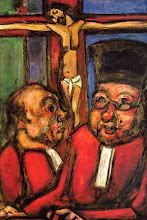
That suggestion seems probable. If it is so, it would explain why much of the modern cri de coeur for equality sounds so vacuous, so banal, and so lawless. Modernly, the cry for equality may be nothing but another way to say non serviam. Indeed, the discrepancy between the cry for equality and the lack of law may explain why, in some cases, the cry for equality departs from mere banality and libertinism into the realms of positive evil itself. Those that cry for equality sometimes have bloody hands that have sacrificed their fellow men to the devil who has donned the name of Isotes or Aequalitas, and shows himself as an angel of light. When these folks came on the scene, they did not speak Latin or Greek, but a vulgar French and they wore funny red hats (though now they speak in all the tongues of Babel and wear all sorts of regalia, such as ugly pantsuits, bottomless pants, or even nothing at all). If we listen well, we can hear the non serviam in the revolutionary cry for égalité, a cry positively demonic, for the devil keeps no law.

Monday, July 6, 2009

Universal Ethic-Convergences 7-Further Evolution


1.5. Further evolution


28. The modern story of the idea of natural law presents itself in certain aspects like a legitimate development of the teaching of medieval Scholasticism in a more complex cultural context, marked particularly with a greater sensitivity to subjective morality. Following these developments, we may point to the work of the 16th century Spanish theologians who, in the manner of the Dominican Francesco de Vitoria, resorted to the natural law to battle the imperialist ideology of some Christian States of Europe and to defend the rights of the non-Christian peoples of the Americas. In fact, such rights are inherent in human nature, and do not depend on any concrete circumstances or upon the Christian faith. The idea of natural law, moreover, concurred with the Spanish theologians’ efforts in finding the basis, that is, a universal norm, which regulated the relationship between peoples and States


29. But, from another perspective, in the modern period the idea of the natural law assumed an orientation which contributed to making it difficult to accept today. In the last centuries of the middle ages, there developed in the Scholasticism a voluntaristic current, whose cultural hegemony changed deeply the idea of the natural law. Voluntarism aimed at valuing the transcendent nature of the free subject in relation to all other contingencies. Against naturalism, which tended to tie God to the laws of nature, voluntarism sought to highlight the unilateral and absolute freedom of God, at the risk compromising His wisdom and of rendering His decisions arbitrary. In addition, against rationalism, suspected of subduing the human person to the order of the world, it exalted an understanding of liberty of pure indifference, one of pure power to choose the opposite, and thus risked detaching the person from his natural inclinations and the objective good.(34)

30. The results of the voluntarism on the doctrine of the natural law were numerous. First of all, while in St. Thomas of Aquinas the law was understood as a work of reason and an expression of a wisdom, voluntarism resulted in binding the law to the will alone, and to a will detached from its intrinsic ordination to the good. Following that reasoning, all the force of the law was seen to reside solely in the will of the lawgiver. So the law was expropriated of its intrinsic intelligibility. Under such conditions, morality was reduced to obedience to the commandments which disclosed the will of the legislator. Thomas Hobbes would therefore declare: "It is authority, not truth, that makes law” (auctoritas, non veritas, facit legem).(35) Modern man, in love with autonomy, could not rise up against a such vision of law. Thus, on the pretext of protecting the absolute sovereignty of God over nature, voluntarism lost any inner intelligibility. The thesis of the potentia Dei absoluta [absolute power of God], according to which God could work independently from his wisdom and goodness, relativized all existing intelligible structures and weakened the natural knowledge man was able to comprehend. Nature ceased to be a criterion in which one could recognize the wise will of God: man could receive such knowledge only from revelation.

31. From another angle, several factors led to the secularization of the notion of the natural law. Among these, one may mention the increasing divorce between Faith and Reason that characterized the end of the medieval age, and also some aspects of the Reformation, (36) but above all the desire to overcome the violent religious conflicts that bloodied Europe at the dawn of the modern age. There was a desire to find a source for the political unity of the human community, putting between parentheses so to speak, religious confessions. Now the doctrine of the natural law prescinds from any particular religious revelation, and therefore from every confessional theology. It claims to base itself only on the light of reason common to all of men and, presents itself as the ultimate norm in the secular field.

32. Additionally, modern rationalism made the existence of an absolute and normative order of intelligible essences accessible to reason, and entirely relativized their reference to God as the ultimate foundation of the natural law. The necessary order of essences, eternal and immutable, were certainly actualized by God, but, it was believed, they already possessed such coherence and rationality. The reference to God ought to be therefore optional. The natural law may be imposed upon all men "even if God did not exist (etsi Deus not daretur).”(37)

33. The modern rationalist model of the natural law is characterized by: (1) the existential belief in an unchanging and ahistoric human nature, of which reason can select perfectly the definition and the essential properties; (2) the placing between parentheses the concrete situation of the human persons in salvation history, marked by sin, and by grace, whose influence on the knowledge and on the practice of the natural law is however decisive; (3) the ideal that it is possible for reason to deduct a priori the precepts of the natural law from the essential definition of the human being; (4) from the expansive extension given to the principles so deduced, the natural law appears as if it were a code of laws already known, which rules govern almost the entirety of behavior. This tendency of extending the field of the determinations of the natural law existed at the origin of the serious crisis when, particularly with the progress of the human sciences, Western thought became much more conscious of the historicity of human institutions and of the cultural relativity of numerous behaviors that at times were justified by referring to the evidences of the natural law. This difference between a maximalist theory of natural law and the complexity of the empirical data explains in part the disaffection with the idea of a natural law. Because the notion of natural law can serve to elaborate a universal ethic in a secularized an pluralistic society like ours, it is necessary therefore to avoid presenting it in the rigid shape that it assumed, particularly in modern rationalism.


(34) Cf. Benedict XVI, Lecture at Regensburg on the Occasion of the Meeting with the Respresentatives of Science. (12 September 2006), in AAS 98 (2006) 733: "In all honesty, one must observe that in the late Middle Ages we find trends in theology which would sunder this synthesis between the Greek spirit and the Christian spirit. In contrast with the so-called intellectualism of Augustine and Thomas, there arose with Duns Scotus a voluntarism which, in its later developments, led to the claim that we can only know God's voluntas ordinata. Beyond this is the realm of God's freedom, in virtue of which he could have done the opposite of everything he has actually done. This gives rise to positions which clearly approach . . . the image of a capricious God, who is not even bound to truth and goodness. God's transcendence and otherness are so exalted that our reason, our sense of the true and good, are no longer an authentic mirror of God, whose deepest possibilities remain eternally unattainable and hidden behind his actual decisions."

(35) Thomas Hobbes, Leviathan, Part II, c. 26 “In the constituted state, the interpretation of the laws of nature do not depend on doctors, on the scribes who address issues of moral philosophy, but on the civil authority. In fact the only possible doctrine that is true is, that authority, not truth, is what makes law.” [Editor's note: the statement auctoritas, non veritas, facit legem is found only in Chapter 26 of Hobbe’s Latin version of Leviathan, not in the English]

(36) The position of the Reformers with regard to the natural law is not monolithic. Those like Martin Luther and John Calvin, being based on St. Paul, recognized the existence of the natural law as an ethical rule, even if is radically incapable of justifying man. "Nothing, indeed is more common, than for man to be sufficiently instructed in a right course of conduct by natural law, of which the Apostle here speaks. . . . .The end of the natural law, therefore, is to render man inexcusable, and may be not improperly defined--the judgment of conscience distinguishing sufficiently between just and unjust, and by convicting men on their own testimony depriving them of all pretext for ignorance." (John Calvin, Institutes of the Christian Religion, Book II, c. 2, 22) (Henry Beveridge, trans.). In the three centuries following the Reformation, for the Protestants, the natural law served as the foundation of jurisprudence. Only with the secularization of the natural law in the 19th century, did Protestant theology keep a distance from it. From that time forward there arose an opposition between Protestant and Catholic opinions on the question of the natural law. But today, Protestant ethics seems to be displaying a new interest in the notion of natural law.

(37) This expression has its origin in Hugo Grotius, De iure belli et pacis, Prolegomena: "Haec quidem quae iam diximus locum aliquem haberent, etsi daremus, quod sine summo scelere dari nequit, non esse Deum."


Wednesday, June 24, 2009

"Law Like Love"--8th Myth--Law as State Power

Others say, Law is our State;

Like so many of his generation, Auden was deeply affected by the rise of the Fascist political philosophy, even though he impulsively rejected it. In particular, Auden experienced first-hand that expression of Fascism found in the Spanish Falangists. No less troublesome, and perhaps a great deal more troublesome, was the Fascism of the the German Nazis and the lemming-like attitude of ordinary citizens who “made no pretense of believing in justice and liberty for all, and attacked Christianity on the grounds that to love one’s neighbor as oneself was a command fit only for effeminate weaklings, not for the ‘healthy blood of the master race.’”[i] Auden consistently distrusted the State as the source of value and Law, for he knew that the State could not nurture the spiritual component of man; it rather tended to sacrifice it.
For without a cement of blood
(it must be human, it must be innocent)
no secular wall will safely stand.
Auden wrote in the poem “Vespers,” part of his Horae Canonicae, in 1950s.[ii] Though it was the mature Christian Auden that held this attitude, it was one he carried over unchanged from his days of unbelief.

Even the unbelieving Auden felt that the State tended toward self-idolatry or idolatry of mammon. The threat such tyranny presented as the basis of law was historically ubiquitous and always a temptation for man. This anti-state animus is certainly present in that Auden who flirted with materialisms and anarchism. The disdain for the Leviathan of Hobbes is found, for example, in Auden’s “Letter to Lord Byron”:

Against the ogre, dragon, what you will;
His many shapes and names all turn us pale,
For he’s immortal, and to-day he still
Swinges the horror of his scaly tail.
. . . .
Whenever [man] endorses Hobbes’ report
“The life of man is nasty, brutish, short,”
The dragon rises from his garden border
And promises to set up law and order.
[iii]


In his early years of the Christian chapter of Auden’s life, the distrust of the State looms large:

If we are never alone or always too busy,
Perhaps we might even believe what we know is not true:
But no one is taken in, at least not all of the time;
In our bath, or the subway, or the middle of the night,
We know very well we are not unlucky but evil,
That the dream of the Perfect State or
No State at all,
To which we fly for refuge, is part of our punishment.
Let us therefore be contrite but without anxiety,
For Powers and Times are not
gods but mortal gifts from God.
[iv]

But the distrust of the State as the source of law remained true even of the Auden of the “later years—the avuncular, domestic, conservative, Horatio, High Anglican poet of civilization,”[v] who, in his poem “The Garrison,” states:

Whoever rules, our duty to the City
is loyal opposition, never greening
for the big money, never neighing after
a public image.
As he put the question that political philosophy forced upon him:

Unless one was prepared to take a relativist view that all values are a matter of personal taste, one could hardly avoid asking the question: ‘If, as I am convinced, the Nazis are wrong and we are right, what is it that validates our values and invalidates theirs?’[vi]

From the advocates of a tyrannous law, Auden turns to the anarchists, the utopians, who blithely advocate a concept of Law that simply is untenable. They are perhaps the Flatworlders of jurisprudence, and that may be why none can seriously entertain such views and must only say that others say . . . .

[i] Kirsch, 21-22, 187 n. 22.
[ii] Auden, “Vespers,” Collected Poems; Mendelson, The Early Auden, 20.
[iii] “Letter to Lord Byron,” in W. H. Auden, Collected Poems, 95.
[iv] Auden, “For the Time Being,” Collected Poems.
[v] Edward Mendelson, The Early Auden (Cambridge: Harvard University Press, 1983), 19.
[vi] Kirsch, 22; see also Mendelson, Early Auden, 306.

Sunday, June 14, 2009

Ecstasis and Telos: John Locke: From Natural Law to Natural Right

WALKING A SORT OF VIA MEDIA, a middle way, between the atheist Thomas Hobbes and the Anglican Richard Hooker, John Locke (1632-1704) is a fundamental figure in the history of natural law (lex naturalis) and its subtle transformation, arising from an emphasis on individualism and away from common nature, into the doctrine of natural rights (ius naturale). His influence on Thomas Jefferson and the American founding fathers--even on the phraseology of the American Declaration of Independence--merits him an important place.

In his book Passage to Modernity, Professor Louis Dupré succinctly describes this process:
. . . British philosophers, beginning with John Locke, attempted to restore a normative, moral meaning to the notion of natural law: the "dictates of reason" may conflict with positive laws. But the more they stressed the norms inherent in an individualist concept of nature, the more they emptied their natural law of any concrete social content. Natural law thus becomes to function as a rational basis of prepolitical, individual rights.
Louis Dupré, Passage to Modernity: An Essay in the Hermeneutics of Nature and Culture (New Haven: Yale University Press, 2004), 99.


While for Hobbes, all natural rights ceased upon formation of the overweening State, that "Mortall God," for Locke the opposite was very clearly the case. Natural rights remained after the formation of the State; indeed, the State was obligated not only to recognize those rights, but was formed through a social contract for the very purpose of defending those rights. Levering, 99; see also Rommen, 79.

However, Locke does not "view the law as an objective order of norms out of which individual righs flow by intrinsic necessity," such as one would see in a classic Natural Law doctrine. Compared to the traditional and classic Natural Law doctrines, which viewed human law and human right as participating in, and flowing out of, a greater order designed by God and written in the substance of the created world and in particular man, Locke's notion of inalienable rights is a very thin. It is merely a "nominalistic symbol for a catalogue or bundle of individual rights that stem from individual self-interest." Indeed, in an odd sort of way, in Locke's view, instead of rights arising out of law, law arises out of rights. "The rights to life, liberty, and estate or property make the law; the law does not create them." Rommen, 79.


Though in parting with Hobbes's doctrine, Locke's doctrine is commendable, it is something altogether different from the classic and traditional Natural Law doctrine such as was still to be found in the Anglican Richard Hooker. Levering attributes this shift to a failure on the part of Locke to appreciate the natural disposition of individuals to live in community, an overemphasis on the individual, and an undue focus on man's animalistic needs of self-preservation (the right to life and the procreation of children by means of the family) to the exclusion of other, higher goods both individual and social. In addition, for Locke the individual's need for self-preservation includes the ownership of private ownership of property. Levering thus summarizes:
In short, Locke reduces natural law to the bare bones of self-preservation, inclusive of property. He thereby turns natural law radically inward upon the individual and upon the inclination most shared by human beings with other animals. In so doing, he has turned upside-down the biblical theocentric and ecstatic account of natural law . . . .
Levering, 103.

Informed as they are by a political philosophy and culture so deeply influenced by Locke's individualism, Americans suffer from the effect of Locke's thin, individualistic theory of natural rights revolving around a short list, an ensemble of private rights. When we talk about rights, we are therefore predisposed to focus on self-interest and questions of commutative justice over questions of distributive justice, legal justice, and the common good. We engage only in "Rights Talk," and it impoverishes our political discourse (Mary Ann Glendon). We ignore "Duties Talk." Looking at the world from the traditional or classical doctrine of the Natural Law will therefore broaden our perspective.

We ought to put Locke's Two Treatises aside for a time, and turn to Richard Hooker's Laws of Ecclesiastical Polity, or, better yet, turn to Thomas Aquinas's Treatise on Law. Best yet, we ought to go to John Paul II and his masterly synopsis on the Natural Law, his Encyclical Veritatis Splendor.


Saturday, June 13, 2009

Ecstasis and Telos: Thomas Hobbes and His Monsters

THE MAN WHO THOUGHT he could square a circle, Thomas Hobbes (1588–1679) is the man who gave birth to our modern materialist political philosophies. Although Hobbes ventured into many areas, including optics and geometry, he is best known for his works on political philosophy and the philosophy of law. In order of increasing precedence, Hobbes's three most important works in this area would be The Elements of Law (1640), De Cive (On the Citizen) (1642), and Leviathan (1651). It is these works which earned him lasting acclaim, and it is these works that have resulted in Hobbes being considered to be the founding father of modern political philosophy.

Hobbes may be characterized as a systematic Machiavellian. If Machiavelli skirmished against the prevalent notion of political philosophy based upon the Natural Law, Hobbes marshaled all his intellectual troops (in a vast misuse of talent, for God had endowed him well) in a sustained, brilliant, and systematic war against it. Hobbes entire theory of political philosophy "amounts at bottom to a denial of the natural law." Rommen, 73. Machiavelli and Hobbes, that "gloomy fellow traveler of Epicurus," were driven by the same dark, cynical materialistic spirit where hedonism seizes the day. There is no notion of the law as love in those men.

Without love it follows there is not to be found anything authentically human in the whole of their theories. Indeed, for Hobbes, the human heart was as if it were steel. "For what is the heart, but a spring?" Leviathan, intro. In Hobbes, there is no notion of man as spirit; man is machine. In fact, there is no such thing as spirit anywhere. "[E]very part of the universe is a body, and that which not body is no part of the universe. And because the universe is all, that which is no part of it is nothing (and consequently nowhere)." Leviathan, 46.11. Spirits, to the extent they exist, are "really bodies," as they have "dimensions," and so all is matter and there is nothing outside of it. Id.

It follows that since for Hobbes there is no spiritual world which maybe known, there is no supernatural world, nor even (as we know it) a God to refer to to establish a Natural Law, much less an Eternal Law. And the principles of morality, if they are to be found at all, are to be found by the observation of mechanistic nature. So Hobbes endeavored upon the quest to build a theory of morality upon the basis that the word was a "machine-body, a 'Leviathan.'" Levering, 93.

Man, which is machine, constructs an "artificial man," "that great LEVIATHAN called COMMONWEALTH, or STATE (in Latin CIVITAS)" on the same mechanical basis. Leviathian, intro. That State, Hobbes says, may be called the "mortall God," from whom there is no appeal. Indeed, "there is no law outside this 'Leviathan," and its laws may are the "will and appetite of the state." Levering, 94; Leviathan, 46.32. Law is passion coupled with power, the sinews and claws of a dragon, the lizardly body of a Great Beast. This Leviathan includes both the State and the Church, and so is frequently cartooned holding both the King's sword and a Bishop's crozier.


Hobbes worships this "mortall God," and asks us to do likewise, though it be but an image of his mind and a creature of man's hands. In a truly perverse way, Hobbes argues that God Almighty requires such worship. "The laws of God, are none but the laws of nature, whereof the principal is that we should not violate our faith, that is a commandment to obey or civil sovereigns." Leviathan, 43.5. What does this mean other than that in Hobbes's view, God's first request of us is to idolize the State?

The most uninformed Christian will known that the first principle of the natural law is to do good, and to avoid evil. He will know that God's principal commandment is to love Him, and his second is like unto it: we are to love our neighbor as our self. He will know that there is no place in Scripture where we are asked to worship Caesar. One can see how far Hobbes is from any Christian sentiment, much less the Christian faith.

What would justify being dissolved in the gastric juices of such monster? Why would men subject themselves to the beast "like wormes in the entrayles of a naturall man"? Hobbes argues that one is worse outside the monster, than in its belly. Outside Leviathan, one would be in a state of nature (status naturalis), where there would be no life in common, no art, no industry. Nothing but self-seizing as to others and self-defense as against others, a life "solitary, poor, nasty, brutish, and short" lived in a state of constant war, "all against all," and all living in constant fear of violent a death. Leviathan, I.13. Outside Leviathan homo homini lupus, "Man to Man is an arrant Wolfe." De Cive; Leviathan. What sort of anthropology is that? Besides this, even Calvin seems an incorrigible optimist.

In Hobbes's view, confronted with his dismal prospects in the state of nature (status naturalis), individual men in the interests of self-preservation covenant together to form "articles of peace," a social compact by which men leave the state of nature and enter into the status civilis, hence forming the State. And through that State comes law. "The reckless rationalism" and individualism of Hobbes "found expression both here and his demand that in speculation one must start by viewing men as beings that have shot forth from the earth like mushrooms, as at once full-grown." Rommen, 75.

For Hobbes, law is found emanating from one place, the State. Laws are not based upon Nature, nor are they based upon Reason. They are based upon raw will. For this reason, Rommen calls Hobbes's legal doctrine "the theodicy of Occam secularized, and the extreme consequence of the proposition that law is will." Rommen, 76.

In his Biblical Natural Law, Levering concludes his discussion of Hobbes theory on law thus:
Their authority as 'laws' flows ultimately not from a teleological 'nature', or from an autonomous 'reason,' let along from divine providence, but from the actual exercise of power by a specific ruler of a specific commonwealth. Natural law has here moved clearly from the biblical self-giving ecstasis, rooted in the teleological dynamism toward communion inscribed by God, to self-asserting power.
Levering, 98.

Hobbes is profuse in the citation of Scripture. One ought not be misled by Hobbes's penchant for scriptural reference as any indication of a sincere belief in God. His doctrine was palpably inconsistent with any belief in God. He was, as Professor Jesseph concludes, "a sly, ironic, and interesting atheist," and not a "bizarre, confused, and ultimately incoherent Christian." Douglas M. Jesseph, Hobbes's Atheism, 26 Midwest Studies in Philosophy 140, 164 (2002). With good reason did Bishop Bishop John Bramhall (1594-1663) in his Catching of Leviathan characterize Hobbe's great work as a “Rebell's Catechism.” Were Hobbes right, the State would be nothing other than Satan's non serviam writ in law. If Hobbes were right, he would be wrong: the State would not be Leviathan a sea monster, but a serpent, that same serpent that reared himself in the Garden of Eden.