Angilbert (fl. ca. 840/50), On the Battle Which was Fought at Fontenoy

The Law of Christians is broken,
Blood by the hands of hell profusely shed like rain,
And the throat of Cerberus bellows songs of joy.

Angelbertus, Versus de Bella que fuit acta Fontaneto

Fracta est lex christianorum
Sanguinis proluvio, unde manus inferorum,
gaudet gula Cerberi.
Showing posts with label Natural and Supernatural. Show all posts

Wednesday, July 11, 2012

God's Glory Appears: Looking Back from Christ

EEVER SINCE HENRI DE LUBAC's view of nature and the supernatural, of nature and grace, there has been a sort of collapse of consensus among Catholic theologians in this area.  In their rejection of a hypothetical state of pure nature (but one with its own end and its own integrity, separate and apart from grace, though--in reality--there was never a time, and never will be a time where pure nature was intended to exist without being tied intimately to the supernatural life of grace), there has been a sort of conflation between nature and grace.

The result is that often grace itself has become naturalized, immanentized so that all are Rahnerian "anonymous Christians," all participate in grace in one way or another, and the uniqueness and importance of the Christ-event seems to have been compromised.  The Christ-event is simply the apex of this nature/grace muddle.  There is only one "existential order," a muddled natural-cum-supernatural one. Alternatively, nature seems to have disappeared from importance, and all is grace and supernatural.  Here, ethics ignores universal laws, any constraints of nature, and all becomes a one-and-one existential encounter.  Each man's path is his own path: man does not have a path he shares with others, a path which may be found by looking at what creation tells him.  "The encounter with God is such that it transforms worldly ethics and refuses the hegemony of natural law."  Steck, 101.  In short, things have become muddled.

In fact, things have become more than muddled.  In some cases, the collapse of the nature/supernature distinction has resulted in tendencies that are dangerous to say the least.  Witness this quasi-anarchical statement from Rahner:

And the ultimate meaning of this revelation [in Jesus Christ] is a calling of man out of this world into the life of God, who leads his personal life . . . as the tri-personal God, in inaccessible light. God is thereby bring himself immediately face to face with man with a demand and a call which flings man out of the course pre-established by nature . . . . [T]here arises the most immediate possibility that [God] might issue commands to mankind which are not at the same time the voice of nature, are not the lex naturae. And if God calls man in this command of his revealing word to a supernatural, supramundane life, . . . [then the world] is condemned to a provisional status, a thing of second rank, subject to a criterion which is no longer intrinsic or proper to it.

Steck, 101.*  While there is nothing objectionable per se in Rahner's statements taken singly, there seems some dangerous tendency arising from some sort of underlying deprivity.  Something smells rotten, sort of like when you open a refrigerator door and smell spoiled food.  You cannot at once find where the foul order might be coming from.  While most of the food is good, there is one piece that is not quite right.

Rahner's formula raises the possibility--only implied, but others have acted on it--that the natural moral law (the lex naturae) no longer binds.  It seems we all have become potential Abrahams who, in obedience to God, may be called to a one-on-one discipleship which requires us to act against the natural moral law.  If we are "flung out of the course pre-established by nature," if God's voice is "not at the same time the voice of nature," if the natural moral law "is condemned to a provisional status, a thing of second rank, subject to a criterion which is no longer intrinsic or proper to it," why in the wrong hands this is a recipe for Christian anarchy.

Whether von Balthasar's ethics is infected by this muddle is uncertain.  Steck believes that von Balthasar avoids a too-strict separation between nature and supernature/grace, but also avoids the problems associated with the modern tendency among the theologians of la nouvelle théologie, of conflation of the two orders of reality.  He navigates between Scylla and Charybdis and offers us the prospect of a perfect recipe for the nature/supernature conundrum.   I am uncertain whether this is the case.
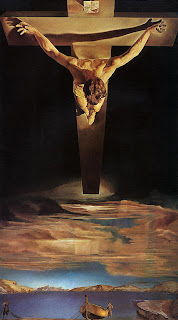
 Salvador Dali's Christ on the Cross According to St. John of the Cross

What von Balthasar seems to do is to seize on Karl Barth's insight that creation is the "external basis of the covenant," and the covenant between man and God in Christ's revelation is the "internal basis" of creation.  Steck, 103.  "Von Balthasar finds this description completely acceptable as a way of relating the two orders [of nature and grace], but believes that Barth himself does not always do full justice to creation."  Steck, 103.
Although there has always been only one human reality, i.e., the graced existence of the person called and destined to be one with Christ, it remains important [to von Balthasar] to preserve a conceptual distinction between the orders of creation and grace. This is necessary not so much in order to protect the gratuity of grace by postulating a "pure nature," sufficient and meaningful apart from grace, but to exclude any hint of what von Balthasar calls "theopanism," where creation is emptied of any ontological reality and instead all that is real in the covenantal encounter is attributed exclusively to the domain of grace. The distinction of the orders underscores that grace works in and through an order that has its own integral, albeit relative meaning, even while leading that order to its perfection.
Steck, 103.  Here's the problem for von Balthasar (which is common to the advocates of la nouvelle théologie).  "Since humanity has always existed within the call of the Word and the presence of the Spirit in the one economy of God, the 'nature' that grace presupposes," so the argument goes, "cannot be uncovered by bracketing the historical 'addition' of Christian revelation."  Steck, 104.

Von Balthasar therefore resists any kind of clear delimitation of nature and grace.  For him such distinction is as hopeless at it is sterile.  And yet he endeavors to preserve these categories in a manner.  He does this by "peer[ing] through the present economy, within the epistemological brackets of the Christ-event," and this allows us to make some "general observations about human existence apart from the full light of Christ."  Steck, 104.

Von Balthasar approaches the problem from the terminus ad quem looking backward, whereas the traditional Thomists might be said to look at the problem from the terminus ad quo looking forwards.  Is this a problem of whether we are to be Epimethius or Prometheus, a looking behind versus a looking ahead?  Is this a question of "what did Christ come to save?" versus a question of "what did Christ save?"

[I]nstead of starting from principles drawn from the revelation in creation to arrive at the revelation in the Word as the crown and summit," von Balthasar proceeds "in the reverse direction, from the revelation in the Word to that in creation," "by determining what the word of revelation itself presupposes and implies."

Steck, 104.**  "Christ is the 'one and only criterion,' 'by which we measure the relations between . . . grace and nature.'"

Using this technique of looking backwards from Christ, the "one and only criterion" by which the "relations between grace . . . and nature" might be gleaned, von Balthasar (in Steck's analysis) identifies three claims of the created order which are important in the ethical life: (1)  the created order gives rise to an agency (a human person) distinct from God; (2) God's call is perceived within creation in some manner; and (3) the creature's encounter with grace preserves, and does not destroy, the spheres of meaning in the created order, so the life of God in Christ is intelligible even when viewed from the created order.

We will discuss these three features in greater depth in our next posting.

____________________________________
*The quote is from Karl Rahner, "The Ignatian Mysticism of Joy in the World," in Theological Investigations, vol. 3 (London: Darton, Longman & Todd, 1967), 285-86. 
**The quotations are from von Balthasar's "The Implications of the Word," in The Word Made Flesh, Vol. 1 of Explorations in Theology (San Francisco: Ignatius Press, 1989), 48.


Friday, February 18, 2011

Natura Pura: St. Thomas in a Nutshell, Part 1

THE DISTINCTION AND UNION between the natural and the supernatural, between nature and grace, is a "foundational distinction for Christian life." Long, 12. The distinction between them, the avoidance of their conflation, and their balanced recombination are fundamental to a correct understanding of Christian doctrine and Christian life. It is not merely a speculative nicety, an academic question, but the distinction plays itself out in both praxis and doxa. The balance between nature and grace must be right. Mess with it and you start getting into error and even into heresy. Too much grace and not enough nature and you venture into the wilds of fideism. Too much nature and not enough faith and you end up in the desert of rationalism. In this regard, the Christian is like a mountain climber on Bosses Ridge at Mont Blanc: he avoids the steep slope on either side and walks the straight and narrow ridge. The last thing he wants to do is to slip down the slippery slope of sola gratia or sola fide. But neither does he want to fall down the equally fatal slope of sola natura or sola ratio. It doesn't help to become a Pelagian to avoid being a Luther. Fides et ratio, gratia et natura is the synthesis that must be maintained to get to the summit of truth. And that synthesis is precarious if you start fiddling with its components, or if you misunderstanding them, which is exactly what de Lubac and the other members of la nouvelle théologie did.


Climbing up Bosses Ridge toward Mont Blanc

For St. Thomas, man enjoys a "human nature." That human nature, which is defined relative to its natural end, is what distinguishes him as a particular species distinct from any other species--whether that other species be inanimate, vegetable, or brute. Man's nature is species defining. The natural end of man's nature is to know or contemplate God as First Cause. It is, a desire one may say, inspired, not by the Holy Spirit, but by man's natural disposition to wonder, θαυμάζεῖν.* Its guide is reason, a reason which is part and parcel of man who is, in contrast to any other material creation, an intellector of being. Man's intellectus ut natura, his intellect as nature, seeks to know not God, but being in general, the essence of a cause once known to exist, and so seeks God only conditionally. The desire for God is conditional because it must be elicited. The desire to know God is elicited by an acquired knowledge that God exists. When that condition is obtained, it triggers as it were, the intellectus ut natura, to focus it upon acquiring the knowledge of God as First Cause. A similar thing occurs with the voluntas ut natura, man's will as nature. It loves or desires the good in general, and not God in particular. The desire or natural love for God must be elicited; and so the natural will towards God as good is conditioned upon man learning that God exists as good. Unaided by revelation and grace, however, the intellect of man cannot know the essence of God. Likewise, unaided by grace, the will of God cannot love and attain union with God. For these reasons, the natural desire to know and love God "is not proportioned to God, but rather is proportioned to the intellective desire to understand the world in general which gives rise to it." Long, 20. In an interesting image, Long describes the difference between the natural desire for God, which is built upon the desire to know the cause of the world (a very narrow reality of God, at best a sliver of who He is), and the supernatural desire to know God as He is and to attain union with Him, as the difference between wanting to know Einstein under the aspect or ratio of "man wearing a raincoat," and versus desiring to know Einstein under the aspect or ratio of Einstein. In the natural order, we know and love God as cause of the world, which means that we know and love him in the world or through the world, and never beyond it. It is a desire that allows man only "to move asymptotically toward God as causal principle of created nature." Long, 26. There is no question of reaching the limit, and certainly none of going beyond it. Since God infinitely transcends the world, this knowledge of God is never anything more than natural. And yet we have a natural inclination, as befits our human nature and to which it tends,** to seek to know God and contemplate him as our last end, as the First Cause.


Knowing the man in the coat
v.
Knowing Einstein in the coat

The natural desire that man has for God as first cause could hypothetically exist in various ways. God could have satisfied Himself with that, and left man to his own devices, and He would not have been unjust. Indeed, such a natural life alone would have been an infinite largess impossible to repay. To be brought forth out of nothing is itself unmerited. But this natural desire could also have been, as it in fact was if we embrace the truth of the Christian revelation, conjoined with sanctifying grace and with supernatural aid which makes the possibility, the hope, of the beatific vision known, real. This, of course, changes things. Among the things it changes is the role of man's specific, that is to say, natural end, by subordinating it. Another change is that it renders the conditional desire to know God unconditional. Before revelation: if it were possible, one would wish it [union with God]. After revelation: Since it is possible, one in fact wishes it [union with God].

It is revealed that man has a supernatural end, the finis ultimus, to which this natural end is subordinate, proximate, proportionate. And yet this natural end does not disappear. It remains real, intellectually tangible, not devised. This human nature has an "obediential potency"*** to a supernatural end. The supernatural end is to know God, not as First Cause, but in his inner being, as Father, Son, and Holy Ghost, in the beatific vision and the life of Glory.**** The supernatural end is a gift of grace, a giving from God's infinite storehouses by virtue of His sheer largess of God, inspired by the Holy Spirit, whose end is communion. It is obtained, not by knowledge, but by faith. Hypothetically, man could have been created without such supernatural destiny; in fact, he was not created so, for Revelation is what informs of its reality as fact. But because hypothetically man could have been created without heaven as his end, it would not have been an injustice for God not to give man the beatific vision. But the reality of Revelation changes things.

Once God reveals Himself and His gift of divine life, the natural desire thus elevated and supernaturalized in grace inclines toward it absolutely by inclining toward the infinitely higher end of union with the Uncreated Persons of the Holy Trinity. For the object of the natural desire for God under the ratio of "cause of these effects" is incorporated within the graced desire of God as God. This idea of the modalization of the natural desire according to the states in which it may be found, contextualizes it in relation to grace.

Long, 21. It is wrong, in the light of revelation, to look at this supernaturalization of the natural end as a "layer cake," Long, 19. The supernatural life is not "frosting" on natural cake. It is not a "maraschino cherry on a purely natural sundae." Long, 29. How it ought to be looked at is the subject of our next posting.

__________________________________
*Aristotle, Metaphysics, 982b (διὰ γὰρ τὸ θαυμάζειν οἱ ἄνθρωποι καὶ νῦν καὶ τὸ πρῶτον ἤρξαντο φιλοσοφεῖν: "It is through wonder that men now begin and originally began to philosophize").
**S.T. I, q. 62, a. 2: "the will's natural inclination is directed toward what is in keeping with its nature."
***That term, as used in the context of the nature/grace controversy, will be handled in a separate future post.
****"Natural understanding of God . . . is necessarily limited with respect to God because condition by finite evidence [Lex Christianorum: and, we might add, finite faculty man's natural knowledge]. Yet this natural desire and natural understanding constitutes a purely passive obediential potency, which under the active agency of God renders man capable of the supernatural vision of God." Long, 18.

Wednesday, February 16, 2011

Natura Pura: Human Nature Unaided

“GRACE PRESUPPOSES NATURE, and perfection supposes something that can be perfected."* So succinctly does St. Thomas distinguish grace and human nature so as to immediately recombine them. But there is a marked tendency among some contemporary theologians, those of la nouvelle théologie, to so emphasize grace as to virtually negate any meaning in the notion of human nature. Ultimately, this tendency is derived from a notion of "nature" which is bereft of any theonomic character,** and one far less ontologically dense than what St. Thomas had in mind by the concept of "nature." As Steven A. Long in his book Natura Pura*** puts it, these theologians (he identifies Etienne Gilson, Henri de Lubac, and Hans Urs von Balthasar among them) "accept an account of the relation of nature and grace that dissolves the entire structure of human nature and its proportionate end into a pure posit or limit concept." Long, 1. A pure posit is nothing other than a wholly intellectual concept, something intellectually posited, with not real existence in concreto, in the concrete world. It is less than a shadow. Pure nature, these theologians say, does not exist in any meaningful sense to the Christian. First, it is unreliable since it is corrupted by the Fall. (Here these Catholic theologians sound uncomfortably Calvinistic or Barthian.) Moreover, its importance pales to the point of practical disappearance as a separate principle since all men are called to a supernatural calling and end, and it is this supernatural end which is the true end of man. For these Christian thinkers, it is a useless abstraction to talk about nature and certainty to talk about its "proportionate natural end," since, in practice, pure human nature is something that, in fact, does not exist, man having a supernatural end only. Ultimately, there is a certain illogic in the stance as Long points out:

For surely it is a crucial failure in logic to assert that, because there is more in the concrete than merely the proportionate ordering of nature, therefore this proportionate ordering of nature does not exist in the concrete or is unknowable in the concrete.

Long, 2. Not only is there a certain illogic, the notion stems from a complete misunderstanding of the Thomistic doctrine of nature and grace, of the natural and its relationship to the supernatural. In fact, Long insists, pace these big-named theologians--pristine representatives of the redoubtable nouvelle théologie--pure human nature does exist in the concrete and is knowable in the concrete. This human nature has an "ontological density and proportionate end," and end distinct from, yet subordinate to, its supernatural end. Human nature, at least in the Thomistic view properly understood, has "its own created perfection positively ordered toward God within natural limits while being capable with divine aid of elevation to divine friendship and the beatific vision." Long, 2. The Thomistic theonomic concept of nature and its relationship to supernatural grace was lost by these theologians and must recovered Long insists.


Please, Sir, may I have something other than thin gruel?
May I have some ontological density added to my understanding of "nature"?

Long traces the sources of the current confusion to: (i) these theologians' understanding of St. Thomas's use of "nature," and (ii) their misapplication of the Thomistic concept of "obediential potency" to the relationship that nature has to grace.**** He traces their misunderstanding of the Thomistic nature/grace relationship to the concept of "nature" they had inherited, and uncritically accepted, and then applied to St. Thomas's writings. This concept of "nature" was a concept after it had been denuded of theological content by the Enlightenment and post-Enlightenment thinkers. Contrary to the term "nature" as understood by St. Thomas Aquinas, these theologians inherited "a reduced and anti-theistic idea of 'nature.'" They also had inherited (like all of us) the deistic idea that "human freedom lies naturally outside the divine causality and providence," and is, for all practical purposes, autonomous. Long, 3. With the concept of "nature" and "freedom" emptied of any theonomic content by progressive and deistic definitions spurred by Enlightenment thinking, it follows that human nature and human freedom did not seem like something particular conducive or fruitful in terms of a proportionate end that could include God. Quite properly, these theologians reacted negatively against the naturalism and the anti-theistic positivism of the the Enlightenment and post-Enlightenment thinkers which found its way into their understanding of human nature. But in so doing they gave the concept of nature as St. Thomas understood it short shrift, minimized its importance, and ultimately robbed it of its proportionate end, that is, ultimately its meaning. If nature and freedom are understood in such a manner so as to exclude God, then it seems quite necessary to deny that human nature has any proportionate end independent of God and his grace. In short, when De Lubac or Gilson or von Balthasar read "nature" in St. Thomas, they did not understand "nature" as Thomas did, but they understood "nature" the way moderns do. Hence the misunderstanding of the Thomistic doctrine of nature/grace.

What Long suggests is that we shouldn't abandon the concept of human nature to save divine grace, but that we ought to recover the original understanding of human nature, so as to preserve the theonomic character of reality that exists in it. The account of human nature that we have inherited from Enlightenment and post-Enlightenment is so thin that nothing philosophically can be done with it. Like some thin, insipid gruel it leaves us wanting, begging for more. The modern concept of nature "has lost its ontological and metaphysical bearings." Long, 6. We must recover an "appropriately and philosophically rigorous theonomic concept of nature." Long, 6. In so doing it, we might recover the proper understanding of human nature and its "proportionate end," and we can leave the Enlightenment gruel and go back to the Thomistic stew where there is, in fact, a nature, theonomic in character, upon which grace can build, a nature which grace can perfect. It's the only way over the trap door set by the Deists and Enlightenment thinkers through the entrance which leads into the kitchen where the Thomistic combination waits to be eaten:
Without the rekindling of the appropriate theoretic habitus--without philosophic contemplation and analysis of natura--there is a grave danger of falling into an anti-theistic naturalism or pure scientism, in which the only first-order propositions derive from positive science, and philosophy is construed as merely second-order logical consideration of implications. The vade mecum for this situation is: the full philosophical contemplation of nature together with the implied realization that nature and natural order are theonomic principles.
Long, 7.

What, in brief, is included in the concept natura pura, this "pure nature" of man from which we may learn the natural law? Based upon St. Thomas Aquinas, the notion of human nature will insist on two things. First, that there is here and now, concretely, "impressed upon each human person a natural order to the proximate, proportionate, natural end from which the species of man is derived, an end which is natural knowable and distinct from the final and supernatural end." Second, that the human person "could without injustice have been created with this natural ordering alone, outside of sanctifying grace, in puris naturalibus, and without the further ordering of man to supernatural beatific vision (for the call to grace is an unmerited gift)." Long, 8. These two things were clearly taught by St. Thomas and were a necessity of his understanding of human nature and his synthesis of nature and grace. These two indicia of human nature were rejected by De Lubac even though they quite clearly were contained in St. Thomas's writings.

How this happened will be the subject of our next few postings.

____________________________
*S.T. Ia,q.2,a.2,ad 1. (Ad primum ergo dicendum quod Deum esse, et alia huiusmodi quae per rationem naturalem nota possunt esse de Deo, ut dicitur Rom. I non sunt articuli fidei, sed praeambula ad articulos, sic enim fides praesupponit cognitionem naturalem, sicut gratia naturam, et ut perfectio perfectibile. Nihil tamen prohibet illud quod secundum se demonstrabile est et scibile, ab aliquo accipi ut credibile, qui demonstrationem non capit.)
**Theonomic comes from the combination of the Greek words for God (θεός or
theos) and law (νόμος or nomos). If nature has no theonomic character, there is no law in it, since there would be no lawgiver. Nature is and cannot be a lawgiver since it is not a person. God is the lawgiver behind nature. The notion of theonomy was briefly treated during our postings on Cardinal Mercier. See Cardinal Mercier and the Natural Law: Part 9, The Natural Law.
***Stephen A. Long, Natura Pura: On the Recovery of Nature in the Doctrine of Grace (New York: Forham University Press, 2010) (hereinafter "Long").
****An "obediential potency" is defined as a potential capacity in a substance or being which allows the reception of either a miraculous transmutation or a supernatural perfection, one that exceeds the natural capacities of a particular substance or being. In the Eucharist, for example, bread and wine are in "obediential potency,"
i.e., they possess a potential capacity outside of their natural capacity through miracle, to be transubstantiated into the body and blood of Christ by the acts of a priest.

Thursday, July 29, 2010

Cardinal Mercier and the Natural Law, Part 5: Contemplation of God as the Ultimate Good

HOW IS IT THAT MAN ACHIEVES HIS NATURAL END? By what means will that which will make man objectively happy, God, and which constitutes man's ultimate good, communicate to man his subjective happiness? How does man (naturally) know God? How does man achieve his perfection? These are all the same way of asking the same thing. And this is Mercier's next inquiry. His thesis, or proposed answer, is that "Man enters into the possession of his happiness by the act of his intellect." [217(12)] The act of the intellect by which it is accomplished is the contemplation of God, an act of the speculative intellect. The contemplation of God, however, is "the subjective end of human nature." Man's objective end is God himself. Man's subjective end (contemplation) is subordinate to Man's objective end (God). "[C]ontemplation . . . is only a subordinate end--'finis sub fine',* as St. Thomas expresses it." [218(14)] Contemplation of God is the ultimate subjective end under the ultimate end, God himself.

In discussing his thesis, Mercier observes that man has many faculties, physical (the senses) and intellectual (mind and will). Man's supreme end, it would seem evident, would employ the exercise of man's highest faculty. So which is man's highest, most noble faculty? Between the physical faculties and the intellectual faculties, the former are subordinate (or are recognized to ought to be subordinate) to the latter, so man's intellectual faculties are clearly more high, more noble than the physical. Of the two intellectual faculties, mind and will, which, then, is the more noble?
Philosophers are divided on this question. St. Bonaventure attributes happiness to both intellect and will, whilst St. Thomas and Duns Scotus argue for a single faculty--the former for the intellect, the latter for the will. The difference between these three is only one of standpoint. However this may be, we are of the opinion that it is in the exercise of the intellect that the supreme end of human nature is formally realized.
[217-18(12)] So in choosing the intellect as the faculty that participates most intimately in the ultimate good, that is, God, Mercier sides with his philosophical master, St. Thomas. He does not do so arbitrarily. He does so by reasoning. How so? He reasons by eliminating the will as a possible candidate, leaving the intellect as the only possible candidate. He asks: What is it that changes at that instant between the will in a state of tendency (as it seeks its end) and the will in a state of repose (when it has sought its end)? "Clearly some change must have been produced in the disposition of the will with regard to its end." [218(12)] What caused that change?

The change must be caused by the intellect, specifically by the fact that will has been brought into contact with the good "by means of a representation made by the act of the intellect." "Hence," Mercier concludes, "the act by which human nature immediately enters into possession of its supreme end, the act by which the taking possession of the supreme end is actually brought about, is an act of the intellect." [218(12)]

But is it an act of the speculative, or an act of the practical intellect? Cardinal Mercier asserts that it is an act of the speculative, as distinguished from the practical intellect, that must be involved in man's ultimate happiness. Since God is sought for his own sake, is an object of contemplation, while acts of the practical intellect "are considered with a view to the end for which the will pursues and realizes them," it would seem that the speculative intellect is how subjective happiness is achieved. This is Mercier's sixth thesis. It is God as grasped by man's speculative intellect that engenders the love of God (a matter of the will), and so it is by means of activity of the speculative intellect, contemplation, which gives rise to our happiness, and thus "is in reality the supreme perfection of our rational nature." [219(14)] Mercier concludes:
The end of a being is the most perfect act of which its nature is capable. In the case of man this act is the contemplative knowledge of God. This knowledge constitutes the end of man, his natural beatitude.

But the perfection of an act of knowledge, as indeed of any action, involves three things: an object, a subject or principle of action, and the delectation of which the action is the source. With regard to the first, the perfection of of our most perfect act is God: He is then the perfection of the objective end of our nature. With regard to the second, the subjective end of our natures is the exercise of our thought applied to its highest object; that is to say, it is the contemplation of God. Finally, with regard to the third, the complacency which results in the will from the union of our nature with its supreme end also forms part of our end. However, as an action presupposes the object towards which it tends, it is necessary to say that the absolute last end [of man] is God, 'finis ultimus'; and the subjective beatitude and the felicity which it brings are a subordinate end, 'finis sub fine'.
[219(15)] This is all consonant with Aristotle and with Thomas.

Mercier acknowledges that various "difficulties"** arise from his thesis (no thesis of morality is without its difficulties), and he attempts to respond to them.

One of the difficulties to the thesis that God is the supreme end of man is that, as a matter of experience, we are not conscious that "the knowledge and love of God are the motive of all our acts of volition." [219(16)] One would think that if all our ends were subordinate to our supreme end, all of us would be always and at each moment conscious of God as our supreme end, and that any other good would be consciously engaged in as a finis sub fine, a subordinate end. But even the pious do not experience this awareness. We engage in a number of concrete acts that are not directly or consciously engaged in with God as their ultimate end (e.g., sleeping, exercising, smoking a cigar, reading the newspaper). "It is true," Mercier acknowledges, "that man does not always represent his supreme end to himself under the explicit concept of the Divine Being." [219(16)] But this difficulty between what philosophy identifies as man's ultimate end and happiness and man's actual behavior can be explained by the distinction between abstract and undetermined acts and concrete and determined acts, and by the distinction between explicit and actual inspiration and implicit and virtual inspiration. God is our ultimate end under the vantage point of abstract and undetermined thought, not concrete and determined (though he may also be our concrete and determined end in an act, say in attending Mass for the purpose of adoring him). Moreover, though God may not be explicitly and actually sought in each and ever good which we seek, it remains true that any particular or subordinate good which is the object of our desire can be good "only inasmuch as it is related to the perfect good," and it is in this sense that one can say that the "desire of the Sovereign Good inspires, at any rate implicitly and virtually, each of our acts of volition," that seek an honest, albeit subordinate, particular good. Thus, when we smoke our cigar, or sleep, or read the newspaper, so long as that act is a particular, concrete, honest good and not contrary to our ultimate end (e.g., we don't sleep to the neglect of our responsibilities, or smoke excessively), it remains, even if tenuously, connected, and is implicitly and virtually remains subordinate, to our ultimate end. The good in created goods are vestigia Dei, and thus enjoyment in them is implicitly or virtually pointing toward the God who created that good.

This perhaps is the reasoning behind St. Paul's advice to the Corinthians:
Therefore, whether you eat or drink, or whatsoever else you do, do all to the glory of God

Sive ergo manducatis sive bibitis vel aliud quid facitis omnia in gloriam Dei facite.
(1 Cor. 10:31) This Pauline injunction is an acknowledgment that God is our summum bonum, our finis ultimus, and that any other particular, concrete good is subordinate to that supreme good, is a good sought (or which ought to be sought) as a finis sub fine.

Other difficulties present themselves. It is apparent that "[d]uring his earthly life man does not experience that complete development of his being which allays all desire and want and endow the soul with the imperturbable repose of happiness." [220(17)] Even so, there is some participation in happiness in this life. And yet, "Beatitude in the full sense is possible only in a life to come." [220(17)]. So here we confront a significant difficulty. If our ultimate good is not fulfilled in this life, but is only fulfilled in a life after this one, then how can this ultimate good be said to be a natural good? It appears to be a supernatural good. Isn't there a contradiction here?
Our destiny is in point of fact a supernatural one; such a destiny is intrinsically possible, since we know [through revelation] that is actually a reality. May we, then, still speak of a happiness that is purely natural? To be happy is to be in possession of a good which gives full satisfaction to the desires of the will, and if its admitted that human nature is capable, by supernatural aid, of knowing God intuitively, it would seem that a discursive knowledge of God cannot suffice for man's happiness.
[222(22)] In other words, what is the value of a natural end of man (discursive, external contemplation of God) if, based upon revelation, man's end is supernatural (intuitive knowledge of God, the light of glory, the beatific vision)? In light of our supernatural end, can the natural end have any real meaning? In light of the supernatural happiness toward which we are called, does it even make sense to speak of such a thing as natural happiness? Various ways have been posited as a means to solve this difficulty.

One way is to state ex hypothesi that if man was in the condition of pure nature (i.e., if God had not deigned to give man a supernatural end), man would never have conceived of the possibility of the beatific (intuitive) vision of God. So what God has superadded (Grace) does not really impugn nature. Mercier does not accept this argument, as he considers it lacking of "sufficient foundation." [222(22)] As for himself, Mercier appears to build a theory that negotiates between the notion that, in a hypothetical situation of man in a state of "pure nature," man would have had no possibility of being aware of his supernatural end and so would not desire any such thing at all and the notion that man would have had a categorically absolute awareness and desire for this supernatural end and have felt frustrated.

In addressing himself to this problem of man's supernatural end and natural end, Mercier distinguishes. Distinguo. First, reason can "establish with certainty," that the supernatural vision of God "surpasses the natural exigencies and capabilities of every creature." [223(22)] If left to his own devices, man would have been unawares of any inclination, he would have had neither an innate appetite or natural appetite (appetitus innatus seu naturalis) which desired or yearned for the intuitive vision of God. It was through revelation alone (and acceptance of it by faith) that man can convince himself of the "positive possibility of the vision of God and that he has the "essential capacity . . . to bear such an intense felicity." [223(22)] Naturally, such an intuitive vision of God would appear to be outside his reach. So it follows:
It is reasonable to say that the will of man, in the condition of pure nature, is incapable of willing the vision of God with a categorical absolute will (appetitus elicitus efficax).
[223(22)] These two distinctions seem soundly based upon the fundamental divide between created, finite nature, and the infinity of God. It also appears to accept the fundamental difference between nature and a grace.

However, this does not mean that man's unaided nature (pure nature in some sort of hypothetical man yanked from reality) could not have an inkling, perhaps speculative or as a result of conjecture, of "the possibility of obtaining from the divine Omnipotence an intuitive knowledge of the Deity." [223(22)] Therefore, though they may not be an absolute or categorical will or desire for the intuitive vision of God (in pure nature), that does not exclude the presence of a "conditional desire (appetitus elicitus inefficax), a 'velleity',*** a hope . . . ." [223(22)] In a state of pure nature, however, such a thin desire would have been overshadowed, as it were, by the stronger impulse to the higher absolute natural desire to conform his life in accordance with the order of the universe, which reason would have seen as the expression of God's will and the ordination of his Providence. "Hence it follows," Mercier concludes, "that the conception of a natural happiness is in no way a contradiction" to the presence of supernatural happiness based upon revelation.
The happiness of a being consists in the possession of its supreme end. Now doubtless the supernatural end alone is, in the absolute sense of the word, the supreme end of an intelligent nature, in the real order of things in which we find ourselves placed. Yet the natural end, which in a possible order of things might have constituted the complete and exclusive end of man, is also, in a legitimate yet relative sense, a supreme end--that is to say, one not subordinated to a higher end. Thus there is nothing to prevent the attainment of the natural end being called happiness, though in a sense less complete than that of the supernatural end.
[223(22)]

The relationship of man's natural end in a state of pure nature (which is a speculative state, since man, a we know from revelation, has never not had a supernatural destiny) to man's natural and supernatural end in the reality in which he finds himself (called to a supernatural destiny) is sort of like the prayers Novus Ordo rite of the Offertory. We start with a calix mixtus, the mixed chalice, where drops of water are put into the chalice full of wine.
Per huius aquæ et vini mysterium
eius efficiamur divinitatis consortes,
qui humanitatis nostrae fieri dignatus est particeps.


By the mystery of this water and wine
may we come to share in the divinity of Christ
who humbled himself to share in our humanity.
Even though the priest has mixed water in the wine, the Offertory Prayer relating to the wine ignores, as it were, the presence of the water which has become practically homogeneous with the wine:
Benedictus es, Domine, Deus universi,
Quia de tua largitate accepimus vinum, quod tibi offerimus,
Fructum vitis et operis manuum hominum:
Ex quo nobis fiet potus spiritalis.


Blessed are you, Lord, God of all creation.
Through your goodness we have this wine to offer,
fruit of the vine and work of human hands.
It will become our spiritual drink.
Intellectually, speculatively, one can talk about offering the water alone, apart from the wine. But, in fact, one is offering water intrinsically, inseparably, really mixed with wine, so that it has already virtually become wine, the admixture is so unitary, so homogeneous.

Something similar occurs when looking at the "mixed chalice" that is man. He is called both to a natural end and supernatural end. Like the unconsecrated wine in the chalice, the supernatural end is overwhelmingly significant, and yet the relatively less significant natural end is mixed in with it much like the drops of water. One can think of man in a state of pure nature, like one may think of the offered water in the "mixed chalice." But in practice, one will never see the two apart. There are not two offerings, one of water and one of wine. The water has become blended in the wine so as to be one offering of wine. Similarly, in reality, there is no such thing as a man in the state of pure nature, but nature has gotten mixed in with supernature, in a composite where there is no more seam, an admixture where there is no more composition, other than intellectual.

St. Cyprian said:
To the Lord one cannot offer only water, and in like manner wine alone cannot be offered. If someone offers only wine, the blood of Christ is without us. If someone offers only water, it is the people who are without Christ. But when both are mingled, and are joined together with one another by a close union, there is complete a spiritual and heavenly sacrament.

Domini offeri aqua sola non potest, quomodo nec vinum solum potest. Nam, si vinum tantum quis offerat, sanguis Christi incipit esse sine nobis: si vero aqua sit sola, plebs incipit esse sine Christo. Quando autem utrumque miscetur et adunatione confusa sibi invicem copulatur, tunc sacramentum spiritale et coeleste perficitur.
Epis. LXIII, Ad Caecilium de sacramento Dominici calicis, xiii, 4 PL 384.

If someone speaks only of the supernatural end of man, and ignores nature, the supernatural end is without man. If someone speaks only of the natural end of man, without reference to the supernatural end he is called to, he is without Christ, that is, he is condemned to be unfulfilled and unhappy. When both are mingled, the natural and supernatural end, and there is a complete man as he really is, as we find him, called to an intense and marvelous communion with the God who made him, who calls him, and who wants him to live with him in the life hereafter.

We step into the universe of grace, without ever leaving the world of nature.

What must we do to realize this happiness of the contemplation of God? Two things seem required of us according to Mercier: First, we must have "rectitude of will or sinlessness." [220(18)] It would make sense that if we seek the end, we ought to seek the means to the end. How can we say that we are pilgrims to Santiago de Compostela, if we are on the road to Seville? The other thing that is required of us is securing the good against loss. The only way for this to happen is that the intellectual knowledge of God does not cease with our death. "[T]he natural desire of existence and happiness cannot be satisfied inf the happiness may be limited or lost . . . its happiness must endure forever." [220-21(18)] There must be a life after life.

Mercier then discusses the issue of whether both body and soul participate in this eternal life, a matter which will not be addressed here, though Mercier's opinion is that the body and soul both, and in particular in their union, appear to be one of the exigencies of human nature and so suggests both must be joined for the fulfillment of eternal life and eternal happiness. [220-221(18)]

________________________________

*"an end under an end," that is, an end subordinate to or beneath another.
**As we must always remind ourselves, "Ten thousand difficulties do not make one doubt." John Henry Cardinal Newman, Apologia pro vita sua (London: Longman 1878), 239. This saying was quoted by the Catechism of the Catholic Church in its teaching on Faith and its certainty. See CCC § 157.
***"Velleity," a word derived from Latin, velle, will or wish, is used to refer to volition or will in its weakest form. The Century Dictionary and Cyclopedia defines it a "an indolent or inactive wish or inclination toward a thing, which leads to no energetic effort to obtain it: chiefly a scholastic term." John Locke, in his Essay Human Concerning Understanding (II.xx.6) defines it well enough: velleity is "the term used to signify the lowest degree of desire, and that which is next to none at all, when there is so little uneasiness in the absence of anything that it carries a man no farther than some faint wishes for it." It is a scintilla of a will, a whisp of desire. Someone once said that a dry Martini is prepared by whispering the word "Vermouth" over the Gin. With respect to will, velleity is hardly more than that.