Angilbert (fl. ca. 840/50), On the Battle Which was Fought at Fontenoy

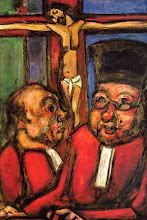
The Law of Christians is broken,
Blood by the hands of hell profusely shed like rain,
And the throat of Cerberus bellows songs of joy.

Angelbertus, Versus de Bella que fuit acta Fontaneto

Fracta est lex christianorum
Sanguinis proluvio, unde manus inferorum,
gaudet gula Cerberi.
Showing posts with label Obligation. Show all posts

Tuesday, June 7, 2011

Ignorance of the Wrong-Restless Hearts' Final Rest

THE NATURAL LAW IS INTENDED to be man's guide to a natural perfection, and this regardless of time, place, and circumstance.* In particulars, it is a highly flexible law, even if in essentials it is an unchanging and immutable law. Human nature remains the same--whether found in a Greek monk holed up on Mount Athos, a Jewish Wall Street broker in New York City, a Venezuelan beauty queen participating in the Miss Universe pageant, an Arab pilgrim on hajj in Mecca circumabulating counterclockwise the Ka'aba, or a Chinese man floating in his Junk in Hong Kong harbor. The normative guidance the natural law provides, both in general and in particular, as we go from man inchoate (in potentia) to man realized (in actu) is found in the natural law's precepts. "The precepts of the law," Bertke says, "are the lights placed in the labyrinth of life guiding human acts to the right paths and turns. It is of the precepts' nature to guide man to a correct realization of his capacities, to inform him what must be done if he is to arrive at his ultimate end." Bertke, 24. It is the precepts that help us judge aright what is the fitting and right means to our ultimate end.

As commands, the precepts inform and guide the intellect and the will, since both intellect and will are involved in any human act. Though guiding both intellect and will, the precepts principally are commands or norms of reason, not merely arbitrary commands, and by acting in accordance with these precepts of reason we are properly fitted into the great order of the cosmos, in harmony with our own nature and with God's plan for us in any particular time and place:

By following the precepts of the natural law man assumes his correct relations to everything else in the realm of being; order is brought out of the apparent chaos of many conflicting tendencies. The conflict between matter and spirit inherent in the complexity of man's nature, is resolved by obedience to their mandates, and harmony in relation to his prime purpose in [his natural and supernatural] life is obtained.

Bertke, 25.**

The precepts of the natural moral law oblige, and as obligations they impose themselves upon man. But they impose themselves upon man's freedom, seeking not to curb it or frustrate it, but to guide its use properly. So the natural moral law is an obligation in the order of freedom. It is not a restriction on freedom. And it certainly is not a law of physical necessity.


Sts. Thomas, Augustine, and Teresa of Avila
God alone suffices


Though there is a necessity to obey the natural moral law, that necessity is moral, not physical. The necessity is not a necessity of must (as if we have no choice or are compelled to obey it), but is a necessity of ought (since the obligation imposes itself upon our freedom and orders its proper use). The precepts of the natural law are oughts which impose upon themselves as an obligation because they are ordinations of reason, and not merely arbitrary dictats. Since they are based upon reason, the precepts carry their own reason for their obligation. It is self-evident that a life in accord with reason, a life fitted with reality and which promotes our very being and reflects who we are, is superior to a life that is irrational and which is not fitted with reality and contradicts or lessens our being and who we are. We are meant to flourish, our whole being inclines towards its flourishing, and obedience to the precepts of the natural law assures that flourishing, whereas disobedience to those precepts would result in our not flourishing. The obligation is then plain, as it is a matter of simply living right or reasonably instead of living wrong or irrationally. Of being rather than not being.

The precepts can be view under an active mode or a passive mode depending upon if we look at them from the perspective of the one commanding or the one commanded:
In the case of the natural law the active command is an act of the divine intellect; passsively, it is the actual ordination as perceived by the creature.
Bertke, 25.

The passive mode of the natural law (God's command as perceived by us) can be known without knowledge of God, so knowledge of at least the foundational precepts of the natural law can be known self-evidently, without knowledge of God, which knowledge is not self-evident. Similarly, the natural law binds us self-evidently, regardless of whether we have derived from our observation of reality and application of reason (or from Faith) that there is a God who has promulgated such a law.

It is a curious fact that man is a restless creature. No created thing fully satisfies him. Glory, honor, power, wealth, health, pleasure, the development of all natural powers of our soul or the possession of any and all created things do not, it would seem, satisfy.† But it would appear implausible for man to have no end, that he is condemned to be dissatisfied, and so there is implied in man's very restlessness that there is something he ought to seek beyond created things that will satisfy him, that ultimate good for which he yearns, which is God alone, his summum bonum, his finis ultimus, his plenary good, his ultimate end in which he alone finds repose and perfect joy and happiness.

I answer that, It is impossible for any created good to constitute man's happiness. For happiness is the perfect good, which lulls the appetite altogether; else it would not be the last end, if something yet remained to be desired. Now the object of the will, i.e. of man's appetite, is the universal good; just as the object of the intellect is the universal true. Hence it is evident that naught can lull man's will, save the universal good. This is to be found, not in any creature, but in God alone; because every creature has goodness by participation. Wherefore God alone can satisfy the will of man, according to the words of Psalm 102:5: "Who satisfieth thy desire with good things." Therefore God alone constitutes man's happiness.

Respondeo dicendum quod impossibile est beatitudinem hominis esse in aliquo bono creato. Beatitudo enim est bonum perfectum, quod totaliter quietat appetitum, alioquin non esset ultimus finis, si adhuc restaret aliquid appetendum. Obiectum autem voluntatis, quae est appetitus humanus, est universale bonum; sicut obiectum intellectus est universale verum. Ex quo patet quod nihil potest quietare voluntatem hominis, nisi bonum universale. Quod non invenitur in aliquo creato, sed solum in Deo, quia omnis creatura habet bonitatem participatam. Unde solus Deus voluntatem hominis implere potest; secundum quod dicitur in Psalmo CII, qui replet in bonis desiderium tuum. In solo igitur Deo beatitudo hominis consistit.

S.T. IaIIae, q. 2, a. 8.

This spiritual inquietude and its satisfaction is classically rendered by St. Augustine in his Confessions: fecisti nos, domine, ad te, et inquietum est cor nostrum donec requiescat in te. You have made us Lord for you, and our heart is restless until it rests in you. St. Thomas succinctly stated: Deus solus satiat.†† The mystic, St. Theresa of Avila put it wonderfully well in her "Bookmark": Solo Dios basta! Only God suffices.
Nada te turbe,
nada te espante;
todo se pasa,
Dios no se muda.
La pacientia todo lo alcanza.
Quien a Dios tiene nada la falta:
solo Dios basta.

Let nothing disturb you,
Let nothing frighten you,
All things are passing away:
God never changes.
Patience obtains all things.
Whoever has God lacks nothing;
God alone suffices.
_________________________________________
*We say natural perfection, not supernatural perfection, which, without thereby deprecating his natural perfection, is what man's ultimate calling. We know, not through nature, but through revelation, however, that the natural law also has a tutorial or preparatorial task, as the natural perfection is fulfilled or perfected by the gift of Grace. While compliance with the natural law is necessary for salvation, it is not sufficient for salvation. Moreover, man's perfection is, as we know through revelation, found ultimately in a union with God, a participation in God's very being, a gift and destiny which is wholly supernatural.
**Again, this harmony will not be achieved without grace, given man's current state of disharmony, his Fallenness. Nature, while not entirely corrupted by man's Fall, is a
natura corrupta or natural lapsa, and is not a natura integra, and the only means to overcome the corrupt or lapsed nature and obtain a measure of its original integrity is through the natural law and through habitual supernatural grace. In this life, however, that integrity is never fully restored, even after sanctifying grace, and full integrity awaits us only after death and resurrection of the body in glorified form.
***E.g., S.T. IaIIae, q. 98, art. 6, ad 2: "A law should not be given save to the people, since it is a general precept." q. 90, art. 2, c. "Consequently, since the law is chiefly ordained to the common good, any other precept in regard to some individual work, must needs be devoid of the nature of a law, save in so far as it regards the common good." The law or precept, however, is also concerned with particularities: "A command denotes an application of a law to matters regulated by the law. Now the order to the common good, at which the law aims, is applicable to particular ends. And in this way commands are given even concerning particular matters." q. 90, art. 2, ad 1.

†This is beautifully analyzed by St. Thomas in his "treatise on happiness," found in the Summa Theologiae, to which, because of its length, the reader is referred. S.T. IaIIae, q. 2 (English); S.T IaIIae, q. 2 (Latin).
"Deus enim solus satiat, et in infinitum excedit: et inde est quod non quiescit nisi in Deo, Augustinus, in I Conf.: fecisti nos, domine, ad te, et inquietum est cor nostrum donec requiescat in te." St. Thomas, In Symbolum Apostolorum, a. 12.

Saturday, April 23, 2011

Natural Law's Modern Cousin Germain: Lex Pure Poenalis

ACCORDING TO JOHN FINNIS THERE IS a division between the advocates of the lex pure poenalis theory (whose representative we might make Suarez) and the Thomists who generally do not support the notion of a law purely penal. The difference between the two schools is, in Finnis's view, the result of their notion of the human act. Essentially, the difference between the Suarezians and the Thomists on this issue is the result of their telescoping their views of a human act into the legislative process. The problem comes from their respective views of the ultimate role of the will--both in an individual man's actions and (by telescoping) in the legislature's actions. It is part of a historical tendency to elevate will over reason, in both human activity and in law and politics.
In short, in examining the purely penal law theories, with their attribution of all moving and obligatory force to the lawgiver's will, we are examining one limited aspect or offshoot of that vast movement of thought which has sought, with overwhelming historical success, to expel from the analysis of individual and political action all systematic attention to the intelligibility of the good which are realizable in action.
NLNR, 342.


Suarez v. Aquinas
Is Will or Reason Supreme in Law?

For a Thomist (as well as for a Suarezian), a human act is a series of interacting human capacities: there is (i) the cognitive grasp of an end or objective (an act of reason); (ii) there is the elicited desire for that good (an act of will); (iii) there is the practical reason's efforts to find means to that desired end (an act of practical reason); (iv) there is the decision to terminate the means-to-end analysis and to act (an act of will). NLNR, 337-38. Up to this point there is agreement between the Thomist and the follower of Suarez.*

Suarez, however, stops his analysis there, and attributes the final internal action required before the completion of the human act to the be internal decision to terminate the means-to-an-end analysis and to act, which is an act of will. For the Thomist, however, there remains one more step: an executive command or imperative order (an imperium) which is, at root, a directive of reason to oneself.** Suarez, on the other hand, finds Aquinas's imperium to be "unnecessary and indeed impossible, 'certainly a fiction'." NLNR, 339 (quoting Suarez, De legibus, I, c.5, para. 6; c. 4, para. 4).***

It is this subtle difference between St. Thomas and his intellectual opponents (which includes Vasquez and Suarez) as to the human act that explains the difference between them in the legislative act, since both seem to analogize from the human act to the legislative act. So, for St. Thomas, "[t]he important thing is that the expressed imperium, the promulgated 'intention of the legislator', represents to the subject an intelligible determinate pattern of action, which, having been chosen by the lawgiver to be obligatory, can actually be obligatory in the eyes of a reasonable subject because the ruler's imperium can (for the sake of the common good) be reasonably treated by the subject as if it were his own imperium." NLNR, 341.†

For, just as an individual's imperium, his formulated resolve to act, motivates his exertions by being transparent for the value of his objectives and the appropriateness of teh chosen means to them, so in the eyes of the subject the ruler's imperium is compelling precisely be being transparent for the common good, tot the needs of which the ruler's stipulation is treated by the subject (who recognizes the need for authoritative resolution of social problems) as a relevant response.

NLNR, 342.

While Suarez and Vazquez apply the notion of imperium to the legislative command, they see it "primarily as an expression of the lawgiver's decision (to impose an obligation)." As a consequence, "the important thing for them is the act of will (decision) thus expressed and addressed to subjects." Finnis believes that Suarez (mistakenly), then, "makes the point that unless the lawgiver decides to make obligatory the pattern of action which prefers, it will not be obligatory," which menns that "what makes the conduct actually obligatory is, precisely and simply, the lawgiver's decision that it should be."†† NLNR, 341.

What takes precedence in man's law in foro interno and in man's law in foro externo? Is it reason or is it will? Does the good precede the right, or does the right precede the good? Is the gist, the kernel of law rationalism or voluntarism? The Thomists will stand on the side of reason. The advocates of purely penal law, as well as most moderns, will stand on the side of will.
_________________________________
*In assessing the thought of Suarez and Aquinas, one ought not to look at reason and will as wholly separate or reified or personified faculties within a man. The one-and-the-same person reasons and wills, and the reason and will "are psychologically entirely interdependent and only analytically distinguishable." NLNR, 338, n. 37. The various steps are not even to be considered to occur separately and seriatim: they are not "necessarily chronologically extended." NLNR, 337.
**Finnis cites to S.T. IaIIae, q. 17, art. 1: "Command [imperare] is an act of the reason presupposing, however, an act of the will. . . . . Consequently it follows that command [imperare] is an act of the reason, presupposing an act of the will, in virtue of which the reason, by its command [imperium], moves (the power) to the execution of the act." [I]mperare est actus rationis, praesupposito tamen actu voluntatis . . . . Unde relinquitur quod imperare sit actus rationis, praesupposito actu voluntatis, in cuius virtute ratio movet per imperium ad exercitium actus."
***Finnis also refers to Gabriel Vasquez who in his
Commentarium Ac Disputationum in Primam Secundae, disp. 49, c. 4 (which addresses St. Thomas's Summa Theologiae, IaIIae, q. 17, art. 17, ad. 1). Vasquez states that the Thomist notion of imperium was "unnecessary," "inept," and "futile." NLNR, 339 n. 39.
†Finnis cites to S.T. IIaIIae, q. 50, art. 2, c. and ad 3; q. 47, art. 12, c.
††Finnis cites to De legibus, I, c. 4, paras. 7-8; c. 5, paras. 16, 19.

Friday, April 22, 2011

Natural Law's Modern Cousin Germain: Obligation and Legislative Will

JOHN FINNIS ACCUSES ALL advocates of purely penal law* of trading in fictions, a "comedy of fictions," specifically fictions that tie in obligation to legislative will. But before dealing with that issue, there are also some factual and legal objections that may be noted.

The factual objections to the theory arise from the factual fictions that are required for the theory's exercise. It would be a rare legislator that would formulate the intent in passing a law with a penalty that he was offering the citizenry an option between obeying the law and avoiding the penalty or disobeying the law and paying the penalty. Disjunctive legislative intent--which is what is required for the purely penal law advocates' theories to have any validity--seems dubiously lacking. Even less likely is the legislator who would think that adding a penalty to a legal proscription is a "trump" card out of the moral obligation to follow that law. It is probably the case that legislators have some sort of sense that a certain behavior ought to be proscribed because it is best for the common good that it be proscribed and any penalty associated with violation of the law is to add law's sanction, to provide a disincentive to disobeying the law, and to advance the pedagogical, retributional, and reformational characteristics of the law. The factual basis for the purely penal law theory is, in Finnis's view, sorely lacking.

The second problem is that the theories confuse, or at least are calculated to confuse, the difference between a tax and a penalty, in that the theories invariably make what is a penalty into something much more akin to a tax.


The third problem is more fundamental in Finnis's view. The "real basic difficulty" of the theory "lies in the very notion which gives the theory its perennial plausibility and popularity," that being that notion that if a legislator can absolutely prohibit an act, he has the authority to do the lesser, namely, providing the option to the citizens either to avoid the act or to pay a fine or penalty if they infringe. The problem with this notion is that it obfuscates the source of any binding nature of positive law that being the moral "higher" or "deeper" principle. In other words, it is not legislative will alone that determines whether a law ought to bind or not bind, it is the legislative will coupled with the moral foundations behind that will that couple to make law binding:

By his decision to stipulate that φ is legally obligatory for X, a person with authority to make laws brings it about that (i) φ is legally obligatory and thus (presumptively) that (ii) φ is morally obligatory. . . . [but] these consequences flow not from any 'force' of the lawgiver's 'superior will', but from the interrelationship between (a) the fact that he has thus decided and (b) a 'higher' (or 'deeper') principle that makes that fact legally and/or morally significant.

NLNR, 334. The problem arises in that the legislator is not really a moral legislator; he is not a "moralislator." The moral obligation arises not from the legislative will,** but from a prior "higher" or "deeper" source, namely the relationship of the law to the common good which the law is intended to advance. If a law prohibiting some behavior derives its binding power from the fact that prohibiting that act is aimed that advancing the common good, then it is the very prohibition of that act that advances the common good, and not the application of a penalty, which has no real relationship to the common good. It is as if the legislator puts his law, like some child his toy boat, on the stream of the natural law; the legislator does not make the stream. The moral obligation to obey a law arises when the law prohibiting a certain act (or commanding a certain act) is passed and promulgated for the purpose of advancing the common good; the attachment of a penalty does not minimize that obligation.
[t]he lawgiver's acts of will have their significance for the practical reason of other people only because can take their place in a normative framework which is not of the lawgiver's making. That framework has no place for legislative 'intentions' (or 'acts of will') to withhold or modify moral obligations; for such intentions, if they had their intended effect, would seriously weaken the clarity and certainty and uniformity of application which are the very bases of law's utility as a specific way of realizing the common good.
NLNR, 335. It would therefore constitute an abuse of legislation to allow for a disjunctive law when the common good demands an outright prohibition of a certain act, an outright prohibition subject to sanction.

This is not say that a legislator cannot intentionally pass disjunctive statutes. In fact, something akin to that is done in cases of taxes that are imposed with the use of certain objects (e.g., cigarettes or liquor) or levies upon certain conduct (e.g., importation of luxuries). A sense of that is also found in cases where certain acts are prohibited unless licenses are obtained (and paid for) (e.g., hunting or fishing). In these sorts of cases, there is no prohibition to doing the act φ (or obligation to do act φ); rather, at best the legislator (often only implicitly) exhorts that act φ not be done without some prior act (license, payment of tax, levy) or that act φ be done (unless one obtains a license, pays a tax or levy). There is therefore no question of any moral obligation because the injunction to do or not do φ has no legal binding effect if the condition excusing it (tax, levy, license) is met. But this is a different beast altogether from the ordinary penal statute that contains a punishment or sanction for its violation. There is therefore an odd mix-up or blending of two different kinds of legislative acts in the thinking of the advocates (such as Francisco Suarez) of the theory of purely penal law.

________________________________
*As we noted in our prior posting a "purely penal law" (lex pure poenalis) is one which does not prohibit an action absolutely, but simply imposes a penalty in case one is convicted of its violation. Thus under the theory's notion, the legislator leaves it, in a certain sense, to the choice of the subject whether he will abstain from the penal action, or whether, if the violation is proved against him, he will submit to the penalty. Under the theory, there is no strict binding of the conscience to abstain from the prohibited act. There is a disjunctive (either/or) choice given the subject: either forego the act (obey the prohibition) or submit to the fine or penalty if caught and convicted of the act's violation.
**Finnis would say that the legislator (and his will) is an efficient cause of the moral obligation that arises from a promulgated law, but that the formal cause of that moral obligation of a law is the benefit to the common good. Finnis repudicates Locke's notion (found in his sixth Essay on the Law of Nature) that the "formal cause of obligation [is] the will of a superior." NLNR, 337 n. 35 (quoting Locke).

Thursday, April 21, 2011

Natural Law's Modern Cousin Germain: Obligation and the Bad Man

IN HANDLING THE TOPIC OF OBLIGATION, John Finnis addresses some subsidiary issues. One of those has to do with defining the obligation that is involved in a promise, more specifically the obligation that may be implied in law on an enforceable promise, a contract. Is the promise made a promise to perform the promised performance or is the promise (more subtly) one to perform the promised performance and if that promised performance not rendered, to pay for damages in such event? If I make a promise to paint a man's house, and I breach that promise, what are my obligations? Are they to paint the house as promised or are they to pay compensatory damages for having failed to paint the house? There is, similarly, a question that arises regarding the obligation to obey a law (say a prohibition against driving more than 70 mph, the breach of which is fined at $100). Is my obligation one to obey the law (that is, not exceed 70 mph on the road) or is it merely to pay the fine or suffer the sanction if I decide to disobey the law (pay the $100).*

The distinction between whether a law (or promise) obliges in conscience to prohibit or to require an act or whether a law (or promise) obliges only to make good if one violates the law (or promise) is a distinction that arose in the 16th century, largely as a result of Spanish theologians and jurists. While it might have some value if applied judiciously to ease conscientious confronted with a multiplicity of laws, particularly in the modern bureaucratic state, it was a principle that the "bad man" could grab and abuse. And so the "bad man" in the law, who wrote for the "bad man," Oliver Wendel Holmes,** sought to remove all moral obligation from the law, particularly in the area of contract (promise).

In his famous works "The Path of the Law" and The Common Law, Holmes sought to "wash with cynical acid" (which ran through the arteries of the cynical Holmes) the notion of duty. He fashioned a notion of duty from the perspective of a "bad man," a man without conscience, and therefore dumbed down the notion of duty to the "prophecy that if he does certain things he will be subjected to disagreeable consequences." In the area of contract, the sense of wrong in failing to fulfill a promise was entirely scrubbed out: "[T]he duty to keep a contract at common law means a prediction that you must pay damages if you do not keep it,--and nothing else." NLNR, 322 (quoting Holmes). "[T]he law's ambitions," however, "are higher than this, and its distinctive schemata of thought quite different" from that advocated by the cynical Holmes. NLNR, 325.


Justice Oliver Wendell Holmes, Jr.

But pace Holmes and his tendentious writings which sought to scrub moral duty from the law, most legal systems--recognizing the benefit to the common good of enforcing promises and laws as obligatory in themselves and not as merely providing for disjunctive options--seem to find something valuable in the enforcement of promise qua promise:

This virtually universal interpretation of contracts and contractual obligation has its significance . . . as an indication that contracts are upheld by the law for the sake of the common good, which is positively enhanced (i) by the co-ordination of action, and solution of co-ordination problems, made possible by performance of contracts (in the ordinary, not the Holmesian, sense of 'performance') and (ii) by the continued existence of a social practice which actively encourages such fully co-ordinate performance and discourages non-performance. If all contracts were interpreted and upheld in the Holmesian disjunctive sense, the common good of co-ordination might still, of course, be served to some extent. But it is served to a much greater extent if the law, as it does, (a) allows parties to enter into disjunctive contracts if they chose to, but (b) allows the parties to a contract to know with precision what unique course of action is required of the other party by law, in all those cases (the great majority) in which it is to the advantage of each party not to give the other party a free option between more than one course of action (as Holmes's contract does give).

NLNR, 324.
____________________________
*This refers to the distinction between a law that is "purely penal" (lex pure poenalis), "merely penal" (lex mere poenalis), or "disjunctive," and one that is not but binds the conscience pure and simple. There were also laws that were simply moral: lex moralis, and laws that were mixed in character (in other words incorporated a moral prohibition, but also added a fine or penalty for its violation): a lex poenalis mixta. If prohibitatory, the lex moralis and the lex poenalis mixta bound the conscience as to prohibited act. On the other hand a law purely penal did not bind the conscience as to the prohibited act, but simply bound the actor either to obey the law or pay the fine or penalty (if caught?!). One of the effects of the theory of purely penal laws is that it seems to inject a blurring into the difference between a tax and a penalty or fine. It changes most penalties into a tax for engaging in the "prohibited" activity. Ordinarily, this is not the intent of the legislative authorities. When the legislature passes a statute prohibiting speeds of 70 mph, it really desires to prohibit speeding, not provide for a tax on vehicles exceeding 70 mph.
**Lex Christianorum is no fan of the positivist and duty-bashing Holmes: See The Natural Law's Devil: Justice Oliver Wendell Holmes for the vicious theories of this vicious jurist, this jurist with cynical blood and cynical brain. He is a singularly unattractive fellow, as unattractive as Rousseau, but for different reasons. Whereas Rousseau was just a selfish little self-regarding and whining prig, Holmes was a cynical and warped moral monster with a stentorian voice. With Rousseau one has to deal with little demons and foolish and irresponsible inconsistencies. One can laugh at Rousseau. With Holmes one is dealing with legal nihilism advanced via a first-class intellect, with all the power of the devil himself. It was as if hell itself occupied the center of the jurist's mind so absent was God from anything he believed. One cannot laugh at Holmes. One either pities him or recoils with horror.

Wednesday, April 20, 2011

Natural Law's Modern Cousin Germain: Promises and Obligations

A PROMISE IS NOT A MONOLITHIC CONCEPT. There is variability in promises, differences in dignity in promises, as it were. From resolutions, to promises, to contracts, to covenants between humans, to vows, to covenants between God and man. We understand that not all promises impose a strict obligation on the promisor, that there are changes in circumstances, either foreseen or unforeseen, that make promises highly impractical or even impossible of performance. There are implied release valves, as it were, implied clausulae rebus sic stantibus,* where the reasonable promisee would not expect performance on the part of the promisor, and thus would accept a simply apology or the making of amends or, in some cases, even the need for these weaker substitutes for performance. If I promise to buy milk on my way back from work, but I get delayed with a client and I cannot leave work until after the store is closed, my wife will probably understand that the commitment to stop by the store and pick up milk was not intentionally breached, was excused by the unforeseen change of circumstance, and an apology or may even mere explanation will suffice despite the broken promise. No moral fault will be ascribed to the failure to abide by the promise.

On the other hand, there are some promises that are more formal, which demand compliance even if great sacrifice is required, even if unforeseen circumstances intervene, and that which are rarely, if at all, allow for breach. The solemn monastic vow, or a priestly vow of celibacy, would be an example of such promise. The marital covenant which binds in sickness and in health, for richer or poorer, for better or worse, until death parts the spouses is another example.** (We ought to be thankful that God's promises are of the exceptionless kind else we could not pray with confidence the traditional Act of Hope: "O my God, relying on Thy promises, I hope that, through the infinite merits of Jesus Christ, Thou wilt grant me pardon of my sins, and the graces necessary to serve Thee in this life and to obtain eternal happiness in the next. Amen.")


Marcus Atilius Regulus Departing for Carthage

And between extremes of exceptionless promises and conditional promises there is room for debate, and so man reasonably argues about promises--their bindingness in general and in particular--like he seems to argue about everything else. This flexibility in promises is found in both moral (extra-legal) analysis of promises and, more formally (though less flexibly), in legal doctrines that soften the enforcement of promises with legal defenses to the enforcement of a contract such as the doctrines of impossibility, impracticability, duress, illegality, failure of consideration, unconscionability, and the like. And yet, despite the recognition that promises enjoy different dignities, there are stories of fidelity to promise that inspire us to do less arguing and parsing of words and to be heroic in the keeping of our promises, perhaps most noble of all in the pagan annals of such is the story of Marcus Atilius Regulus.*** God, a Christian need hardly be reminded, is more faithful that Regulus. "The Lord," says the Psalmist, "is faithful to all his promises." Psalm 145(144):13. Fidelis Dominus in omnibus verbis suis.

Regardless of the play-in-the-joints quality that reasonably inheres in promises, a "promise properly made is always an exclusionary reasons, that is, [it] always gives a reasons for disregarding some reasons, which are genuine and relevant and which in the absence of the promise to do φ would have sufficed to justify not doing φ." NLNR, 308. Nevertheless, the exclusionary reasons that is incorporated within a promise "can be defeated by some countervailing reasons, often by a wide range of readily available reasons (though never by any and all of the reasons that would in the absence of the promise, have warranted not doing the thing promised)." NLNR, 309. In other words, promises restrict freedom of action: they are a willing limitation on our future reasons for acting. They are also reasons in and of themselves for acting. Even if defeasible by reason or circumstance, by condition precedent or subsequent, the promise limits, it constrains, it obliges in some manner.

Finnis addresses the question of why promises bind, but specifically why they bind legally so that public authority can enforce them against the promisor. What is the justification for the legal enforcement of the promise? And from the enforcement of promises by law it is an easy step to the enforcement of laws by law.

Finnis finds the answer to the problem of why promises may legally bind and be enforceable by public authority to lie in the "correct identification of the law-abiding subject's practical reasoning, reasoning to which such a norm is directed and which such a norm is intended to direct in a distinctively 'obligatory' way." NLNR, 315. As in most of Finnis's analysis, justification for force is found by reference to the common good. He sees the "relevant schema of practical reasoning" justifying enforcement to follow a three-step process:
  1. In all coordination problems among individuals (whether these are to be done by public authority through law, or privately through compact, i.e., promises or contracts), one must act in a way that is legally specified if one is to respect the common good.
  2. Where a certain "pattern-of-action" is legally specified as resulting in obligation (and incurred either as a matter of law or a matter of individual compact), the "only way of satisfying the need postulated" in step 1 above is "to act according to the pattern so specified."
  3. So to act in a matter that respects the common good where a "pattern-of-action" is legally specified to result in obligation, one must or ought to act in the way that is specified as obligatory.
Finnis concedes that this sounds "empty and/or viciously circular." NLNR, 315. He simplifies the technical language to the following schema:
  1. We need for the sake of the common good to be law-abiding;
  2. But where φ is stipulated by law as obligatory [whether as a result of promise or as a result of law], the only way to be law-abiding is to do φ.
  3. Therefore, we need [it is obligatory for us] to do φ when φ has been legally stipulated to be obligatory.
NLNR, 316. According to Finnis, the "law thus anticipates and seeks to capitalize upon, indeed, to absorb and take over, the 'good citizen's' schema of practical reasoning, and to give it unquestioned or dogmatic status." The first step is a moral principle, the moral principle that ties in to the legal system and justifies our obligation to it. The moral principle assumes that "laws provided directly applicable and authoritative guidance for the reasonable man and eliminate the need for him to weigh up (as the legislature had to weigh up) the pros and cons of man possible courses of action." NLNR, 318.

And yet the interplay between the moral reason (which can bow out in the event something is contrary to the common good or practical reason) and the legal reason (which is invariant, and positivistic, even if it allows for legal exclusions) makes it clear:

The equal obligation in law of each obligation-imposing law is to be clearly distinguished from the moral obligation to obey each law. For, like the obligation of promises, the moral obligation to obey each law is variable in force. . . . [T]he reasons that justify the vast legal effort to render the law, unlike the informal social institution of promising, relatively impervious to discretionary assessments of competing values and conveniences are reasons also that justify us in asserting that the moral obligation to conform to legal obligations is relatively weighty. These reasons relate particularly to the extent, complexity, and depth of the social interdependences which the law, unlike promises between individuals, attempts to regulate. Such an ambitious attempt as the law's can only succeed in creating and maintaining order, and a fair order, inasmuch as individual drastically restrict the occasions on which they trade off their legal obligations against their individual convenience and conceptions of the social good. . . . The law provides the citizen, like the judge, with strongly exclusionary moral reasons for acting or abstaining from actions.

NLNR, 318.
_____________________________________
*A clausula rebus sic stantibus (Latin = "things-thus-standing clause" or "things-being-the-same-as-now clause") is a clause in a treaty (implied or express) that the promises or covenants assume that the circumstances that warrant the treaty and justify the obligations thereunder shall remain the same, and their material change could change the obligations therein contained.
**Even these are, in some (rare and extraordinary) cases, able to be dispensed. A Pope may, for grave reasons, dispense from a solemn religious vow (e.g., celibacy), and, the Pope may dispense from the marital promise for
unconsummated marriages. See, e.g., John Paul II, Apostolic Constitution Pastor Bonus, II, art. 67; Code of Canon Law cc. 1142, 1698. Non-sacramental marriages can sometimes be dispensed with for reasons of faith (Pauline or Petrine privilege). There is an exceptionless promise: a valid sacramental and consummated marriage, however, can never be the subject of dispensation by any earthly power. Quod ergo Deus iunxit homo non separet. What God has joined, let no man separate. (Mark 10:9)
***Regulus was a Roman general and consul between 267 and 256 B.C. In the First Punic War, he defeated the Carthaginian fleet, invaded northern Africa, and defeated the Carthaginian army 256 B.C. He was then defeated and captured by the Carthaginians 255 B.C, where he remained prisoner for five years. Having promised to return in the event he was unsuccessful, he was sent as a peace envoy to Rome, he successfully persuaded the Senate to reject the Carthaginians' proposals. Then, in keeping with his promises to his sworn enemies the Carthaginians, he freely returned to Carthage and was tortured to death when he delivered the Roman response to their entreaty.

Tuesday, April 19, 2011

Natural Law's Modern Cousin Germain: Promises, Promises

WHAT IS IT THAT WE MEAN BY "OBLIGATION"? There is not a language in the world that does not include this notion, though the various connotations of the various words have subtle differences. But the term obligation comprehends those things that we have to do (though the "must" is not because we are extrinsically compelled to), or must do, that we which have a duty to do, that which is wrong not to do or which it is shameful not to do, that which we are morally or legally under an obligation to do. In Latin we have the notion of oportet facere, in French il faut faire, one's devoir, which in Greek is known as το δέον (to deon) (from which we get the work deontological). The notion of obligation moves us from external compulsion to internal, self-imposed compulsion. The concept of obligation includes the "demand of conscience, a claim upon one's commitment, decision, action," all sorts and manners of "rational necessity" or compulsion, requirements of practical reasonableness. NLNR, 297.

The word "obligation," at least in English, has connotations of "promise," and so we may talk sensibly of situations in which we ought to do something which we have no obligation (as a result of a prior promise) to do. And yet it is also used more broadly, so that we can also intelligibly talk about an obligation not to commit suicide. Has not a man, Finnis suggests, who is "irretrievably marooned alone on an island," and obligation to try to survive, and not to "drink himself . . . to death"? NLNR, 298.

The term obligation, however, is something more compulsory than something that is fitting or something that is supererogatory in nature, something that goes beyond the call of duty, and yet is no wise contrary to obligation. The term obligation has a sense that it is of precept, not something that is counseled.*

Man is a promising animal, ein Tier . . . das versprechen darf.** He is not only an animal that is under an obligation, but he is an animal that can obligate himself. A man binds himself by a promise,*** but how is it that, going beyond the perhaps conventional signs of promise, that this promise binds? How is it that after engaging in a promise there is a "new motive" for behavior, that one believes himself "immediately bound by his interest to execute his engagements, and must never expect to be trusted any more, if he refuse to perform what he promises . . . . [who] subjects himself to the penalty of never being trusted again in case of failure."† But going beyond both conventional sign and Humean self-interest (a "prudential ought"), what is it in the promise that makes the "promising-and-therefore-performing-or-accepting-the-justice-of reproaches-etc." something that benefits the common good outside our selfish regard?

The benefit to the common good of promise-making is quite apparent, and so its utilitarian justification is simple and forthright:


[A promise] provides an effective means of maintaining co-operation, once initiated, over the span of time necessary for the fulfilment of any human project . . . Like the law, it enables past, present, and predictable future to be related in a stable though developing order; enables this order to be effected in complex interpersonal patterns; and brings all this within reach of individual initiative and arrangement, thus enhancing individual autonomy in the very process of increasing individuals' obligations. . . . So if on is to be a person who favours and contributes to the common good, one must go along with the practice of promising. Similarly, and secondarily, if one is not to be a 'free-rider' who unfairly takes the benefits of beneficial social institutions but repudiates the burdens, then one must go along with the practice when one has promised, as much as when one has been promised.

NLNR, 303. Perhaps more basic than even this is that there is a tie-in to the natural law (what Finnis habitually refers to as the requirements of practical reasonableness), specifically the "Golden Rule," that "one doe as one would be done by," or "impartiality."
Promising is one way of incurring such responsibilities. For the making of the promises creates a new criterion of impartiality, relative to the persons concerned and the subject-matter of the promise. The promise constitutes a special frame of reference or vantage point, in relation to which the conduct of the parties can be assessed for its impartiality.
NLNR, 304. And so this ties into to justice, in particular, commutative justice. The person to whom something is promised is owed something that before that promise he was not owed. He is due something where before the promise such was not due. The recipient of the promise receives "a special locus standi," which translates to a moral (and often legal) "right to claim performance" as something owed to him. NLNR, 304. This sort of private extension of impartialities, of modifying the various flows of private transactions and relationships of justice, relate back to the common good. There is no victimless crime in the breach of promise: not only is the promisee harmed by the promisor's breach, but all society in some way suffers from the breach.††


The making and keeping of promises is therefore intimately tied to both private and common good:


[T]hat common good (including the good of the promisee or other ascertained beneficiary) can be realized with reasonable impartiality only if the individual performs on his promise; and this necessity is the obligation of his promise (both the general moralists' obligation, and the obligation owed to the promisee or beneficiary). 'I cannot be one who acts for the common good unless I go along with the practice by performing on this promise.' Secondarily, 'I cannot be one who is rationally impartial unless I take the burdens of the practice as well as the benefits, and perform on this promise . . . .' The conclusion, in each case, is: "Therefore, I must perform . . . '

NLNR, 307. It is this that gives the promisee (or third party beneficiary) the right to claim performance from the promisor, and which justifies the imposition of force or compulsion on the part of public authority to enforce the promise made.†††


_____________________________________
*The distinction between counsel and precept is fundamental. We might quote St. Ambrose in his work Concerning Widows (De Viduis), XII.73.

You will see the difference between precept and counsel, if you remember the case of him in the Gospel, to whom it is first commanded to do no murder, not to commit adultery, not to bear false witness; for that is a commandment which has a penalty for its transgression. But when he said that he had fulfilled all the commandments of the Law, there is given to him a counsel that he should sell all that he had and follow the Lord, for these things are not imposed as commands, but are offered as counsels. For there are two ways of commanding things, one by way of precept, the other by way of counsel. And so the Lord in one way says: "Thou shalt not kill," where He gives a commandment; in the other He says: "If thou wilt be perfect, sell all that thou hast." He is, then, not bound by a commandment to whom the choice is left.

En tibi distantia praecepti atque consilii, si illum recorderis, cui in Evangelio (Matt. xix.13 et seq.) ante preascribitur, ne homicidium faciat, ne adulterium admittat, nefalsum testimonium dicat; praeceptum etenim ibi est, ubi est poena peccati. At verose pracepta legis memorasset implesse, consilium eidem datur, ut vendat omnia, et sequatur Dominum; haec enim non praecepto imprantur, sed pro consiliodeferuntur. Duplex namque fora mandati est: una praceptiva, altera voluntaria. Undeet Dominus in alia dicit:
cum Non occides, ubi precepit; in alia: Si vis perfectus esse, vende omnia tua. Ergo hic liber est praecepto, cui defertur arbitrium.

**We don't usually cite to Nietzsche, but in this case we do.
See On the Genealogy of Morals, II.1:

To breed an animal with the right to make promises--is this not the paradoxical task that nature has set itself in the case of man?

Ein Tier heranzüchten, das versprechen darf – ist das nicht gerade jene paradoxeAufgabe selbst, welche sich die Natur in Hinsicht auf den Menschen gestellt hat?

***Finnis defines a promise as "the making of a sign, a sign which signifies the creation of an obligation, and which is knowingly made with the intention of being taken as creative of such obligation." NLNR, 299.
†Hume,
A Treatise of Human Nature, III.ii.5 (quoted in NLNR, 301).
††A reality too often forgotten in the laws that permit divorce, which is nothing other than a breach of promise, and a promise which is to last, and is binding to the promissor, as long as the promisee is alive.
†††Finnis rejects the notion of promise as "'bonds' created by 'acts of will' . . . on the part of the promisor." NLNR, 307. While there is obviously a voluntaristic component to the making of the promise (a promise must be made with the promisor's free will), the act of will is not the fundamental component of the promise. The act of will for Finnis "has no special role in explaining the
obligation of performance promised." Rather, the obligation is one founded upon reason, and not will.